
This month, a remarkable Bitcoin-focused artwork will grace one of the art world’s most prestigious stages. Block 1 from Robert Alice’s Portraits of a Mind series is set to be auctioned in Sotheby’s Now & Contemporary Evening Sale on November 18, carrying an estimate of $600,000 to $800,000.
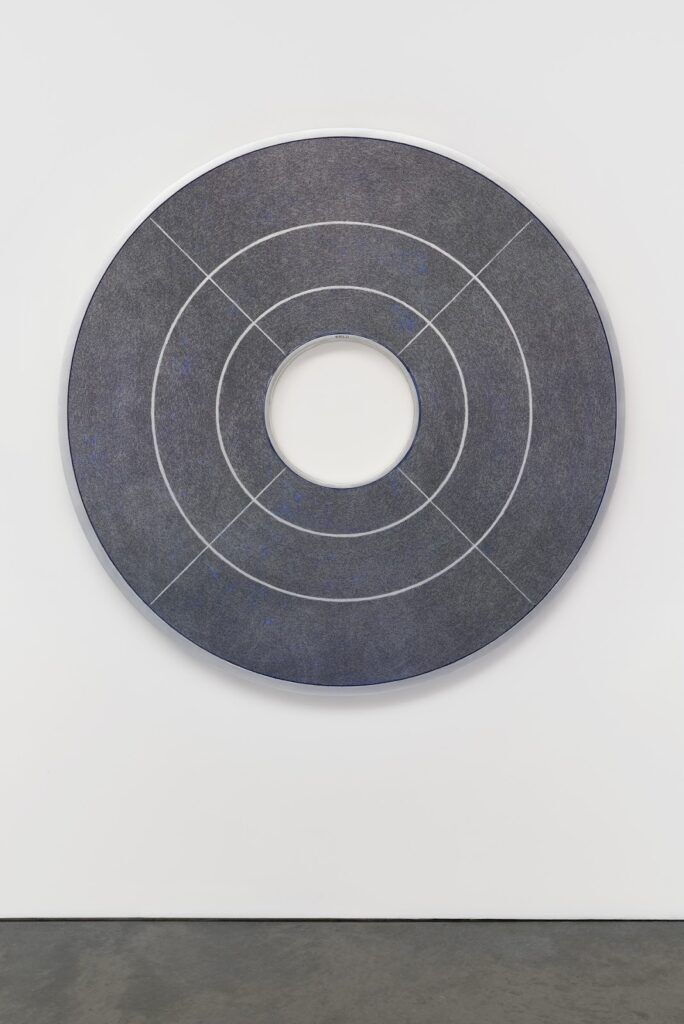
Robert Alice, Portraits of a Mind, 2019. Credit: Theo Cristelis
This event is where marquee works by renowned artists like Yves Klein or Jean-Michel Basquiat appear, so the inclusion of Block 1 signals an important moment for Bitcoin’s cultural presence. The auction will be held at The Breuer Building — once the home of the Whitney Museum of American Art and now Sotheby’s new worldwide headquarter in New York. It marks the first time a physical artifact of Bitcoin’s history stands alongside blue-chip artworks in such a high-profile sale.
In preparing this text, I spoke with Tad Smith, the former CEO of Sotheby’s and a thoughtful Bitcoiner, about the upcoming sale and what it means for Bitcoin’s cultural standing. Speaking as an archivist and art historian, I found our conversation becoming a meditation on value: how art and Bitcoin both rely on scarcity, story, and shared belief rather than financial metrics alone. Some of his remarks are included throughout this piece. His own path –– from auction house executive to Bitcoiner –– reflects the shift he describes: from assigning value within institutions to seeing value take shape through collective consensus.
Why does this matter? For years, Bitcoin has been understood primarily as a monetary revolution or a technical breakthrough. But Bitcoin is also an emerging cultural phenomenon, lacking obvious forums for recognition in mainstream culture. When a work like Block 10 (52.5243° N, -0.4362° E) from Alice’s series enters major collections like the Centre Pompidou –– one of Europe’s foremost museums of modern art –– it externalizes Bitcoin’s cultural value by translating intangible ethos into the language of art. I will return to this later. It is a clear sign that Bitcoin’s story is seeping into broader cultural memory, validated by institutions that historically canonize what matters in art and culture.
Block 1: The Code That Became Art
Formally and conceptually, Block 1 is steeped in Bitcoin’s origin story. Robert Alice’s Portraits of a Mind series took the original Bitcoin codebase (version 0.1.0) — arguably one of the most consequential texts of the 21st century — and dispersed it into 40 large-format paintings. In doing so, the project formed a decentralized, physical archive of Satoshi Nakamoto’s code with hundreds of thousands of hexadecimal digits distributed across the series.
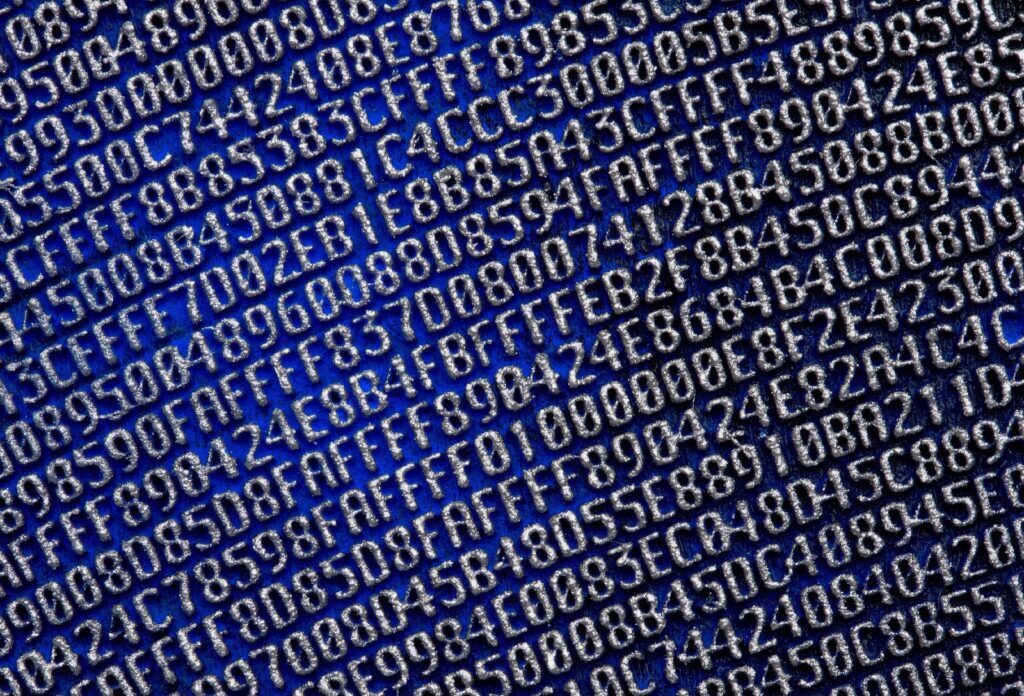
Robert Alice, Detail of Portraits of a Mind, 2019. Credit: Theo Cristelis
Each painting in the series carries a set of geographical coordinates that tie fragments of Bitcoin’s code to places of human culture and memory. Block 1 (24.9472° N, 118.5979° E) points to the Statue of Laozi in Quanzhou, a place where philosophy and exchange have quietly coexisted for centuries — near a city that once marked an important point along the Silk Road. The choice of site draws a subtle line between Taoist thought and the libertarian ethos that runs through Bitcoin: Laozi’s idea of wu wei –– governing through non-interference –– echoes the blockchain’s own preference for order without rulers.
Tad Smith has called the series a memorial to the foundations of digital sovereignty — a body of work that captures the moment Bitcoin began to take form.
A decentered form runs through the series, echoing rai stones and allusions to Japanese currency. The work engages with themes of decentralization, code as text, code as portrait and the nature of memory. Influenced by conceptual and minimalist art (artists like Roman Opalka and Jasper Johns come to mind), Portraits of a Mind treats the Bitcoin codebase as cultural heritage, as something to be preserved and contemplated. The series makes something hidden, visible: it translates the code –– the true first text of Bitcoin, written even before the whitepaper –– into material form. On November 9, 2008, Satoshi wrote to Hal Finney: “I actually did this kind of backwards. I had to write all the code before I could convince myself that I could solve every problem, then I wrote the paper”. And Alice asks us to see code not just as functional instruction but as a foundational human document.
Since its debut, Portraits of a Mind has traveled in ways that mirror the network it was born from. Parts of the series have been shown in London, Hong Kong, and New York, as well as at Sealand — the self-declared cypherpunk micronation, once an illegal data haven for irregulated internet traffic. Works from the series have also appeared in museums across the world in Zurich, Seoul, Beijing, Hanover and Linz. In 2023, the series was shown at Monnaie de Paris, the world’s oldest continually running mint, further extending its reach into the contemporary art world.
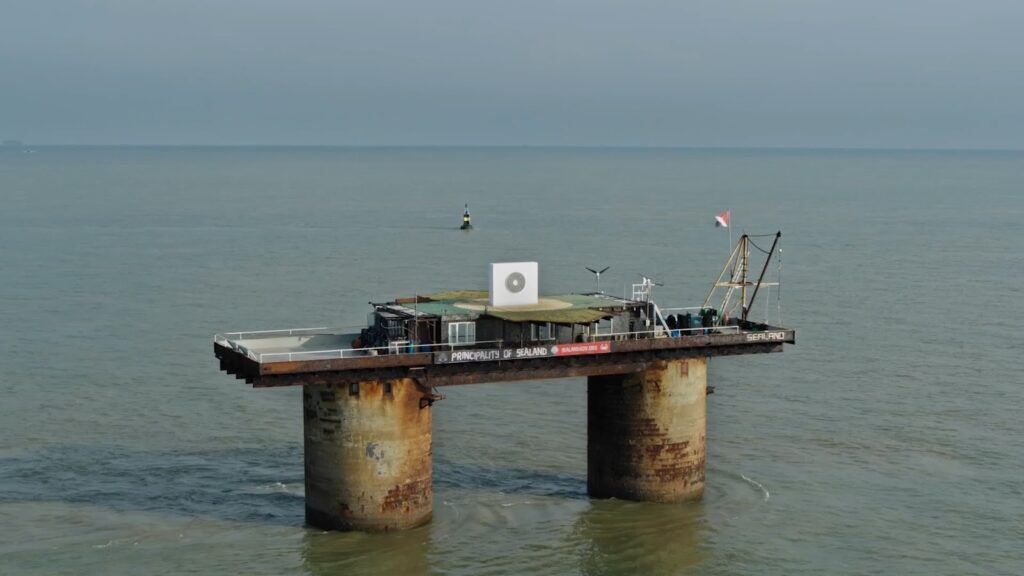
Robert Alice’s exhibition of Portraits of a Mind at Sealand, the former cypher punk data haven in the North Sea in 2021. Credit: Robert Alice
Major auction houses like Sotheby’s and Christie’s play a pivotal role in validating new artistic movements. For blockchain-based art, that validation began in 2020 when Portraits of a Mind first made waves: one of its panels, Block 21 (42.36433° N, -71.26189° E), was the first Bitcoin-focused artwork to sell at a premier auction house and laid the foundation for the crypto art explosion, pre-dating the Beeple NFT sensation by six months and back then reached around $130,000. With Block 1 joining Sotheby’s Contemporary Evening Auction in New York, Bitcoin art reaches a new level of visibility. “In the evening sale [this piece] will further increase the reputation” of the series, Tad Smith noted, emphasizing how Sotheby’s platform brings tremendous publicity and cultural cachet. Indeed, a high result at Sotheby’s would broadcast the message that Bitcoin’s codebase is now an important cultural fixture to the narrative of the 21st century, rather than a niche plaything for tech enthusiasts.
Bitcoin’s Cultural Maturation
What does Block 1 at Sotheby’s tell us about Bitcoin’s own cultural maturation? For one, it underscores that Bitcoin’s impact isn’t measured only in market cap or hash rate — it’s also measured in cultural capital. Bitcoin has spawned ideas, values, and aesthetics, yet the protocol itself can’t record those human elements. There’s a lack of on-chain metrics for culture: the blockchain timestamps transactions, but not, say, the moment a Bitcoin artwork hangs in a museum. Therefore we look to external signals. When the Centre Pompidou acquires Block 10 as mentioned earlier, or when artworld’s leading curators like Hans-Ulrich Obrist critically engage with it, those are flashes of recognition that Bitcoin has birthed something worthy of heritage status. These signals indicate that Bitcoin is evolving from a purely financial phenomenon into a broader cultural one. The acquisition of Block 10 marked the first time a fragment of Bitcoin’s code entered a national collection. In France, works that enter the national collection become part of the public domain and are legally inalienable –– they can never be sold or removed. In a country whose modern identity was forged in revolution, the gesture carries its own quiet irony: a technology built to resist authority now preserved by one of the oldest symbols of it. A part of Bitcoin’s genesis code now belongs, permanently, to the people of France –– archived under the same ideals that once demanded the rewriting of history itself. It’s hard to imagine a stronger validation that the Bitcoin narrative has broken out of its early techno-utopian niche and into the broader cultural conversation.
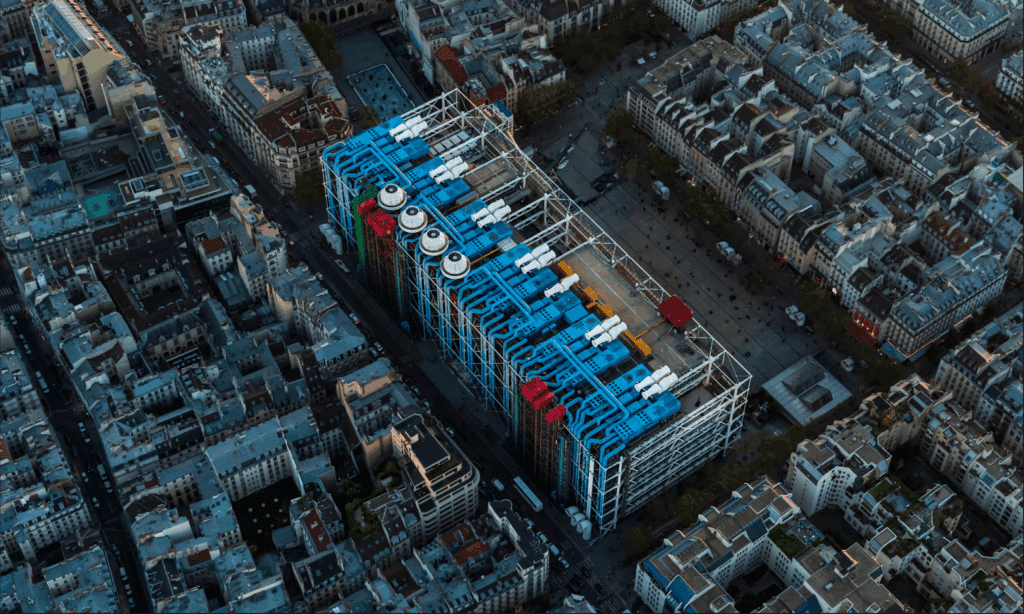
The Centre Pomidou in Paris. Home to the French National Collection of Contemporary Art, which now includes BLOCK 10 from the series, Portraits of a Mind.
Interestingly, this institutional recognition coincides with a growing awareness within the Bitcoin community itself — an appreciation that culture is not peripheral but central to its mission. As Smith observes, “Bitcoiners have something really powerful when it comes to art. They’re on a mission and they’re highly motivated. This isn’t a hobby or something you do on the side. It’s a deeply committed crowd, full of enthusiasm and driven by a genuine desire to make the world better”.
He adds that Bitcoiners are “very culturally and socially engaged and natural storytellers who understand memetics and communication in every possible way”. That, Smith notes, “is what art is about”. Indeed to be a Bitcoiner is to be a collector, not of art, but of UTXOs. The psychology of collecting and especially ownership, runs deeply through the psyche of Bitcoiners.
In short, Bitcoiners have been creating culture all along and the cultural work began long before its memes. The very first act in its history wasn’t financial but symbolic –– Satoshi’s embedding of The Times headline in the genesis block. It was a gesture of record and resistance, the first instance of Bitcoin declaring itself through culture.
Now, as significant wealth accumulates in this community, their taste in art is maturing as well. “Many of them, of course, tend to be younger”, Smith notes, “and younger people usually aren’t all that interested in the art of older generations. That’s nothing new; it’s been that way for centuries. The younger crowd always wants its own art. That’s why art and taste evolve every few generations”.
Over time, he predicts, “Bitcoiners’ growing financial capital will translate into cultural capital”. With Bitcoin’s market value climbing into the trillions and a massive wealth transfer to millennials and Gen Z on the horizon, the future of Bitcoin art indeed looks bright. “The future is very, very bright”, Smith says, “because the younger crowd has all the tailwinds” — referring both to financial means and cultural appetite.
In effect, a new collector base is rising — one that sees Bitcoin not just as an investment, but as a story and identity worth expressing through art.
Making Culture Visible
Because Bitcoin lacks formal cultural institutions of its own, artworks like Block 1 become crucial mirrors. They reflect and externalize the cultural values of the Bitcoin adoption in a form that the wider world can see and evaluate. The Sotheby’s sale forces questions about how we value such an object: Is it its materials and aesthetics, its backstory and conceptual depth, or its significance to a community? In practice, all of these converge to give Block 1 value. That value is cultural and contextual, not merely speculative. As Tad Smith learned during his years as CEO at Sotheby’s, a painting’s price can swing wildly based on intangibles: “a piece of canvas with a certain color of paint on it and a certain artist’s name and a certain year and a certain look, is worth $20 million, and then one right next to it could be worth $2”, a disparity that revealed to him “something inherently cultural that really drives the notion of value”. Bitcoin, often touted as digital gold, similarly derives its value from a cultural consensus, a shared belief in its significance. But that consensus can be hard to perceive directly. Art provides a tangible embodiment of those beliefs. When a Bitcoin-inspired artwork commands attention and a high price, it quantifies a bit of Bitcoin’s cultural impact in a language the art world understands.
Reflecting on this connection, Smith once compared Bitcoin’s evolution to the building of a pyramid — a new financial infrastructure, a new concept for money. “For the first time in human history”, he noted, “it’s digital capital. And to start building a pyramid, you start with a bunch of blocks. On the lower level, you make a great big square, and then you add a slightly smaller one on top, and another on top of that”. He described Portraits of a Mind as “memorials of the foundation layer of the creation of future and modern digital capital. It’s the foundation document, recording the charter of where it all began”. A century from now, he suggested, people will look back to these works to understand how Bitcoin started, “they paint a picture of a moment in time”.
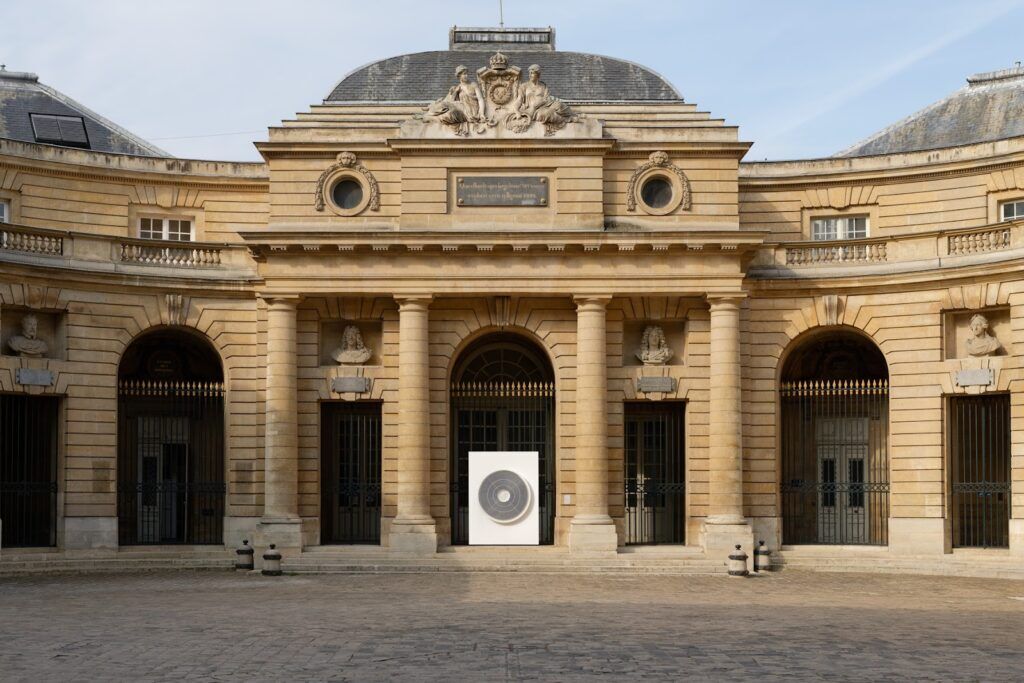
Robert Alice’s exhibition of Portraits of a Mind at the Monnaie de Paris, 29 June to 22 October 2023. Credit: Monnaie de Paris.
Art teaches by being seen. It invites interpretation and dialogue; a work like Block 1 makes people ask questions — about Bitcoin’s earliest days, its philosophy, its community — and it does so beyond the usual venues of conferences or developer meetings. Those engaged in this space understand that securing Bitcoin’s place in history means telling and retelling its story in many forms. Visual art, especially works that can hang in galleries or be studied in art history classrooms, gives that story a tangible presence — externalizing Bitcoin’s narrative and weaving it into the broader fabric of contemporary culture.
Finally, the Sotheby’s event highlights a broader truth: Bitcoin’s maturation isn’t just about technological adoption or financial metrics, but about cultural integration. As Tad Smith puts it, “a life of success and wealth without culture is a pretty unexciting life”. He goes on to suggest that “the sooner you begin to experience culture and understand the beautiful qualities that make being human so incredible — literally a divine gift — the better”.
His point is simple but profound: Bitcoin’s promise lies not only in disrupting finance, but in enriching human experience. Engaging with art is part of that fulfillment. The presence of Block 1 in a venue like Sotheby’s signals that the Bitcoin community, consciously or not, is beginning to heed that message. Bitcoin is developing a cultural memory with artifacts like Block 1 acting as its external vessels.
Bitcoin is stepping out as a subject of cultural heritage, not just economic speculation. This single lot at Sotheby’s carries within it the story of Bitcoin’s birth — lines of code painstakingly inscribed in paint and gold — now acknowledged by some of the highest arbiters of cultural value, institutions whose validation both defines and depends on what culture chooses to recognize.
The sale will be closely watched, as the hammer price will say as much about belief as about value, and about how far Bitcoin’s cultural standing has come. You can’t exactly measure culture, but a number can make its value briefly visible. The fact that Block 1 now shares space with contemporary masters signals that Bitcoin’s presence in the world is no longer invisible to traditional gatekeepers. Emerging from a lineage of artistic experiments and cypherpunk culture, it has become a living, multifaceted phenomenon.
At the end, as a closing note and an invitation: the auction takes place on November 18 at Sotheby’s. You don’t have to bid, but you can look. It costs nothing to follow auctions, visit previews, or walk through museums. That’s how culture becomes understandable: by showing up to see it change.
This is a guest post by Steven Reiss. Opinions expressed are entirely their own and do not necessarily reflect those of BTC Inc or Bitcoin Magazine.