
Close Menu
  • Latest News
    • Bitcoin
    • Ethereum
    • Altcoins
    • Meme Coins
  • Tech
    • Blockchain
    • Security and Privacy
  • Web 3
    • Gaming
  • Legal
    • Legal and Regulatory
    • Adoption
  • Analysis
  • Learn
    • Education
    • Wallets and Exchanges
  • Tools
    • Market Overview
    • Exchange Tool
  • INFO@FREE.CC
What's Hot

U.S. CFTC in talks with every major pro sports league on policing prediction markets

May 14, 2026

Monad Backs Stablecoin Startup Rain for Global Visa Payments

May 14, 2026

Senate Confirms Bitcoin Friendly Kevin Warsh As Fed Chair Ahead Of Clarity Act Vote

May 14, 2026
Facebook X (Twitter) Instagram
  • Contact
  • Privacy Policy
  • Terms & Conditions
  • Disclosure
Facebook X (Twitter) Instagram
Free.cc (Free Cryptocurrency)Free.cc (Free Cryptocurrency)
  • Latest News
    1. Bitcoin
    2. Ethereum
    3. Altcoins
    4. Meme Coins
    5. View All

    Senate Confirms Bitcoin Friendly Kevin Warsh As Fed Chair Ahead Of Clarity Act Vote

    May 14, 2026

    Exodus slashes Bitcoin holdings by 50% in Q1 2026 – Is BTC’s volatility why?

    May 14, 2026

    ZachXBT Names Teen Behind $19 Million Crypto Theft Who Flaunted It On Instagram

    May 14, 2026

    Analyst Says No Reason for Bitcoin Reversal, Sees BTC Approaching Next Resistance Levels – Here Are His Targets

    May 14, 2026

    Bitcoin, Ethereum and XRP Price Analysis: What’s Coming Next?

    May 13, 2026

    Wells Fargo Boosts Ethereum ETF Holdings in Q1

    May 13, 2026

    Why Market Experts Are Still Predicting A Rise Above $10,000

    May 13, 2026

    Bitmine ETH Holdings Cross 5.2 Million—CEO Announces New Phase For Crypto Markets

    May 12, 2026

    XRP Holds Key Level, But Binance Flow Data Signals Weakening Demand

    May 14, 2026

    Bitcoin Just Entered A Deceptive Territory, Here’s What You Should Know

    May 14, 2026

    XRP Ledger Hits Record High In 10K+ Wallets: Santiment

    May 13, 2026

    Mysterious Bitcoin Whale Transfers $40B After Years Of Silence

    May 13, 2026

    Meme Coin Market Faces Imbalance as Supply Rises, Demand Falls

    April 4, 2026

    Crypto Interest Rising Toward Meme Coin Sector

    January 9, 2026

    Memes Market Cap Adds $10B in Days: Fresh Capital or Dead-Cat-Bounce?

    January 5, 2026

    Meme Coin Market Surges Past $45B as Shiba Inu, PEPE, BONK Stage 54% Price Pump

    January 4, 2026

    U.S. CFTC in talks with every major pro sports league on policing prediction markets

    May 14, 2026

    Monad Backs Stablecoin Startup Rain for Global Visa Payments

    May 14, 2026

    Senate Confirms Bitcoin Friendly Kevin Warsh As Fed Chair Ahead Of Clarity Act Vote

    May 14, 2026

    What Is the CLARITY Act? The US Crypto Bill That Could Reshape Digital Asset Regulation This Week

    May 14, 2026
  • Tech
    1. Blockchain
    2. Security and Privacy
    3. View All

    Monad Backs Stablecoin Startup Rain for Global Visa Payments

    May 14, 2026

    Stables Taps T-0 Network as Asia’s 60% Stablecoin Payment Share Tests USDT Rails

    May 14, 2026

    UBOX Taps ClawWorks to Accelerate Independent AI Agent Economics

    May 14, 2026

    UXLINK And Origins Network Partner To Power Scalable AI-Driven Web3 Applications Using Decentralized Computing

    May 13, 2026

    Ripple Shares DPRK Threat Data on Fraud Domains, Wallets, Campaigns

    May 5, 2026

    Digital Asset Security Moves Beyond Keys as Bitgo Adds 5-Layer Checks

    May 1, 2026

    Defillama Confirms April 2026 as Crypto’s Most-Hacked Month With 30 Incidents

    May 1, 2026

    Malicious npm Dependency Linked to AI Assisted Commit Targets Crypto W

    April 29, 2026

    U.S. CFTC in talks with every major pro sports league on policing prediction markets

    May 14, 2026

    Monad Backs Stablecoin Startup Rain for Global Visa Payments

    May 14, 2026

    Senate Confirms Bitcoin Friendly Kevin Warsh As Fed Chair Ahead Of Clarity Act Vote

    May 14, 2026

    What Is the CLARITY Act? The US Crypto Bill That Could Reshape Digital Asset Regulation This Week

    May 14, 2026
  • Web 3
    1. Gaming
    2. View All

    NUMINE Joins Outer Ring MMO for the Expansion of Web3 Gaming Experiences

    May 13, 2026

    GMatrixs And MiniverseCore Join Forces To Unlock Web3 Gaming Experience With Cross-Chain DApp, DeFi Applications

    May 11, 2026

    The Identity Crisis of 2026: NFTs, AI Agents and Trust on the Agentic Web

    May 11, 2026

    DTCC’s May 2026 Tokenization Announcement Explained: What It Means for U.S. Securities and Real-World Assets

    May 11, 2026

    U.S. CFTC in talks with every major pro sports league on policing prediction markets

    May 14, 2026

    Monad Backs Stablecoin Startup Rain for Global Visa Payments

    May 14, 2026

    Senate Confirms Bitcoin Friendly Kevin Warsh As Fed Chair Ahead Of Clarity Act Vote

    May 14, 2026

    What Is the CLARITY Act? The US Crypto Bill That Could Reshape Digital Asset Regulation This Week

    May 14, 2026
  • Legal
    1. Legal and Regulatory
    2. Adoption
    3. View All

    U.S. CFTC in talks with every major pro sports league on policing prediction markets

    May 14, 2026

    What Is the CLARITY Act? The US Crypto Bill That Could Reshape Digital Asset Regulation This Week

    May 14, 2026

    Michael Saylor Says the Transparency Act in the US Congress Will Positively Impact Bitcoin! Here Are the Details

    May 14, 2026

    Consensys Urges SEC to Exempt Self-Custody Wallets, Citing Regulatory Gap for 99% of Tokens

    May 14, 2026

    Tether launches decentralized local AI using Isaac Asimov’s Psychohistory straight out of Foundation

    May 11, 2026

    Has Donald Trump been a net positive for Bitcoin or created an unbreakable partisan divide?

    May 10, 2026

    BlackRock looks to sidestep Clarity yield issues, filing for two new tokenized money market funds

    May 10, 2026

    Cardano’s Charles Hoskinson says the future of crypto wallets will be inside iPhones and Androids

    May 8, 2026

    U.S. CFTC in talks with every major pro sports league on policing prediction markets

    May 14, 2026

    Monad Backs Stablecoin Startup Rain for Global Visa Payments

    May 14, 2026

    Senate Confirms Bitcoin Friendly Kevin Warsh As Fed Chair Ahead Of Clarity Act Vote

    May 14, 2026

    What Is the CLARITY Act? The US Crypto Bill That Could Reshape Digital Asset Regulation This Week

    May 14, 2026
  • Analysis

    Trump’s CEO-filled China visit can decide whether Bitcoin’s $80,000 risk rally survives this week

    May 14, 2026

    Wall Street is buying XRP while Binance traders keep betting against it

    May 13, 2026

    Is a Drop Below $1 Coming Next?

    May 13, 2026

    UB Price Breakout Enters Discovery Phase

    May 13, 2026

    Billions Network Rally Accelerates After Binance Futures Launch

    May 13, 2026
  • Learn
    1. Education
    2. Wallets and Exchanges
    3. View All

    What’s on the Ethereum Roadmap: Glamsterdam, Hegota and Beyond

    March 30, 2026

    What Is Bluesky? The Decentralized Social Media Rival to Elon Musk’s X

    March 27, 2026

    What Is Strategy (MSTR)? The Bitcoin Treasury Company

    February 21, 2026

    What Are Prediction Markets? How Polymarket, Kalshi and Myriad Work

    February 13, 2026

    Coinbase went down for over 5 hours after missing earnings. Bulls still see a path to $300 billion by 2030

    May 8, 2026

    Coinbase cuts 14% of staff as Armstrong ties cost reset to AI and market volatility

    May 6, 2026

    Bitcoin is still in charge

    May 3, 2026

    CLARITY Act stablecoin fight shifts from yield to who captures digital-dollar economics

    April 29, 2026

    U.S. CFTC in talks with every major pro sports league on policing prediction markets

    May 14, 2026

    Monad Backs Stablecoin Startup Rain for Global Visa Payments

    May 14, 2026

    Senate Confirms Bitcoin Friendly Kevin Warsh As Fed Chair Ahead Of Clarity Act Vote

    May 14, 2026

    What Is the CLARITY Act? The US Crypto Bill That Could Reshape Digital Asset Regulation This Week

    May 14, 2026
  • Tools
    • Market Overview
    • Exchange Tool
  • INFO@FREE.CC
Free.cc (Free Cryptocurrency)Free.cc (Free Cryptocurrency)
Home»Blockchain»Directed Acyclic Graph Vs Blockchain Technology
Blockchain

Directed Acyclic Graph Vs Blockchain Technology

January 6, 2026No Comments5 Mins Read
Share
Facebook Twitter LinkedIn Pinterest Email

Introduction

In 2008, Bitcoin heralded a revolutionary change in the world of finance with the advent of blockchain technology. Decentralization, anonymity, and transparency helped Bitcoin and the subsequent blockchains develop traction among investors. Being a data structure, a blockchain relied on the connections of blocks that contained essential information about transactions. Every block had information about the previous block in the form of a cryptographic hash. For years, the technology had no competitor, but the introduction of directed acyclic graph changed the situation.

What is The Directed Acyclic Graph (DAG)?

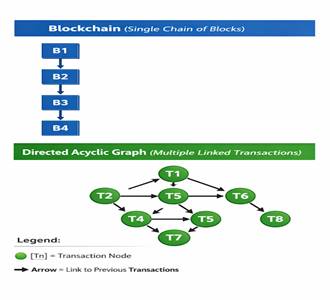
The Directed Acyclic Graph (DAG) is a data structure like blockchains, but instead of operating on a single sequential chain, it is a network of many linked transactions. It appeared for the first time in 2016 when IOTA, a crypto project, applied the concept for its transactions. The project referred to its transaction structure as a tangle instead of a blockchain ledger. The term came originated the fact that it is like a web consisting of nodes that contain transactions.

If we try to represent a blockchain diagrammatically, it has many blocks arranged in a line, with every block connected only to the previous one. On the other hand, the representation of a DAG structure show dots, many of which are connected to more than one dots in such a way that the loop only moves forwards, never coming back to where it originated. Every dot (or sphere) is a vertex and every line an edge. From the following image, you can understand the nomenclature of the model. The edges are directed because they point to one direction, and they are acyclic because they never come back to the vertex from which they originated.
How the Structure Works

At every step towards understanding DAG, one does need information about the blockchain technology as well because that’s what DAG claims to improve or replace. A blockchain works on the basis of blocks that carry data of one or more transactions. It groups many transactions together in order to be space efficient. Every block is added and verified by miners or validators.

See also  BNP Paribas and HSBC Join Privacy-Focused Blockchain Canton

Contrarily, every transaction in DAG structure stands on its own without being grouped into blocks. Neither does this structure need any miners or validators, nor is it sequential like blockchain structure. Before a transaction is added, the user’s device does a very small amount of work to prove it is genuine. This small effort helps prevent spam and also helps confirm earlier transactions, keeping the network secure and orderly.

Every new transaction in DAG structure must connect to an earlier unconfirmed transaction, or if all previous transactions are already confirmed, the new transaction merely needs to reference the last one. This structure refers to a previous unconfirmed transaction as a “tip”. When you propose a transaction to the network, it connects to a few previous tips which are automatically confirmed consequent upon your reference. Yours will be confirmed only one someone else builds on it.

Advantages of DAG Structure

No Delay

In blockchains, your transaction has to wait until a block is created. If too many transactions are sent at once, they form a queue, and wait for a long time or pay a higher fee. But you can get your transaction processed at once in DAG networks provided that you confirm the previous unconfirmed transactions. Your wallet automatically checks the transaction that it is going to confirm by tracing it to the very first transaction on the network. Therefore, it is highly unlikely that you accidentally confirm an invalid transaction.

NO scalability Issues

Think of a blockchain as an expressway, which can be crowded at times, so it needs a few extra lanes added. These extra lanes are the scalability solutions. Since there is no such issue as a waiting time for blocks, DAG can process many more transactions on its own, without needing any scalability solutions.

See also  Chainlink Expands Its Reach Across Banks, Central Banks, and Financial Markets

No Miners, No Validators, No Fees

DAG structure does not work on any consensus mechanism, so there are no miners or validators. That’s why transactions are processed free of cost. However, there are a few special nodes that charge a very tiny fee, to secure the network.

Disadvantages of DAG

Centralization poses a serious risk in DAG’s way to progress. Certain special nodes and coordinator nodes run by corporations tend to have an upper hand. This carries a potential danger of scams and attacks in future. Moreover, DAG is 8 years younger than the blockchain technology is it is not as time tested yet.

Bottom Line

Both blockchain and Directed Acyclic Graph technology aim to enable decentralized and secure transactions, but they approach the problem in very different ways. While blockchain remains the more mature and widely adopted solution, DAG introduces notable improvements in speed, scalability, and transaction costs. However, concerns around centralization and its relatively short track record still limit broader adoption. As innovation accelerates in 2026, DAG is likely to complement rather than fully replace blockchain, with each technology serving use cases where its strengths are most effective.

Frequently Asked Questions

What is the main difference between DAG and blockchain technology?

Blockchain records transactions in sequential blocks, while DAG processes individual transactions in a web-like structure, allowing faster and more scalable validation.

Is DAG more scalable than blockchain?

Yes, DAG can handle higher transaction volumes without relying on block creation, reducing congestion and scalability issues.

Does DAG require miners or validators?

No, DAG networks do not rely on traditional miners or validators. Each new transaction helps validate previous ones, keeping the network operational.

See also  Calastone Taps Polygon to Launch Tokenized Fund Share Classes
Can DAG replace blockchain in the future?

DAG is unlikely to fully replace blockchain but may complement it by powering applications that require high speed, low fees, and scalability.

Acyclic Blockchain Directed Graph Technology
Share. Facebook Twitter Pinterest LinkedIn Tumblr Email

Related Posts

Monad Backs Stablecoin Startup Rain for Global Visa Payments

May 14, 2026

Stables Taps T-0 Network as Asia’s 60% Stablecoin Payment Share Tests USDT Rails

May 14, 2026

UBOX Taps ClawWorks to Accelerate Independent AI Agent Economics

May 14, 2026

UXLINK And Origins Network Partner To Power Scalable AI-Driven Web3 Applications Using Decentralized Computing

May 13, 2026
Add A Comment
Leave A Reply Cancel Reply

Top Posts

ZCash Price Climbs After Steep $190 Fall, Grayscale Inflows Signal Growing Confidence?

October 18, 2025

Robinhood is constructing a “regional triangle” that unlocks the one thing US regulators won’t permit

December 14, 2025

Stay ahead with the latest crypto news, market updates, blockchain insights, and trends. Your trusted source for everything happening in the digital asset world.


We're social. Connect with us:

Facebook X (Twitter) Instagram Pinterest YouTube
Top Insights

U.S. CFTC in talks with every major pro sports league on policing prediction markets

May 14, 2026

Monad Backs Stablecoin Startup Rain for Global Visa Payments

May 14, 2026

Senate Confirms Bitcoin Friendly Kevin Warsh As Fed Chair Ahead Of Clarity Act Vote

May 14, 2026
Get Informed

Subscribe to Updates

Get the latest creative news From Free.cc directly in your Inbox!

  • Contact
  • Privacy Policy
  • Terms & Conditions
  • Disclosure
© 2026 free.cc - All rights reserved.

Type above and press Enter to search. Press Esc to cancel.