Close Menu
  • Latest News
    • Bitcoin
    • Ethereum
    • Altcoins
    • Meme Coins
  • Tech
    • Blockchain
    • Security and Privacy
  • Web 3
    • Gaming
  • Legal
    • Legal and Regulatory
    • Adoption
  • Analysis
  • Learn
    • Education
    • Wallets and Exchanges
  • Tools
    • Market Overview
    • Exchange Tool
What's Hot

Oliver Investigates Trump’s Crypto Ventures

July 29, 2026

Is the Web3 startup extinction event here, as Wall Street silently inherits crypto architecture?

July 29, 2026

Audiera loses KEY support – Can BEAT recover from a 24% crash?

July 29, 2026
Facebook X (Twitter) Instagram
  • Contact
  • Privacy Policy
  • Terms & Conditions
  • Disclosure
Facebook X (Twitter) Instagram
Free.cc (Free Cryptocurrency)Free.cc (Free Cryptocurrency)
  • Latest News
    1. Bitcoin
    2. Ethereum
    3. Altcoins
    4. Meme Coins
    5. View All

    Oliver Investigates Trump’s Crypto Ventures

    July 29, 2026

    Coinbase wants to be Canada’s ‘everything exchange,’ but says clearer rules are needed first

    July 29, 2026

    SEC Chairman Wants To Advance Crypto Clarity Act

    July 29, 2026

    Bitcoin whales buy 19K BTC – Can $61K keep the recovery alive?

    July 29, 2026

    A Breakthrough in Crypto Encryption Timescales

    July 29, 2026

    Why is crypto down today? $24B market cap loss exposes cracks in recovery

    July 28, 2026

    Tom Lee Reveals Why CLARITY Act Matters for Bitcoin, Ethereum, XRP and Crypto

    July 28, 2026

    Ethereum ETFs add $96M – Are institutions favoring ETH over Bitcoin?

    July 28, 2026

    Audiera loses KEY support – Can BEAT recover from a 24% crash?

    July 29, 2026

    AAVE faces $100 test after Revolut’s $6.44M transfer: Can buyers stay in control?

    July 29, 2026

    Kraken Brings CFTC-Regulated Perpetual Futures To US Traders

    July 28, 2026

    Ondo extends RWA dominance with new network – But will institutions use it?

    July 28, 2026

    Why Is BOME’s Price Up Today? Finally, Capital Rotating to the Meme Coins?

    July 28, 2026

    Brian Armstrong Warns Traders After BRIAN Meme Coin Surges and Crashes

    July 21, 2026

    $1.2 Billion Exits Memecoins: Binance Data Signals Heavy Sell-Off

    July 14, 2026

    CASHCAT Soars 1,600% Amid Robinhood Memecoin Frenzy

    July 8, 2026

    Oliver Investigates Trump’s Crypto Ventures

    July 29, 2026

    Is the Web3 startup extinction event here, as Wall Street silently inherits crypto architecture?

    July 29, 2026

    Audiera loses KEY support – Can BEAT recover from a 24% crash?

    July 29, 2026

    Your AI Chats May Be Showing up in Google Search — One Sharing Feature Made It Possible

    July 29, 2026
  • Tech
    1. Blockchain
    2. Security and Privacy
    3. View All

    Merck and Hashgraph Group launch Hedera-based product passport for EU compliance

    June 12, 2026

    COTI and Midnight Foundation Partner to Advance the Global Privacy Ecosystem

    June 11, 2026

    Cardano Gets Exposure From Olympics Committee

    June 11, 2026

    How Privacy and Composability Trade-Offs Differ

    June 11, 2026

    Your AI Chats May Be Showing up in Google Search — One Sharing Feature Made It Possible

    July 29, 2026

    Michael Saylor Says Bitcoin Can Grow 100-Fold, Warns Rule Changes Could Threaten Its Future

    July 29, 2026

    Apple’s App Store promoted fake Bitcoin wallet that stole $1.8M after developer spent a year warning them

    July 29, 2026

    A Quantum Computer Could One Day Break Crypto Security — Coinbase Is Preparing Now

    July 26, 2026

    Oliver Investigates Trump’s Crypto Ventures

    July 29, 2026

    Is the Web3 startup extinction event here, as Wall Street silently inherits crypto architecture?

    July 29, 2026

    Audiera loses KEY support – Can BEAT recover from a 24% crash?

    July 29, 2026

    Your AI Chats May Be Showing up in Google Search — One Sharing Feature Made It Possible

    July 29, 2026
  • Web 3
    1. Gaming
    2. View All

    Ichimoku Cloud Explained for Beginners: How to Read the “One-Glance” Indicator

    July 22, 2026

    How to Research a Crypto Coin Before You Buy (2026 Guide)

    July 17, 2026

    Top AI Logo Generators for Web3 Founders in 2026

    July 17, 2026

    Top 11 NFT games to play in July 2026

    July 16, 2026

    Oliver Investigates Trump’s Crypto Ventures

    July 29, 2026

    Is the Web3 startup extinction event here, as Wall Street silently inherits crypto architecture?

    July 29, 2026

    Audiera loses KEY support – Can BEAT recover from a 24% crash?

    July 29, 2026

    Your AI Chats May Be Showing up in Google Search — One Sharing Feature Made It Possible

    July 29, 2026
  • Legal
    1. Legal and Regulatory
    2. Adoption
    3. View All

    Crypto holders face a July 29 Maine deadline as state manual conflicts on when abandoned funds trigger seizure

    July 28, 2026

    How a crypto exchange secretly hid $53M in stolen crypto to prevent a bank run – as the SEC targets its directors

    July 28, 2026

    SEC warning over crypto yield vaults puts DeFi’s secret human controllers in the crosshairs

    July 27, 2026

    Lawsuit claims 3.8M dormant BTC using police lost-and-found rules as Congress races to stop it with CLARITY

    July 27, 2026

    Multi-trillion-dollar offshore engine driving 90% of crypto trading arrives in America

    July 26, 2026

    The $25 million Bitcoin glitch hiding inside Wall Street’s clearinghouses

    July 26, 2026

    The $1T network settling millions while banks sleep on weekends

    July 25, 2026

    Investors rejected crypto basket ETFs and now this $1.9 trillion manager is putting the reason to the test

    July 17, 2026

    Oliver Investigates Trump’s Crypto Ventures

    July 29, 2026

    Is the Web3 startup extinction event here, as Wall Street silently inherits crypto architecture?

    July 29, 2026

    Audiera loses KEY support – Can BEAT recover from a 24% crash?

    July 29, 2026

    Your AI Chats May Be Showing up in Google Search — One Sharing Feature Made It Possible

    July 29, 2026
  • Analysis

    SOL Price Eyes Breakout as Morgan Stanley Launches Solana ETP

    July 28, 2026

    ZEC Price Climbs After Zcash Ironwood Upgrade Goes Live

    July 28, 2026

    TRON Holds Multi-Year Bullish Trend as Institutional Adoption Accelerates—Can TRX Price Reach $1?

    July 28, 2026

    BOME Price Is Heating Up Again—Here’s Why

    July 28, 2026

    Key Reasons Behind the Sell-Off

    July 28, 2026
  • Learn
    1. Education
    2. Wallets and Exchanges
    3. View All

    What Is Robinhood Chain? The Ethereum Layer-2 Network for Tokenized Stocks

    July 12, 2026

    What Is BChat? The Decentralized Messaging App Built for Privacy

    June 2, 2026

    What Is an AI Prompt Injection Attack? The Hidden Threat Hijacking Your Chatbots

    May 31, 2026

    What Is AI Jailbreaking? A Beginner’s Guide to the Cat-and-Mouse Game Behind Every Chatbot

    May 17, 2026

    Is the Web3 startup extinction event here, as Wall Street silently inherits crypto architecture?

    July 29, 2026

    Federal court shields Kalshi and Polymarket from Minnesota’s felony crackdown days before deadline

    July 28, 2026

    Lawsuit claims BitMEX used server freezes and internal trading to seize 622 Bitcoin ahead of its September closure

    July 28, 2026

    BitMart’s sudden shutdown triggers withdrawal delays and on-chain panic, echoing the ghosts of 2022

    July 27, 2026

    Oliver Investigates Trump’s Crypto Ventures

    July 29, 2026

    Is the Web3 startup extinction event here, as Wall Street silently inherits crypto architecture?

    July 29, 2026

    Audiera loses KEY support – Can BEAT recover from a 24% crash?

    July 29, 2026

    Your AI Chats May Be Showing up in Google Search — One Sharing Feature Made It Possible

    July 29, 2026
  • Tools
    • Market Overview
    • Exchange Tool
Free.cc (Free Cryptocurrency)Free.cc (Free Cryptocurrency)
Home»Security and Privacy»Why Bitcoin ATMs are becoming the last stop in America’s $11B crypto scam pipeline
CASHCAT memecoin emerging from a green Robinhood Chain permissionless gateway beside liquidity pool panels and tokenized asset symbols, showing how open rails created a market outside formal listings.
Security and Privacy

Why Bitcoin ATMs are becoming the last stop in America’s $11B crypto scam pipeline

July 9, 2026No Comments8 Mins Read
Share
Facebook Twitter LinkedIn Pinterest Email

Crypto scams start online with a fake bank alert, a cloned voice, a romance message, or a tech-support pop-up. Then, the last instruction is usually much more physical: withdraw cash, find a crypto kiosk, scan a QR code, and keep the scammer on the phone until the money is gone.

However, that last step is turning Bitcoin ATMs and other crypto kiosks into a pressure point in America’s fraud problem.

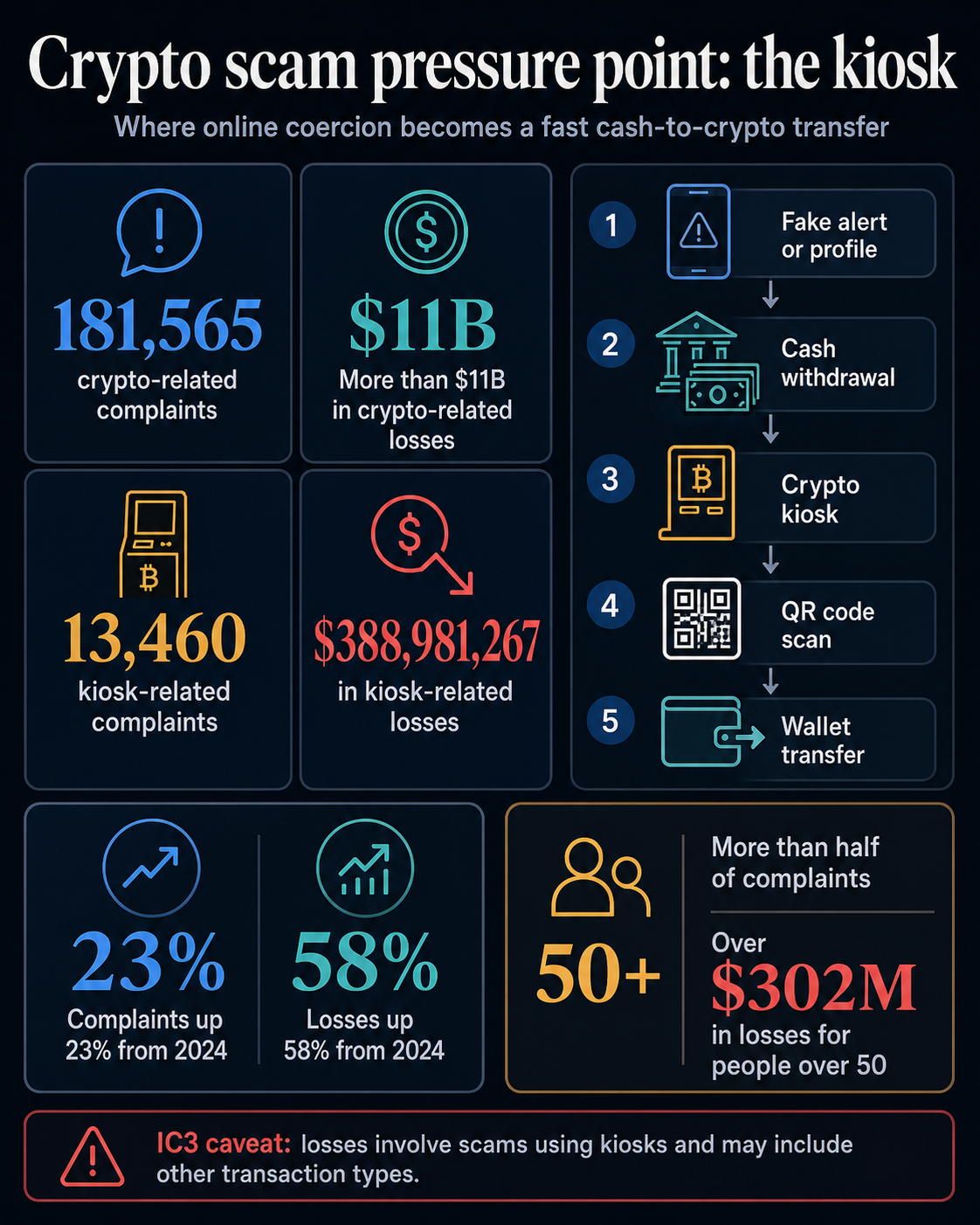
The FBI’s Internet Crime Report said that Americans submitted 181,565 complaints involving cryptocurrency, with reported losses exceeding $11 billion. A later IC3 cryptocurrency-kiosk PSA put a smaller but more concrete mechanism under the spotlight: 13,460 complaints involving crypto kiosks in 2025 and $388,981,267 in adjusted losses.

Online fraud creates the belief that money must move immediately. The kiosk creates the payment rail a frightened victim can operate in a convenience store, gas station, or supermarket while a criminal gives instructions in real time.

Once cash becomes crypto and moves into a wallet controlled by the scammer, the window to interrupt the transfer usually closes.

The kiosk becomes the point where families, banks, operators, and state regulators still have a chance to step in.

The $11B problem has a street-level endpoint

The FBI’s 2025 numbers show the scale of the broader fraud pipeline. IC3 received 1,008,597 total complaints in 2025, and the FBI said cyber-enabled crimes defrauded Americans of nearly $21 billion.

Cryptocurrency complaints were the highest-loss descriptor in the report, while AI-related complaints added nearly $893 million in losses.

The rise of generative AI has helped scammers get victims to reach the kiosk already primed to act. The FBI said scammers now use fake social profiles, voice clones, identification documents, and believable videos depicting public figures or loved ones.

Those tools do not need to touch a blockchain to push someone toward the machine. They create the pressure, authority, or panic that sends a victim out the door with cash.

The kiosk PSA shows what happens next. IC3 said cryptocurrency kiosks are ATM-like devices or terminals that allow users to exchange cash for cryptocurrency.

It said criminals may direct victims to send funds through them, and that complaints involving the devices rose 23% in 2025 while losses rose 58% from 2024.

Official measure 2025 figure Reader consequence
Cryptocurrency-related IC3 complaints 181,565 complaints and more than $11 billion in reported losses Shows the national scale of crypto-linked fraud
Cryptocurrency-kiosk complaints 13,460 complaints and $388,981,267 in adjusted losses Shows the physical last-mile channel
Kiosk trend from 2024 Complaints up 23%; losses up 58% Shows the problem is accelerating
People over 50 in kiosk complaints More than half of complaints; over $302 million in losses Shows where consumer harm is concentrated
See also  The Massive Supply Chain Attack Targeting Crypto Developers

Infographic showing 2025 crypto scam and kiosk complaint figures, the kiosk payment flow, growth rates, older-victim losses, and IC3 caveat.

IC3 also warned that its kiosk data covers scams involving cryptocurrency kiosks and may include other transaction types. Still, kiosks are becoming a recurring part of the payment path in scams that have already moved from online persuasion to real-world cash movement.
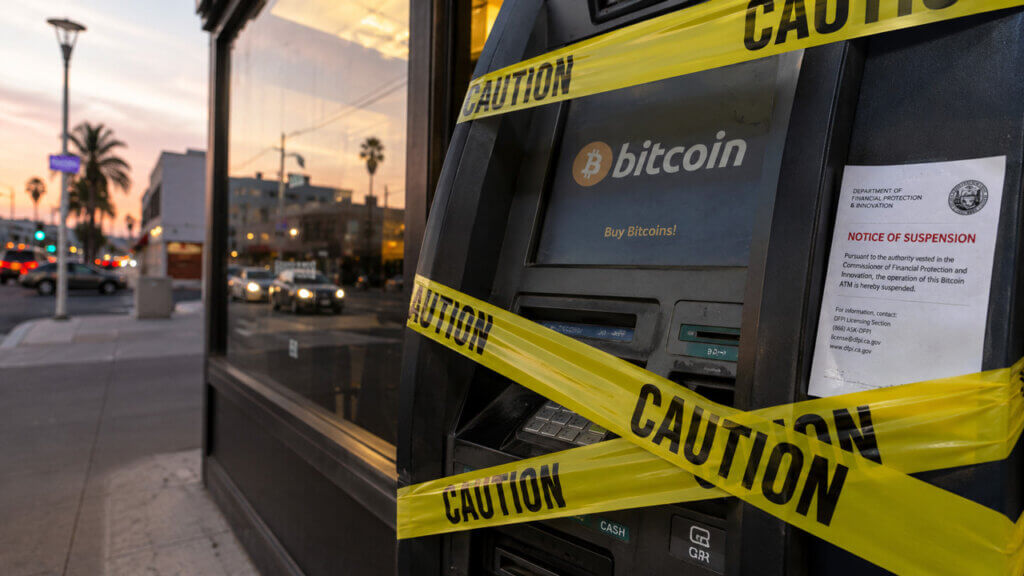
Bitcoin ATMs were crypto’s street-corner bank. Now regulators are shutting the door
Related Reading

Bitcoin ATMs were crypto’s street-corner bank. Now regulators are shutting the door

Crypto’s first real-world retail infrastructure is breaking down under the weight of scam complaints, legal pressure and the growing normalization of regulated Bitcoin investing.
May 30, 2026
·
Andjela Radmilac

The scammer does not need to touch the machine

The mechanics are simple enough to make the device dangerous. IC3 said typical kiosk complaints involve criminals providing detailed instructions on how to withdraw cash from a bank, locate a kiosk, and deposit and send funds using it.

Its warning signs include people holding QR-code documentation they cannot explain, making large first-time cash withdrawals, speaking on the phone while appearing confused at a bank or kiosk, or lingering around the machine.

California’s Department of Financial Protection and Innovation describes the same pattern in its consumer warning.

A scammer contacts the victim, creates a sense of urgency, directs them to a crypto ATM, stays on the phone during the transaction, and may send a QR code that routes the purchased assets directly to the scammer’s wallet. The DFPI also highlights the danger in that the transactions are quick and immediate and cannot be reversed.

FinCEN’s 2025 notice on convertible virtual currency kiosks explains why that workflow is attractive to criminals.

A CVC kiosk purchase looks like a standard ATM transaction to a user, but the wallet address that receives the crypto may belong to someone else and is often embedded in a QR code. FinCEN said scammers often keep victims in constant phone or online contact until payment is completed.

See also  Bithumb $43 Billion Bitcoin Blunder Triggers Political Backlash In South Korea

It also said scammers may instruct victims to split deposits across amounts or machines to avoid safeguards.

The economics add another clue. Kiosk fees can range from 7% to 20%, but scammers tolerate the cost because crypto can move quickly upon receipt, and recovery can be difficult.
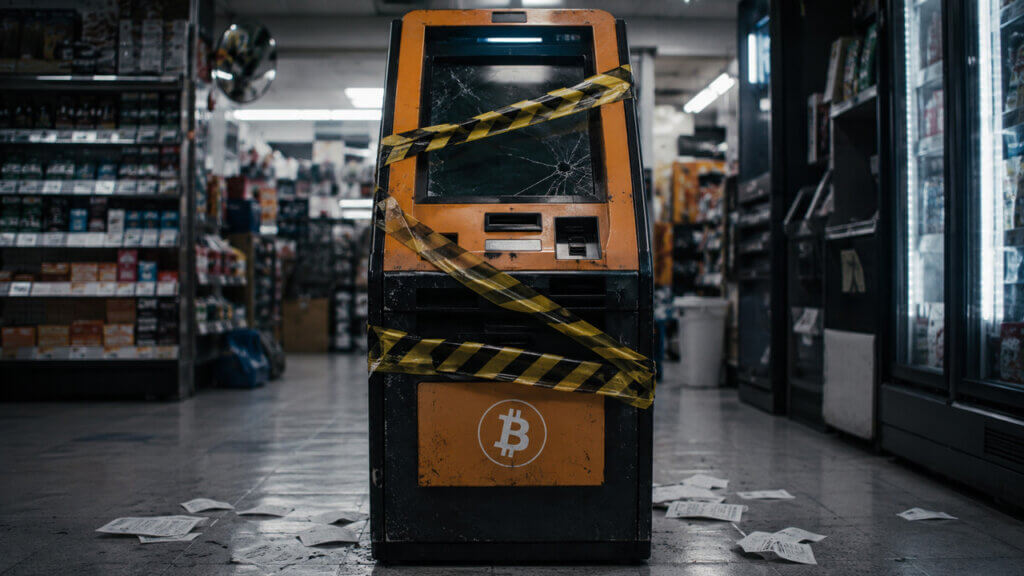
The US Bitcoin ATM industry is breaking under fraud, bans, and fees
Related Reading

The US Bitcoin ATM industry is breaking under fraud, bans, and fees

Bitcoin Depot’s collapse shows how fraud losses, state bans, KYC rules, and high fees are forcing a reassessment of the US Bitcoin ATM model.
May 19, 2026
·
Gino Matos

For a legitimate buyer, a high fee is a bad deal. For a criminal trying to convert a victim’s cash into fast-moving crypto, it can be part of the business model.

That is why the device sits at the center of the question of responsibility. The victim may be the one pressing buttons, but the transaction often includes visible warning signs before the funds move.

The warning signs include a large cash withdrawal, a nervous customer, a phone call that does not end, a QR code supplied by someone else, repeated deposits, or a destination wallet the customer cannot explain.

Operators and banks are now part of the control surface

FinCEN has urged financial institutions to identify and report suspicious activity involving CVC kiosks. It also warned that the risk of illicit activity is higher when operators fail to meet Bank Secrecy Act obligations.

That puts pressure on both sides of the kiosk business. Operators have to monitor the customer and the transaction. Banks and credit unions that serve the operators have to understand whether a kiosk business has real anti-fraud and anti-money-laundering controls.

FinCEN said non-compliant operators are especially vulnerable to abuse by scammers and other criminals. It said some scammers direct victims to specific kiosks, sometimes across state lines, likely to avoid stronger controls.

California’s DFPI says the state’s Digital Financial Assets Law prohibits kiosk operators from accepting more than $1,000 per person per day.

CryptoSlate’s recent coverage of Florida’s new crypto ATM law described another model with warnings, receipts, transaction caps, registration, and conditional refunds that can shift some of the scam risk onto operators.
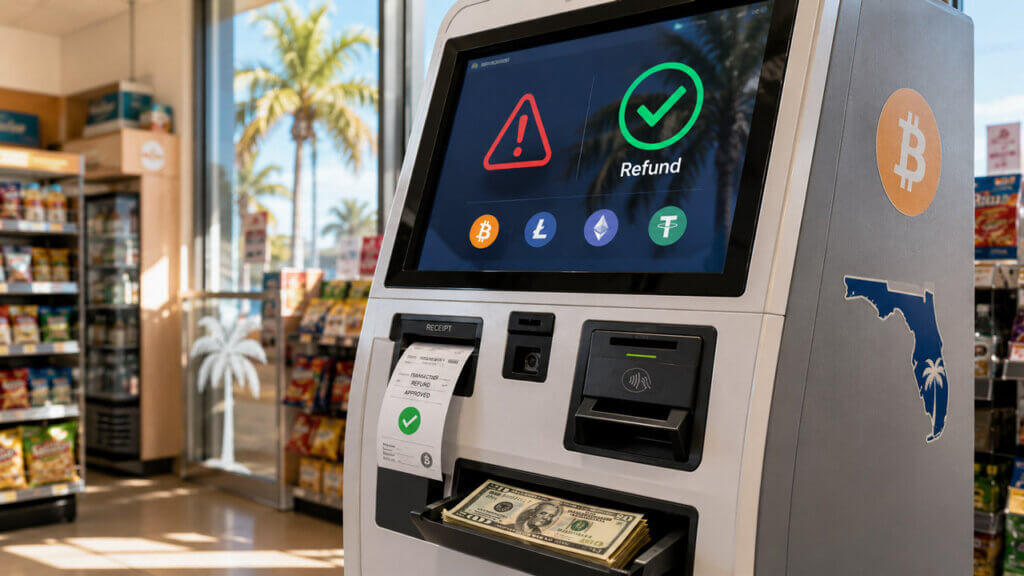
Florida’s new crypto ATM law makes scam refunds the cost of doing business
Related Reading

See also  Crypto exchange HTX rejects U.K. sanction allegations, says it refused A7A5 stablecoin listing

Florida’s new crypto ATM law makes scam refunds the cost of doing business

HB 505 tests whether caps, receipts, warnings, and conditional refunds can shift fraud costs onto kiosk businesses.
Jul 1, 2026
·
Liam 'Akiba' Wright

Those examples form a state-level menu rather than a national standard: lower daily limits, clearer warnings, live customer support, refund rights, operator registration, bank monitoring, and direct calls from operators when a transaction appears to be fraudulent.

Each approach aims at the same small window of time between cash withdrawal and blockchain settlement.

The FTC’s earlier Bitcoin ATM data spotlight helps explain the urgency. It said reported fraud losses involving Bitcoin ATMs increased nearly tenfold from 2020 to 2023 and topped $65 million in the first half of 2024, with a median reported loss of $10,000 in that six-month period.

It also said older adults were hit disproportionately.

IC3’s 2025 kiosk figures framed that concern within a larger official context. More than half of the kiosk complaints involved people over 50, resulting in losses of over $302 million.

That is a household-finance risk, often arriving through the same places where people already buy gas, groceries, and convenience-store goods.

The next test is whether those everyday touchpoints can become interruption points. A bank teller who questions a rushed cash withdrawal, an operator who blocks a suspicious transaction, a state cap that prevents a full account drain, or a family member who recognizes the script can all change the outcome before the money moves.

After the transaction, the tools are weaker. The fraud may still be traceable on-chain, but the funds can move through wallets and exchanges faster than a victim can understand what happened.

That asymmetry is drawing scrutiny because the kiosk may be the last practical place to stop the transfer.

If operators, banks, and lawmakers cannot make that moment safer, the official numbers point toward a harsher conclusion. The weakest link in the crypto scam pipeline may be the ATM-like machine that turns fear into a crypto transfer before anyone else can intervene.

The post Why Bitcoin ATMs are becoming the last stop in America’s $11B crypto scam pipeline appeared first on CryptoSlate.

11B Americas ATMs Bitcoin Crypto Pipeline scam Stop
Share. Facebook Twitter Pinterest LinkedIn Tumblr Email

Related Posts

Oliver Investigates Trump’s Crypto Ventures

July 29, 2026

Is the Web3 startup extinction event here, as Wall Street silently inherits crypto architecture?

July 29, 2026

Your AI Chats May Be Showing up in Google Search — One Sharing Feature Made It Possible

July 29, 2026

A Breakthrough in Crypto Encryption Timescales

July 29, 2026
Add A Comment
Leave A Reply Cancel Reply

Top Posts

Worldcoin Sell-Off Deepens, But Bullish Momentum Remains Intact — What’s Next for WLD Price?

June 23, 2026

U.S. Treasury Secretary Scott Bessent Makes Hot Comments on Bitcoin and Altcoin Declines – Will the Market Recover?

February 18, 2026

Stay ahead with the latest crypto news, market updates, blockchain insights, and trends. Your trusted source for everything happening in the digital asset world.


We're social. Connect with us:

Facebook X (Twitter) Instagram Pinterest YouTube
Top Insights

Oliver Investigates Trump’s Crypto Ventures

July 29, 2026

Is the Web3 startup extinction event here, as Wall Street silently inherits crypto architecture?

July 29, 2026

Audiera loses KEY support – Can BEAT recover from a 24% crash?

July 29, 2026
Get Informed

Subscribe to Updates

Get the latest creative news From Free.cc directly in your Inbox!

  • Contact
  • Privacy Policy
  • Terms & Conditions
  • Disclosure
© 2026 free.cc - All rights reserved.

Type above and press Enter to search. Press Esc to cancel.