
Close Menu
  • Latest News
    • Bitcoin
    • Ethereum
    • Altcoins
    • Meme Coins
  • Tech
    • Blockchain
    • Security and Privacy
  • Web 3
    • Gaming
  • Legal
    • Legal and Regulatory
    • Adoption
  • Analysis
  • Learn
    • Education
    • Wallets and Exchanges
  • Tools
    • Market Overview
    • Exchange Tool
  • INFO@FREE.CC
What's Hot

Ripple’s Schwartz Donates XRP to John Deaton

May 19, 2026

Atlaspad Partners with UXLINK to Expand Web3 Social Engagement Ecosystem

May 19, 2026

The US Bitcoin ATM industry is breaking under fraud, bans, and fees

May 19, 2026
Facebook X (Twitter) Instagram
  • Contact
  • Privacy Policy
  • Terms & Conditions
  • Disclosure
Facebook X (Twitter) Instagram
Free.cc (Free Cryptocurrency)Free.cc (Free Cryptocurrency)
  • Latest News
    1. Bitcoin
    2. Ethereum
    3. Altcoins
    4. Meme Coins
    5. View All

    $500mln in longs wiped, conviction intact: Is Bitcoin’s pullback a healthy reset?

    May 19, 2026

    Bitcoin Whales Defy $77K Drop as Large Wallets Surge 11%

    May 19, 2026

    Standard Chartered To Absorb Zodia Custody’s Core Business In Digital Asset Consolidation

    May 19, 2026

    Why Bitcoin price faces new risk as exchange reserves rise by 20K BTC

    May 19, 2026

    Why Are Bitcoin, Ethereum and XRP Prices Crashing Despite the CLARITY Act Breakthrough?

    May 19, 2026

    Ethereum’s Vitalik Buterin Explains How AI Could Make Smart Contracts Truly Secure

    May 18, 2026

    Why Ethereum Is About To Break The Bear Cycle And Rally To $8,000

    May 18, 2026

    Tom Lee Reveals Why Ethereum Price Is Down

    May 18, 2026

    Why This Weekly Close Is Critical For Its Rally

    May 19, 2026

    Bitcoin Supply Shock? Binance Flags 500k BTC Leaving Exchange

    May 19, 2026

    Trump’s Iran Warning Sends Bitcoin Tumbling Below $77K

    May 19, 2026

    Pundit Says Only This Move Will Make It Happen

    May 18, 2026

    Meme Coin Market Faces Imbalance as Supply Rises, Demand Falls

    April 4, 2026

    Crypto Interest Rising Toward Meme Coin Sector

    January 9, 2026

    Memes Market Cap Adds $10B in Days: Fresh Capital or Dead-Cat-Bounce?

    January 5, 2026

    Meme Coin Market Surges Past $45B as Shiba Inu, PEPE, BONK Stage 54% Price Pump

    January 4, 2026

    Ripple’s Schwartz Donates XRP to John Deaton

    May 19, 2026

    Atlaspad Partners with UXLINK to Expand Web3 Social Engagement Ecosystem

    May 19, 2026

    The US Bitcoin ATM industry is breaking under fraud, bans, and fees

    May 19, 2026

    $500mln in longs wiped, conviction intact: Is Bitcoin’s pullback a healthy reset?

    May 19, 2026
  • Tech
    1. Blockchain
    2. Security and Privacy
    3. View All

    Atlaspad Partners with UXLINK to Expand Web3 Social Engagement Ecosystem

    May 19, 2026

    Dexa AI Taps Vector AI to Accelerate Web3-Based Market Intelligence

    May 19, 2026

    MetaOne Taps Fomoin to Broaden Web3 Gaming Network and Alpha Access

    May 19, 2026

    B.AI Partners with Unibase to Boost Decentralized AI Agent Networks

    May 19, 2026

    THORChain exploit turns emergency chain halt into a DeFi trust test

    May 16, 2026

    Ripple insider warns XRP holders as fake airdrop scams surge across XRPL

    May 14, 2026

    Ripple Shares DPRK Threat Data on Fraud Domains, Wallets, Campaigns

    May 5, 2026

    Digital Asset Security Moves Beyond Keys as Bitgo Adds 5-Layer Checks

    May 1, 2026

    Ripple’s Schwartz Donates XRP to John Deaton

    May 19, 2026

    Atlaspad Partners with UXLINK to Expand Web3 Social Engagement Ecosystem

    May 19, 2026

    The US Bitcoin ATM industry is breaking under fraud, bans, and fees

    May 19, 2026

    $500mln in longs wiped, conviction intact: Is Bitcoin’s pullback a healthy reset?

    May 19, 2026
  • Web 3
    1. Gaming
    2. View All

    Account Abstraction in 2026: The Structural Overhaul That Makes Web3 Usable

    May 18, 2026

    RealGo Partners With Bitget Wallet To Expand User Access To DeFi And Advance Web3 Gaming Adoption

    May 18, 2026

    How Tokenized Treasuries Became Crypto’s New Margin Layer

    May 18, 2026

    CLARITY Act and Blockchain Gaming: 2026 Impact Explained

    May 15, 2026

    Ripple’s Schwartz Donates XRP to John Deaton

    May 19, 2026

    Atlaspad Partners with UXLINK to Expand Web3 Social Engagement Ecosystem

    May 19, 2026

    The US Bitcoin ATM industry is breaking under fraud, bans, and fees

    May 19, 2026

    $500mln in longs wiped, conviction intact: Is Bitcoin’s pullback a healthy reset?

    May 19, 2026
  • Legal
    1. Legal and Regulatory
    2. Adoption
    3. View All

    Ripple’s Schwartz Donates XRP to John Deaton

    May 19, 2026

    The US Bitcoin ATM industry is breaking under fraud, bans, and fees

    May 19, 2026

    House Committee pushes Trump to fill CFTC seats as crypto regulation ramps up

    May 19, 2026

    When Will Donald Trump Sign the Clarity Act, the Bullish Cryptocurrency Bill? A Clear Prediction Has Emerged

    May 19, 2026

    Societe Generale pushes stablecoins into Canton repo and collateral rails

    May 17, 2026

    Tether launches decentralized local AI using Isaac Asimov’s Psychohistory straight out of Foundation

    May 11, 2026

    Has Donald Trump been a net positive for Bitcoin or created an unbreakable partisan divide?

    May 10, 2026

    BlackRock looks to sidestep Clarity yield issues, filing for two new tokenized money market funds

    May 10, 2026

    Ripple’s Schwartz Donates XRP to John Deaton

    May 19, 2026

    Atlaspad Partners with UXLINK to Expand Web3 Social Engagement Ecosystem

    May 19, 2026

    The US Bitcoin ATM industry is breaking under fraud, bans, and fees

    May 19, 2026

    $500mln in longs wiped, conviction intact: Is Bitcoin’s pullback a healthy reset?

    May 19, 2026
  • Analysis

    Goldman Sachs Exec Says High Leverage Could Spark Volatility in AI and Semiconductor Sectors: ‘3% Can Turn Into 10% Very Quickly’

    May 19, 2026

    Here’s Why INJ Is Suddenly Gaining Momentum

    May 19, 2026

    Bitcoin price drop below $78K clears path for rebound as options traders hedge downside

    May 19, 2026

    TRUMP coin offers World Cup suite as insider sale terms raise scrutiny

    May 19, 2026

    Why Is KITE Price Rising So Fast Today? Can It Break $0.26 Break?

    May 18, 2026
  • Learn
    1. Education
    2. Wallets and Exchanges
    3. View All

    What Is AI Jailbreaking? A Beginner’s Guide to the Cat-and-Mouse Game Behind Every Chatbot

    May 17, 2026

    What’s on the Ethereum Roadmap: Glamsterdam, Hegota and Beyond

    March 30, 2026

    What Is Bluesky? The Decentralized Social Media Rival to Elon Musk’s X

    March 27, 2026

    What Is Strategy (MSTR)? The Bitcoin Treasury Company

    February 21, 2026

    Kraken moves Bitcoin to Chainlink as bridge fears spread across DeFi

    May 16, 2026

    Coinbase went down for over 5 hours after missing earnings. Bulls still see a path to $300 billion by 2030

    May 8, 2026

    Coinbase cuts 14% of staff as Armstrong ties cost reset to AI and market volatility

    May 6, 2026

    Bitcoin is still in charge

    May 3, 2026

    Ripple’s Schwartz Donates XRP to John Deaton

    May 19, 2026

    Atlaspad Partners with UXLINK to Expand Web3 Social Engagement Ecosystem

    May 19, 2026

    The US Bitcoin ATM industry is breaking under fraud, bans, and fees

    May 19, 2026

    $500mln in longs wiped, conviction intact: Is Bitcoin’s pullback a healthy reset?

    May 19, 2026
  • Tools
    • Market Overview
    • Exchange Tool
  • INFO@FREE.CC
Free.cc (Free Cryptocurrency)Free.cc (Free Cryptocurrency)
Home»Legal and Regulatory»Trillions of dollars in crypto liquidity is concentrating inside the venues US regulators fear most
Trillions of dollars in crypto liquidity is concentrating inside the venues US regulators fear most
Legal and Regulatory

Trillions of dollars in crypto liquidity is concentrating inside the venues US regulators fear most

April 25, 2026No Comments8 Mins Read
Share
Facebook Twitter LinkedIn Pinterest Email

Crypto market liquidity is increasingly hyper-concentrating within a handful of massive trading venues, creating a market structure that global central bank researchers warn is evolving into a heavily leveraged “shadow crypto financial system.”

Data from CryptoQuant shows that Binance, the world’s largest crypto exchange, cleared over $1 trillion in trading volume during the first 112 days of 2026.

This is significantly higher than the total of rival platforms like MEXC, which stood at about $284.9 billion; Bybit at $242.3 billion; Crypto.com at $219.9 billion; Coinbase at $209.3 billion; and OKX at $195.2 billion.
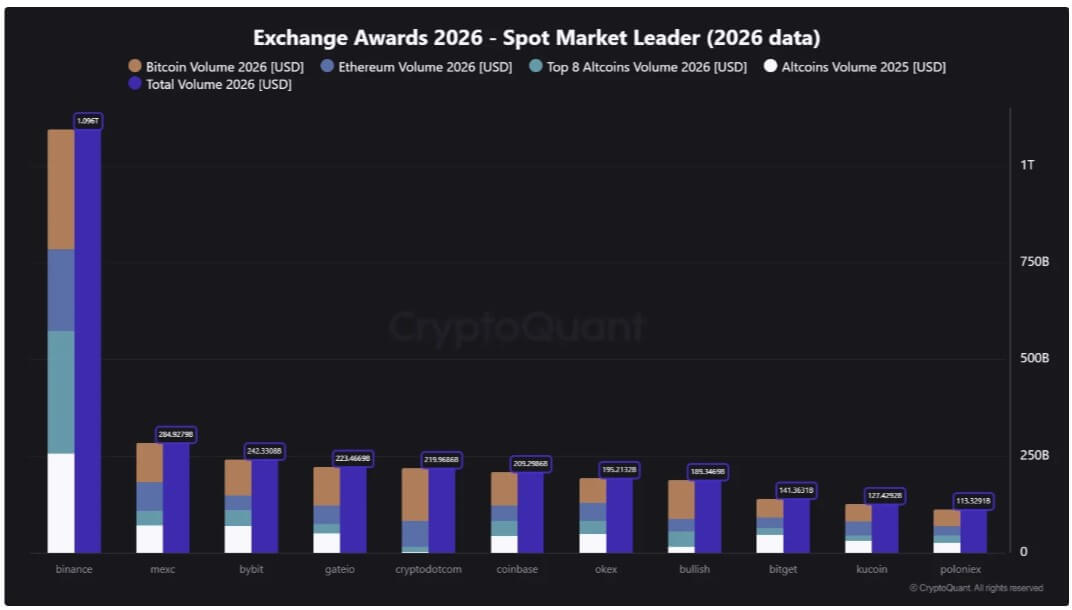
Crypto Exchanges Trading Volume
Crypto Exchanges Trading Volume in 2026 (Source: CryptoQuant)

The gap gives a market anchor to a new Financial Stability Institute paper published by the Bank for International Settlements, which said large crypto platforms have expanded beyond trading and custody into yield products, lending, derivatives, staking, and token-related services.

The paper described many of these trading platforms as “multifunction cryptoasset intermediaries” (MCIs) because they now combine roles that are usually split among banks, brokers, exchanges, and custodians in traditional finance.

Due to this, BIS flagged concerns that the crypto trading venues attracting the deepest liquidity are also becoming the places where users store assets, post collateral, take leverage, and seek yield.

That has turned the current exchange concentration into a wider question for regulators: whether platforms built for crypto trading have become financial intermediaries before the rules around customer assets, leverage, and liquidity risk have caught up.

Liquidity is concentrated where risk is rising

Crypto’s trading base has not spread evenly across hundreds of platforms despite years of exchange failures, enforcement actions, and market drawdowns.

The BIS paper said there were about 200 to 250 active centralized spot exchanges as of 2025, but trading remained dominated by a small group of large platforms.

BIS pointed out that Binance accounted for about 39% of global centralized exchange spot volume, while the top 10 exchanges handled about 90% of global trading activity.

The BIS paper said the largest MCIs often operate through subsidiaries or licensed entities across more than 100 jurisdictions. It also cited estimates that the top five MCIs collectively serve about 200 million to 230 million unique users, with 20 million to 34 million using staking or earn products.

That means the biggest crypto exchanges are no longer just places where buyers meet sellers. They are becoming balance-sheet hubs for a market that still lacks many of the legal protections built into traditional finance.

See also  Digital Asset Treasuries plummet 43% this year: What it means for crypto

That structure gives the largest venues power beyond ordinary market share as their order books influence pricing and their derivatives products shape leverage.

At the same time, their custody systems hold the assets customers use to move across spot, margin, staking, and yield products.

Binance’s $1.09 trillion in early-year volume shows the force of that network effect. Traders continue to cluster where liquidity is deepest and execution is most reliable.

In normal conditions, that concentration can reduce friction. During stress, it can make a handful of venues central to the way losses move through the system.

Exchanges are becoming financial supermarkets

The business model that has made large exchanges commercially powerful is the same model now drawing scrutiny.

A major crypto platform can offer spot trading, perpetual futures, custody, staking, lending, secured borrowing, wallet services, and yield products under one roof. Some also operate affiliated token ecosystems or infrastructure tied to their broader platforms.

In traditional finance, those services are usually split among institutions with different capital, liquidity, disclosure, and conduct rules. Banks, brokerages, exchanges, clearinghouses, and custodians each sit inside specific regulatory lanes.

Crypto has moved toward a more integrated model. A user can deposit assets, trade spot tokens, borrow against collateral, open leveraged derivatives positions, and allocate idle balances to yield products without leaving the platform.

That model keeps capital inside the venue. However, it also makes it harder for users and regulators to separate trading risk from credit, custody, and liquidity risks.

The BIS paper said MCIs that accept customer assets through investment programs and use them for lending, market-making, or other activities take on risks similar to those faced by financial intermediaries. Those include credit risk, maturity risk, and liquidity risk.

The difference is that many crypto platforms do not face the same prudential requirements as banks or regulated broker-dealers. They may not be subject to comparable capital buffers, liquidity rules, deposit protection, stress tests, or resolution frameworks.

Yield turns balances into credit exposure

The clearest example is the growth of earn-and-yield products.

These products are often marketed as a way for users to earn passive returns on idle crypto assets.

See also  Crypto Investor Donates $12M to UK's Reform Party

However, the economic reality can be much less straightforward. Depending on the terms, customers may give the platform control over their assets, allowing those funds to be used for staking, lending, market-making, margin financing, or other activities.

The BIS paper said some arrangements can leave customers with an unsecured claim on the intermediary rather than a protected right to specific assets. In practice, the user may think of the product as a savings account, while the legal exposure resembles a loan to the platform.

That distinction becomes critical in a crisis.

A bank depositor is usually protected by a framework built around capital requirements, liquidity management, deposit insurance, and access to central bank liquidity in extreme cases.

A crypto exchange customer using a yield product may have none of those protections. If the platform cannot meet withdrawals or suffers trading losses, the customer may become an unsecured creditor.

The BIS cited Celsius Network and FTX’s bankruptcy as examples of how those weaknesses can surface.

Celsius offered yield products that depended on lending, leverage, and liquidity transformation. When market conditions turned, and customers sought withdrawals, the platform failed.

On the other hand, FTX exposed a different version of the same structural problem, with customer assets, affiliated trading activity, and group-level risk becoming entangled.

Those examples remain important because the largest exchanges today are bigger, more global, and more embedded in crypto market infrastructure than many failed firms were in 2022.

Leverage can transmit stress fast

The BIS warning also extends beyond customer protection into market structure.

Crypto derivatives markets run continuously, use automated liquidation engines, and often rely on collateral whose value can fall sharply within minutes. When leverage is concentrated on the same venues that dominate spot liquidity, price shocks can become liquidation events before human traders have time to respond.

The BIS pointed to the October 2025 flash crash as an example of how fast the system can move. The episode triggered about $19 billion in forced liquidations across crypto derivatives markets and affected more than 1.6 million traders.

The crash showed how tightly connected leverage, collateral, automated risk engines, and venue concentration have become. Notably, some market observers blamed the October 10 incident on Binance’s operating practices. 

See also  Solana Partners with Everclear to Optimize Cross-Chain Liquidity and Asset Flows into Web3 Ecosystems

This is because a sharp macro move hit spot prices, resulting in a price decline that weakened collateral. Then, this weaker collateral triggered margin calls, which forced liquidations and deepened the downward price move.

That loop is not unique to crypto, but the emerging market structure can accelerate it.

Large exchanges sit at the center of that process because they host the liquidity, collateral accounts, and derivatives positions through which deleveraging occurs. A brief outage, pricing gap, or liquidity shortfall at a dominant venue can affect more than that venue’s own users. It can influence market prices across the sector.

Regulators face a business model that outgrew the exchange label

Against this backdrop, the policy challenge is that the largest crypto platforms do not fit neatly into existing categories.

A single firm may operate as an exchange, custodian, broker, lender, staking provider, derivatives venue, and wallet infrastructure provider simultaneously. Each activity may fall under a different regulator, or outside clear oversight altogether, depending on the jurisdiction.

As a result, the BIS paper called for prudential requirements for MCIs engaged in financial intermediation. Those could include capital and liquidity buffers, stronger governance standards, stress testing, risk-management rules, and clearer segregation of customer assets.

It also suggested that regulators may need both entity-based and activity-based rules. Entity-based rules would look at the health and structure of the platform as a whole. Activity-based rules would apply to specific services such as lending, custody, staking, derivatives, or yield products.

That approach would mark a shift from treating large crypto firms mainly as trading platforms to more closely aligning them with their surrounding financial conglomerates.

This would now raise questions about how they manage balance-sheet risk, protect customer assets, handle liquidity stress, and how a failure would be contained.

Meanwhile, this issue is becoming more urgent as traditional finance links to crypto deepen through exchange-traded products, institutional custody, stablecoin reserves, and brokerage integrations.

The BIS paper warned that as MCIs become more connected to traditional finance, disruptions at major platforms could have consequences beyond the crypto ecosystem.

The post Trillions of dollars in crypto liquidity is concentrating inside the venues US regulators fear most appeared first on CryptoSlate.

concentrating Crypto Dollars fear Liquidity regulators Trillions venues
Share. Facebook Twitter Pinterest LinkedIn Tumblr Email

Related Posts

Ripple’s Schwartz Donates XRP to John Deaton

May 19, 2026

The US Bitcoin ATM industry is breaking under fraud, bans, and fees

May 19, 2026

House Committee pushes Trump to fill CFTC seats as crypto regulation ramps up

May 19, 2026

When Will Donald Trump Sign the Clarity Act, the Bullish Cryptocurrency Bill? A Clear Prediction Has Emerged

May 19, 2026
Add A Comment
Leave A Reply Cancel Reply

Top Posts

Bitcoin – Why a ‘potential move towards $150K’ is still possible

October 17, 2025

FINRA appoints four crypto policy hitters, including Rostin Behnam and Dan Gallagher, to its board

January 9, 2026

Stay ahead with the latest crypto news, market updates, blockchain insights, and trends. Your trusted source for everything happening in the digital asset world.


We're social. Connect with us:

Facebook X (Twitter) Instagram Pinterest YouTube
Top Insights

Ripple’s Schwartz Donates XRP to John Deaton

May 19, 2026

Atlaspad Partners with UXLINK to Expand Web3 Social Engagement Ecosystem

May 19, 2026

The US Bitcoin ATM industry is breaking under fraud, bans, and fees

May 19, 2026
Get Informed

Subscribe to Updates

Get the latest creative news From Free.cc directly in your Inbox!

  • Contact
  • Privacy Policy
  • Terms & Conditions
  • Disclosure
© 2026 free.cc - All rights reserved.

Type above and press Enter to search. Press Esc to cancel.