Close Menu
  • Latest News
    • Bitcoin
    • Ethereum
    • Altcoins
    • Meme Coins
  • Tech
    • Blockchain
    • Security and Privacy
  • Web 3
    • Gaming
  • Legal
    • Legal and Regulatory
    • Adoption
  • Analysis
  • Learn
    • Education
    • Wallets and Exchanges
  • Tools
    • Market Overview
    • Exchange Tool
What's Hot

North Korea Blamed For $6.3 Billion Binance Hack

November 1, 2026

Gemini Boss Slams Crypto-Hater Lagarde Following Her Resignation Announcement

November 1, 2026

FBI blames North Korea for $6 billion Binance hack, urges THORChain to block stolen funds

November 1, 2026
Facebook X (Twitter) Instagram
  • Contact
  • Privacy Policy
  • Terms & Conditions
  • Disclosure
Facebook X (Twitter) Instagram
Free.cc (Free Cryptocurrency)Free.cc (Free Cryptocurrency)
  • Latest News
    1. Bitcoin
    2. Ethereum
    3. Altcoins
    4. Meme Coins
    5. View All

    North Korea Blamed For $6.3 Billion Binance Hack

    November 1, 2026

    Why is CZ expecting limited Bitcoin downside from the $6.3B Binance hack?

    November 1, 2026

    Satoshi Nakamoto’s Vision Became a $1.55T

    November 1, 2026

    SEC Charges Two Companies In $130 Million Crypto Trading Scheme

    November 1, 2026

    Premia Labs loses $464K – NEAR Intents and Chainflip enter the trail

    November 1, 2026

    Ethereum: From strong demand to a 23-week outflow, how ETH ETF sentiment collapsed

    November 1, 2026

    Ethereum’s staking queue jumps to $2.8B – Is an ETH season incoming?

    November 1, 2026

    Ethereum faces 420K ETH supply overhang, yet bulls remain hopeful – Why?

    November 1, 2026

    Worldcoin is ‘squeezed tight,’ says analyst – Can WLD escape its downtrend?

    November 1, 2026

    Polygon Adds Agent Payment Limits to Open Money Stack

    November 1, 2026

    Coinbase stock crashes 10% despite $719M Q3 profit – Here’s why

    November 1, 2026

    XRP exchange reserves drop by 250M tokens – Is a price recovery ahead?

    October 31, 2026

    Top 5 Memecoins to Watch in 2026: Hype, Utility, or Growth?

    October 14, 2026

    Did Jean Phil Go Viral First — or Was the Viral Persona Built to Launch a Memecoin?

    October 5, 2026

    Thinking Cat Gains Momentum After CASHCAT’s Breakout

    August 12, 2026

    What Tokens Could He Target?

    July 30, 2026

    North Korea Blamed For $6.3 Billion Binance Hack

    November 1, 2026

    Gemini Boss Slams Crypto-Hater Lagarde Following Her Resignation Announcement

    November 1, 2026

    FBI blames North Korea for $6 billion Binance hack, urges THORChain to block stolen funds

    November 1, 2026

    20 institutions join DTCC token service, but only 34 securities qualify

    November 1, 2026
  • Tech
    1. Blockchain
    2. Security and Privacy
    3. View All

    20 institutions join DTCC token service, but only 34 securities qualify

    November 1, 2026

    Request Network Launches Unified Dashboard for Multi-Merchant Payment Management

    November 1, 2026

    What the wallet update brings to XLM users

    November 1, 2026

    Chainlink Oracle Network Surpasses 20 Billion Verified Messages and $36.42 Trillion in Transaction Value

    November 1, 2026

    Five Wallets Drained in About Four Minutes

    November 1, 2026

    Michael Saylor Sees Stronger Crypto Security After Binance’s $6.3 Billion Hack

    November 1, 2026

    Binance Says BTC, ETH, XRP and 7 Other Cryptos Fully Backed After Hack

    November 1, 2026

    AI Gives Crypto Hackers Machine Speed as Billions Sit at Risk

    October 31, 2026

    North Korea Blamed For $6.3 Billion Binance Hack

    November 1, 2026

    Gemini Boss Slams Crypto-Hater Lagarde Following Her Resignation Announcement

    November 1, 2026

    FBI blames North Korea for $6 billion Binance hack, urges THORChain to block stolen funds

    November 1, 2026

    20 institutions join DTCC token service, but only 34 securities qualify

    November 1, 2026
  • Web 3
    1. Gaming
    2. View All

    FLOKI Ships Valhalla 1.13.2 ‘Special Delivery’ to Players on Mainnet

    October 27, 2026

    Top 12 NFT games every player should know about in August 2026

    September 22, 2026

    GameShame Studios founder details Raijin Protocol’s roadmap in NeoPod’s sixth AMA

    September 22, 2026

    Proof of Play to shut down after blockchain gaming thesis falls short

    September 22, 2026

    North Korea Blamed For $6.3 Billion Binance Hack

    November 1, 2026

    Gemini Boss Slams Crypto-Hater Lagarde Following Her Resignation Announcement

    November 1, 2026

    FBI blames North Korea for $6 billion Binance hack, urges THORChain to block stolen funds

    November 1, 2026

    20 institutions join DTCC token service, but only 34 securities qualify

    November 1, 2026
  • Legal
    1. Legal and Regulatory
    2. Adoption
    3. View All

    Gemini Boss Slams Crypto-Hater Lagarde Following Her Resignation Announcement

    November 1, 2026

    Canadian crypto scammer gets 25 months for $13M Bitcoin theft

    November 1, 2026

    Polymarket faces Australia’s binary options wall as ASIC signals strict scrutiny for any applicant

    November 1, 2026

    India’s ED Probes Mudrex, Instadapp Over Alleged FEMA Violations

    November 1, 2026

    Why Ripple’s $16 trillion payment volume isn’t boosting XRP

    October 31, 2026

    Ripple is heading for its best year ever while XRP faces its worst since 2022

    October 29, 2026

    BNY offers XRP custody, but only 1 rollout type exists

    October 28, 2026

    Ripple connects XRP Ledger to a £22 billion investment giant while chasing the next wave of corporate money

    October 27, 2026

    North Korea Blamed For $6.3 Billion Binance Hack

    November 1, 2026

    Gemini Boss Slams Crypto-Hater Lagarde Following Her Resignation Announcement

    November 1, 2026

    FBI blames North Korea for $6 billion Binance hack, urges THORChain to block stolen funds

    November 1, 2026

    20 institutions join DTCC token service, but only 34 securities qualify

    November 1, 2026
  • Analysis

    Bitcoin’s recovery faces rising derivatives exposure and $643 million in ETF outflows

    November 1, 2026

    Could Bulls Lose $10 Before Bulls Regain Control?

    October 31, 2026

    Can RENDER Price Prediction Put $3 Back in Reach?

    October 31, 2026

    Prediction markets lift Robinhood as crypto revenue slumps

    October 31, 2026

    Stacks Price Rallies as Bitcoin Staking Gains Traction: What Comes Next?

    October 31, 2026
  • Learn
    1. Education
    2. Wallets and Exchanges
    3. View All

    What Is Robinhood Chain? The Ethereum Layer-2 Network for Tokenized Stocks

    July 12, 2026

    What Is BChat? The Decentralized Messaging App Built for Privacy

    June 2, 2026

    What Is an AI Prompt Injection Attack? The Hidden Threat Hijacking Your Chatbots

    May 31, 2026

    What Is AI Jailbreaking? A Beginner’s Guide to the Cat-and-Mouse Game Behind Every Chatbot

    May 17, 2026

    FBI blames North Korea for $6 billion Binance hack, urges THORChain to block stolen funds

    November 1, 2026

    Binance hackers deploy never-seen-before laundering tactics to conceal $6.3 billion theft

    November 1, 2026

    Westpac limits crypto exchange deposits driven by fraud rules

    October 31, 2026

    Uniswap launches TJAR fee tool, but only fast searchers capture the hidden arbitrage profit

    October 31, 2026

    North Korea Blamed For $6.3 Billion Binance Hack

    November 1, 2026

    Gemini Boss Slams Crypto-Hater Lagarde Following Her Resignation Announcement

    November 1, 2026

    FBI blames North Korea for $6 billion Binance hack, urges THORChain to block stolen funds

    November 1, 2026

    20 institutions join DTCC token service, but only 34 securities qualify

    November 1, 2026
  • Tools
    • Market Overview
    • Exchange Tool
Free.cc (Free Cryptocurrency)Free.cc (Free Cryptocurrency)
Home»Security and Privacy»THORChain exploit turns emergency chain halt into a DeFi trust test
THORChain exploit turns emergency chain halt into a DeFi trust test
Security and Privacy

THORChain exploit turns emergency chain halt into a DeFi trust test

May 16, 2026No Comments9 Mins Read
Share
Facebook Twitter LinkedIn Pinterest Email

THORChain’s suspected multichain exploit and emergency halt on May 15 has turned into another DeFi security incident, and another test of cross-chain trust.

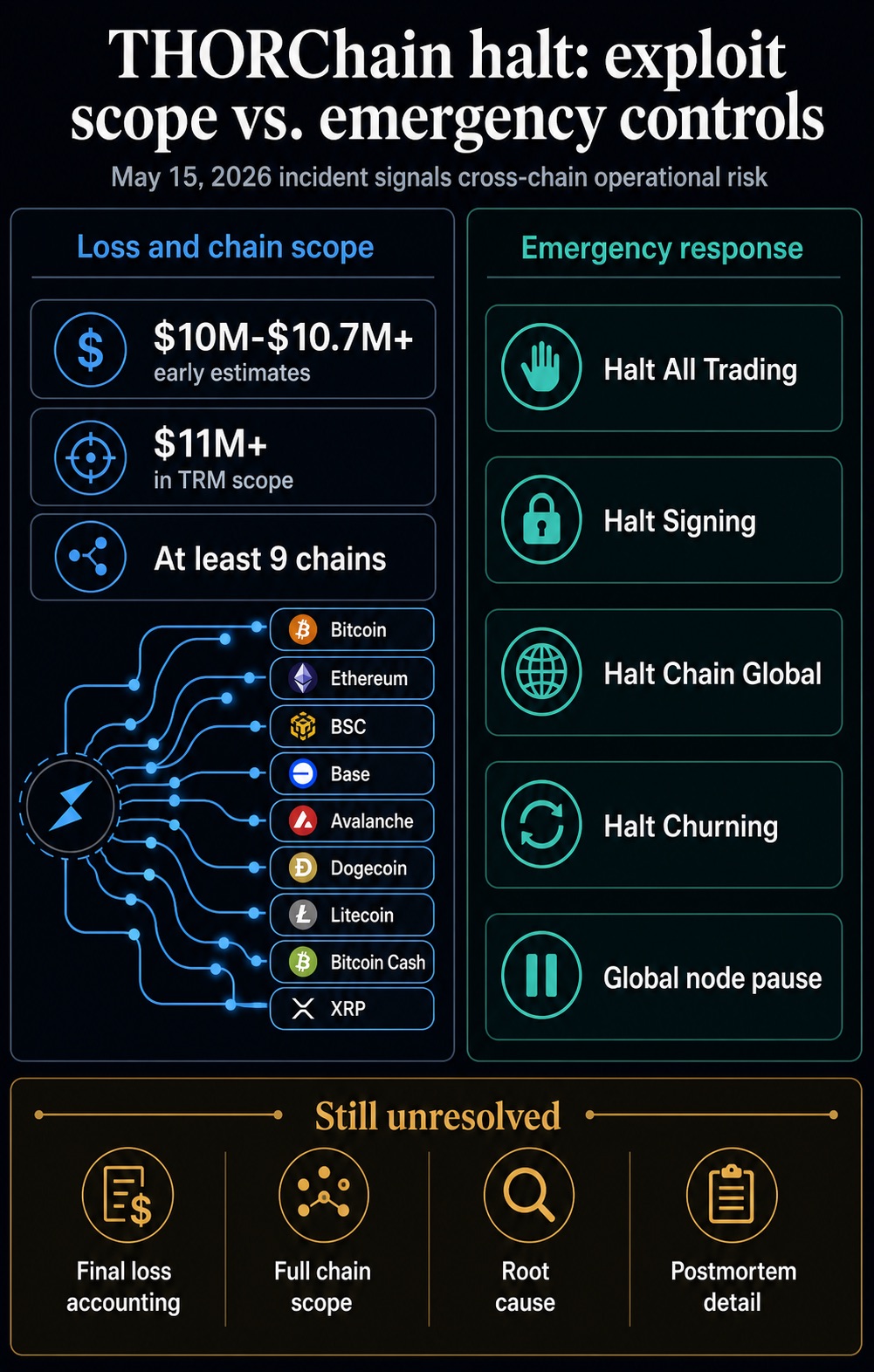
Emergency controls moved through chain-specific halts, Halt All Trading, Halt Signing, Halt Chain Global, Halt Churning, and repeated global node-pause updates.

One public alert described the likely exploit affecting Bitcoin, Ethereum, BSC, and Base, resulting in more than $10.7 million in losses, revised from an earlier $7.4 million estimate.

Another security estimate put the loss near $10 million, including 36.75 BTC and about $7 million across BNB Chain, Ethereum, and Base.

The chain scope was later expanded in a TRM Labs assessment, which reported that the attacker drained more than $11 million across at least nine chains. Those chains included Avalanche, Dogecoin, Litecoin, Bitcoin Cash, and XRP, in addition to the initial four-chain framing. The figures may still move as the accounting is reconciled, but the available record points to a multichain infrastructure event touching several native-asset routes.

The halt, therefore, carried consequences beyond THORChain. Cross-chain liquidity is supposed to make crypto feel more useful, liquid, and connected. Yet the same design that lets assets move between isolated networks can also compress the response window when something breaks.

Kraken moves Bitcoin to Chainlink as bridge fears spread across DeFi
Related Reading

Kraken moves Bitcoin to Chainlink as bridge fears spread across DeFi

Kraken is rebuilding how Bitcoin moves through DeFi after the KelpDAO shock.
May 15, 2026
·
Liam 'Akiba' Wright

In this case, DeFi’s promise of seamless routing ran straight into the need for an emergency stop.
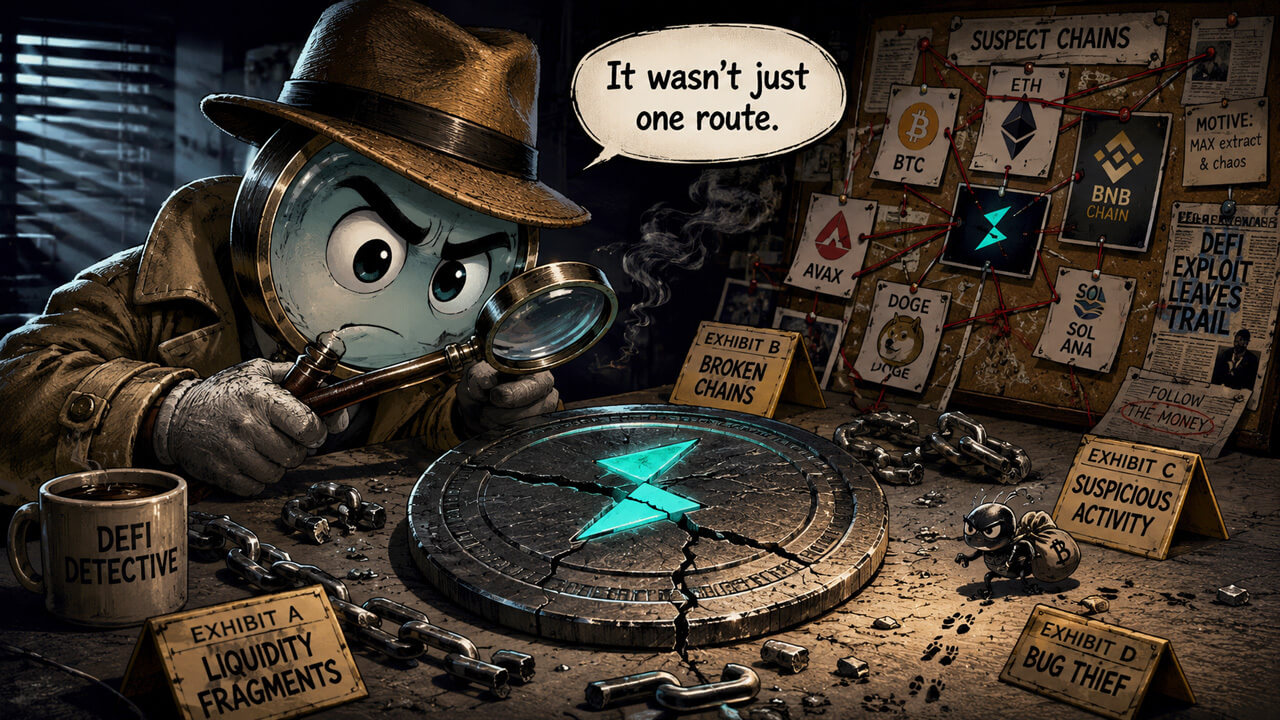
Detective investigating a DeFi exploit map with THORChain, Bitcoin, BNB, DOGE, and liquidity clues.

The Halt Became The Signal

The operational response is documented in the chain’s emergency framework. THORChain’s procedures describe network and chain halts as tools node operators can use when funds are at risk.

Its architecture relies on Bifrost observation, vaults, and threshold-signature signing to move native assets across chains without wrapping them.

Those controls can protect funds by stopping further activity. They also show that cross-chain infrastructure is a stack of observers, validators, vaults, signing logic, node operations, and emergency procedures.

When that stack is tested, the market asks whether a single bug can be patched and whether the system can remain credible while the response itself disrupts routing.

I think that distinction brings the THORChain incident into the broader DeFi story. Mature financial infrastructure is expected to fail safely, explain quickly, and restore confidence with a documented root cause.

DeFi often moves faster than that standard. It ships integrations, new chains, and liquidity routes before users and institutions have a clear way to price the full operational risk.

After the $16.5 billion in exploits, DeFi is now being forced toward the controls it once resisted
Related Reading

See also  Bybit Theft Drives Record-Breaking $2bn Haul for North Korea

After the $16.5 billion in exploits, DeFi is now being forced toward the controls it once resisted

Aave’s rsETH bad debt shows DeFi’s next security crisis rests in broken assumptions across bridges, governance, collateral listings, and risk controls.
May 10, 2026
·
Gino Matos

A compact confidence ladder captures the current state of record:

Signal What is supported What remains unresolved
Initial security alert Likely exploit across Bitcoin, Ethereum, BSC, and Base for more than $10.7 million. Final loss accounting and complete chain scope.
Independent estimate About $10 million, including 36.75 BTC and roughly $7 million on EVM-linked chains. Whether all affected assets and addresses have been fully reconciled.
Analytics scope More than $11 million across at least nine chains. How the wider scope maps to THORChain’s final postmortem.
Emergency controls Trading, signing, global chain activity, and churning controls were activated. How quickly the halt contained the damage and what activity resumed afterward.
Protocol confirmation One of six Asgard vaults was reportedly compromised for roughly $10.7 million; initial indications said individual swaps were unaffected. Final root cause, final user-impact accounting, and postmortem detail.
Infographic mapping THORChain's May 15 exploit scope against emergency halt controls and unresolved postmortem questions.
THORChain’s May 15 halt showed how suspected multichain losses, emergency controls, and unresolved postmortem questions converged into a broader DeFi infrastructure test.

The Trust Discount Is Now Measurable

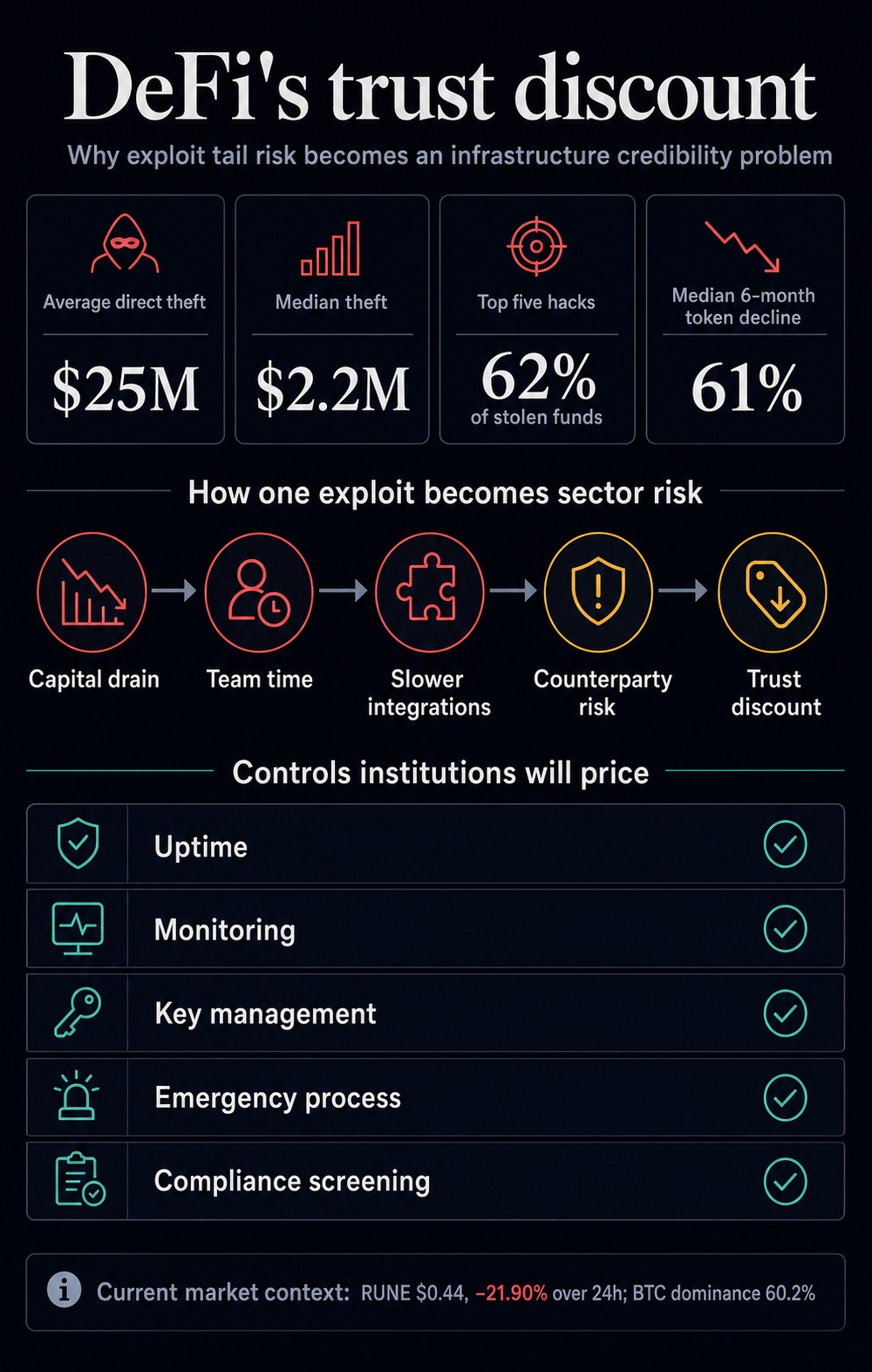
The damage from exploits rarely ends with the drained wallet. Immunefi’s 2026 security findings put the average direct theft at $25 million, while the median loss fell to $2.2 million.

That gap shows a market where routine defenses may improve while the largest incidents still define confidence.

The same report found that the top five hacks in 2024 and 2025 accounted for 62% of stolen funds, and hacked tokens saw a median six-month decline of 61%.

Those token moves cannot be cleanly separated from market conditions or project-specific weakness in every case. Still, the pattern supports the core market reaction: exploits become long-tail business events.

They drain capital, consume team time, slow integrations, and make partners question whether the next failure will hit them indirectly.

The trust discount reflects an extra layer of skepticism toward a sector that wants to be treated as financial infrastructure, yet still produces failures that look like crisis drills.

Users, exchanges, market makers, custodians, and institutions require more evidence to trust a protocol’s uptime, monitoring, key management, and emergency processes.

Recent cross-chain incidents reinforce that point. In the KelpDAO bridge exploit, attackers targeted off-chain verification and source-chain watching infrastructure rather than a conventional smart-contract bug.

See also  Solana becomes second-largest chain for tokenized stocks

The result was a false view of reality that led to valid-looking transactions releasing funds. Bridge-security fears have already influenced infrastructure decisions, including Kraken’s move to use Chainlink CCIP for kBTC and future wrapped assets following the KelpDAO shock.
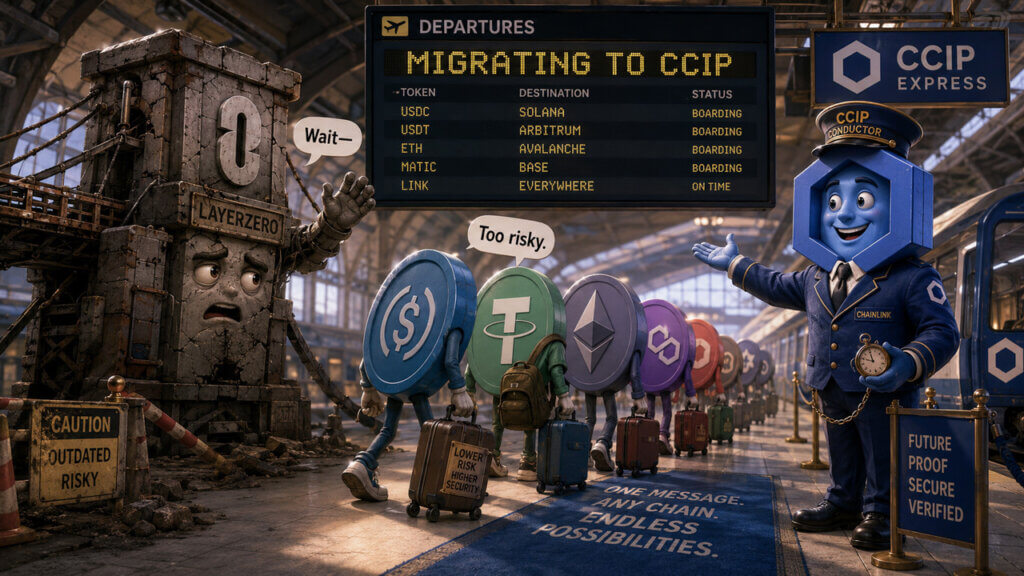
Chainlink emerges as the unlikely $3B winner of KelpDAO exploit as DeFi projects dump LayerZero
Related Reading

Chainlink emerges as the unlikely $3B winner of KelpDAO exploit as DeFi projects dump LayerZero

More than $3 billion in DeFi value is moving toward Chainlink’s CCIP after the KelpDAO exploit exposed weaknesses in bridge verification.
May 11, 2026
·
Oluwapelumi Adejumo

That makes the THORChain halt feel less isolated. The sector is being forced to prove that the trust path across chains is observable, redundant, and controllable before billions of dollars of liquidity are routed through it.

For institutional users, the issue becomes operational due diligence. Cross-chain exposure touches custody policy, liquidity commitments, incident response, and counterparty reviews.

A protocol that routes native assets across chains has to prove that the monitoring and emergency process around that routing is as strong as the connectivity itself.

For builders, that changes what counts as progress. New routes and integrations can deepen liquidity, but they also create more surfaces for monitoring, key management, and incident response.

The next credibility gains will come from showing that controls scale with liquidity before a failure forces counterparties to revisit assumptions.
THORChain Carries A Compliance Layer Too

THORChain’s position is especially sensitive because the protocol combines an attack surface with a routing role in major illicit-flow episodes.

As of TRM’s report, the May 15 exploit had no public actor attribution. That caveat keeps the current incident separate from earlier laundering cases unless new evidence changes the record.

The same analysis described THORChain as a recurring rail for moving stolen funds, including flows tied to the Bybit and KelpDAO incidents.

That pressure was evident after Lazarus-linked Bybit funds moved through the protocol, when THORChain faced tensions between developers and validators.

Thorchain faces developer exodus amid North Korean money laundering scandal
Related Reading

Thorchain faces developer exodus amid North Korean money laundering scandal

A core contributor known as TCB warned that Thorchain could face a crisis if the network is framed as a money laundering facilitator.
Feb 28, 2025
·
Gino Matos

Federal investigators attributed the February 2025 Bybit theft of about $1.5 billion in virtual assets to North Korea’s TraderTraitor activity.

The FBI also urged private-sector crypto entities, including DeFi services and bridges, to block transactions to or from addresses linked to laundering.

That history sharpens the current episode. A protocol can be useful because it makes native cross-chain swaps efficient. The same utility can make it attractive to attackers and difficult for compliance teams to ignore.

See also  Hacker Steals Over $570m from Binance Bridge

Once a protocol is seen as both exploitable infrastructure and a route for illicit funds, counterparties have to price in more than just smart-contract risk.

They have to price operational interruption, screening exposure, and the chance that integrations become reputational liabilities.

RUNE price reaction stays secondary. Market data on May 16 put RUNE at around $0.44, down 21.90% over 24 hours.

The broader crypto market stood near $2.61 trillion with Bitcoin dominance at 60.2%. The market noticed the incident, but the more important question is whether liquidity providers, routing interfaces, wallet integrations, and compliance desks change behavior after the halt.

The important market signal will come from the next set of operational choices rather than from a one-day chart. Liquidity interfaces can route around protocols that introduce uncertainty; custodians and market makers can raise internal risk scores.

Compliance teams can demand better screening and incident records before supporting integrations. Those reactions are slower than a token selloff, but they are the way a security event becomes a durable trust discount.

That is the slower repricing institutions notice. It shows up in due diligence questions, integration queues, and risk limits long after the emergency halt leaves the alert feed.

The Next Test Is The Postmortem

The next test starts with more than a recovery message: THORChain needs to produce a clear postmortem, reconcile the final loss figure and chain count, explain the root cause without speculation, and show what changed in its vault, key-management, node, monitoring, and halt processes.

Recovery details may help contain user harm while leaving the infrastructure question intact.

If THORChain completes compensation, resumes safely, and documents a credible fix, the incident can remain a severe but contained confidence hit.

If the root cause remains unsettled, final accounting keeps changing, or integrations pull back, the event becomes another data point in a broader repricing of cross-chain DeFi.

That is the sector-level consequence. DeFi wants to present itself as a durable, always-on financial infrastructure.

Every major cross-chain exploit makes that claim harder to defend until the industry can show that the bridges, vaults, signing systems, and emergency controls connecting its markets are as mature as the capital they aim to attract.

The post THORChain exploit turns emergency chain halt into a DeFi trust test appeared first on CryptoSlate.

Chain DeFi emergency Exploit Halt Test THORChain Trust Turns
Share. Facebook Twitter Pinterest LinkedIn Tumblr Email

Related Posts

FBI blames North Korea for $6 billion Binance hack, urges THORChain to block stolen funds

November 1, 2026

Five Wallets Drained in About Four Minutes

November 1, 2026

Michael Saylor Sees Stronger Crypto Security After Binance’s $6.3 Billion Hack

November 1, 2026

Binance Says BTC, ETH, XRP and 7 Other Cryptos Fully Backed After Hack

November 1, 2026
Add A Comment
Leave A Reply Cancel Reply

Top Posts

KelpDAO’s $292M hack sparks $10B bank run across DeFi

April 20, 2026

Bitcoin Price Slips While US Treasury Yields Soar

September 24, 2026

Stay ahead with the latest crypto news, market updates, blockchain insights, and trends. Your trusted source for everything happening in the digital asset world.


We're social. Connect with us:

Facebook X (Twitter) Instagram Pinterest YouTube
Top Insights

North Korea Blamed For $6.3 Billion Binance Hack

November 1, 2026

Gemini Boss Slams Crypto-Hater Lagarde Following Her Resignation Announcement

November 1, 2026

FBI blames North Korea for $6 billion Binance hack, urges THORChain to block stolen funds

November 1, 2026
Get Informed

Subscribe to Updates

Get the latest creative news From Free.cc directly in your Inbox!

  • Contact
  • Privacy Policy
  • Terms & Conditions
  • Disclosure
© 2026 free.cc - All rights reserved.

Type above and press Enter to search. Press Esc to cancel.