
Close Menu
  • Latest News
    • Bitcoin
    • Ethereum
    • Altcoins
    • Meme Coins
  • Tech
    • Blockchain
    • Security and Privacy
  • Web 3
    • Gaming
  • Legal
    • Legal and Regulatory
    • Adoption
  • Analysis
  • Learn
    • Education
    • Wallets and Exchanges
  • Tools
    • Market Overview
    • Exchange Tool
What's Hot

583 Companies Go Public in 18 Months, Says SEC Chairman

October 3, 2026

Ethereum Price Faces $2,800 Wall Again — Are Whales Selling or Accumulating ETH?

October 3, 2026

New SIMD-0675 Proposal Aims to Streamline Block Production

October 3, 2026
Facebook X (Twitter) Instagram
  • Contact
  • Privacy Policy
  • Terms & Conditions
  • Disclosure
Facebook X (Twitter) Instagram
Free.cc (Free Cryptocurrency)Free.cc (Free Cryptocurrency)
  • Latest News
    1. Bitcoin
    2. Ethereum
    3. Altcoins
    4. Meme Coins
    5. View All

    Bitcoin Is Up, DeFi Is Recovering, So Why Doesn’t This Look Like a Bull Market Yet?

    October 3, 2026

    Bank group sues U.S. regulator over granting crypto trust charters

    October 3, 2026

    When The Banks Don’t Work, Bitcoin Does: Report

    October 3, 2026

    Bitcoin clears $85K, but is ‘Uptober’ setting up a bull trap?

    October 3, 2026

    Ethereum: Why ETH faces October reversal risk after 70% Q3 rally

    October 3, 2026

    Why Did Blast Decide to Wind Down Its L2?

    October 2, 2026

    Bitcoin Q3 Strength Faces a Tougher Q4 Test

    October 1, 2026

    Ethereum beats Bitcoin by 42.71% in Q3 – Can ETH do it again?

    October 1, 2026

    Can NEAR crypto rebound? THESE metrics could decide what’s next

    October 3, 2026

    Polymath And CineCity Explore Regulated Tokenized Film Investment Platform

    October 3, 2026

    XLM price prediction – Why Stellar’s $0.21 rebound could trigger a 9% rally

    October 2, 2026

    XRP’s $1.54 breakout test meets Ripple’s 1B token unlock – Can demand absorb supply?

    October 2, 2026

    Thinking Cat Gains Momentum After CASHCAT’s Breakout

    August 12, 2026

    What Tokens Could He Target?

    July 30, 2026

    The Next Meme Coin Winner Could Be Determined by Incentives, Not Memes

    July 30, 2026

    Why Is BOME’s Price Up Today? Finally, Capital Rotating to the Meme Coins?

    July 28, 2026

    583 Companies Go Public in 18 Months, Says SEC Chairman

    October 3, 2026

    Ethereum Price Faces $2,800 Wall Again — Are Whales Selling or Accumulating ETH?

    October 3, 2026

    New SIMD-0675 Proposal Aims to Streamline Block Production

    October 3, 2026

    New SEC crypto rules threaten small advisers, but big firms win

    October 3, 2026
  • Tech
    1. Blockchain
    2. Security and Privacy
    3. View All

    New SIMD-0675 Proposal Aims to Streamline Block Production

    October 3, 2026

    State Street Fund Goes Live on Stellar

    October 3, 2026

    Blockchains Unlock an Explosion of New Markets

    October 3, 2026

    Cloak Launches Payroll Feature for Private Onchain

    October 2, 2026

    Masked Robbers Threaten Pregnant Wife in UK Crypto Home Attack

    October 3, 2026

    Bitcoin Lightning Nodes Targeted as Core Lightning Sounds Alarm

    October 2, 2026

    The $459,000 Bot Hacker Was a Customer First, Researchers Say

    October 2, 2026

    Metamask Pulls Validators as Meager ETH Theft Sounds Big Alarm

    October 2, 2026

    583 Companies Go Public in 18 Months, Says SEC Chairman

    October 3, 2026

    Ethereum Price Faces $2,800 Wall Again — Are Whales Selling or Accumulating ETH?

    October 3, 2026

    New SIMD-0675 Proposal Aims to Streamline Block Production

    October 3, 2026

    New SEC crypto rules threaten small advisers, but big firms win

    October 3, 2026
  • Web 3
    1. Gaming
    2. View All

    Top 12 NFT games every player should know about in August 2026

    September 22, 2026

    GameShame Studios founder details Raijin Protocol’s roadmap in NeoPod’s sixth AMA

    September 22, 2026

    Proof of Play to shut down after blockchain gaming thesis falls short

    September 22, 2026

    How BC.GAME is turning players into stakeholders

    September 22, 2026

    583 Companies Go Public in 18 Months, Says SEC Chairman

    October 3, 2026

    Ethereum Price Faces $2,800 Wall Again — Are Whales Selling or Accumulating ETH?

    October 3, 2026

    New SIMD-0675 Proposal Aims to Streamline Block Production

    October 3, 2026

    New SEC crypto rules threaten small advisers, but big firms win

    October 3, 2026
  • Legal
    1. Legal and Regulatory
    2. Adoption
    3. View All

    583 Companies Go Public in 18 Months, Says SEC Chairman

    October 3, 2026

    New SEC crypto rules threaten small advisers, but big firms win

    October 3, 2026

    Daines Unveils Crypto Tax Bill Pairing Payment Relief With Wash-Sale Rules

    October 3, 2026

    Tax on Bitcoin Gains? Dutch Government to Introduce Capital Gains Tax From 2028

    October 3, 2026

    Stablecoin issuers have replaced 40% of China’s lost US Treasury demand

    October 3, 2026

    Bitcoin’s $113,000 case strengthens as US regulators push 9 crypto actions

    October 2, 2026

    Bitget restores $300M fund after absorbing $388M security breach

    October 2, 2026

    Ripple’s biggest institutional bet may now be Brazil

    October 1, 2026

    583 Companies Go Public in 18 Months, Says SEC Chairman

    October 3, 2026

    Ethereum Price Faces $2,800 Wall Again — Are Whales Selling or Accumulating ETH?

    October 3, 2026

    New SIMD-0675 Proposal Aims to Streamline Block Production

    October 3, 2026

    New SEC crypto rules threaten small advisers, but big firms win

    October 3, 2026
  • Analysis

    Ethereum Price Faces $2,800 Wall Again — Are Whales Selling or Accumulating ETH?

    October 3, 2026

    Bull Market Targets for BTC, ETH, SOL, and XRP

    October 3, 2026

    Ethereum Price Faces A Critical $0.040 ETH/BTC Test

    October 2, 2026

    AAVE Price Surges 8% as Whale Activity Spikes — Can AAVE Break $200?

    October 2, 2026

    PropAMMs lower Solana trade costs, and public pool returns crash

    October 2, 2026
  • Learn
    1. Education
    2. Wallets and Exchanges
    3. View All

    What Is Robinhood Chain? The Ethereum Layer-2 Network for Tokenized Stocks

    July 12, 2026

    What Is BChat? The Decentralized Messaging App Built for Privacy

    June 2, 2026

    What Is an AI Prompt Injection Attack? The Hidden Threat Hijacking Your Chatbots

    May 31, 2026

    What Is AI Jailbreaking? A Beginner’s Guide to the Cat-and-Mouse Game Behind Every Chatbot

    May 17, 2026

    Coinbase completes Deribit migration, ends INTX trading

    October 2, 2026

    Binance Funding Account ends direct crypto deposits

    October 1, 2026

    Coinbase just completed its US derivatives stack but its biggest bet still sits outside it

    September 30, 2026

    Bitget had 30 minutes to contain its hack before $290 million started moving

    September 30, 2026

    583 Companies Go Public in 18 Months, Says SEC Chairman

    October 3, 2026

    Ethereum Price Faces $2,800 Wall Again — Are Whales Selling or Accumulating ETH?

    October 3, 2026

    New SIMD-0675 Proposal Aims to Streamline Block Production

    October 3, 2026

    New SEC crypto rules threaten small advisers, but big firms win

    October 3, 2026
  • Tools
    • Market Overview
    • Exchange Tool
Free.cc (Free Cryptocurrency)Free.cc (Free Cryptocurrency)
Home»Adoption»Tether’s Georgia stablecoin plan moves early on national payment rails
Adoption

Tether’s Georgia stablecoin plan moves early on national payment rails

May 26, 2026No Comments8 Mins Read
Share
Facebook Twitter LinkedIn Pinterest Email
Make CryptoSlate logo CryptoSlate preferred on Google logo

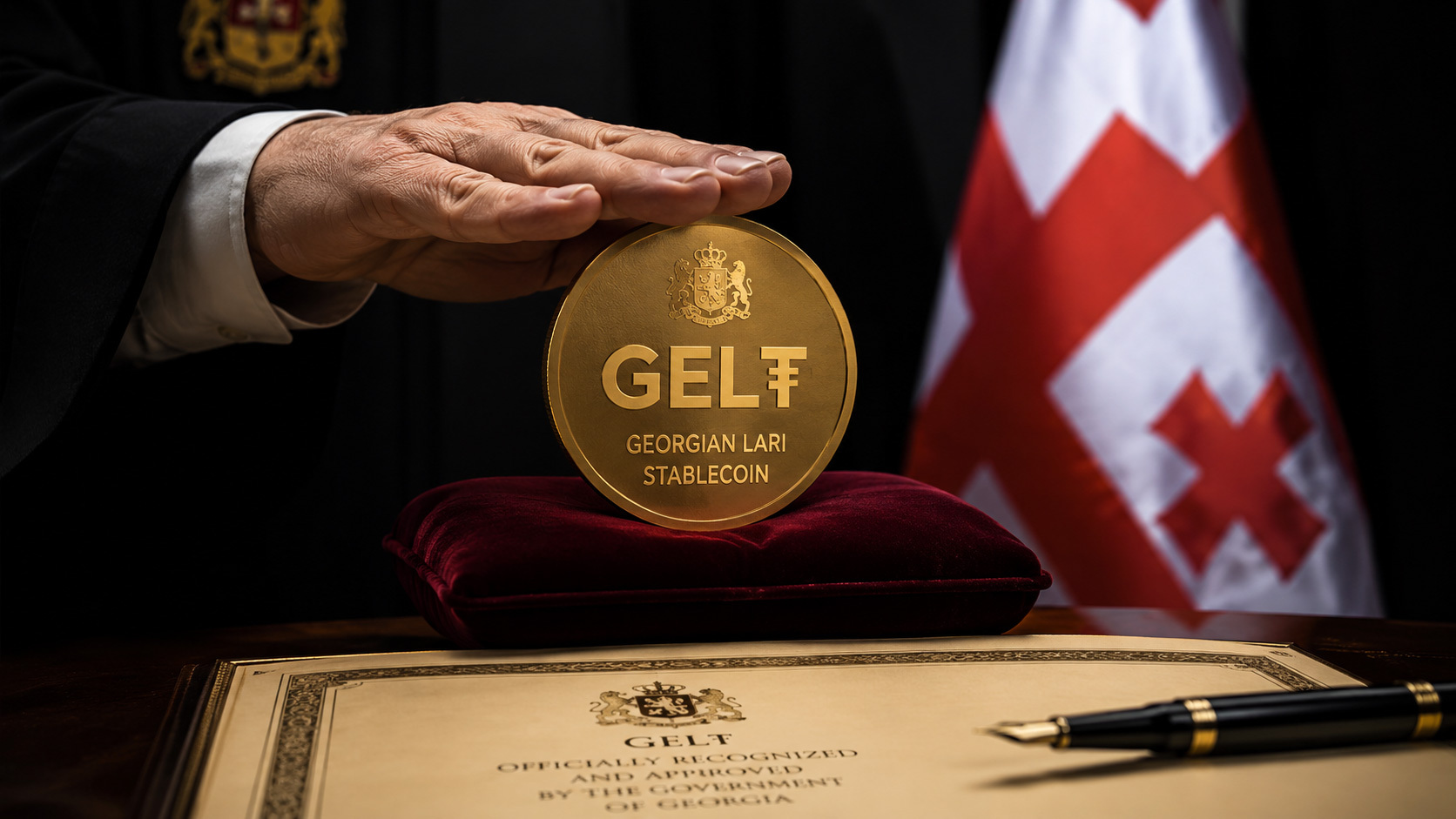
Tether and the Government of Georgia plan to launch a stablecoin, pushing a national currency directly onto private stablecoin rails before most governments have settled on how that model should work. The Tether Georgia stablecoin plan centers on GEL₮, a stablecoin representing the Georgian lari.

The May 25 announcement describes GEL₮ as the official stablecoin of Georgia and ties the project to the country’s digital asset framework. It says the token is intended to lower transaction costs, settle near instantly, support programmable payments, and improve cross-border commerce, fintech development, and digital payments.

That makes the Tether Georgia stablecoin plan larger than a single new token. Georgia is trying to turn lari-denominated value into a payment infrastructure while presenting its rulebook as compatible with the emerging U.S. stablecoin framework created under the GENIUS Act.

Tether gives the plan scale and distribution credibility, but the announcement leaves the practical architecture unresolved: who issues GEL₮, where the reserves sit, who can redeem, which networks support it, and how far official oversight reaches.
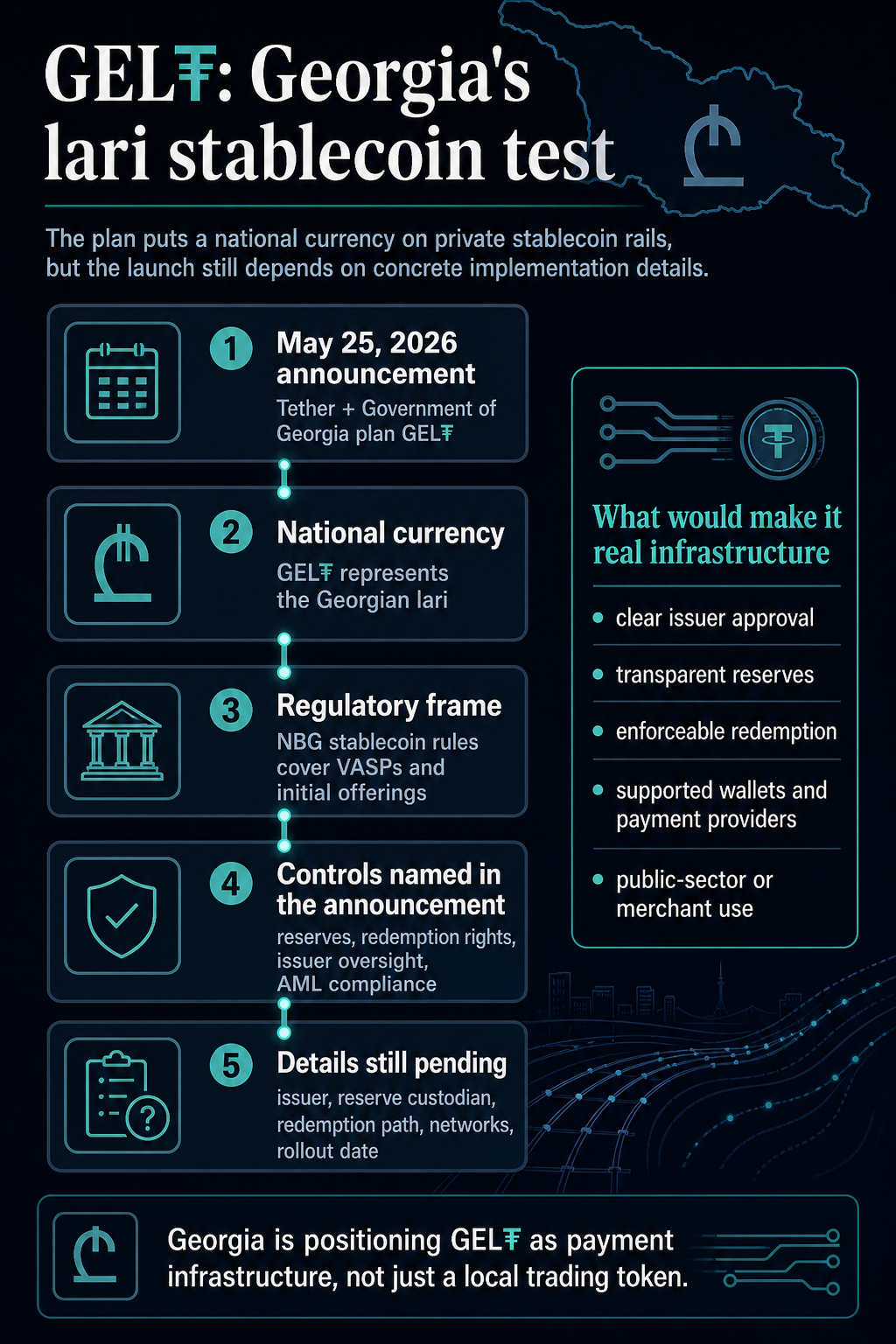
Infographic showing the Tether Georgia stablecoin GEL₮, also rendered as the GELT stablecoin, as a lari payment rail test.

A national currency on private stablecoin rails

GEL₮ lands at the intersection of two trends that have mostly developed separately: governments are writing stablecoin rules, while private issuers are building the payment rails people actually use.

Georgia’s announcement tries to join those tracks. The token is meant to represent the Georgian lari rather than the U.S. dollar, which makes it different from the dominant stablecoin model in crypto markets.

It also comes with government support, giving it a public-sector policy frame that most local-currency stablecoins lack.

The National Bank of Georgia had already moved in that direction. In March, the central bank said it had developed a regulation for the initial offering of stable virtual assets as part of a broader effort to strengthen consumer protection, risk management, and alignment with international standards.

That gives the Georgia stablecoin framework a regulatory anchor alongside Tether’s private infrastructure.

The underlying rule applies to registered virtual asset service providers that want to offer stablecoins and bars stablecoin initial offerings in Georgia outside the National Bank’s framework.

The distinction is practical. GEL₮ is being pitched as infrastructure, not just as a trading instrument.

A stablecoin can promise fast settlement, but it becomes useful only when the legal claim, reserve model, redemption process, and payment access are clear enough for businesses, wallets, exchanges, and payment processors to rely on it.

See also  Crypto wanted to replace Wall Street

For Georgia, the benefit is obvious if the structure works. A lari stablecoin could let domestic fintechs and cross-border businesses move GEL value through blockchain networks without waiting for older bank settlement paths.

It could also make Georgia a regional test case for how smaller national currencies plug into crypto payment systems without surrendering the entire rails layer to dollar tokens.

The risk is equally direct. If the token depends too heavily on a private issuer’s infrastructure, users may get speed and reach at the cost of new dependencies around custody, freeze powers, redemption access, chain support, and reserve disclosure.

Why the Tether Georgia stablecoin plan matters

Tether’s role is the reason this announcement carries more weight than a local pilot. CryptoSlate data lists USDT near $1 on May 25, with roughly $189 billion in market capitalization and tens of billions of dollars in 24-hour volume.

USDT is also one of crypto’s main liquidity rails for trading pairs, dollar settlement, DeFi liquidity, payments, remittances, and on-chain transfers.
Tether’s $141 billion Treasury pile reveals the stablecoin risk now embedded in US debt
Related Reading

Tether’s $141 billion Treasury pile reveals the stablecoin risk now embedded in US debt

Tether’s $141 billion Treasury exposure has turned the world’s largest stablecoin into an unlikely pillar of America’s debt machine.

May 24, 2026 · Andjela Radmilac

That scale gives Tether operational experience that a government pilot would struggle to match on its own. Tether already manages tokens across multiple blockchain networks and serves users who treat stablecoins as working payment and settlement tools rather than speculative assets.

But scale is not the same as public accountability. The same market context lists USDT’s key risk areas as peg stability, reserves, redemption access, issuer controls, regulation, chain-specific transfer risk, and market confidence.

Those are precisely the categories that become more sensitive when the token is tied to a national currency and backed by government support.

The announcement says Georgia’s framework was developed with reserve management, redemption rights, issuer oversight, and AML compliance in mind. It also says further details on GEL₮’s structure, rollout, and regulatory implementation will come later.

See also  Bitcoin Moves Past Halfway Point In Halving Cycle As Supply Tightens Toward 2028

Until those details arrive, the project is best understood as a policy-forward launch plan rather than a finished payment system.

The missing details are not minor technicalities. They define who has the claim on reserves, how quickly holders can redeem at par, whether retail users have direct rights or depend on intermediaries, and how law enforcement or sanctions requests are handled.

They also define what happens if a supported blockchain becomes congested, compromised, or commercially irrelevant.

Georgia and Tether are also using the language of regulatory interoperability. The announcement says Georgia’s framework was designed to achieve substantive compatibility with emerging U.S. stablecoin regulation, including the GENIUS Act. Treasury announced the law’s enactment in July 2025.

That makes GENIUS Act stablecoin regulation a reference point for Georgia’s claim of compatibility, even without formal U.S. recognition,

CryptoSlate Daily Brief

Daily signals, zero noise.

Market-moving headlines and context delivered every morning in one tight read.

5-minute digest 100k+ readers

Free. No spam. Unsubscribe any time.

Whoops, looks like there was a problem. Please try again.

You’re subscribed. Welcome aboard.

The Congress.gov text requires permitted payment stablecoin issuers to maintain identifiable reserves backing outstanding payment stablecoins on at least a one-to-one basis with specified liquid assets.

Treasury’s first GENIUS rule tightens Washington’s grip on who can scale stablecoins
Related Reading

Treasury’s first GENIUS rule tightens Washington’s grip on who can scale stablecoins

The proposal leaves states with a narrow lane while pushing large stablecoin issuers toward federal control.

Apr 2, 2026 · Gino Matos

Recent U.S. implementation has shifted attention toward issuer qualification, scale, and who controls the terms under which stablecoins can grow. That context is central for Georgia because compatibility is only meaningful if it translates into usable recognition by counterparties, exchanges, banks, and payment providers.

A Georgian framework can mirror U.S. categories around reserves, redemption, oversight, and compliance without being formally recognized by U.S. authorities.

The key distinction sits there: Georgia can design for alignment, but market participants will still want to know whether the framework creates enforceable rights and whether foreign counterparties treat GEL₮ as credible payment infrastructure.

For readers, the practical issue is whether a national-currency stablecoin can give users faster payment rails without making them depend on a weaker legal claim than they would have through regulated bank money.

Congress on verge of making regulated dollar stablecoins act almost like digital cash
Related Reading

See also  Bitcoin ETFs attract $2.9 billion in fresh capital

Congress on verge of making regulated dollar stablecoins act almost like digital cash

The GENIUS act has already defined what a legal payment stablecoin looks like. Now lawmakers are trying to make those digital dollars practical to use.

Apr 18, 2026 · Andjela Radmilac

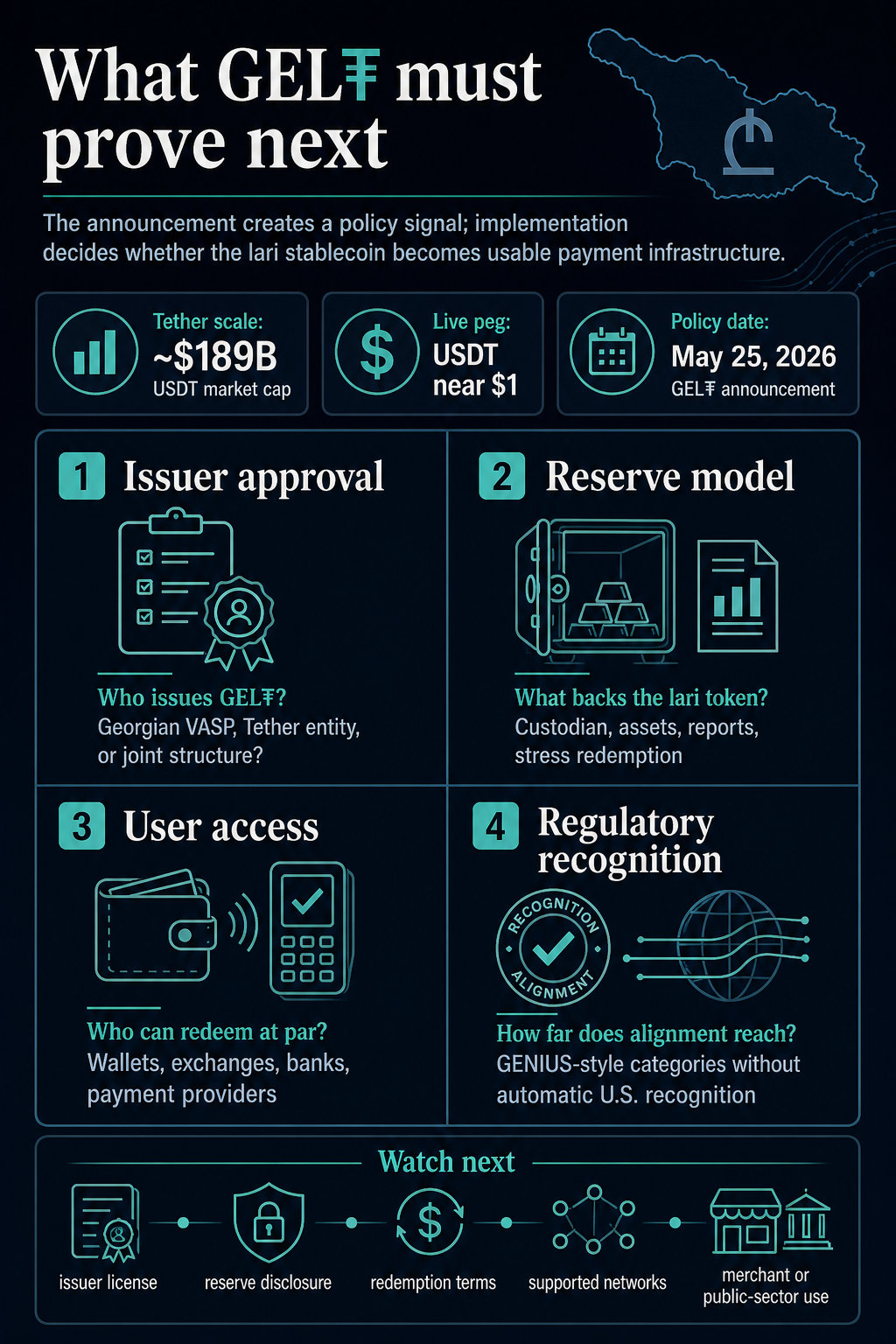
Infographic showing the issuer, reserve, user access, and regulatory recognition tests GEL₮ must prove next

The next test is implementation

GEL₮ will be judged by the parts of the announcement that remain blank.

The first is issuance. The National Bank’s stablecoin rule points to registered VASPs and regulator consent, but the announcement does not say which entity will issue GEL₮ or how responsibilities will be divided between Tether, Georgian authorities, and any local partners.

The second is reserves. If GEL₮ is meant to represent the lari, users and payment firms will need to know what stablecoin reserves back it, where those assets are held, how frequently reserves are reported, and what happens during heavy redemptions.

The third is access. A stablecoin can settle quickly on-chain, but it still needs reliable entry and exit points.

Businesses will care which wallets, exchanges, banks, payment processors, and public-sector services support the token. Retail users will care whether they can move from GEL₮ back to lari at par without hidden spreads or institutional-only redemption gates.

The fourth is legal durability. Tether’s infrastructure can make GEL₮ more immediately useful than a central-bank sandbox token, but it also places a private issuer at the center of a national-currency payment experiment.

That may be the model stablecoin adoption needs, or it may expose the unresolved tension between public money and private rails.

Georgia is moving early. That gives it a chance to shape regional stablecoin infrastructure while larger jurisdictions are still turning laws into supervisory systems.

It also means the burden shifts quickly from announcement to execution.

If GEL₮ launches with clear issuer approval, transparent reserves, enforceable redemption rights, and real payment access, it could become one of the more important examples of a national currency entering stablecoin circulation through a private global issuer.

If those details remain vague, the project will say more about the direction governments want to travel than about whether national-currency stablecoins are ready to work at scale.

Early Georgia Moves national Payment Plan rails Stablecoin Tethers
Share. Facebook Twitter Pinterest LinkedIn Tumblr Email

Related Posts

Daines Unveils Crypto Tax Bill Pairing Payment Relief With Wash-Sale Rules

October 3, 2026

Stablecoin issuers have replaced 40% of China’s lost US Treasury demand

October 3, 2026

US moves to choke off Russia’s $17 billion A7 network

October 2, 2026

Bitcoin’s $113,000 case strengthens as US regulators push 9 crypto actions

October 2, 2026
Add A Comment
Leave A Reply Cancel Reply

Top Posts

Bitcoin Register Record 15.8M Long-Term Holders Amid Price Decline

May 31, 2026

US Sanctions Iranian $6bn Crypto “Exchange” Shelbit

September 24, 2026

Stay ahead with the latest crypto news, market updates, blockchain insights, and trends. Your trusted source for everything happening in the digital asset world.


We're social. Connect with us:

Facebook X (Twitter) Instagram Pinterest YouTube
Top Insights

583 Companies Go Public in 18 Months, Says SEC Chairman

October 3, 2026

Ethereum Price Faces $2,800 Wall Again — Are Whales Selling or Accumulating ETH?

October 3, 2026

New SIMD-0675 Proposal Aims to Streamline Block Production

October 3, 2026
Get Informed

Subscribe to Updates

Get the latest creative news From Free.cc directly in your Inbox!

  • Contact
  • Privacy Policy
  • Terms & Conditions
  • Disclosure
© 2026 free.cc - All rights reserved.

Type above and press Enter to search. Press Esc to cancel.