Close Menu
  • Latest News
    • Bitcoin
    • Ethereum
    • Altcoins
    • Meme Coins
  • Tech
    • Blockchain
    • Security and Privacy
  • Web 3
    • Gaming
  • Legal
    • Legal and Regulatory
    • Adoption
  • Analysis
  • Learn
    • Education
    • Wallets and Exchanges
  • Tools
    • Market Overview
    • Exchange Tool
  • INFO@FREE.CC
What's Hot

Senate Confirms Bitcoin Friendly Kevin Warsh As Fed Chair Ahead Of Clarity Act Vote

May 14, 2026

What Is the CLARITY Act? The US Crypto Bill That Could Reshape Digital Asset Regulation This Week

May 14, 2026

Stables Taps T-0 Network as Asia’s 60% Stablecoin Payment Share Tests USDT Rails

May 14, 2026
Facebook X (Twitter) Instagram
  • Contact
  • Privacy Policy
  • Terms & Conditions
  • Disclosure
Facebook X (Twitter) Instagram
Free.cc (Free Cryptocurrency)Free.cc (Free Cryptocurrency)
  • Latest News
    1. Bitcoin
    2. Ethereum
    3. Altcoins
    4. Meme Coins
    5. View All

    Senate Confirms Bitcoin Friendly Kevin Warsh As Fed Chair Ahead Of Clarity Act Vote

    May 14, 2026

    Exodus slashes Bitcoin holdings by 50% in Q1 2026 – Is BTC’s volatility why?

    May 14, 2026

    ZachXBT Names Teen Behind $19 Million Crypto Theft Who Flaunted It On Instagram

    May 14, 2026

    Analyst Says No Reason for Bitcoin Reversal, Sees BTC Approaching Next Resistance Levels – Here Are His Targets

    May 14, 2026

    Bitcoin, Ethereum and XRP Price Analysis: What’s Coming Next?

    May 13, 2026

    Wells Fargo Boosts Ethereum ETF Holdings in Q1

    May 13, 2026

    Why Market Experts Are Still Predicting A Rise Above $10,000

    May 13, 2026

    Bitmine ETH Holdings Cross 5.2 Million—CEO Announces New Phase For Crypto Markets

    May 12, 2026

    XRP Holds Key Level, But Binance Flow Data Signals Weakening Demand

    May 14, 2026

    Bitcoin Just Entered A Deceptive Territory, Here’s What You Should Know

    May 14, 2026

    XRP Ledger Hits Record High In 10K+ Wallets: Santiment

    May 13, 2026

    Mysterious Bitcoin Whale Transfers $40B After Years Of Silence

    May 13, 2026

    Meme Coin Market Faces Imbalance as Supply Rises, Demand Falls

    April 4, 2026

    Crypto Interest Rising Toward Meme Coin Sector

    January 9, 2026

    Memes Market Cap Adds $10B in Days: Fresh Capital or Dead-Cat-Bounce?

    January 5, 2026

    Meme Coin Market Surges Past $45B as Shiba Inu, PEPE, BONK Stage 54% Price Pump

    January 4, 2026

    Senate Confirms Bitcoin Friendly Kevin Warsh As Fed Chair Ahead Of Clarity Act Vote

    May 14, 2026

    What Is the CLARITY Act? The US Crypto Bill That Could Reshape Digital Asset Regulation This Week

    May 14, 2026

    Stables Taps T-0 Network as Asia’s 60% Stablecoin Payment Share Tests USDT Rails

    May 14, 2026

    Exodus slashes Bitcoin holdings by 50% in Q1 2026 – Is BTC’s volatility why?

    May 14, 2026
  • Tech
    1. Blockchain
    2. Security and Privacy
    3. View All

    Stables Taps T-0 Network as Asia’s 60% Stablecoin Payment Share Tests USDT Rails

    May 14, 2026

    UBOX Taps ClawWorks to Accelerate Independent AI Agent Economics

    May 14, 2026

    UXLINK And Origins Network Partner To Power Scalable AI-Driven Web3 Applications Using Decentralized Computing

    May 13, 2026

    WheelX.fi Expands Cross-Chain Liquidity Access Through KiteAI Integration

    May 13, 2026

    Ripple Shares DPRK Threat Data on Fraud Domains, Wallets, Campaigns

    May 5, 2026

    Digital Asset Security Moves Beyond Keys as Bitgo Adds 5-Layer Checks

    May 1, 2026

    Defillama Confirms April 2026 as Crypto’s Most-Hacked Month With 30 Incidents

    May 1, 2026

    Malicious npm Dependency Linked to AI Assisted Commit Targets Crypto W

    April 29, 2026

    Senate Confirms Bitcoin Friendly Kevin Warsh As Fed Chair Ahead Of Clarity Act Vote

    May 14, 2026

    What Is the CLARITY Act? The US Crypto Bill That Could Reshape Digital Asset Regulation This Week

    May 14, 2026

    Stables Taps T-0 Network as Asia’s 60% Stablecoin Payment Share Tests USDT Rails

    May 14, 2026

    Exodus slashes Bitcoin holdings by 50% in Q1 2026 – Is BTC’s volatility why?

    May 14, 2026
  • Web 3
    1. Gaming
    2. View All

    NUMINE Joins Outer Ring MMO for the Expansion of Web3 Gaming Experiences

    May 13, 2026

    GMatrixs And MiniverseCore Join Forces To Unlock Web3 Gaming Experience With Cross-Chain DApp, DeFi Applications

    May 11, 2026

    The Identity Crisis of 2026: NFTs, AI Agents and Trust on the Agentic Web

    May 11, 2026

    DTCC’s May 2026 Tokenization Announcement Explained: What It Means for U.S. Securities and Real-World Assets

    May 11, 2026

    Senate Confirms Bitcoin Friendly Kevin Warsh As Fed Chair Ahead Of Clarity Act Vote

    May 14, 2026

    What Is the CLARITY Act? The US Crypto Bill That Could Reshape Digital Asset Regulation This Week

    May 14, 2026

    Stables Taps T-0 Network as Asia’s 60% Stablecoin Payment Share Tests USDT Rails

    May 14, 2026

    Exodus slashes Bitcoin holdings by 50% in Q1 2026 – Is BTC’s volatility why?

    May 14, 2026
  • Legal
    1. Legal and Regulatory
    2. Adoption
    3. View All

    What Is the CLARITY Act? The US Crypto Bill That Could Reshape Digital Asset Regulation This Week

    May 14, 2026

    Michael Saylor Says the Transparency Act in the US Congress Will Positively Impact Bitcoin! Here Are the Details

    May 14, 2026

    Consensys Urges SEC to Exempt Self-Custody Wallets, Citing Regulatory Gap for 99% of Tokens

    May 14, 2026

    Three men charged in US over crypto wrench attack spree

    May 13, 2026

    Tether launches decentralized local AI using Isaac Asimov’s Psychohistory straight out of Foundation

    May 11, 2026

    Has Donald Trump been a net positive for Bitcoin or created an unbreakable partisan divide?

    May 10, 2026

    BlackRock looks to sidestep Clarity yield issues, filing for two new tokenized money market funds

    May 10, 2026

    Cardano’s Charles Hoskinson says the future of crypto wallets will be inside iPhones and Androids

    May 8, 2026

    Senate Confirms Bitcoin Friendly Kevin Warsh As Fed Chair Ahead Of Clarity Act Vote

    May 14, 2026

    What Is the CLARITY Act? The US Crypto Bill That Could Reshape Digital Asset Regulation This Week

    May 14, 2026

    Stables Taps T-0 Network as Asia’s 60% Stablecoin Payment Share Tests USDT Rails

    May 14, 2026

    Exodus slashes Bitcoin holdings by 50% in Q1 2026 – Is BTC’s volatility why?

    May 14, 2026
  • Analysis

    Trump’s CEO-filled China visit can decide whether Bitcoin’s $80,000 risk rally survives this week

    May 14, 2026

    Wall Street is buying XRP while Binance traders keep betting against it

    May 13, 2026

    Is a Drop Below $1 Coming Next?

    May 13, 2026

    UB Price Breakout Enters Discovery Phase

    May 13, 2026

    Billions Network Rally Accelerates After Binance Futures Launch

    May 13, 2026
  • Learn
    1. Education
    2. Wallets and Exchanges
    3. View All

    What’s on the Ethereum Roadmap: Glamsterdam, Hegota and Beyond

    March 30, 2026

    What Is Bluesky? The Decentralized Social Media Rival to Elon Musk’s X

    March 27, 2026

    What Is Strategy (MSTR)? The Bitcoin Treasury Company

    February 21, 2026

    What Are Prediction Markets? How Polymarket, Kalshi and Myriad Work

    February 13, 2026

    Coinbase went down for over 5 hours after missing earnings. Bulls still see a path to $300 billion by 2030

    May 8, 2026

    Coinbase cuts 14% of staff as Armstrong ties cost reset to AI and market volatility

    May 6, 2026

    Bitcoin is still in charge

    May 3, 2026

    CLARITY Act stablecoin fight shifts from yield to who captures digital-dollar economics

    April 29, 2026

    Senate Confirms Bitcoin Friendly Kevin Warsh As Fed Chair Ahead Of Clarity Act Vote

    May 14, 2026

    What Is the CLARITY Act? The US Crypto Bill That Could Reshape Digital Asset Regulation This Week

    May 14, 2026

    Stables Taps T-0 Network as Asia’s 60% Stablecoin Payment Share Tests USDT Rails

    May 14, 2026

    Exodus slashes Bitcoin holdings by 50% in Q1 2026 – Is BTC’s volatility why?

    May 14, 2026
  • Tools
    • Market Overview
    • Exchange Tool
  • INFO@FREE.CC
Free.cc (Free Cryptocurrency)Free.cc (Free Cryptocurrency)
Home»Legal and Regulatory»Prediction markets let insiders profit on leaks, yet a massive Dow Jones partnership just validated the rig
Bitcoin
Legal and Regulatory

Prediction markets let insiders profit on leaks, yet a massive Dow Jones partnership just validated the rig

January 8, 2026No Comments8 Mins Read
Share
Facebook Twitter LinkedIn Pinterest Email

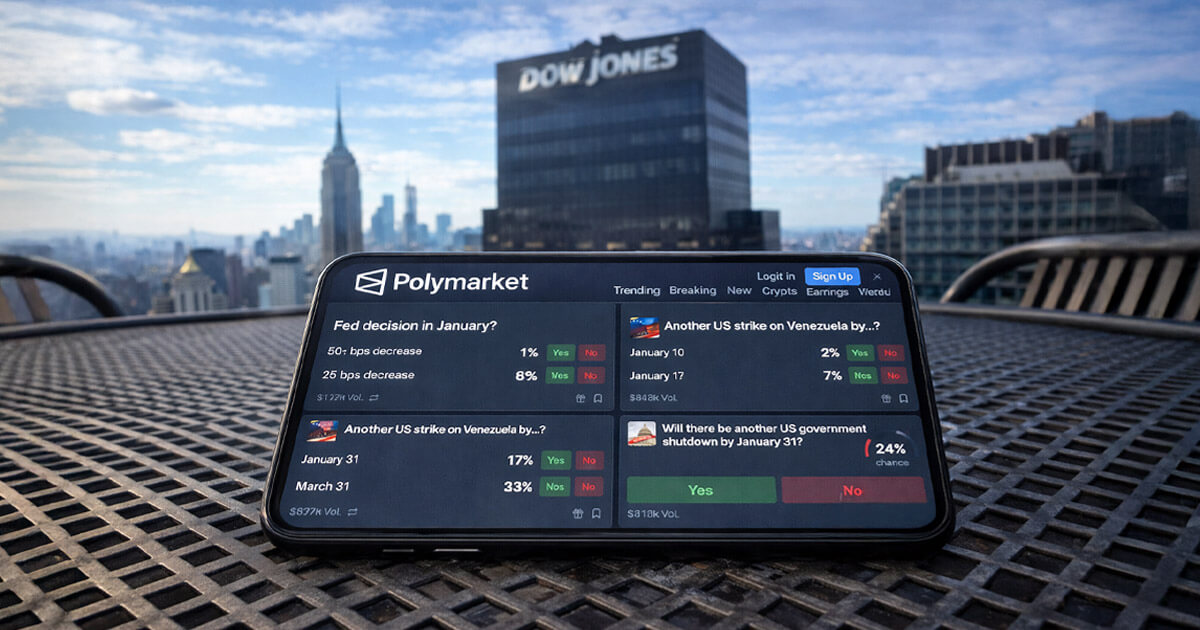
Dow Jones announced an exclusive partnership to distribute Polymarket prediction data across The Wall Street Journal, Barron’s, and MarketWatch on the same day Kalshi claimed it had hit $100 billion in annualized trading volume.

The juxtaposition captures where prediction markets sit at the start of 2026: simultaneously legitimized as a financial data product and mired in methodological disputes, oracle controversies, and insider trading optics that would sink most consumer finance products before they reach distribution.

The difference is that institutions are not validating the integrity of prediction markets, but their utility as an information layer. ICE, the owner of the New York Stock Exchange, announced it would invest up to $2 billion in Polymarket and become a global distributor of the platform’s event-driven data to institutional investors.

CNN and CNBC both partnered with Kalshi to integrate prediction probabilities into their coverage starting in 2026. Coinbase rolled out Kalshi-based prediction markets in December, turning probabilities into a broker-style feature rather than a niche site users have to navigate separately.

These are not venture capital press releases, they are distribution deals that treat prediction markets as a data feed comparable to sentiment indicators or volatility indexes, not as a consumer product that needs to be trusted end-to-end.

The recurring failure modes

The list of controversies that unfolded in 2025 is long enough to establish patterns rather than isolated incidents.

A Polymarket market on whether Ukrainian President Volodymyr Zelensky would wear a suit during a specific event became a definitional dispute with $210 million on the line, centering on what counts as a suit and how crowd-based resolution mechanisms handle ambiguity.

Polymarket faces backlash over disputed $200M Zelensky ‘suit' market
Related Reading

Polymarket faces backlash over disputed $200M Zelensky ‘suit’ market

Lack of clear parameters in Zelensky suit bet raises questions over crypto betting.

Jul 8, 2025
·
Oluwapelumi Adejumo

A NASCAR market escalated into a governance dispute that spilled into UMA’s oracle process, raising questions about who decides what happened when the outcome is contested.

A UFO declassification market with $16 million at stake resolved “YES” without any released documents, driven by late-session whale activity and dispute mechanics that favored speed over clarity.

Information asymmetry produced even sharper optics problems. Forbes reported that a trader allegedly netted over $1 million on Google Year in Search markets, raising the question of whether prediction markets price public information or reward access to leaks.

See also  A No-BS Legal Guide for Bitcoin and Crypto Builders

A trader profited over $400,000 from suspiciously timed positions on the political future of Venezuelan President Nicolás Maduro. This episode renewed calls for explicit restrictions on government insiders trading in prediction markets.

Six major prediction market controversies in 2025 exhibited recurring failure modes including definition ambiguity, oracle disputes, settlement refusals, and information asymmetry.

The Financial Times reported that Polymarket refused to settle a market on whether the US would “invade” Venezuela, arguing that a raid does not meet the platform’s definition of invasion, leaving more than $10.5 million tied up in related contracts and forcing users to lawyer the language of their own bets.

These are not edge cases. They are structural features of a market design that treat definitions as negotiable, resolution as governance theater, and information advantage as a tradable edge.

The question is not whether these problems exist, as they do, repeatedly. The question is whether these controversies are disqualifying.

So far, the answer from institutions has been no, as long as the data layer can be separated from the trading venue and as long as regulated pipes handle consumer access.

The bifurcation thesis

Prediction markets are institutionalizing in two directions that do not require the underlying venues to be trusted.

The first is data distribution. ICE’s $2 billion investment treats Polymarket as an event-driven data source that can be packaged and sold to institutional investors who want probabilities without exposure to the oracle disputes or definitional fights that plague retail users.

ICE bets $2B on Polymarket: What it means for US prediction markets
Related Reading

ICE bets $2B on Polymarket: What it means for US prediction markets

The deal represents the most significant single investment in prediction markets and positions the sector as crypto's emerging battleground.

Oct 8, 2025
·
Gino Matos

Dow Jones is embedding prediction data into earnings calendars and financial analysis across its properties, treating probabilities as a sentiment layer rather than a trading recommendation.

This is the same move that legitimized crypto market data before crypto trading itself became compliant. Data can be consumed without endorsing the venue.

The second direction is regulated consumer access. Kalshi built its distribution strategy around its CFTC regulation, which gives it the credibility to integrate with CNN, CNBC, and Coinbase without dragging those partners into the compliance gray zones that offshore venues occupy.

Kalshi’s pitch is not that its markets are cleaner or less subject to manipulation, but that the regulatory wrapper makes them easier to distribute through existing broker and media infrastructure.

See also  Trump's National Security Strategy Gives Reality Check to Crypto's Low Interest Rate Obsession

Coinbase’s rollout is the clearest example: prediction markets become a feature inside a regulated financial app rather than a standalone product users have to trust independently.

Prediction market institutionalization splits between regulated data distribution through financial media and regulated consumer access through brokers, separating data from venue endorsement.

This bifurcation means that integrity controversies are not stopping institutional adoption. Instead, they are accelerating the separation between regulated and unregulated venues.

Polymarket can keep liquidity and volume while taking reputational hits, as long as institutions consume the data layer through ICE rather than directing retail users to the platform itself.

Kalshi can grow distribution even if its volume claims are methodologically suspect, because media partners care more about having a compliant probability feed than about whether the annualized run rate is real.

Prediction markets as the new trenches

The comparison to memecoin speculation is unavoidable, given that the volume is converging. In September 2025, prediction markets posted $4.28 billion in monthly volume, while Solana memecoin volume hit roughly $19 billion, with prediction markets accounting for about 22% of memecoin churn.

By November, Solana memecoin volume had dropped to $13.9 billion while Polymarket did $3.7 billion and Kalshi added $4.25 billion, bringing combined prediction market volume to approximately $8 billion, 57% of memecoin activity.

In December, data from DefiLlama and Blockworks shows that Kalshi and Polymarket accounted for $8.3 billion in trading volume, compared with $9.8 billion for Solana-based memecoins. The ratio was 84.7%, the highest on record.

Prediction marktes vs memecoins
Prediction market volume grew from 22.5% of Solana memecoin volume in September 2025 to 84.7% by December, narrowing the speculative activity gap.

The gap is closing, and the comparison is no longer dismissive.

But prediction markets are not morally superior to memecoins, they are just more legible to institutions.

Memecoins offer an edge through launch timing, distribution, social reflexivity, and supply control. Prediction markets provide an edge through information, but also through market wording, resolution politics, and access to non-public information that can look indistinguishable from insider trading.

The Google Year in Search trade and the Maduro bet are not bugs, they are features of a market design that rewards information asymmetry. The difference is that institutions can frame prediction markets as a data product rather than a casino, even when the underlying dynamics are speculative.

Potential scenarios for 2026

The base case is bifurcation. Regulated venues like Kalshi continue gaining distribution through media partners and brokers, while crypto-native venues like Polymarket retain liquidity but absorb reputational damage from ongoing disputes.

See also  ‘Updating the Plumbing of the Financial System’: BlackRock CEO Larry Fink Says Tokenization Could Expand Access to Markets

Institutions consume the data layer without endorsing the venues, and prediction markets normalize the way crypto did: probabilities become a standard input, but compliance controls where consumers trade.

The bull case is that information-finance goes mainstream. More newsroom and terminal integrations follow Dow Jones, and ICE’s distribution makes event probabilities a sentiment indicator as common as the VIX.

Prediction markets become embedded in financial workflows not because they are trusted, but because they are useful and because the data can be packaged separately from the trading venue.

The bear case is that integrity backlash becomes regulation-by-headline. High-profile insider episodes accelerate rulemaking: explicit bans for government officials, stricter KYC and surveillance expectations, and partners demanding stronger controls before they will integrate.

The Maduro trade and the Google leak have already sparked legislative discussion. If another major episode lands in the next six months, the regulatory response could tighten faster than the industry expects.

What to expect

The next 12 months will clarify whether prediction markets can scale as a data product without solving their integrity problems.

The barometers are distribution density, such as how many more media and terminal integrations follow Dow Jones and ICE, and whether regulated venues can hold market share as controversies pile up.

Volume growth matters less than distribution breadth, because institutional adoption depends on probabilities being embedded in workflows, not on retail users trusting the venues directly.

Kalshi’s $100 billion annualized volume claim, derived by multiplying a single week of sports betting that generated nearly $2 billion over the seven days ending Jan. 4, illustrates the marketing dynamic.

Kalshi reality check
Kalshi’s $100 billion annualized volume claim extrapolated from a $1.98 billion peak sports week, compared to $15.4 billion from a typical quieter week.

Analysts dismissed it as unserious, but the claim still generated headlines and momentum for partnerships.

Prediction markets are institutionalizing not because they have solved their problems, but because institutions have decided the data layer is worth building around.

The controversies are not stopping. They are being priced as a known risk rather than a disqualifying flaw.

The post Prediction markets let insiders profit on leaks, yet a massive Dow Jones partnership just validated the rig appeared first on CryptoSlate.

Dow insiders Jones leaks markets Massive Partnership Prediction profit Rig validated
Share. Facebook Twitter Pinterest LinkedIn Tumblr Email

Related Posts

What Is the CLARITY Act? The US Crypto Bill That Could Reshape Digital Asset Regulation This Week

May 14, 2026

Michael Saylor Says the Transparency Act in the US Congress Will Positively Impact Bitcoin! Here Are the Details

May 14, 2026

Consensys Urges SEC to Exempt Self-Custody Wallets, Citing Regulatory Gap for 99% of Tokens

May 14, 2026

Three men charged in US over crypto wrench attack spree

May 13, 2026
Add A Comment
Leave A Reply Cancel Reply

Top Posts

Luxembourg sets precedent with first eurozone Bitcoin allocation in national fund

October 10, 2025

Canza Finance Reaches $131M USDT on Aptos platform, Introduces AI-powered Payment Protocol in Africa

January 8, 2026

Stay ahead with the latest crypto news, market updates, blockchain insights, and trends. Your trusted source for everything happening in the digital asset world.


We're social. Connect with us:

Facebook X (Twitter) Instagram Pinterest YouTube
Top Insights

Senate Confirms Bitcoin Friendly Kevin Warsh As Fed Chair Ahead Of Clarity Act Vote

May 14, 2026

What Is the CLARITY Act? The US Crypto Bill That Could Reshape Digital Asset Regulation This Week

May 14, 2026

Stables Taps T-0 Network as Asia’s 60% Stablecoin Payment Share Tests USDT Rails

May 14, 2026
Get Informed

Subscribe to Updates

Get the latest creative news From Free.cc directly in your Inbox!

  • Contact
  • Privacy Policy
  • Terms & Conditions
  • Disclosure
© 2026 free.cc - All rights reserved.

Type above and press Enter to search. Press Esc to cancel.