Close Menu
  • Latest News
    • Bitcoin
    • Ethereum
    • Altcoins
    • Meme Coins
  • Tech
    • Blockchain
    • Security and Privacy
  • Web 3
    • Gaming
  • Legal
    • Legal and Regulatory
    • Adoption
  • Analysis
  • Learn
    • Education
    • Wallets and Exchanges
  • Tools
    • Market Overview
    • Exchange Tool
  • INFO@FREE.CC
What's Hot

ZachXBT Names Teen Behind $19 Million Crypto Theft Who Flaunted It On Instagram

May 14, 2026

Consensys Urges SEC to Exempt Self-Custody Wallets, Citing Regulatory Gap for 99% of Tokens

May 14, 2026

UBOX Taps ClawWorks to Accelerate Independent AI Agent Economics

May 14, 2026
Facebook X (Twitter) Instagram
  • Contact
  • Privacy Policy
  • Terms & Conditions
  • Disclosure
Facebook X (Twitter) Instagram
Free.cc (Free Cryptocurrency)Free.cc (Free Cryptocurrency)
  • Latest News
    1. Bitcoin
    2. Ethereum
    3. Altcoins
    4. Meme Coins
    5. View All

    ZachXBT Names Teen Behind $19 Million Crypto Theft Who Flaunted It On Instagram

    May 14, 2026

    Analyst Says No Reason for Bitcoin Reversal, Sees BTC Approaching Next Resistance Levels – Here Are His Targets

    May 14, 2026

    70% of long-term holders are in profit as the bitcoin floor hardens

    May 13, 2026

    What’s Really At Stake In The Market Structure Debate: The BRCA

    May 13, 2026

    Bitcoin, Ethereum and XRP Price Analysis: What’s Coming Next?

    May 13, 2026

    Wells Fargo Boosts Ethereum ETF Holdings in Q1

    May 13, 2026

    Why Market Experts Are Still Predicting A Rise Above $10,000

    May 13, 2026

    Bitmine ETH Holdings Cross 5.2 Million—CEO Announces New Phase For Crypto Markets

    May 12, 2026

    Bitcoin Just Entered A Deceptive Territory, Here’s What You Should Know

    May 14, 2026

    XRP Ledger Hits Record High In 10K+ Wallets: Santiment

    May 13, 2026

    Mysterious Bitcoin Whale Transfers $40B After Years Of Silence

    May 13, 2026

    First Hyperliquid ETF Launch: Day One Volume Hits $1.8M–Key Details

    May 13, 2026

    Meme Coin Market Faces Imbalance as Supply Rises, Demand Falls

    April 4, 2026

    Crypto Interest Rising Toward Meme Coin Sector

    January 9, 2026

    Memes Market Cap Adds $10B in Days: Fresh Capital or Dead-Cat-Bounce?

    January 5, 2026

    Meme Coin Market Surges Past $45B as Shiba Inu, PEPE, BONK Stage 54% Price Pump

    January 4, 2026

    ZachXBT Names Teen Behind $19 Million Crypto Theft Who Flaunted It On Instagram

    May 14, 2026

    Consensys Urges SEC to Exempt Self-Custody Wallets, Citing Regulatory Gap for 99% of Tokens

    May 14, 2026

    UBOX Taps ClawWorks to Accelerate Independent AI Agent Economics

    May 14, 2026

    Analyst Says No Reason for Bitcoin Reversal, Sees BTC Approaching Next Resistance Levels – Here Are His Targets

    May 14, 2026
  • Tech
    1. Blockchain
    2. Security and Privacy
    3. View All

    UBOX Taps ClawWorks to Accelerate Independent AI Agent Economics

    May 14, 2026

    UXLINK And Origins Network Partner To Power Scalable AI-Driven Web3 Applications Using Decentralized Computing

    May 13, 2026

    WheelX.fi Expands Cross-Chain Liquidity Access Through KiteAI Integration

    May 13, 2026

    TopNod Integrates Hyperliquid – The Future of Seamless On-Chain Perpetual Trading

    May 13, 2026

    Ripple Shares DPRK Threat Data on Fraud Domains, Wallets, Campaigns

    May 5, 2026

    Digital Asset Security Moves Beyond Keys as Bitgo Adds 5-Layer Checks

    May 1, 2026

    Defillama Confirms April 2026 as Crypto’s Most-Hacked Month With 30 Incidents

    May 1, 2026

    Malicious npm Dependency Linked to AI Assisted Commit Targets Crypto W

    April 29, 2026

    ZachXBT Names Teen Behind $19 Million Crypto Theft Who Flaunted It On Instagram

    May 14, 2026

    Consensys Urges SEC to Exempt Self-Custody Wallets, Citing Regulatory Gap for 99% of Tokens

    May 14, 2026

    UBOX Taps ClawWorks to Accelerate Independent AI Agent Economics

    May 14, 2026

    Analyst Says No Reason for Bitcoin Reversal, Sees BTC Approaching Next Resistance Levels – Here Are His Targets

    May 14, 2026
  • Web 3
    1. Gaming
    2. View All

    NUMINE Joins Outer Ring MMO for the Expansion of Web3 Gaming Experiences

    May 13, 2026

    GMatrixs And MiniverseCore Join Forces To Unlock Web3 Gaming Experience With Cross-Chain DApp, DeFi Applications

    May 11, 2026

    The Identity Crisis of 2026: NFTs, AI Agents and Trust on the Agentic Web

    May 11, 2026

    DTCC’s May 2026 Tokenization Announcement Explained: What It Means for U.S. Securities and Real-World Assets

    May 11, 2026

    ZachXBT Names Teen Behind $19 Million Crypto Theft Who Flaunted It On Instagram

    May 14, 2026

    Consensys Urges SEC to Exempt Self-Custody Wallets, Citing Regulatory Gap for 99% of Tokens

    May 14, 2026

    UBOX Taps ClawWorks to Accelerate Independent AI Agent Economics

    May 14, 2026

    Analyst Says No Reason for Bitcoin Reversal, Sees BTC Approaching Next Resistance Levels – Here Are His Targets

    May 14, 2026
  • Legal
    1. Legal and Regulatory
    2. Adoption
    3. View All

    Consensys Urges SEC to Exempt Self-Custody Wallets, Citing Regulatory Gap for 99% of Tokens

    May 14, 2026

    Three men charged in US over crypto wrench attack spree

    May 13, 2026

    CLARITY Act faces 100+ amendments as bankers send 8,000 demand letters against stablecoin rewards

    May 13, 2026

    Bhutan’s GMC offers quick licenses, bank accounts to lure crypto firms

    May 13, 2026

    Tether launches decentralized local AI using Isaac Asimov’s Psychohistory straight out of Foundation

    May 11, 2026

    Has Donald Trump been a net positive for Bitcoin or created an unbreakable partisan divide?

    May 10, 2026

    BlackRock looks to sidestep Clarity yield issues, filing for two new tokenized money market funds

    May 10, 2026

    Cardano’s Charles Hoskinson says the future of crypto wallets will be inside iPhones and Androids

    May 8, 2026

    ZachXBT Names Teen Behind $19 Million Crypto Theft Who Flaunted It On Instagram

    May 14, 2026

    Consensys Urges SEC to Exempt Self-Custody Wallets, Citing Regulatory Gap for 99% of Tokens

    May 14, 2026

    UBOX Taps ClawWorks to Accelerate Independent AI Agent Economics

    May 14, 2026

    Analyst Says No Reason for Bitcoin Reversal, Sees BTC Approaching Next Resistance Levels – Here Are His Targets

    May 14, 2026
  • Analysis

    Wall Street is buying XRP while Binance traders keep betting against it

    May 13, 2026

    Is a Drop Below $1 Coming Next?

    May 13, 2026

    UB Price Breakout Enters Discovery Phase

    May 13, 2026

    Injective (INJ) Price Explodes 13% After Bullish Breakout—Is a Rally to $6 Next?

    May 13, 2026

    Bitcoin (BTC) Price Holds Strong Above $80K Despite Hot CPI Data—Is Retail Accumulation Returning?

    May 13, 2026
  • Learn
    1. Education
    2. Wallets and Exchanges
    3. View All

    What’s on the Ethereum Roadmap: Glamsterdam, Hegota and Beyond

    March 30, 2026

    What Is Bluesky? The Decentralized Social Media Rival to Elon Musk’s X

    March 27, 2026

    What Is Strategy (MSTR)? The Bitcoin Treasury Company

    February 21, 2026

    What Are Prediction Markets? How Polymarket, Kalshi and Myriad Work

    February 13, 2026

    Coinbase went down for over 5 hours after missing earnings. Bulls still see a path to $300 billion by 2030

    May 8, 2026

    Coinbase cuts 14% of staff as Armstrong ties cost reset to AI and market volatility

    May 6, 2026

    Bitcoin is still in charge

    May 3, 2026

    CLARITY Act stablecoin fight shifts from yield to who captures digital-dollar economics

    April 29, 2026

    ZachXBT Names Teen Behind $19 Million Crypto Theft Who Flaunted It On Instagram

    May 14, 2026

    Consensys Urges SEC to Exempt Self-Custody Wallets, Citing Regulatory Gap for 99% of Tokens

    May 14, 2026

    UBOX Taps ClawWorks to Accelerate Independent AI Agent Economics

    May 14, 2026

    Analyst Says No Reason for Bitcoin Reversal, Sees BTC Approaching Next Resistance Levels – Here Are His Targets

    May 14, 2026
  • Tools
    • Market Overview
    • Exchange Tool
  • INFO@FREE.CC
Free.cc (Free Cryptocurrency)Free.cc (Free Cryptocurrency)
Home»Bitcoin»Cluster Mempool, Problems Are Easier In Chunks
Bitcoin

Cluster Mempool, Problems Are Easier In Chunks

February 21, 2026No Comments8 Mins Read
Share
Facebook Twitter LinkedIn Pinterest Email

Cluster Mempool1 is a complete reworking of how the mempool handles organizing and sorting transactions, conceptualized and implemented by Suhas Daftuar and Pieter Wuille. The design aims to simplify the overall architecture, better align transaction sorting logic with miner incentives, and improve security for second layer protocols. It was merged into Bitcoin Core in PR #336292 on November 25, 2025. 

The mempool is a giant set of pending transactions that your node has to keep track of for a number of reasons: fee estimation, transaction replacement validation, and block construction if you’re a miner. 

This is a lot of different goals for a single function of your node to service. Bitcoin Core up to version 30.0 organizes the mempool in two different ways to help aid in these functions, both from the relative point of view of any given transaction: combined feerate looking forward of the transaction and its children (descendant feerate), and combined feerate looking backwards of the transaction and its parents (ancestor feerate). 

These are used to decide which transactions to evict from your mempool when it’s full, and which to include first when constructing a new block template. 

How Is My Mempool Managed?

When a miner is deciding whether to include a transaction in their block, their node looks at that transaction, and any ancestors that must be confirmed first for it to be valid in a block, and look at the average feerate per byte across all of them together considering the individual fees they paid as a whole. If that group of transactions fits within the blocksize limit while outcompeting others in fees, it is included in the next block. This is done for every transaction.

When your node is deciding which transactions to evict from its mempool when it is full, it looks at each transaction and any children it has, evicting the transaction and all its children if the mempool is already full with transactions (and their descendants) paying a higher feerate. 
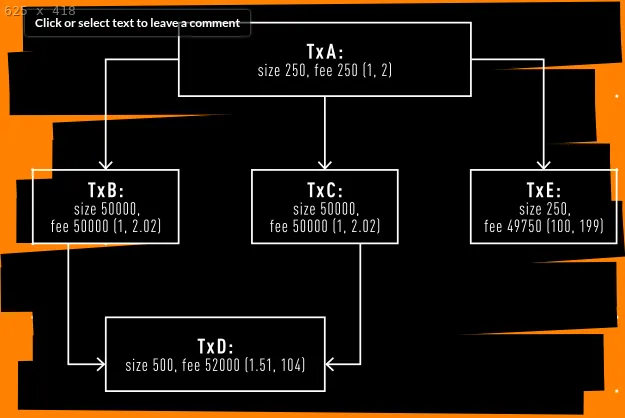
Look at the above example graph of transactions, the feerates are shown as such in parentheses (ancestor feerate, descendant feerate). A miner looking at transaction E would likely include it in the next block, a small transaction paying a very high fee with a single small ancestor. However, if a node’s mempool was filling up, it would look at transaction A with two massive children paying a low relative fee, and likely evict it or not accept and keep it if it was just received. 

See also  Bitcoin Price Fell In 2025, But Lows Show A Strong Floor

These two rankings, or orderings, are completely at odds with each other. The mempool should reliably propagate what miners will mine, and users should be confident that their local mempool accurately predicts what miners will mine. 

The mempool functioning in this way is important for:

  • Mining decentralization: getting all miners the most profitable set of transactions
  • User reliability: accurate and reliable fee estimation and transaction confirmation times
  • Second layer security: reliable and accurate execution of second layer protocols’ on-chain enforcement transactions

The current behavior of the mempool does not fully align with the reality of mining incentives, which creates blind spots that can be problematic for second layer security by creating uncertainty as to whether a transaction will make it to a miner, as well as pressure for non-public broadcasting channels to miners, potentially worsening the first problem. 

This is especially problematic when it comes to replacing unconfirmed transactions, either simply to incentivize miners to include a replacement sooner, or as part of a second layer protocol being enforced on-chain. 

Replacement per the existing behavior becomes unpredictable depending on the shape and size of the web of transactions yours is caught in. In a simple fee-bumping situation this can fail to propagate and replace a transaction, even when mining the replacement would be better for a miner. 

In the context of second layer protocols, the current logic allows participants to potentially get necessary ancestor transactions evicted from the mempool, or make it not possible for another participant to submit a necessary child transaction to the mempool under the current rules because of child transactions the malicious participant created, or the eviction of necessary ancestor transactions. 

All of these problems are the result of these inconsistent inclusion and eviction rankings and the incentive misalignments they create. Having a single global ranking would fix these issues, but globally reordering the entire mempool for every new transaction is impractical. 

It’s All Just A Graph
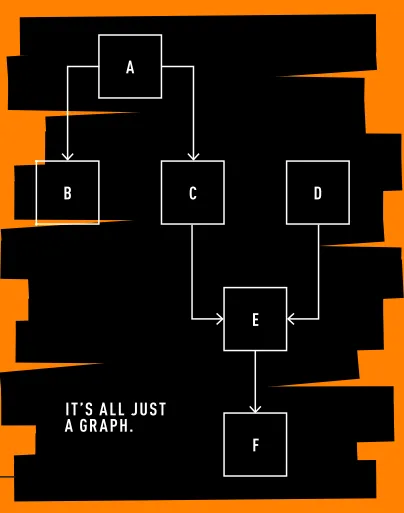
Transactions that depend on each other are a graph, or a directed series of “paths.” When a transaction spends outputs created by another in the past, it is linked with that past transaction. When it additionally spends outputs created by a second past transaction, it links both of the historical transactions together. 

See also  BTC is seeing accumulation across all cohorts, according to Glassnode

When unconfirmed, chains of transactions like this must have the earlier transactions confirmed first for the later ones to be valid. After all, you can’t spend outputs that haven’t been created yet. 

This is an important concept for understanding the mempool, it is explicitly ordered directionally. 

It’s all just a graph. 

Chunks Make Clusters Make Mempools
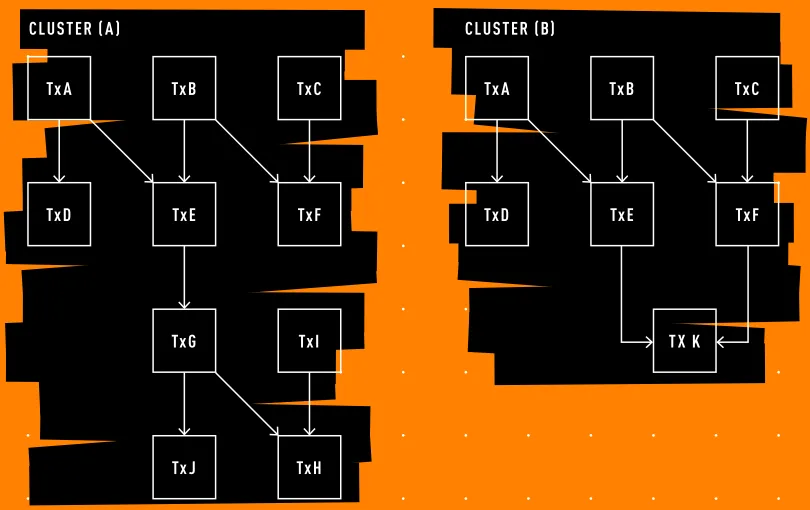
In cluster mempool, the concept of a cluster is a group of unconfirmed transactions that are directly related to each other, i.e. spending outputs created by others in the cluster or vice versa. This becomes a fundamental unit of the new mempool architecture. Analyzing and ordering the entire mempool is an impractical task, but analyzing and ordering clusters is a much more manageable one. 

Each cluster is broken down into chunks, small sets of transactions from the cluster, which are then sorted in order of highest feerate per byte to lowest, respecting the directional dependencies. So for instance, let’s say from highest to lowest feerate the chunks in cluster (A) are: [A,D], [B,E], [C,F], [G, J], and last [I, H]. 

This allows pre-sorting all of these chunks and clusters, and more efficient sorting of the whole mempool in the process. 

Miners can now simply grab the highest feerate chunks from every cluster and put them into their template, if there is still room they can go down to the next highest feerate chunks, continuing until the block is roughly full and just needs to figure out the last few transactions it can fit. This is roughly the optimal block template construction method assuming access to all available transactions. 

When nodes’ mempools get full, they can simply grab the lowest feerate chunks from every cluster, and start evicting those from their mempool until it is not over the configured limit. If that was not enough, it moves on to the next lowest feerate chunks, and so on, until it is within its mempool limits. Done this way it removes strange edge cases out of alignment with mining incentives. 

Replacement logic is also drastically simplified. Compare cluster (A) to cluster (B) where transaction K has replaced G, I, J, and H. The only criteria that needs to be met is the new chunk [K] must have a higher chunk feerate than [G, J] and [I, H], [K] must pay more in total fees than [G, J, I, H], and K cannot go over an upper limit of how many transactions it is replacing. 

See also  How Pseudonymous Reputation and the Dark Web Have Made Cybercrime Easier Than Ever

In a cluster paradigm all of these different uses are in alignment with each other. 

The New Mempool

This new architecture allows us to simplify transaction group limits, removing previous limitations on how many unconfirmed ancestors a transaction in the mempool can have and replacing them with a global cluster limit of 64 transactions and 101 kvB per cluster. 

This limit is necessary in order to keep the computational cost of pre-sorting the clusters and their chunks low enough to be practical for nodes to perform on a constant basis. 

This is the real key insight of cluster mempool. By keeping the chunks and clusters relatively small, you simultaneously make the construction of an optimal block template cheap, simplify transaction replacement logic (fee-bumping) and therefore improve second layer security, and fix eviction logic, all at once. 

No more expensive and slow on the fly computation for template building, or unpredictable behavior in fee-bumping. By fixing the misalignment of incentives in how the mempool was managing transaction organization in different situations, the mempool functions better for everyone. 

Cluster mempool is a project that has been years-long in the making, and will make a material impact on ensuring profitable block templates are open to all miners, that second layer protocols have sound and predictable mempool behaviors to build on, and that Bitcoin can continue functioning as a decentralized monetary system. 

For those interesting in diving deeper into the nitty gritty of how cluster mempool is implemented and works under the hood, here are two Delving Bitcoin threads you can read:

High Level Implementation Overview (With Design Rationale): https://delvingbitcoin.org/t/an-overview-of-the-cluster-mempool-proposal/393 

How Cluster Mempool Feerate Diagrams Work: https://delvingbitcoin.org/t/mempool-incentive-compatibility/553 

Get your copy of The Core Issue today!

Don’t miss your chance to own The Core Issue — featuring articles written by many Core Developers explaining the projects they work on themselves!

This piece is the Letter from the Editor featured in the latest Print edition of Bitcoin Magazine, The Core Issue. We’re sharing it here as an early look at the ideas explored throughout the full issue.

[1] https://github.com/bitcoin/bitcoin/issues/27677 

[2] https://github.com/bitcoin/bitcoin/pull/33629 

Chunks Cluster Easier Mempool Problems
Share. Facebook Twitter Pinterest LinkedIn Tumblr Email

Related Posts

ZachXBT Names Teen Behind $19 Million Crypto Theft Who Flaunted It On Instagram

May 14, 2026

Analyst Says No Reason for Bitcoin Reversal, Sees BTC Approaching Next Resistance Levels – Here Are His Targets

May 14, 2026

70% of long-term holders are in profit as the bitcoin floor hardens

May 13, 2026

What’s Really At Stake In The Market Structure Debate: The BRCA

May 13, 2026
Add A Comment
Leave A Reply Cancel Reply

Top Posts

Michael Saylor Confirmed As A Speaker For Bitcoin 2026

February 25, 2026

What the CLARITY Act Means for NFT Projects: A 2026 Builder’s Guide

May 8, 2026

Stay ahead with the latest crypto news, market updates, blockchain insights, and trends. Your trusted source for everything happening in the digital asset world.


We're social. Connect with us:

Facebook X (Twitter) Instagram Pinterest YouTube
Top Insights

ZachXBT Names Teen Behind $19 Million Crypto Theft Who Flaunted It On Instagram

May 14, 2026

Consensys Urges SEC to Exempt Self-Custody Wallets, Citing Regulatory Gap for 99% of Tokens

May 14, 2026

UBOX Taps ClawWorks to Accelerate Independent AI Agent Economics

May 14, 2026
Get Informed

Subscribe to Updates

Get the latest creative news From Free.cc directly in your Inbox!

  • Contact
  • Privacy Policy
  • Terms & Conditions
  • Disclosure
© 2026 free.cc - All rights reserved.

Type above and press Enter to search. Press Esc to cancel.