

Close Menu
  • Latest News
    • Bitcoin
    • Ethereum
    • Altcoins
    • Meme Coins
  • Tech
    • Blockchain
    • Security and Privacy
  • Web 3
    • Gaming
  • Legal
    • Legal and Regulatory
    • Adoption
  • Analysis
  • Learn
    • Education
    • Wallets and Exchanges
  • Tools
    • Market Overview
    • Exchange Tool
  • INFO@FREE.CC
What's Hot

Michael Saylor’s Strategy adds $255M in Bitcoin – Why markets turn cautious

April 29, 2026

CLARITY Act Misses April Deadline — What That Means for the Industry

April 29, 2026

CLARITY Act stablecoin fight shifts from yield to who captures digital-dollar economics

April 29, 2026
Facebook X (Twitter) Instagram
  • Contact
  • Privacy Policy
  • Terms & Conditions
  • Disclosure
Facebook X (Twitter) Instagram
Free.cc (Free Cryptocurrency)Free.cc (Free Cryptocurrency)
  • Latest News
    1. Bitcoin
    2. Ethereum
    3. Altcoins
    4. Meme Coins
    5. View All

    Michael Saylor’s Strategy adds $255M in Bitcoin – Why markets turn cautious

    April 29, 2026

    BlackRock Brings Tokenized Money Fund to OKX

    April 29, 2026

    Strategic Bitcoin Reserve Announcement Arriving ‘Within Next Few Weeks,’ Says White House Crypto Official

    April 29, 2026

    Microsoft says legacy banks are hitting a breaking point as AI takes over the heavy lifting

    April 28, 2026

    Bitmine’s Ethereum Accumulation Signals A New Corporate Playbook

    April 29, 2026

    Here’s Where It Will Start And End

    April 29, 2026

    Why Are Bitcoin & Ethereum Prices Dropping? What’s Behind Today’s Crypto Market Correction?

    April 28, 2026

    Ethereum Repeats 2021 Price Levels

    April 28, 2026

    Expert Says—Only One Condition Must Be Met

    April 29, 2026

    Binance Ethereum Supply Hits 2020 Levels While Staking Locks A Third: Repricing Ahead?

    April 28, 2026

    Solana Nears Triangle Apex: Is A 10% Breakout Move Coming?

    April 28, 2026

    XRP Price Rejection Sparks Drop, Bulls Lose Short-Term Control

    April 28, 2026

    Meme Coin Market Faces Imbalance as Supply Rises, Demand Falls

    April 4, 2026

    Crypto Interest Rising Toward Meme Coin Sector

    January 9, 2026

    Memes Market Cap Adds $10B in Days: Fresh Capital or Dead-Cat-Bounce?

    January 5, 2026

    Meme Coin Market Surges Past $45B as Shiba Inu, PEPE, BONK Stage 54% Price Pump

    January 4, 2026

    Michael Saylor’s Strategy adds $255M in Bitcoin – Why markets turn cautious

    April 29, 2026

    CLARITY Act Misses April Deadline — What That Means for the Industry

    April 29, 2026

    CLARITY Act stablecoin fight shifts from yield to who captures digital-dollar economics

    April 29, 2026

    Bitmine’s Ethereum Accumulation Signals A New Corporate Playbook

    April 29, 2026
  • Tech
    1. Blockchain
    2. Security and Privacy
    3. View All

    Why moving IP on-chain is right for the entertainment industry

    April 29, 2026

    Binance pushes the ecosystem, but speculation is growing

    April 29, 2026

    Elfa AI Launches Real-Time Agent Execution Platform on Solana

    April 28, 2026

    UXLINK and Decentralized Intelligence (DI) Form Strategic Alliance to Redefine AI-Powered Social Networking

    April 28, 2026

    North Korean Hackers Target Crypto Firms with ClickFix and Zoom Lures

    April 28, 2026

    US Sanctions Target Cambodian Scam Network Leaders

    April 27, 2026

    AI scams in crypto approach breaking point – OpenAI’s new image model shows why they could get worse

    April 27, 2026

    For 93 minutes, installing Bitwarden’s ‘official’ CLI turned laptops into launchpads for hijacking GitHub accounts

    April 24, 2026

    Michael Saylor’s Strategy adds $255M in Bitcoin – Why markets turn cautious

    April 29, 2026

    CLARITY Act Misses April Deadline — What That Means for the Industry

    April 29, 2026

    CLARITY Act stablecoin fight shifts from yield to who captures digital-dollar economics

    April 29, 2026

    Bitmine’s Ethereum Accumulation Signals A New Corporate Playbook

    April 29, 2026
  • Web 3
    1. Gaming
    2. View All

    B.AI and CROSS Transform the Future of AI in Web3 Gaming

    April 28, 2026

    How to Tokenize Assets: A Complete Guide for Beginners and Businesses

    April 27, 2026

    Tomoland Partners With Anome Protocol To Advance Web3 Gaming Engagement With DeFi Applications

    April 25, 2026

    KuCoin Launches KuCard in Australia, Expanding Real-World Crypto Payments

    April 24, 2026

    Michael Saylor’s Strategy adds $255M in Bitcoin – Why markets turn cautious

    April 29, 2026

    CLARITY Act Misses April Deadline — What That Means for the Industry

    April 29, 2026

    CLARITY Act stablecoin fight shifts from yield to who captures digital-dollar economics

    April 29, 2026

    Bitmine’s Ethereum Accumulation Signals A New Corporate Playbook

    April 29, 2026
  • Legal
    1. Legal and Regulatory
    2. Adoption
    3. View All

    CLARITY Act Misses April Deadline — What That Means for the Industry

    April 29, 2026

    South Africa Crypto Draft Triggers 1M Rand Fine Warning From Valr CEO

    April 29, 2026

    US CLARITY Act will ‘get done’ in May, says Mike Novogratz

    April 28, 2026

    ‘Project Crypto’—Why Atkins Could Suddenly Push Bitcoin Past $80K

    April 28, 2026

    What would Satoshi say? Director of the FBI appears at Bitcoin 2026

    April 29, 2026

    The South Korean bank powering Upbit is testing Ripple integration for cross-border payments

    April 28, 2026

    Hong Kong targets 10,000 BTC in purchases for Asia’s first regulated Bitcoin capital pool

    April 26, 2026

    DeFi losses are now 8,500% higher than TradFi breaches per dollar moved

    April 25, 2026

    Michael Saylor’s Strategy adds $255M in Bitcoin – Why markets turn cautious

    April 29, 2026

    CLARITY Act Misses April Deadline — What That Means for the Industry

    April 29, 2026

    CLARITY Act stablecoin fight shifts from yield to who captures digital-dollar economics

    April 29, 2026

    Bitmine’s Ethereum Accumulation Signals A New Corporate Playbook

    April 29, 2026
  • Analysis

    UB Price Breakout Gains Steam After OKX Listing Sparks Volatility

    April 28, 2026

    Fundstrat’s Tom Lee Outlines Roadmap for S&P 500 To Reach 7,700 This Year

    April 28, 2026

    Humanity Protocol (H) Price Surges as AI Narrative Fuels Breakout Momentum

    April 28, 2026

    Will $1.35 Hold or Break?

    April 28, 2026

    Worldcoin (WLD) Price Down 97% From ATH — Top Reasons Why the Downtrend Still Isn’t Over

    April 28, 2026
  • Learn
    1. Education
    2. Wallets and Exchanges
    3. View All

    What’s on the Ethereum Roadmap: Glamsterdam, Hegota and Beyond

    March 30, 2026

    What Is Bluesky? The Decentralized Social Media Rival to Elon Musk’s X

    March 27, 2026

    What Is Strategy (MSTR)? The Bitcoin Treasury Company

    February 21, 2026

    What Are Prediction Markets? How Polymarket, Kalshi and Myriad Work

    February 13, 2026

    CLARITY Act stablecoin fight shifts from yield to who captures digital-dollar economics

    April 29, 2026

    Over 80% of Bitcoin ETF assets hit Coinbase custody choke point with $74B at risk

    April 13, 2026

    FTX begins $2.2B payout. Can Bitcoin absorb another liquidity test?

    March 31, 2026

    BlinkEx investment platform infrastructure – matching, risk controls, reliability

    March 21, 2026

    Michael Saylor’s Strategy adds $255M in Bitcoin – Why markets turn cautious

    April 29, 2026

    CLARITY Act Misses April Deadline — What That Means for the Industry

    April 29, 2026

    CLARITY Act stablecoin fight shifts from yield to who captures digital-dollar economics

    April 29, 2026

    Bitmine’s Ethereum Accumulation Signals A New Corporate Playbook

    April 29, 2026
  • Tools
    • Market Overview
    • Exchange Tool
  • INFO@FREE.CC
Free.cc (Free Cryptocurrency)Free.cc (Free Cryptocurrency)
Home»Wallets and Exchanges»CLARITY Act stablecoin fight shifts from yield to who captures digital-dollar economics
Wallets and Exchanges

CLARITY Act stablecoin fight shifts from yield to who captures digital-dollar economics

April 29, 2026No Comments9 Mins Read
Share
Facebook Twitter LinkedIn Pinterest Email
Make CryptoSlate preferred on

Washington is turning stablecoins into regulated payment instruments while trying to keep issuer-paid yield away from holders. That combination changesthe economics of digital dollars and puts the value of user balances up for grabs across the intermediary stack.

The GENIUS Act bars permitted payment stablecoin issuers and foreign payment stablecoin issuers from paying holders any form of interest or yield solely for holding, using, or retaining a payment stablecoin.

The FDIC’s April 7 proposal would turn parts of that law into operating standards for FDIC-supervised issuers, including reserves, redemption, capital, risk management, custody, pass-through insurance, and tokenized-deposit treatment.

That leaves a practical question for a market that reached roughly $320 billion in stablecoin supply in mid-April. If holders cannot receive direct issuer-paid yield, the value created by tokenized dollars still has to land somewhere.

The redistribution runs through the operating stack. The fight shifts to issuers, exchanges, wallets, custodians, banks, asset managers, card networks, and tokenized-deposit providers. They are the parties positioned to collect reserve income, distribution payments, custody fees, payment fees, settlement benefits, loyalty economics, or deposit economics.
Infographic mapping five stablecoin intermediaries that can capture digital dollar economics after a direct issuer-paid yield ban.

The rulebook pushes yield into the plumbing

The stablecoin framework begins with reserves. GENIUS requires permitted issuers to maintain identifiable reserves backing outstanding payment stablecoins at least 1:1, with reserve categories that include cash, bank deposits, short-term Treasuries, certain repo arrangements, government money market funds, and limited tokenized reserve forms.

It also requires reserve disclosures and redemption policies, restricts reserve reuse, and calls for capital, liquidity, risk management, AML, and sanctions controls.

That makes compliant payment stablecoins look more like regulated cash-management products than free-form crypto instruments. Issuers can hold large pools of income-producing assets. At the same time, the statute blocks those issuers from paying stablecoin holders direct interest or yield merely for holding or using the token.

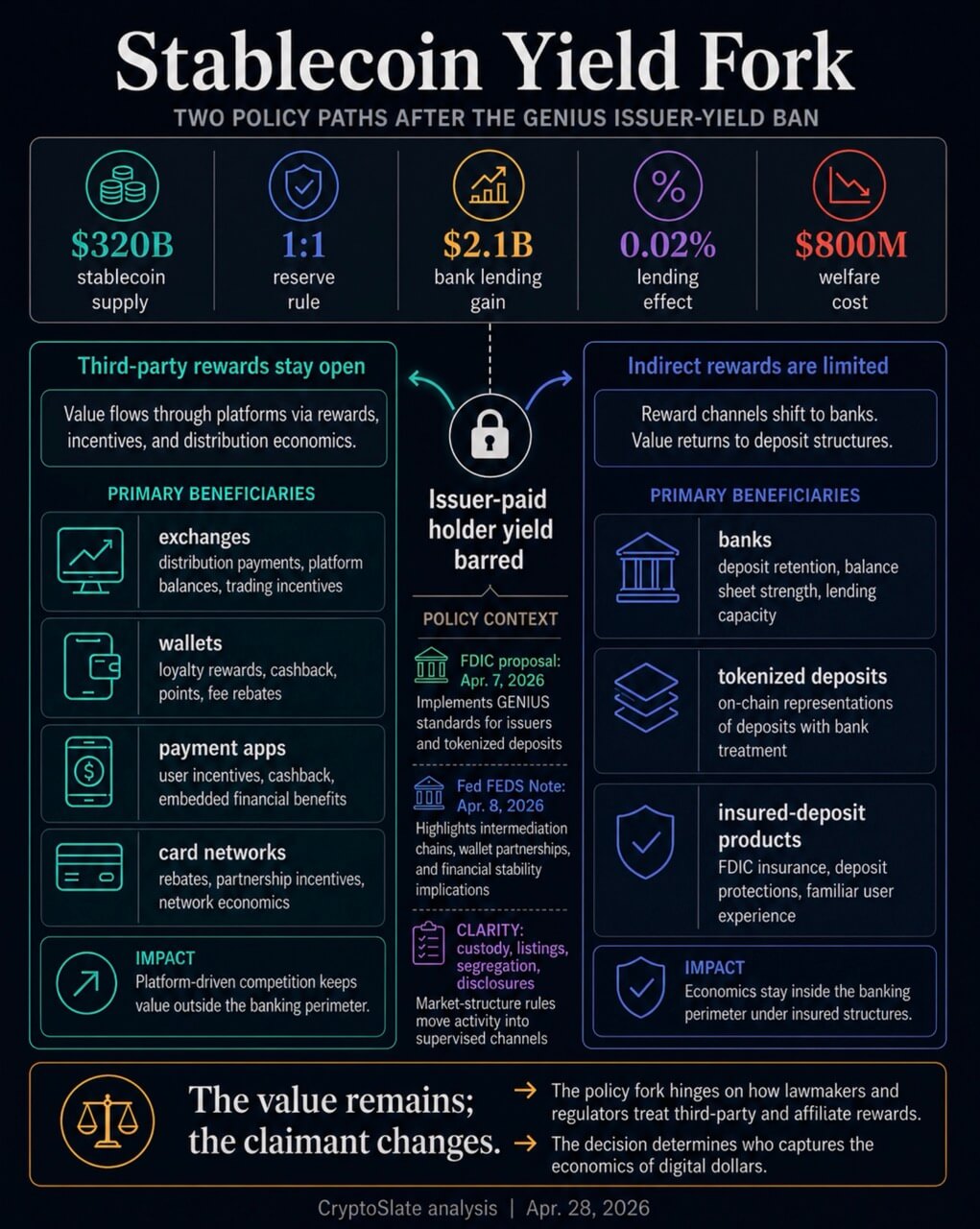
The economic trade-off looked uneven in the White House’s April 8 yield-prohibition note, which estimated a baseline $2.1 billion increase in bank lending from eliminating stablecoin yield, equal to a 0.02% lending effect, alongside an $800 million net welfare cost.

The same note said affiliate or third-party arrangements could remain unless CLARITY variants close that channel.

White House exposes stablecoin yield ban wouldn't help banks, raising the stakes for CLARITY in the Senate
Related Reading

White House exposes stablecoin yield ban wouldn’t help banks, raising the stakes for CLARITY in the Senate

The report’s own projections show the ban barely nudges bank lending while putting stablecoin innovation and consumer yields on the line.

Apr 15, 2026 · Liam ‘Akiba’ Wright

That caveat is where the post-CLARITY money map starts. A direct issuer-yield ban controls the issuer-holder relationship. It leaves open the harder economic question of how platforms, partners, payment apps, and bank structures treat the same value once it moves through distribution or product design.

CryptoSlate has already explored how the CLARITY fight is tied to stablecoin yield, regulatory control, market structure, and banking-sector pressure.

See also  zkSync Lite to shut down next year as ecosystem shifts to next-generation ZK systems

The commercial layer asks whether the law captures only the obvious form of yield, or also the ways a platform can turn stablecoin economics into something that feels like rewards, pricing power, or bundled financial service access.

The split runs through two layers. One side of the stack is statutory and prudential: reserve assets, redemption rights, capital standards, and supervision. The other side is commercial: distribution, wallet placement, exchange balances, merchant pricing, and settlement liquidity.

The policy debate becomes sharper when those layers are separated, because a ban at the issuer level can still leave value moving through the rest of the stack.

Issuers and exchanges already show the money trail

One clear example is USDC. Circle’s public filings describe a business built around reserve income, distribution costs, and partner economics. Its 2025 Form 10-K says Coinbase supports USDC usage across key products and that Circle makes payments to Coinbase tied principally to net reserve income from USDC.

The mechanics are more explicit in Circle’s S-1/A. The payment base is generated from reserves backing the stablecoin after management fees and other expenses.

Circle keeps an issuer portion, Circle and Coinbase receive allocations tied to stablecoins held in their own custodial products or managed wallets, and Coinbase receives 50% of the remaining payment base after approved participant payments.

That structure is the money map in miniature. A holder may see a stable dollar token. In the reserve and distribution structure, the reserve yield can move through issuer retention, platform-balance economics, ecosystem incentives, distribution agreements, and payments to approved participants.

Coinbase’s own filing shows why that channel is economically meaningful. Its 2025 Form 10-K reported stablecoin revenue as a business line and said a hypothetical 150 basis-point move in average rates applied to daily USDC reserve balances held by Circle would have affected stablecoin revenue by $540 million for 2025.

The point is specific: a large platform with distribution, balances, liquidity, and a deep issuer relationship can capture economics that the statute keeps away from holders in direct form.

Asset managers and custodial infrastructure sit on the same map. BlackRock’s Circle Reserve Fund showed a 3.60% seven-day SEC yield as of April 27, while Circle’s filing describes BlackRock as a preferred reserve-management partner and discusses the reserve-management relationship.

Stablecoin economics can accrue to the reserve stack, the manager, the custodian, the issuer, and the distributor before a user ever sees a token in a wallet.

Intermediary Economic lane User-facing form Policy constraint
Issuer Reserve income and issuance scale Stable dollar token and redemption promise Issuer-paid holder yield is barred under GENIUS
Exchange or wallet Distribution payments, platform balances, loyalty incentives Rewards, fee offsets, product access, liquidity Third-party reward treatment remains the live CLARITY fork
Custodian or asset manager Reserve management, custody, safekeeping Operational trust and reserve transparency FDIC and issuer rules shape permitted reserve and custody practices
Payment network or app Merchant fees, settlement speed, treasury operations Cheaper payments, faster settlement, rewards programs Payment integration raises intermediation and resiliency questions
Bank or tokenized-deposit provider Deposit economics and insured-bank balance-sheet activity Deposit-like digital dollars with bank treatment FDIC says qualifying tokenized deposits would be treated as deposits
See also  Stablecoin yield debate stalls congressional crypto bill progress

Wallets and payment rails turn yield into product economics

The Fed’s April 8 FEDS Note gives the policy version of that table. It identifies complex intermediation chains, vertical integration, and accelerating retail adoption through wallet partnerships as structural stablecoin vulnerabilities.

It also points to integration with payment networks, banks, retail applications, broker-dealer funding, and card networks.

The Fed is studying a market where the issuer is only one node. Wallet providers, infrastructure firms, payment processors, brokers, banks, and card networks can all sit between the reserve asset and the user experience.

PayPal’s July 2025 Pay with Crypto announcement shows how that looks commercially.

The company described instant crypto-to-stablecoin or fiat conversion, a 0.99% merchant transaction rate through July 31, 2026, support for more than 100 cryptocurrencies and wallets, and PYUSD rewards for funds held on PayPal at the time of the announcement.

CryptoSlate Daily Brief

Daily signals, zero noise.

Market-moving headlines and context delivered every morning in one tight read.

5-minute digest 100k+ readers

Free. No spam. Unsubscribe any time.

Whoops, looks like there was a problem. Please try again.

You’re subscribed. Welcome aboard.

That is a different economic shape from direct issuer yield. The holder sees payment access, merchant savings, wallet connectivity, or rewards attached to a platform. The platform can monetize conversion, distribution, customer balances, merchant pricing, and product stickiness.

Visa’s December 2025 USDC settlement launch shows the card-network version of the same intermediary lane. Visa said U.S. issuer and acquirer partners could settle VisaNet obligations in USDC, with Cross River and Lead Bank among initial banking participants.

It described more than $3.5 billion in annualized stablecoin settlement volume as of Nov. 30, 2025, and framed the product around seven-day settlement, liquidity timing, treasury automation, and operational resiliency.

Those benefits accrue through payment networks, issuing banks, acquiring banks, fintech partners, and corporate treasury operations. The user-facing return is payment access, faster settlement, or better pricing rather than issuer-paid yield.

That distinction is central to the policy fight. A yield ban can reduce the visible consumer return on a token while allowing platforms to compete through pricing, access, loyalty, and settlement benefits. The economics remain, but the claim on them becomes mediated by the platform relationship.

Banks gain leverage if the third-party channel closes

The banking lobby understands that channel. The Bank Policy Institute argued in August 2025 that GENIUS’s issuer-yield prohibition could be undermined if exchanges, affiliates, or distribution partners are still able to pay interest indirectly on stablecoins.

See also  Score Big with BTCC's Ultimate $500K Trading Competition Featuring NBA Star Jaren Jackson Jr.

BPI framed that as a loophole that could increase deposit-flight risk and weaken credit creation.

Crypto trade groups answered from the other side. Their August 2025 response argued that third-party rewards are competitive consumer benefits rather than evasion of the statute.

The US Senate could wipe out $6 billion in crypto rewards this week by closing one specific loophole
Related Reading

The US Senate could wipe out $6 billion in crypto rewards this week by closing one specific loophole

Banks want the “affiliate loophole” closed; exchanges say that turns lawful loyalty incentives into an illegal end-run overnight.

Jan 13, 2026 · Gino Matos

The dispute determines whether the post-GENIUS stablecoin market becomes a platform-rewards market or a bank-protected payments market.

The FDIC proposal adds the second bank lane. It says tokenized deposits that satisfy the statutory definition of deposit would be treated no differently from other deposits under the Federal Deposit Insurance Act.

That gives banks a cleaner argument if stablecoin rewards face stricter limits: deposit tokens can keep the economics inside the banking perimeter, where interest, insurance, and lending relationships already have a legal home.

JPMorgan reveals global regulators favor tokenized bank deposits over stablecoins
Related Reading

JPMorgan reveals global regulators favor tokenized bank deposits over stablecoins

According to the lender, regulators see tokenized bank deposits as safer digital currency alternative to stablecoins amid crypto volatility concerns.

Jul 18, 2025 · Assad Jafri

CLARITY’s market-structure section-by-section summary points to another intermediary layer. Digital commodity exchanges, brokers, and dealers would face registration, listing, custody, segregation, disclosure, and customer-election requirements.

Customers could elect into blockchain services such as staking under conditions, while access to the exchange could not be conditioned on that election.

Those provisions reinforce the same intermediary shift by moving economic activity into supervised channels. The contested issue is who owns distribution, customer balances, wallet access, custody, settlement, and optional services.

Infographic showing two policy paths for stablecoin rewards, with platform rewards on one side and bank or tokenized-deposit products on the other.

As of press time, USDT was around $189.71 billion in market capitalization and USDC around $77.63 billion.

CryptoSlate rankings also showed USDe around $3.79 billion, PYUSD around $3.42 billion, and RLUSD around $1.6 billion. That scale means the issuer-yield rule lands first on the largest payment-stablecoin rails.

The next test is the definition of indirect yield. If lawmakers and regulators allow third-party rewards, the advantage sits with platforms that own users, balances, payments, and distribution. If they limit those arrangements, banks and tokenized-deposit providers get a stronger path to keep digital-dollar returns inside deposit products.

The emerging U.S. framework decides whether stablecoin holders can receive yield and how much of the economics of digital dollars becomes visible to users. The rest is absorbed by the intermediaries that move, custody, package, and settle those dollars.

Act captures clarity digitaldollar Economics fight Shifts Stablecoin Yield
Share. Facebook Twitter Pinterest LinkedIn Tumblr Email

Related Posts

CLARITY Act Misses April Deadline — What That Means for the Industry

April 29, 2026

US CLARITY Act will ‘get done’ in May, says Mike Novogratz

April 28, 2026

BNB Chain Stablecoin Supply Surges 200% to $13.9 Billion

April 28, 2026

NC Industry Group pushes Clarity Act forward, warning stablecoin yield ban could drive capital offshore

April 28, 2026
Add A Comment
Leave A Reply Cancel Reply

Top Posts

Bittensor (TAO) Price Heats Up — Why Reaching $500 Could Be Just the Start of a Bull Run

March 25, 2026

Solana Sell-Off Cools as SOL Price Defends Support—A Recovery Depends on This Level

December 10, 2025

Stay ahead with the latest crypto news, market updates, blockchain insights, and trends. Your trusted source for everything happening in the digital asset world.


We're social. Connect with us:

Facebook X (Twitter) Instagram Pinterest YouTube
Top Insights

Michael Saylor’s Strategy adds $255M in Bitcoin – Why markets turn cautious

April 29, 2026

CLARITY Act Misses April Deadline — What That Means for the Industry

April 29, 2026

CLARITY Act stablecoin fight shifts from yield to who captures digital-dollar economics

April 29, 2026
Get Informed

Subscribe to Updates

Get the latest creative news From Free.cc directly in your Inbox!

  • Contact
  • Privacy Policy
  • Terms & Conditions
  • Disclosure
© 2026 free.cc - All rights reserved.

Type above and press Enter to search. Press Esc to cancel.