

Close Menu
  • Latest News
    • Bitcoin
    • Ethereum
    • Altcoins
    • Meme Coins
  • Tech
    • Blockchain
    • Security and Privacy
  • Web 3
    • Gaming
  • Legal
    • Legal and Regulatory
    • Adoption
  • Analysis
  • Learn
    • Education
    • Wallets and Exchanges
  • Tools
    • Market Overview
    • Exchange Tool
What's Hot

New SIMD-0675 Proposal Aims to Streamline Block Production

October 3, 2026

New SEC crypto rules threaten small advisers, but big firms win

October 3, 2026

Bitcoin Is Up, DeFi Is Recovering, So Why Doesn’t This Look Like a Bull Market Yet?

October 3, 2026
Facebook X (Twitter) Instagram
  • Contact
  • Privacy Policy
  • Terms & Conditions
  • Disclosure
Facebook X (Twitter) Instagram
Free.cc (Free Cryptocurrency)Free.cc (Free Cryptocurrency)
  • Latest News
    1. Bitcoin
    2. Ethereum
    3. Altcoins
    4. Meme Coins
    5. View All

    Bitcoin Is Up, DeFi Is Recovering, So Why Doesn’t This Look Like a Bull Market Yet?

    October 3, 2026

    Bank group sues U.S. regulator over granting crypto trust charters

    October 3, 2026

    When The Banks Don’t Work, Bitcoin Does: Report

    October 3, 2026

    Bitcoin clears $85K, but is ‘Uptober’ setting up a bull trap?

    October 3, 2026

    Ethereum: Why ETH faces October reversal risk after 70% Q3 rally

    October 3, 2026

    Why Did Blast Decide to Wind Down Its L2?

    October 2, 2026

    Bitcoin Q3 Strength Faces a Tougher Q4 Test

    October 1, 2026

    Ethereum beats Bitcoin by 42.71% in Q3 – Can ETH do it again?

    October 1, 2026

    Can NEAR crypto rebound? THESE metrics could decide what’s next

    October 3, 2026

    Polymath And CineCity Explore Regulated Tokenized Film Investment Platform

    October 3, 2026

    XLM price prediction – Why Stellar’s $0.21 rebound could trigger a 9% rally

    October 2, 2026

    XRP’s $1.54 breakout test meets Ripple’s 1B token unlock – Can demand absorb supply?

    October 2, 2026

    Thinking Cat Gains Momentum After CASHCAT’s Breakout

    August 12, 2026

    What Tokens Could He Target?

    July 30, 2026

    The Next Meme Coin Winner Could Be Determined by Incentives, Not Memes

    July 30, 2026

    Why Is BOME’s Price Up Today? Finally, Capital Rotating to the Meme Coins?

    July 28, 2026

    New SIMD-0675 Proposal Aims to Streamline Block Production

    October 3, 2026

    New SEC crypto rules threaten small advisers, but big firms win

    October 3, 2026

    Bitcoin Is Up, DeFi Is Recovering, So Why Doesn’t This Look Like a Bull Market Yet?

    October 3, 2026

    Daines Unveils Crypto Tax Bill Pairing Payment Relief With Wash-Sale Rules

    October 3, 2026
  • Tech
    1. Blockchain
    2. Security and Privacy
    3. View All

    New SIMD-0675 Proposal Aims to Streamline Block Production

    October 3, 2026

    State Street Fund Goes Live on Stellar

    October 3, 2026

    Blockchains Unlock an Explosion of New Markets

    October 3, 2026

    Cloak Launches Payroll Feature for Private Onchain

    October 2, 2026

    Masked Robbers Threaten Pregnant Wife in UK Crypto Home Attack

    October 3, 2026

    Bitcoin Lightning Nodes Targeted as Core Lightning Sounds Alarm

    October 2, 2026

    The $459,000 Bot Hacker Was a Customer First, Researchers Say

    October 2, 2026

    Metamask Pulls Validators as Meager ETH Theft Sounds Big Alarm

    October 2, 2026

    New SIMD-0675 Proposal Aims to Streamline Block Production

    October 3, 2026

    New SEC crypto rules threaten small advisers, but big firms win

    October 3, 2026

    Bitcoin Is Up, DeFi Is Recovering, So Why Doesn’t This Look Like a Bull Market Yet?

    October 3, 2026

    Daines Unveils Crypto Tax Bill Pairing Payment Relief With Wash-Sale Rules

    October 3, 2026
  • Web 3
    1. Gaming
    2. View All

    Top 12 NFT games every player should know about in August 2026

    September 22, 2026

    GameShame Studios founder details Raijin Protocol’s roadmap in NeoPod’s sixth AMA

    September 22, 2026

    Proof of Play to shut down after blockchain gaming thesis falls short

    September 22, 2026

    How BC.GAME is turning players into stakeholders

    September 22, 2026

    New SIMD-0675 Proposal Aims to Streamline Block Production

    October 3, 2026

    New SEC crypto rules threaten small advisers, but big firms win

    October 3, 2026

    Bitcoin Is Up, DeFi Is Recovering, So Why Doesn’t This Look Like a Bull Market Yet?

    October 3, 2026

    Daines Unveils Crypto Tax Bill Pairing Payment Relief With Wash-Sale Rules

    October 3, 2026
  • Legal
    1. Legal and Regulatory
    2. Adoption
    3. View All

    New SEC crypto rules threaten small advisers, but big firms win

    October 3, 2026

    Daines Unveils Crypto Tax Bill Pairing Payment Relief With Wash-Sale Rules

    October 3, 2026

    Tax on Bitcoin Gains? Dutch Government to Introduce Capital Gains Tax From 2028

    October 3, 2026

    Bitwise CIO says Clarity Act failure gave crypto ‘better rules faster’

    October 3, 2026

    Stablecoin issuers have replaced 40% of China’s lost US Treasury demand

    October 3, 2026

    Bitcoin’s $113,000 case strengthens as US regulators push 9 crypto actions

    October 2, 2026

    Bitget restores $300M fund after absorbing $388M security breach

    October 2, 2026

    Ripple’s biggest institutional bet may now be Brazil

    October 1, 2026

    New SIMD-0675 Proposal Aims to Streamline Block Production

    October 3, 2026

    New SEC crypto rules threaten small advisers, but big firms win

    October 3, 2026

    Bitcoin Is Up, DeFi Is Recovering, So Why Doesn’t This Look Like a Bull Market Yet?

    October 3, 2026

    Daines Unveils Crypto Tax Bill Pairing Payment Relief With Wash-Sale Rules

    October 3, 2026
  • Analysis

    Bull Market Targets for BTC, ETH, SOL, and XRP

    October 3, 2026

    Ethereum Price Faces A Critical $0.040 ETH/BTC Test

    October 2, 2026

    AAVE Price Surges 8% as Whale Activity Spikes — Can AAVE Break $200?

    October 2, 2026

    PropAMMs lower Solana trade costs, and public pool returns crash

    October 2, 2026

    Wall Street arrived in NEAR just as a $4 billion-a-month app got hacked

    October 2, 2026
  • Learn
    1. Education
    2. Wallets and Exchanges
    3. View All

    What Is Robinhood Chain? The Ethereum Layer-2 Network for Tokenized Stocks

    July 12, 2026

    What Is BChat? The Decentralized Messaging App Built for Privacy

    June 2, 2026

    What Is an AI Prompt Injection Attack? The Hidden Threat Hijacking Your Chatbots

    May 31, 2026

    What Is AI Jailbreaking? A Beginner’s Guide to the Cat-and-Mouse Game Behind Every Chatbot

    May 17, 2026

    Coinbase completes Deribit migration, ends INTX trading

    October 2, 2026

    Binance Funding Account ends direct crypto deposits

    October 1, 2026

    Coinbase just completed its US derivatives stack but its biggest bet still sits outside it

    September 30, 2026

    Bitget had 30 minutes to contain its hack before $290 million started moving

    September 30, 2026

    New SIMD-0675 Proposal Aims to Streamline Block Production

    October 3, 2026

    New SEC crypto rules threaten small advisers, but big firms win

    October 3, 2026

    Bitcoin Is Up, DeFi Is Recovering, So Why Doesn’t This Look Like a Bull Market Yet?

    October 3, 2026

    Daines Unveils Crypto Tax Bill Pairing Payment Relief With Wash-Sale Rules

    October 3, 2026
  • Tools
    • Market Overview
    • Exchange Tool
Free.cc (Free Cryptocurrency)Free.cc (Free Cryptocurrency)
Home»Analysis»Bitcoin quantum computing risk hits exchange wallets
Analysis

Bitcoin quantum computing risk hits exchange wallets

May 21, 2026No Comments5 Mins Read
Share
Facebook Twitter LinkedIn Pinterest Email
Make CryptoSlate logo CryptoSlate preferred on Google logo

Cryptocurrency exchanges are emerging as the clearest pressure point in Bitcoin’s long-running debate over quantum computing risk, sitting on millions of coins with publicly visible cryptographic keys.

Bitcoin quantum risk begins with a fundamental feature of its transaction verification: public keys are hidden until funds are spent.

Once a wallet signs a transaction, the public key required to verify that signature is permanently published to the blockchain. The risk compounds when a custodian reuses that address, leaves remaining balances in it, or continues directing deposits to wallets that should have been retired.

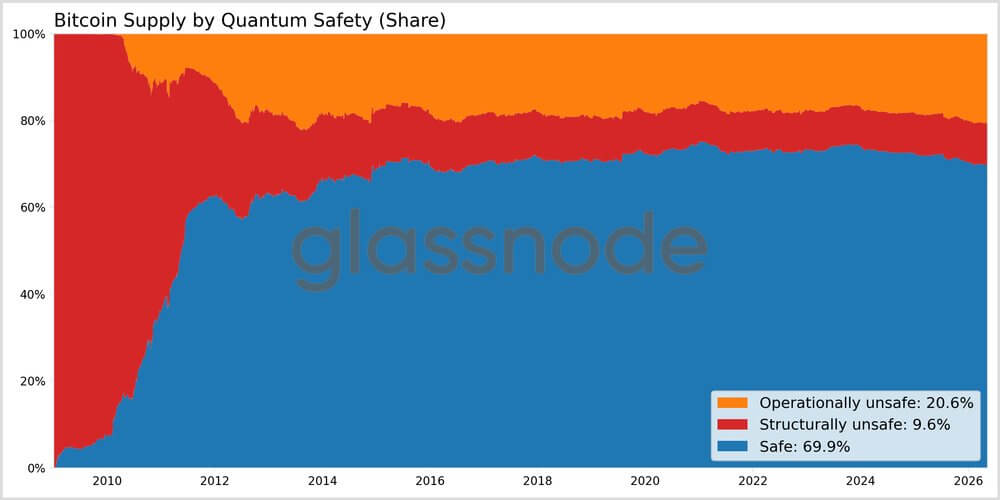
That exposure has reached a massive scale, with Glassnode noting that about 6.04 million Bitcoin, representing 30.2% of the asset’s circulating supply, are currently held in wallets with exposed public keys.
Bitcoin SUpply by quantum Safety
Bitcoin Supply by Quantum Safety (Source: Glassnode)

In Glassnode’s framework, public key exposure becomes the core metric for identifying wallets that would matter most in a future quantum-attack scenario.

The data does not imply an immediate threat because quantum computers remain years away from the scale required to break Bitcoin’s encryption.

However, the metric reveals exactly where the network’s vulnerabilities are concentrated if advances in quantum hardware eventually make public-key exposure a practical security concern.

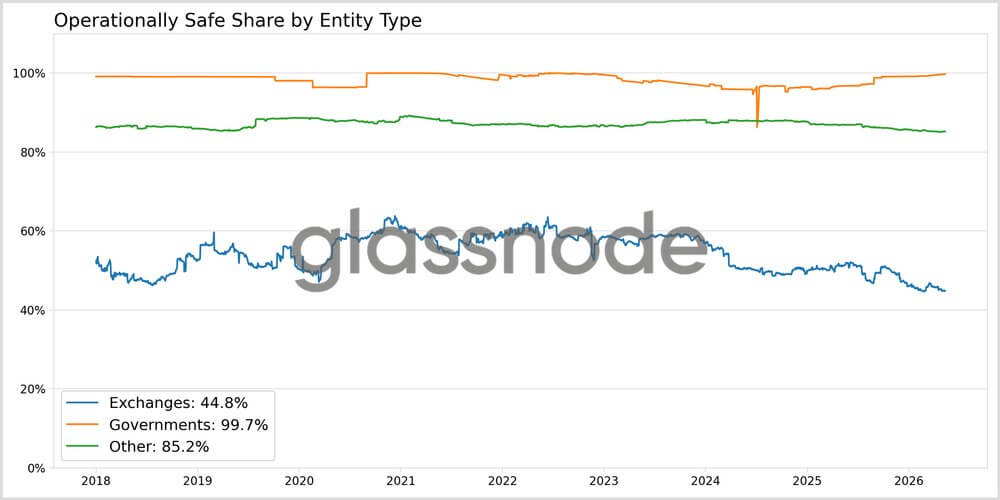
According to Glassnode, roughly half of all Bitcoin held by labeled exchanges is susceptible under the firm’s public-key visibility framework, compared with less than 30% of the non-exchange supply.

Notably, the exposure breaks down into two distinct categories, with the largest being operational risk.

This bucket covers 4.12 million Bitcoin and is tied directly to poor wallet management decisions, such as address reuse and partial spending without proper rotation of change outputs. Exchanges account for a significant portion of this risk, holding about 1.66 million exposed Bitcoin, equal to more than 8% of the total issued supply.

See also  TRX Price Eyes Breakout as Tron Enters U.S. Regulatory Perimeter

Moreover, data suggests custody standards are slipping as trading platforms expand their wallet infrastructure, deposit systems, and liquidity operations. The share of exchange-held Bitcoin considered operationally safe has steadily fallen from about 55% in 2018 to roughly 45% today.
That makes Bitcoin wallet security a measurable custody issue rather than a theoretical protocol debate.
Quantum Computing operationally Safe Bitcoin Wallets
Quantum Computing operationally Safe Bitcoin Wallets (Source: Glassnode)

Crypto exchanges vs Wall Street vs Sovereign wallets

A broader look at the data reveals that public-key exposure is wildly uneven across the global financial landscape, fracturing sharply along the lines of crypto-native platforms, traditional Wall Street institutions, and nation-states.

The clearest gap appears in crypto exchange wallets, where address reuse and legacy infrastructure leave large balances more visible on-chain.

Within the crypto sector alone, security standards vary drastically.

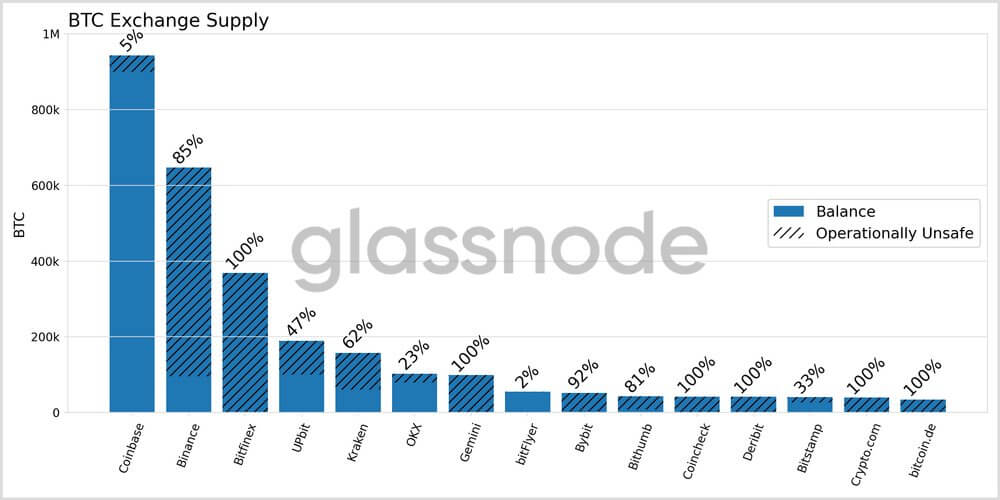
Binance, the world’s largest crypto exchange by volume, holds 85% of its labeled Bitcoin balances in addresses where public keys have already been revealed, Glassnode found.

With users holding more than $40 billion in Bitcoin on the platform, per DeFiLlama data, that methodology places over $34 billion of those assets squarely in the exposed category.

Meanwhile, other major trading venues show even higher concentrations. Bitfinex, Crypto.com, and Gemini each have 100% of their labeled Bitcoin balances classified as exposed.
Crypto Exchanges Quantum Computing Exposure
Crypto Exchanges Quantum Computing Exposure (Source: Glassnode)

Coinbase, the largest US-based exchange, sits at the opposite end of the spectrum. The Brian Amrstong-led firm carries public-key exposure on just 5% of its Bitcoin reserves, placing it among the strongest large-scale custodians in the report.

Meanwhile, that same custody divide is glaringly apparent when comparing crypto exchanges to traditional finance heavyweights and retail-focused platforms.

See also  UNI Price Rally Could Have More Room After Q3 Breakout

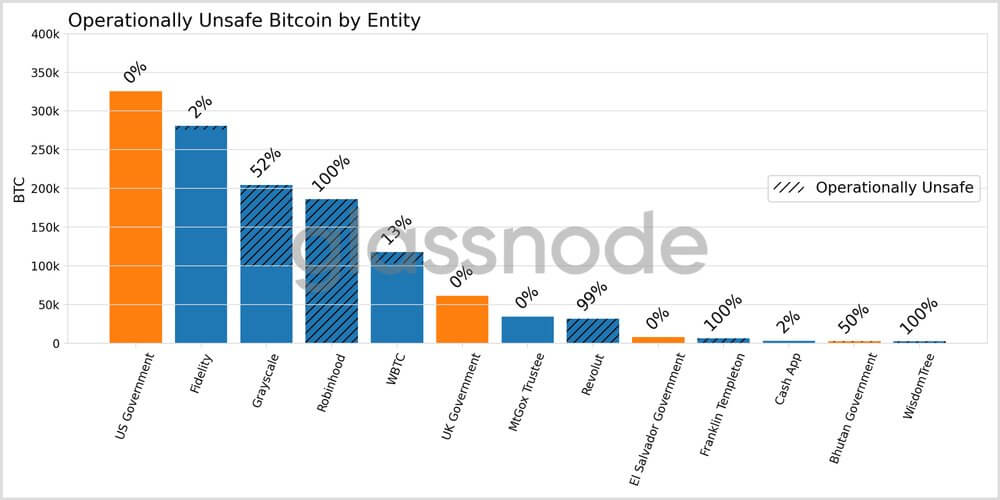
Bitcoin ETF issuers like Fidelity maintain exposure levels near 2%, while rivals like Grayscale and WisdomTree have exposure levels of around 50% and 100%, respectively.

CryptoSlate Daily Brief

Daily signals, zero noise.

Market-moving headlines and context delivered every morning in one tight read.

5-minute digest 100k+ readers

Free. No spam. Unsubscribe any time.

Whoops, looks like there was a problem. Please try again.

You’re subscribed. Welcome aboard.

Other platforms, like Block’s Cash App, align with industry best practices, while Robinhood and Revolut flag nearly 100% exposure in their labeled wallets.
Bitcoin Supply QUantum Exposure by ENtity
Bitcoin Supply Quantum Exposure by Entity (Source: Glassnode)

Government actors, meanwhile, display the strictest cryptographic hygiene of all. Wallets tied to the United States, the United Kingdom, and El Salvador have maintained zero quantum exposure, boasting safety rates above 99% for several years.

The split across these platforms confirms that the vulnerability stems from internal wallet architecture and address rotation policies, rather than from the inherent burden of managing massive liquidity.

A slow Bitcoin upgrade leaves exchanges with the first move

While the timeline for a quantum-capable attack remains fiercely debated, Glassnode’s data makes one thing clear: the crypto industry’s most immediate defense lies in basic operational hygiene, not protocol-level overhauls.

By separating the exposed supply into structural and operational categories, the data highlights that operational exposure, the largest vulnerability, can be drastically reduced without waiting for a complex change to Bitcoin’s consensus rules.

This means that trading platforms can immediately lower their risk profile simply by moving balances to fresh addresses, retiring used wallets, and tightening internal controls around change outputs.

See also  Bloomberg Analyst Mike McGlone Predicts Massive ‘Flippening,’ Says USDT Will Overtake Ethereum and Bitcoin

This gives custodians a direct path to secure customer funds while the broader Bitcoin community debates longer-term cryptographic solutions.

Notably, Bitcoin itself cannot be refitted overnight. So any systemic migration to post-quantum signatures would require massive coordination across developers, miners, node operators, wallet providers, and custodians.

Given that consensus changes are intentionally slow, a broad cryptographic transition would likely unfold over several years.

Exchanges, however, have a much shorter path available to them right now.

As Bitcoin becomes increasingly embedded in spot ETFs, traditional brokerage accounts, and institutional custody products, the first line of defense against future quantum threats will not come from code upgrades, but from the entities holding the largest pools of customer coins.

Wallet hygiene is no longer a back-office detail; it is a highly visible test of whether Bitcoin’s custodial layer is prepared for a threat that, while uncertain in its timing, is already measurable on-chain.

Bitcoin quantum computing risk is therefore becoming a test of custody before it becomes a protocol-level emergency.

Bitcoin Computing Exchange hits Quantum Risk wallets
Share. Facebook Twitter Pinterest LinkedIn Tumblr Email

Related Posts

Bitcoin Is Up, DeFi Is Recovering, So Why Doesn’t This Look Like a Bull Market Yet?

October 3, 2026

Tax on Bitcoin Gains? Dutch Government to Introduce Capital Gains Tax From 2028

October 3, 2026

When The Banks Don’t Work, Bitcoin Does: Report

October 3, 2026

Bull Market Targets for BTC, ETH, SOL, and XRP

October 3, 2026
Add A Comment
Leave A Reply Cancel Reply

Top Posts

UBS CEO says blockchain will be the future of traditional banking

January 24, 2026

Story Protocol Explained: Decentralizing IP Management for Creators and Developers

September 28, 2025

Stay ahead with the latest crypto news, market updates, blockchain insights, and trends. Your trusted source for everything happening in the digital asset world.


We're social. Connect with us:

Facebook X (Twitter) Instagram Pinterest YouTube
Top Insights

New SIMD-0675 Proposal Aims to Streamline Block Production

October 3, 2026

New SEC crypto rules threaten small advisers, but big firms win

October 3, 2026

Bitcoin Is Up, DeFi Is Recovering, So Why Doesn’t This Look Like a Bull Market Yet?

October 3, 2026
Get Informed

Subscribe to Updates

Get the latest creative news From Free.cc directly in your Inbox!

  • Contact
  • Privacy Policy
  • Terms & Conditions
  • Disclosure
© 2026 free.cc - All rights reserved.

Type above and press Enter to search. Press Esc to cancel.