
Close Menu
  • Latest News
    • Bitcoin
    • Ethereum
    • Altcoins
    • Meme Coins
  • Tech
    • Blockchain
    • Security and Privacy
  • Web 3
    • Gaming
  • Legal
    • Legal and Regulatory
    • Adoption
  • Analysis
  • Learn
    • Education
    • Wallets and Exchanges
  • Tools
    • Market Overview
    • Exchange Tool
What's Hot

LSEG Expands Canton Role as DiSH Enables Digital Settlement

October 1, 2026

Bitcoin lending under UK’s 2027 rules: trust protection limits

October 1, 2026

Ether.Fi: How whale buying could extend ETHFI’s 10% price rally

October 1, 2026
Facebook X (Twitter) Instagram
  • Contact
  • Privacy Policy
  • Terms & Conditions
  • Disclosure
Facebook X (Twitter) Instagram
Free.cc (Free Cryptocurrency)Free.cc (Free Cryptocurrency)
  • Latest News
    1. Bitcoin
    2. Ethereum
    3. Altcoins
    4. Meme Coins
    5. View All

    Bitcoin’s Price Jumps Above $85,000 On Inflation Data

    October 1, 2026

    Bitcoin price stalls at $84.5K – Is a deeper BTC reset still possible?

    September 30, 2026

    Bitcoin Up 43.1% In Q3 2026, Best Quarterly Performance Since 2024

    September 30, 2026

    OpenAI seeks $30 in funding at whopping $1.4 trillion valuation after delaying IPO

    September 30, 2026

    Crypto Market Cap Breakout Signals End of 2026 Accumulation

    September 30, 2026

    Arthur Hayes calls Ethereum to $10K by end of year – Can ETH hit this target?

    September 30, 2026

    BitMine adds 17K ETH as Ethereum eyes a Q4 breakout against Bitcoin

    September 30, 2026

    BUIDL Leads US Treasury Debt RWA Returns With 371.98%

    September 29, 2026

    Ether.Fi: How whale buying could extend ETHFI’s 10% price rally

    October 1, 2026

    Lighter crashes below $4 as Robinhood repricing triggers $7.2M in liquidations

    September 30, 2026

    BTCS Prepares DeFi Business To Provide Liquidity For Tokenized Stocks

    September 30, 2026

    Raydium corrects 12% after a 138% monthly run – Is RAY losing strength?

    September 30, 2026

    Thinking Cat Gains Momentum After CASHCAT’s Breakout

    August 12, 2026

    What Tokens Could He Target?

    July 30, 2026

    The Next Meme Coin Winner Could Be Determined by Incentives, Not Memes

    July 30, 2026

    Why Is BOME’s Price Up Today? Finally, Capital Rotating to the Meme Coins?

    July 28, 2026

    LSEG Expands Canton Role as DiSH Enables Digital Settlement

    October 1, 2026

    Bitcoin lending under UK’s 2027 rules: trust protection limits

    October 1, 2026

    Ether.Fi: How whale buying could extend ETHFI’s 10% price rally

    October 1, 2026

    Bitcoin’s Price Jumps Above $85,000 On Inflation Data

    October 1, 2026
  • Tech
    1. Blockchain
    2. Security and Privacy
    3. View All

    LSEG Expands Canton Role as DiSH Enables Digital Settlement

    October 1, 2026

    Coinbase Teases Pokémon Card Packs Backed by Physical Collectibles

    September 30, 2026

    Phygitals Launches Tokenized Magazine on Solana, Reshaping

    September 30, 2026

    The Clearing House Selects Quant to Power Its Tokenized Deposit Network

    September 30, 2026

    Bitget Hackers Were Inside the Exchange for 25 Days Before $388M Heist

    September 30, 2026

    Bitget Restarts Bitcoin Withdrawals Following $387.5m Wallet Breach

    September 28, 2026

    Scammers Launch Fake ETH L2 to Steal $2M From Crypto Traders

    September 28, 2026

    Zano Wipes 1 Month of History to Fix Massive Crypto Inflation Bug

    September 27, 2026

    LSEG Expands Canton Role as DiSH Enables Digital Settlement

    October 1, 2026

    Bitcoin lending under UK’s 2027 rules: trust protection limits

    October 1, 2026

    Ether.Fi: How whale buying could extend ETHFI’s 10% price rally

    October 1, 2026

    Bitcoin’s Price Jumps Above $85,000 On Inflation Data

    October 1, 2026
  • Web 3
    1. Gaming
    2. View All

    Top 12 NFT games every player should know about in August 2026

    September 22, 2026

    GameShame Studios founder details Raijin Protocol’s roadmap in NeoPod’s sixth AMA

    September 22, 2026

    Proof of Play to shut down after blockchain gaming thesis falls short

    September 22, 2026

    How BC.GAME is turning players into stakeholders

    September 22, 2026

    LSEG Expands Canton Role as DiSH Enables Digital Settlement

    October 1, 2026

    Bitcoin lending under UK’s 2027 rules: trust protection limits

    October 1, 2026

    Ether.Fi: How whale buying could extend ETHFI’s 10% price rally

    October 1, 2026

    Bitcoin’s Price Jumps Above $85,000 On Inflation Data

    October 1, 2026
  • Legal
    1. Legal and Regulatory
    2. Adoption
    3. View All

    Bitcoin lending under UK’s 2027 rules: trust protection limits

    October 1, 2026

    No CLARITY Act? Here’s how U.S. regulators are moving crypto forward

    September 30, 2026

    SEC changes token buyback guidance as spending hits $638M

    September 30, 2026

    Canadian ‘crypto king’ set to represent himself at fraud trial

    September 30, 2026

    Stablecoin cards enter ‘hyper growth’ mode as monthly spending hits record $1.17 billion

    September 30, 2026

    El Salvador targets $9 billion in transfers, but chooses stablecoins

    September 30, 2026

    Coinbase powers Citi’s new stablecoin rails, and corporate banking faces a major shift

    September 29, 2026

    Chainlink CCIP 2.0 exposes bridge risk, and issuer gates trigger stalls

    September 29, 2026

    LSEG Expands Canton Role as DiSH Enables Digital Settlement

    October 1, 2026

    Bitcoin lending under UK’s 2027 rules: trust protection limits

    October 1, 2026

    Ether.Fi: How whale buying could extend ETHFI’s 10% price rally

    October 1, 2026

    Bitcoin’s Price Jumps Above $85,000 On Inflation Data

    October 1, 2026
  • Analysis

    AAVE Price Tests 200-Week EMA as Burn Talk Meets Rising Exchange Supply

    September 30, 2026

    XRP Price Prediction Q4 2026: Can XRP Reach $2.20?

    September 30, 2026

    Bitcoin’s bull market has an $80,000 problem

    September 30, 2026

    SUI Price Eyes $4 After 54% Rally — Golden Cross Could Trigger the Next Move

    September 30, 2026

    A $7 billion crypto ETF plumbing boom just ran into the IRS

    September 29, 2026
  • Learn
    1. Education
    2. Wallets and Exchanges
    3. View All

    What Is Robinhood Chain? The Ethereum Layer-2 Network for Tokenized Stocks

    July 12, 2026

    What Is BChat? The Decentralized Messaging App Built for Privacy

    June 2, 2026

    What Is an AI Prompt Injection Attack? The Hidden Threat Hijacking Your Chatbots

    May 31, 2026

    What Is AI Jailbreaking? A Beginner’s Guide to the Cat-and-Mouse Game Behind Every Chatbot

    May 17, 2026

    Coinbase just completed its US derivatives stack but its biggest bet still sits outside it

    September 30, 2026

    Bitget had 30 minutes to contain its hack before $290 million started moving

    September 30, 2026

    Bitcoin withdrawals open at Bitget as futures trade

    September 29, 2026

    Nearly 5,000 BTC leaves Bitget as hackers begin laundering $387 million haul

    September 29, 2026

    LSEG Expands Canton Role as DiSH Enables Digital Settlement

    October 1, 2026

    Bitcoin lending under UK’s 2027 rules: trust protection limits

    October 1, 2026

    Ether.Fi: How whale buying could extend ETHFI’s 10% price rally

    October 1, 2026

    Bitcoin’s Price Jumps Above $85,000 On Inflation Data

    October 1, 2026
  • Tools
    • Market Overview
    • Exchange Tool
Free.cc (Free Cryptocurrency)Free.cc (Free Cryptocurrency)
Home»Legal and Regulatory»Bitcoin lending under UK’s 2027 rules: trust protection limits
Bitcoin lending under UK’s 2027 rules: trust protection limits
Legal and Regulatory

Bitcoin lending under UK’s 2027 rules: trust protection limits

October 1, 2026No Comments9 Mins Read
Share
Facebook Twitter LinkedIn Pinterest Email

UK crypto firms can now apply for authorization as of Sept. 30, bringing Bitcoin holders closer to a rulebook that will treat coins pledged as qualifying borrowing collateral differently from coins transferred into lending for yield. The distinction could matter when a platform fails: safeguarded assets and a contractual promise to return equivalent coins give customers different starting points for seeking recovery.

The Financial Conduct Authority now allows firms to apply for authorization or vary their permissions through its Connect system. But the safeguards in the rules it finalized June 30 are forthcoming, with the new regime expected to begin Oct. 25, 2027. An application today does not establish authorization or bring those protections into effect.

The central distinction concerns what a platform is allowed to do with customer assets. Under the future rules, covered custody generally requires a safeguarding trust under CASS 17, the crypto custody chapter of the FCA’s Client Assets Sourcebook. Retail collateral supporting an in-scope crypto borrowing service must remain safeguarded, with a narrow debt-discharge exception. A qualifying lending service can instead use an exemption from the trust requirement while the lending continues. The collateral protection concerns qualifying cryptoasset borrowing, a defined service; it cannot automatically be extended to every cash loan marketed as Bitcoin-backed.

The different legal basis for asking for coins back matters when assets are missing. Recovery still depends on whether the failed firm has enough assets to return, and the newly regulated crypto activities will remain outside Financial Services Compensation Scheme coverage.

Pledged coins must remain safeguarded

Under the forthcoming framework, the FCA’s retail collateral rule requires a firm providing qualifying cryptoasset borrowing to arrange safeguarding for relevant crypto collateral. It can safeguard the assets itself if it has the necessary permission, or arrange for an appropriately authorized custodian to do so if it has permission to arrange safeguarding.

For Bitcoin used as collateral in such an arrangement, the firm cannot simply obtain full ownership so it can deploy the coins elsewhere. The rule prevents either the firm or another person taking full ownership unless the retail client has given express prior consent to an ownership transfer to discharge debt arising from that borrowing service.

The associated debt-discharge provision adds another condition. A written, binding agreement must give the firm the right to take ownership to discharge an obligation, and the firm must actually exercise that right according to the agreement. Until the firm exercises that agreed right, merely signing the agreement leaves the coins subject to the safeguarding requirement.

See also  Elizabeth Warren slams SEC’s Atkins over weak enforcement against Trump-linked crypto firms

The practical consequence is that pledging coins does not automatically turn them into the platform’s freely usable inventory. The safeguarding obligation continues unless a permitted change in their treatment occurs. Borrowing against coins therefore needs to be distinguished from handing them over for a yield-generating lending service.

For a borrower comparing products, the legal classification therefore matters. These provisions concern qualifying cryptoasset borrowing, a defined service whose treatment depends on the substance of the arrangement. The FCA’s perimeter guidance says the legal substance of an arrangement and the roles of its participants determine its characterization. The retail collateral rule cannot automatically be read across to every cash loan secured by Bitcoin.

The retail and wholesale boundaries also differ. The core lending and borrowing chapter generally applies to retail clients who are not overseas retail clients, while certain records and transfer requirements have broader application to clients who are not overseas clients.

Related Reading

FCA draws the UK boundary for offshore crypto platforms ahead of 2027 rules

Lending can change the customer’s claim

Qualifying cryptoasset lending moves assets in the other direction. In the FCA’s description, a person disposes of cryptoassets to or through another person, with an obligation or right to reacquire the same or equivalent assets, typically earning yield.

That return right is different from an instruction to keep coins in custody. Under CASS 17.3.4, a firm providing a qualifying lending service can be exempt from acting as trustee for those assets during the service. If it already holds them in a safeguarding trust, the rule allows it to stop treating them as client cryptoassets while the exemption applies.

The exemption ends when the lending service ends, including where the client exercises a right to terminate it. Actual return still depends on the availability of coins, the agreed return timing and access restrictions. Ending the service therefore leaves practical questions about when the customer can receive the assets owed.

Crucially, the lending exemption cannot be used for qualifying borrowing collateral. A separate exemption for other services requiring an ownership transfer is also unavailable for that collateral. The rulebook therefore prevents those routes from undermining the collateral safeguard.

For a customer whose coins have been transferred into lending outside the required trust, a CASS 17 trust claim cannot be assumed. Recovery may instead depend on the contractual return right and the applicable insolvency treatment. The contract and service structure determine the particular claim; the exemption does not assign every lending customer the same creditor ranking.

See also  Bitcoin Spikes to a 2-Month High: Dead-cat-bounce or $100k Next? Experts Insights 

The FCA’s forthcoming information requirements make this distinction part of the customer explanation. Firms must provide information about transfer and return, access, yield and risks. Its guidance also calls for explaining the implications of ownership transfers, including what happens if the firm or another relevant party becomes insolvent.

For a customer earning yield, the agreement is central to understanding the claim behind the balance shown on an app. It needs to establish whether the coins remain safeguarded, whether ownership changes and what must be returned when the service ends.

The Catalyst

What’s moving crypto. Why it matters.

Get CryptoSlate’s essential stories and what to watch next.

Published on Substack

Seven days a week. Unsubscribe anytime.

Whoops, looks like there was a problem. Please try again.

Check your inbox.

Your signup request was sent. If confirmation is required, follow the email from Substack.

Look in spam or promotions if you don’t see it.

Related Reading

The UK just quietly carved out a massive stablecoin loophole while crushing crypto lending

Custody recovery still depends on assets and costs

For covered custody, CASS 17 generally requires the firm to safeguard cryptoassets as trustee under documented arrangements. The FCA explains that trusts are intended to protect clients’ rights against competing claims, including when the custodian becomes insolvent.

The rules require firms to establish private trusts through the relevant legal arrangements. The safeguarding obligation depends on those arrangements being put in place, rather than on a statutory trust arising automatically from the rules. Those arrangements and their operation still have to satisfy the specified legal and safeguarding requirements.

The asset boundary is also important. CASS 17’s application rules concern regulated activities carried on from a UK establishment, subject to exceptions. The FCA’s final-policy overview says custody of relevant specified investment cryptoassets will initially follow the separate CASS 6 requirements. Different assets and service structures can therefore fall under different custody provisions.

Records help establish what belongs in the trust. The forthcoming reconciliation requirements include calculating what a firm must hold for each client, trust and asset class at least once each business day. That supports identifying entitlements, but identifying an entitlement is different from having all the assets needed to satisfy it.

Trust terms must specify how shortfalls are allocated where several clients share a trust. They must also state whether client assets can pay distribution costs following trustee failure and, if so, how those deductions work. The FCA generally expects a shortfall within an asset class in a trust to be shared proportionally among the affected clients.

See also  Bitcoin miners hold firm as stocks sink – What it means for BTC

Those provisions make the recovery limit concrete. A trust can strengthen the basis for an asset claim without ensuring full repayment after losses or costs.

Staking should also be distinguished from lending. The FCA’s collateral guidance says staking eligible collateral should remain possible only with compliance with the staking rules, no transfer of full ownership and continued trust safeguarding. That conditional treatment does not create a lending exemption for borrowing collateral.
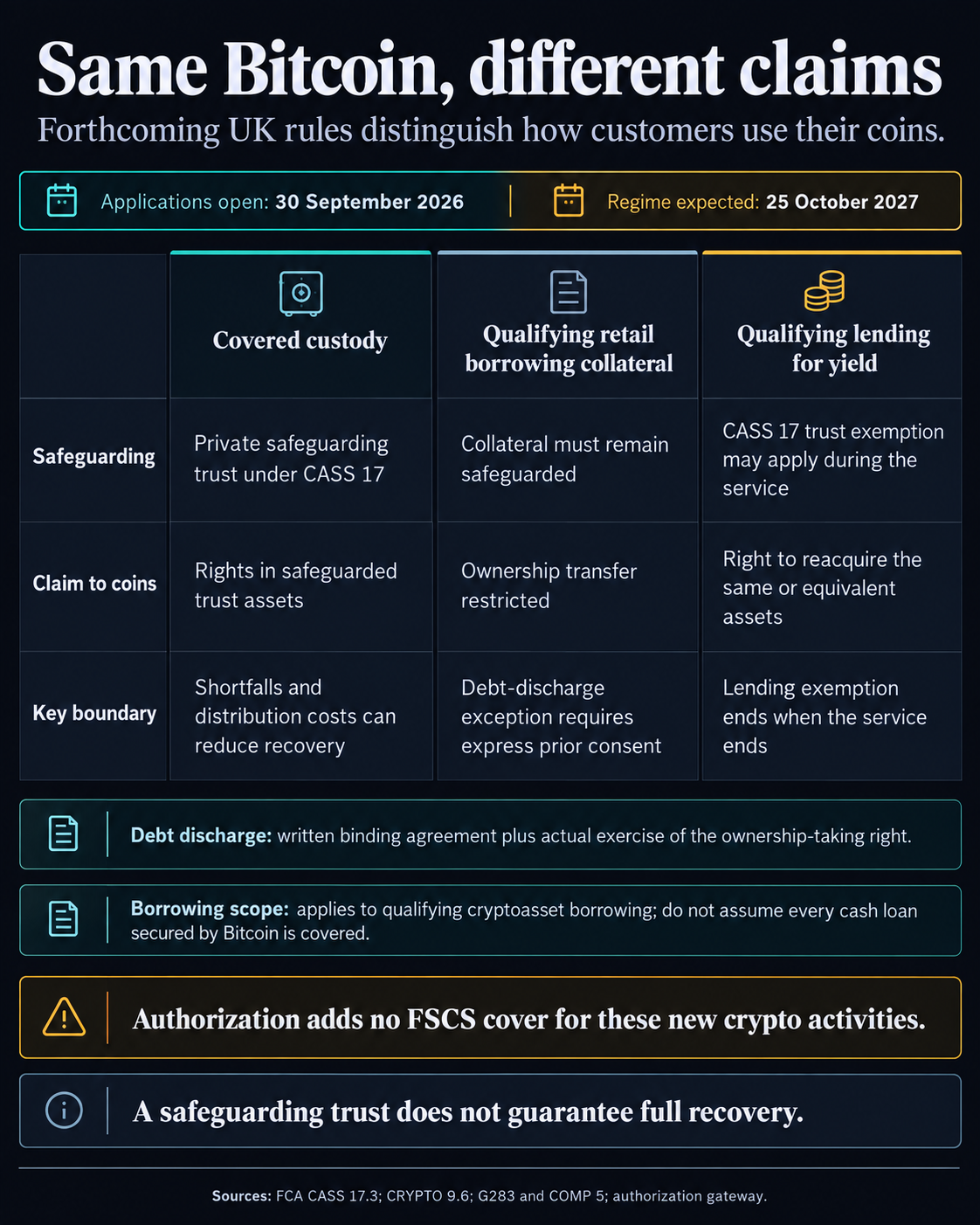
Comparison of forthcoming UK crypto rules: covered custody uses private safeguarding trusts; qualifying retail borrowing collateral remains safeguarded with a limited debt-discharge exception; qualifying lending can use a trust exemption during the service. Applications open September 30, 2026, and the regime is expected October 25, 2027. Recovery is not guaranteed and these new activities gain no FSCS cover.Comparison of forthcoming UK crypto rules: covered custody uses private safeguarding trusts; qualifying retail borrowing collateral remains safeguarded with a limited debt-discharge exception; qualifying lending can use a trust exemption during the service. Applications open September 30, 2026, and the regime is expected October 25, 2027. Recovery is not guaranteed and these new activities gain no FSCS cover.

Authorization will not add FSCS insurance

The compensation boundary survives the move to authorization. In the future Handbook glossary, the FCA brings the new crypto activities into the definition of designated investment business for general Handbook purposes, then expressly excludes them when that definition is used in the compensation rules.

The exclusions include crypto safeguarding, arranging safeguarding, operating trading platforms, dealing and arranging deals in qualifying cryptoassets, stablecoin issuance and arranging staking. Together with the protected-claim rules, that means authorization for these new activities does not add FSCS investment compensation protection.

A firm could conduct other business with different compensation eligibility. Its authorization for an uncovered crypto service, however, cannot turn that service into a covered investment claim.

The Financial Ombudsman Service is a separate route. DISP’s jurisdiction rules can permit eligible complaints about regulated activities, subject to the applicable conditions. An eligible complaint addresses the firm’s conduct. Payment of any award still depends on the circumstances, while FSCS eligibility remains a separate question.

Earlier coverage examined the authorization timetable and the stablecoin and lending perimeter.

Overseas platform access is another part of the regulatory picture. For customers, the next question is how the particular service treats their assets after a firm gains the permissions it needs.

The FCA also said in its June policy overview that it would consult later in 2026 on managing cryptoasset firm failures, including distribution rules for failed custodians and stablecoin issuers. The shape of the failure and distribution framework will also matter to the practical outcome for customers.

As applications open, the distinction for Bitcoin holders is between access to a regulated service and the rights attached to their coins within it. Custody, qualifying borrowing collateral and lending for yield can lead to different asset claims. The October 2027 framework will make that distinction more explicit, while leaving recovery dependent on the arrangement, the assets available and the applicable failure process.

Related Reading

FCA finalizes UK crypto rules as firms face 2027 access deadline

Bitcoin Lending Limits Protection Rules Trust UKs
Share. Facebook Twitter Pinterest LinkedIn Tumblr Email

Related Posts

No CLARITY Act? Here’s how U.S. regulators are moving crypto forward

September 30, 2026

SEC changes token buyback guidance as spending hits $638M

September 30, 2026

Bitcoin price stalls at $84.5K – Is a deeper BTC reset still possible?

September 30, 2026

Canadian ‘crypto king’ set to represent himself at fraud trial

September 30, 2026
Add A Comment
Leave A Reply Cancel Reply

Top Posts

USCR crypto stabilizes at $0.0022: Can the memecoin reverse Q2 losses?

July 21, 2026

NFL Rivals Review: A Web3 Football Game That Packs a Punch

October 5, 2025

Stay ahead with the latest crypto news, market updates, blockchain insights, and trends. Your trusted source for everything happening in the digital asset world.


We're social. Connect with us:

Facebook X (Twitter) Instagram Pinterest YouTube
Top Insights

LSEG Expands Canton Role as DiSH Enables Digital Settlement

October 1, 2026

Bitcoin lending under UK’s 2027 rules: trust protection limits

October 1, 2026

Ether.Fi: How whale buying could extend ETHFI’s 10% price rally

October 1, 2026
Get Informed

Subscribe to Updates

Get the latest creative news From Free.cc directly in your Inbox!

  • Contact
  • Privacy Policy
  • Terms & Conditions
  • Disclosure
© 2026 free.cc - All rights reserved.

Type above and press Enter to search. Press Esc to cancel.