

When one thinks about the MiCA regulation, it is usually about the EU, where it applies directly. That framing is technically correct: it is a European framework for regulating European markets. However, in practice, it is misleading to call it purely European.
MiCA Decoded is a 12-article weekly series for Bitcoin.com News, co-authored by LegalBison’s Co-Founding and Managing Directors: Aaron Glauberman, Viktor Juskin, and Sabir Alijev. LegalBison advises crypto and FinTech companies on MiCA licensing, CASP and VASP applications, and regulatory structuring across Europe and beyond.
Filing a white paper to have a token admitted for trading in Europe does not require a European address, and the European Securities and Market Authority (ESMA) public registers tell a story that most founders have not yet read.
Based on a study LegalBison conducted at the end of February for its clients, the numbers are pretty surprising.
Of 441 independent token project filings in the MiCA registers as of March 12th 2026, only 73 (17%) come from entities headquartered inside the EU or EEA. The other 275 with known head offices (62% of the total) are based outside the EU, primarily in the British Virgin Islands (92 entities), Switzerland (61), and the Cayman Islands (44). For the remaining 93 entities either the ESMA did not include them or there is no identifiable centralized entity (think of Bitcoin as an example).
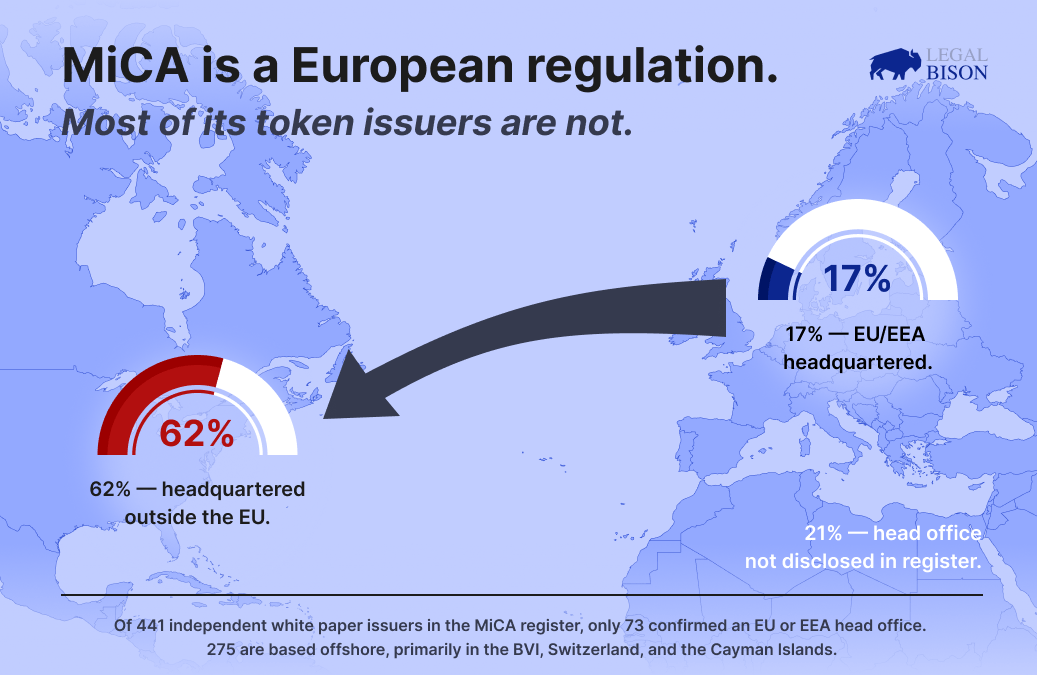
MiCA governs where tokens are admitted for trading and by whom they are offered, not where the companies behind them are incorporated. That design choice is what produces the data above, and it has significant practical consequences for any offshore project evaluating its EU market access strategy.
In simple terms: If you have a utility token or ‘other token’ as per narrow MiCA definition launched from a non-EU country like the BVIs, Panama, Cayman Islands or others, you are still able to have your token be admitted for trading in the EU.
In this second piece of our MiCA Decoded series, we share findings from the MiCA registry of issued crypto-assets.
What the white paper register actually measures
Under MiCA, any party seeking to offer a crypto-asset to EU investors or have it admitted to trading on an EU exchange must publish a compliant white paper. The obligation falls primarily on the offeror or the person seeking admission to trading, rather than the original issuer of the token. This is an important distinction: the issuer is the entity that created the crypto-asset, while the offeror is the entity actively offering it to the public in the EU. In many decentralized projects, there is no identifiable centralized issuer at all, but the party offering the token to the market must still ensure regulatory compliance.
MiCA also allows a trading platform to take on that responsibility, either on its own initiative or by written agreement with the project team.
That second path is what most early analyses of MiCA missed. Large exchanges built internal processes to file white papers for every token they offer for EU customers. Kraken’s EU entity, authorized in Ireland, filed 133 such records by itself. $LCX, operating from Liechtenstein, filed 63. A German compliance provider filed 88 records on behalf of token projects, with no exchange role of its own.
As we underlined above, this implies that the exchange assumes a certain level of responsibility of the token, in regards to regulatory compliance. This poses a legal risk, in case the whitepaper would be deemed misleading or unfit to MiCA standards. Yet, they still do it. In certain cases ( Bitcoin, multiple popular memecoins), no centralized issuer can be identified and no active marketing is done. But these crypto-assets are in high demand, exchanges are willing to offer them to their clients, while being legally compliant.
Now, strip out those 284 proxy and compliance-provider filings and 477 records remain: token projects that engaged directly with a national regulator to satisfy the white paper requirement for EU access. These are not CASP license holders. They are token issuers taking on a disclosure obligation: a different, much simpler and narrower commitment.
Of those 477, only 73 confirm an EU or EEA head office.
The rest are offshore entities reaching into the European market through a targeted regulatory filing, not through a corporate relocation.
Ireland and Malta as Whitepaper Go-To Jurisdictions
The 477 independent filings concentrate in two jurisdictions. Ireland lists 151 white papers, issued from 147 distinct entities. Malta holds 145 white papers from 95 entities.
Together, they account for two-thirds of all independent token project registrations. For any offshore project pursuing a crypto license in Europe, these are the two starting points the data supports.
The range of what is being filed in each jurisdiction is worth examining closely. Ireland’s filer list includes:
- Layer-1 blockchain networks (VeChain),
- DePIN protocols (DIMO Network),
- AI data projects (Giza, Venice.ai), DeFi infrastructure (Init Capital), and
- Developer tooling (Subsquid).
Malta’s list includes:
- Fan token platforms (Socios, covering 50 sports clubs including FC Barcelona and AC Milan),
- DeFi protocols (WalletConnect),
- AI tokens (Ondo AI),
- Identity tooling (QuantiID Systems).
Neither jurisdiction shows a category preference. The breadth of filings in both places reflects the full variety of tokens that European exchanges are currently listing.
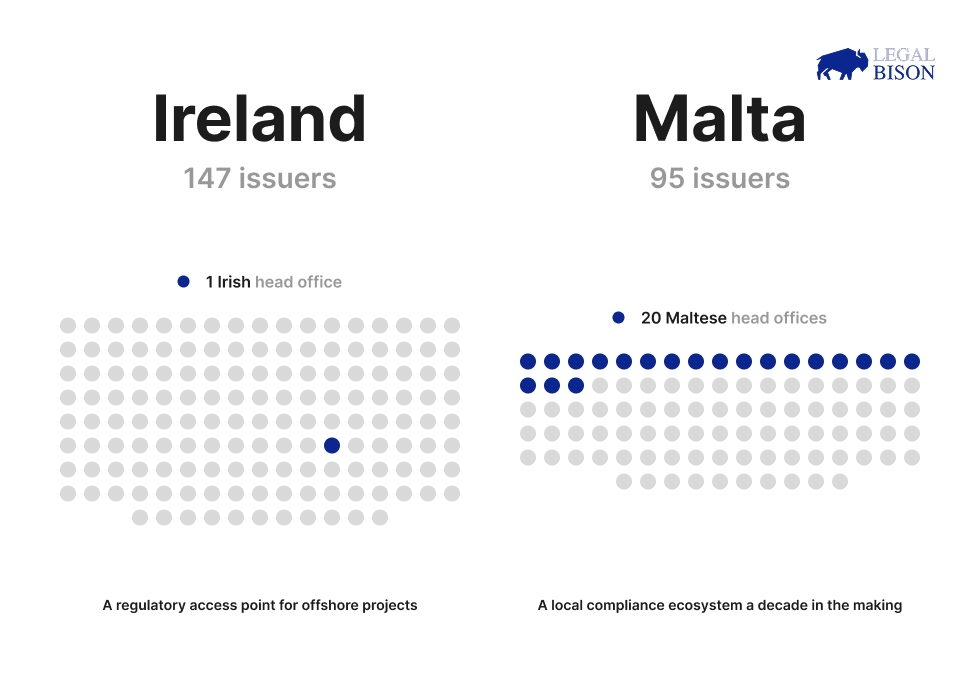
For offshore entities choosing between the two, the practical difference comes down to what each regulatory environment actually looks like in practice.
Ireland offers an English-language process inside a jurisdiction with a deep technology sector track record. One entity out of 147 Irish filers has an Irish head office, which confirms the pattern clearly: Ireland is not a corporate home for these projects, only a point of regulatory access. The British Virgin Islands alone accounts for 47 of the 116 Irish filers with known head offices (41%), noting that 31 Irish filers have no known headquarter, by the register’s data.
It is worth noting that at the moment of writing the Central Bank of Ireland is not charging a processing fee in comparison to most other National Competent Authorities (NCAs) to have projects seek admission for trading.
Malta tells a different story. Twenty of its 95 entities have a Maltese head office, reflecting a decade of crypto-specific regulation that produced a local ecosystem of compliance professionals and legal advisors whose practices are built around this industry. For projects that want proximity to that ecosystem rather than just a filing address, Malta tends to produce a different kind of regulatory engagement.
36 Stablecoins in the EU? How many does the market need?
MiCA classifies crypto-assets in three categories:
- Electronic Money Tokens (EMT): Crypto-assets that aim to stabilise their value by referencing only one official currency;
- Asset-Referenced Tokens (ART): Crypto-assets that aim to stabilise their value by referencing a basket of assets (including, but not limited to, official currencies);
- Other crypto-assets: All remaining crypto-assets that do not fall into the first two categories, covering a wide variety of tokens including utility tokens.
In everyday conversation, EMTs are part of what we usually call stablecoin. MiCA draws a precise distinction: EMT for single-currency-pegged tokens, ART for tokens referencing a basket of assets.
The EMT register contains 36 records as of March 12th of 2026.
That number is not low by accident. Issuing an EMT under MiCA requires prior authorization as an Electronic Money Institution (EMI) or a credit institution. A local entity is mandatory and high capital and solvency requirements filter out startups at the entry point. The entities in the register are banks and licensed payment institutions, not token-native projects.
The geographic distribution reflects that structure:
- France leads with 7 registrations (19%), including Circle (the issuer of $USDC and $EURC) and Societe Generale (with its EURCV and USDCV tokens),
- The Netherlands holds 6 registrations (17%), covering Quantoz Payments and Fiat Republic,
- Lithuania, Malta, Czech Republic, Finland and Germany each hold 3 to 4 registrations,
- The remaining 6 are spread across other member states.
France’s position at the top is not incidental. The Autorité de Contrôle Prudentiel et de Résolution (ACPR) has a long track record supervising electronic money institutions, and Circle’s choice of France as its EU base anchors the most liquid dollar-denominated stablecoin in that jurisdiction. Paxos, another institutional-grade issuer, authorized its European EMT business in Finland.
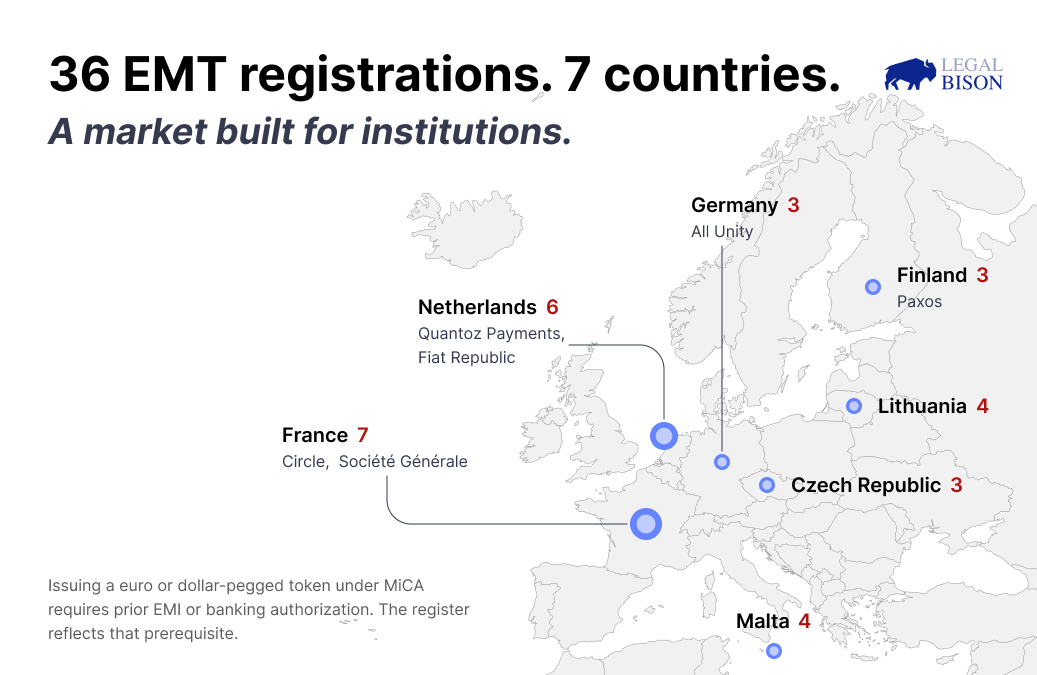
For founders: the EMT market as MiCA has structured it is an institutional product category. Any project exploring fiat-pegged token issuance under MiCA is entering a market defined by Circle, Societe Generale, and Paxos, not by early-stage teams.
The path to EMT issuance runs begins with securing an EMI license or a banking authorization first. There are no ways around it and this itself constitutes a major hurdle to issuing stablecoins under MiCA.
What zero ARTs means
An ART is a token whose value references a basket of assets rather than a single currency.
The MiCA registers contain 761 other-crypto-asset white papers and 36 EMT (Electronic Money Token) white papers. The ART (Asset-Referenced Token) row reads zero.
This category was created for digital assets such as DAI, a stablecoin mimicking the value of the US dollar while being backed by a basket of assets including wrapped Bitcoin and Ether.
The regulator’s intention was to address projects such as Libra/Diem, a category of crypto-assets that largely disappeared. The market clearly gravitated towards single-asset backed stablecoins.
That zero is not an anomaly. The authorization path is structurally more demanding than other MiCA categories: capital requirements can reach 2% of average outstanding reserve asset value, and the authorization process is far more rigorous than for standard token issuance.
No entity has completed that process anywhere in the EU. Whether the explanation is market preference, regulatory complexity, capital cost, or a strategic preference for structures outside MiCA’s scope entirely, the register does not say. It only confirms the outcome.
Takeaways for project seeking the right crypto license in Europe
- MiCA compliance for token issuance is operationally accessible to offshore entities. A BVI or Cayman company can satisfy the EU white paper requirement without moving its legal seat to Europe. The registration data confirms this common standard practice.
- Jurisdiction choice under MiCA still matters, as the approval process is heavily influenced by the regulator’s expertise and the underlying common law or civil law assumptions that shape their approach to white paper review.
- Ireland has processed the widest variety of token categories. Malta has the deepest local crypto compliance infrastructure. The Netherlands, Germany, and Luxembourg handle smaller volumes with different regulator profiles.
- While the proxy model facilitates market access for assets with no centralized issuer, it remains an impractical route for early-stage projects. Current industry standards, set by Kraken and $LCX, prioritize the filing of white papers for high- volume tokens that already possess significant market depth.
- A token issuer seeking EU market access needs to engage the white paper process directly. For most projects, that means Ireland or Malta as the first practical option, regardless of where the legal entity is located.
- While the deadline for token issuers was in December 2024, the July 1, 2026, deadline for crypto-asset services applies to CASPs. But exchanges listing tokens for EU customers require a compliant white paper for each one. The closer that deadline gets, the less runway exists for token projects that have not yet filed. And the register data shows that the projects moving now are predominantly offshore.

LegalBison advises crypto and FinTech companies on MiCA licensing, CASP and VASP applications, token white paper compliance, and regulatory structuring across Europe and beyond. More information at legalbison.com.
This article is based on a study conducted by LegalBison in February 2026, with data updated as of March 12th, 2026. The content is for informational purposes only and does not constitute legal advice.