Close Menu
  • Latest News
    • Bitcoin
    • Ethereum
    • Altcoins
    • Meme Coins
  • Tech
    • Blockchain
    • Security and Privacy
  • Web 3
    • Gaming
  • Legal
    • Legal and Regulatory
    • Adoption
  • Analysis
  • Learn
    • Education
    • Wallets and Exchanges
  • Tools
    • Market Overview
    • Exchange Tool
What's Hot

Neo SPCC launches public S3 gateway for NeoFS on MainNet

September 25, 2026

SEC’s Hester Peirce wants to end crypto’s KYC honeypots

September 25, 2026

Senate Fails to Advance Crypto Clarity Act After Key Negotiators Vote No

September 25, 2026
Facebook X (Twitter) Instagram
  • Contact
  • Privacy Policy
  • Terms & Conditions
  • Disclosure
Facebook X (Twitter) Instagram
Free.cc (Free Cryptocurrency)Free.cc (Free Cryptocurrency)
  • Latest News
    1. Bitcoin
    2. Ethereum
    3. Altcoins
    4. Meme Coins
    5. View All

    Senate Fails to Advance Crypto Clarity Act After Key Negotiators Vote No

    September 25, 2026

    Crypto shrugs off Bitget’s $351.6 million hack as altcoins rally: Crypto Markets Today

    September 25, 2026

    Nearly $352M Moved From Crypto Exchange Bitget Wallets In Suspected Hack

    September 25, 2026

    ‘Only hedge funds, retail sold’ — Will BTC sustain rally as Bitcoin ETF flows turn positive?

    September 25, 2026

    Bitcoin holds $85K as $18B Options expiry nears: What comes next?

    September 24, 2026

    Analyzing Ethereum’s 70% Q3 rally: Can ETH hold its breakout?

    September 24, 2026

    Ethereum’s next move: Can ETH reclaim $2,700 after a $111M whale exit?

    September 24, 2026

    Optimism Says Superchain TVL Has Crossed $14 Billion

    September 24, 2026

    MEXC Returns to TOKEN2049 Singapore as Platinum Sponsor with Interactive Experiences and Industry Conversations

    September 25, 2026

    Why TRUMP crypto’s recovery odds depend on the $1.93 support

    September 25, 2026

    Visa Says Bank-Level Fraud Protection and Deposit Insurance Could Unlock US Stablecoin Adoption

    September 25, 2026

    Sui crypto recovers from $0.94—can SUI break above $1?

    September 24, 2026

    Thinking Cat Gains Momentum After CASHCAT’s Breakout

    August 12, 2026

    What Tokens Could He Target?

    July 30, 2026

    The Next Meme Coin Winner Could Be Determined by Incentives, Not Memes

    July 30, 2026

    Why Is BOME’s Price Up Today? Finally, Capital Rotating to the Meme Coins?

    July 28, 2026

    Neo SPCC launches public S3 gateway for NeoFS on MainNet

    September 25, 2026

    SEC’s Hester Peirce wants to end crypto’s KYC honeypots

    September 25, 2026

    Senate Fails to Advance Crypto Clarity Act After Key Negotiators Vote No

    September 25, 2026

    Ondo unlocks BlackRock portfolio strategies, but only non-US traders benefit

    September 25, 2026
  • Tech
    1. Blockchain
    2. Security and Privacy
    3. View All

    Neo SPCC launches public S3 gateway for NeoFS on MainNet

    September 25, 2026

    Arch Lending eyes tokenized stocks as next collateral market

    September 25, 2026

    Cross-Border Payments Evolve with Hedera’s Stablecoin

    September 25, 2026

    Alpenglow Moves to Testnet Phase, Marking Milestone for Solana

    September 25, 2026

    Cryptominer Abuses Linux PAM to Hide From SOC Analysts

    September 25, 2026

    Crypto Casino Duelbits Hit With $7M Hack, Taken Offline

    September 25, 2026

    Coldcard Users Lose $89m After Bitcoin Wallet Is Hacked

    September 25, 2026

    Bitget Hit by $351M Hack, Withdrawals Frozen as Probe Begins

    September 25, 2026

    Neo SPCC launches public S3 gateway for NeoFS on MainNet

    September 25, 2026

    SEC’s Hester Peirce wants to end crypto’s KYC honeypots

    September 25, 2026

    Senate Fails to Advance Crypto Clarity Act After Key Negotiators Vote No

    September 25, 2026

    Ondo unlocks BlackRock portfolio strategies, but only non-US traders benefit

    September 25, 2026
  • Web 3
    1. Gaming
    2. View All

    Top 12 NFT games every player should know about in August 2026

    September 22, 2026

    GameShame Studios founder details Raijin Protocol’s roadmap in NeoPod’s sixth AMA

    September 22, 2026

    Proof of Play to shut down after blockchain gaming thesis falls short

    September 22, 2026

    How BC.GAME is turning players into stakeholders

    September 22, 2026

    Neo SPCC launches public S3 gateway for NeoFS on MainNet

    September 25, 2026

    SEC’s Hester Peirce wants to end crypto’s KYC honeypots

    September 25, 2026

    Senate Fails to Advance Crypto Clarity Act After Key Negotiators Vote No

    September 25, 2026

    Ondo unlocks BlackRock portfolio strategies, but only non-US traders benefit

    September 25, 2026
  • Legal
    1. Legal and Regulatory
    2. Adoption
    3. View All

    SEC’s Hester Peirce wants to end crypto’s KYC honeypots

    September 25, 2026

    White House adviser defends President Trump’s crypto ties in wake of Clarity Act defeat

    September 25, 2026

    What Shortcomings Were Identified in Cryptocurrency Companies?

    September 25, 2026

    Former Polish Police Officer Charged as Zondacrypto Probe Searches Fuel Depot

    September 25, 2026

    Ondo unlocks BlackRock portfolio strategies, but only non-US traders benefit

    September 25, 2026

    Solana DEX volume spike hides circular trades, and automated bots are blamed

    September 25, 2026

    Payy bridge exploit freezes crypto cards, and no balances remain safe

    September 25, 2026

    Lightning Labs discloses critical bug marking canceled invoices paid, risking free product delivery

    September 25, 2026

    Neo SPCC launches public S3 gateway for NeoFS on MainNet

    September 25, 2026

    SEC’s Hester Peirce wants to end crypto’s KYC honeypots

    September 25, 2026

    Senate Fails to Advance Crypto Clarity Act After Key Negotiators Vote No

    September 25, 2026

    Ondo unlocks BlackRock portfolio strategies, but only non-US traders benefit

    September 25, 2026
  • Analysis

    Crypto Exchange Bitget Confirms $351,600,000 Hot Wallet Breach, Abruptly Suspends Withdrawals

    September 25, 2026

    Quant Price Explodes After Clearing House Deal — Is QNT Heading for $110?

    September 25, 2026

    Zcash Co-Founder Predicts $5,000 ZEC Amid Historic Europe ETP Launch

    September 25, 2026

    Polymarket becomes New York’s latest prediction-market target

    September 25, 2026

    Can Ethereum Price Reclaim the $2,800 Level Soon?

    September 24, 2026
  • Learn
    1. Education
    2. Wallets and Exchanges
    3. View All

    What Is Robinhood Chain? The Ethereum Layer-2 Network for Tokenized Stocks

    July 12, 2026

    What Is BChat? The Decentralized Messaging App Built for Privacy

    June 2, 2026

    What Is an AI Prompt Injection Attack? The Hidden Threat Hijacking Your Chatbots

    May 31, 2026

    What Is AI Jailbreaking? A Beginner’s Guide to the Cat-and-Mouse Game Behind Every Chatbot

    May 17, 2026

    Bitget’s North Korea-linked $352 million hack could drain 76% of its protection fund

    September 25, 2026

    Bitget hit by $351.6 million breach days before 8th anniversary

    September 25, 2026

    Tether, Binance and a $1.5 billion Iran oil network converge in new US forfeiture case

    September 24, 2026

    Coinbase pushes beyond crypto with retail access to $2.2 billion Oura IPO

    September 24, 2026

    Neo SPCC launches public S3 gateway for NeoFS on MainNet

    September 25, 2026

    SEC’s Hester Peirce wants to end crypto’s KYC honeypots

    September 25, 2026

    Senate Fails to Advance Crypto Clarity Act After Key Negotiators Vote No

    September 25, 2026

    Ondo unlocks BlackRock portfolio strategies, but only non-US traders benefit

    September 25, 2026
  • Tools
    • Market Overview
    • Exchange Tool
Free.cc (Free Cryptocurrency)Free.cc (Free Cryptocurrency)
Home»Legal and Regulatory»SEC’s Hester Peirce wants to end crypto’s KYC honeypots
SEC's Hester Peirce wants to end crypto’s KYC honeypots
Legal and Regulatory

SEC’s Hester Peirce wants to end crypto’s KYC honeypots

September 25, 2026No Comments6 Mins Read
Share
Facebook Twitter LinkedIn Pinterest Email

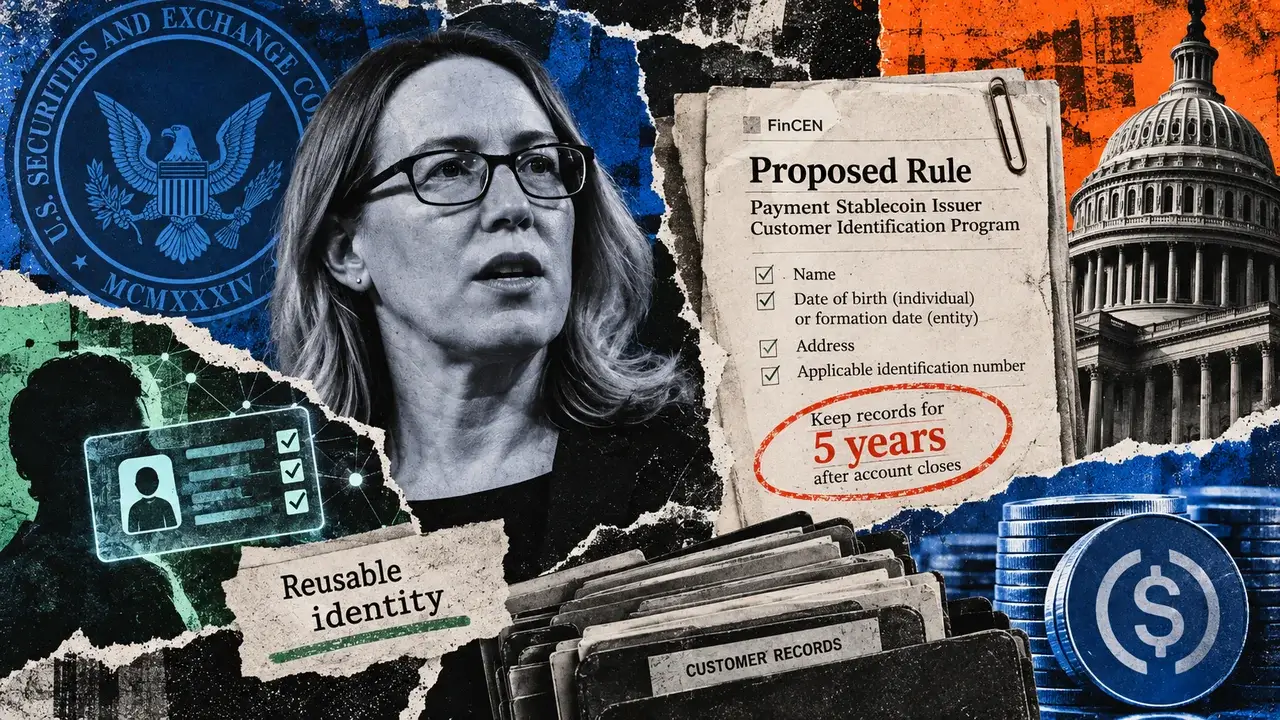
US Securities and Exchange Commission (SEC) Commissioner Hester Peirce wants financial firms to stop stockpiling customer data after breaches exposed the cost of mandatory identity collection.

This week, the SEC Commissioner called for wider use of reusable digital credentials that could establish facts about customers without requiring every financial institution to collect the underlying personal information again.

According to her:

“Today society is at a crossroads. Down one path lies the status quo: more data collection, more intermediary surveillance, more “know your customer’ requirements that turn our financial rails into a panopticon. Down the other path lies an opportunity to use new technologies to improve our ability to catch criminals while collecting less personal information than ever before, and monitoring more sparingly to protect Americans’ privacy.”

Her remarks follow recent security incidents at major financial platforms like Revolut that exposed identity documents, addresses, and other information these companies collect to meet customer-verification and anti-money-laundering requirements.

Peirce said regulators should reconsider whether institutions need particular pieces of information or merely need confirmation of the facts those records establish. Attribute-based credentials, she said, could prove whether someone meets an age requirement, holds a particular citizenship or appears on sanctions lists without revealing information such as their name, income or address.

“Does more than one firm need to collect it?” Peirce asked, arguing that technology already exists to reduce the information customers surrender and the number of institutions that receive it. She said the remarks represented her own views rather than those of the SEC.

The question is becoming more consequential as Washington builds a new compliance regime for stablecoins.

The GENIUS Act requires permitted payment stablecoin issuers to maintain customer-identification programs, and regulators are proposing rules that would continue requiring covered issuers to obtain and retain identifying information from customers.

See also  Crypto's banker adversaries didn't want to deal in latest White House meeting on bill

Breaches turn KYC records into targets

Coinbase provided one of the clearest examples of the risk last year.

Attackers bribed contractors or employees working in overseas customer-support roles to obtain information from the exchange’s internal systems. Coinbase later disclosed that 69,461 customers were affected.

The compromised information included names, addresses, phone numbers, email addresses, partial Social Security numbers, government-issued identification images, account balances and transaction histories. Passwords and private keys were not stolen, but Coinbase warned that the information could be used in social-engineering attacks against customers.

Chief Executive Officer Brian Armstrong then turned the breach into an argument against how much information financial companies are required to retain.

“We don’t want to collect it, and our customers hate it,” Armstrong said while calling for lawmakers to reconsider the Bank Secrecy Act and anti-money-laundering requirements.

He also argued that Congress should review the laws or they should face a constitutional challenge, a position that goes considerably further than Peirce’s proposal to change how required information is collected and verified.

The problem resurfaced this month at Revolut through a different route.

The fintech company said an unauthorized party used a legitimate government-agency email domain to send fraudulent information requests.

Revolut disclosed customer information in response, including identity and contact details and copies of passports and driver’s licenses. Depending on the customer, the material could also include verification selfies, account statements, and transaction histories. Revolut said its systems and customer funds were unaffected.

The episodes illustrate the vulnerability Peirce is targeting: once institutions accumulate identity records, stealing money does not require breaching private keys or directly compromising financial accounts. Personal information can itself become an asset for extortion, impersonation, and subsequent attacks.

See also  Supreme People’s Court of China to refine rules on AI content and data ownership
The Catalyst

What’s moving crypto. Why it matters.

Get CryptoSlate’s essential stories and what to watch next.

Published on Substack

Seven days a week. Unsubscribe anytime.

Whoops, looks like there was a problem. Please try again.

Check your inbox.

Your signup request was sent. If confirmation is required, follow the email from Substack.

Look in spam or promotions if you don’t see it.

Stablecoin rules preserve the collection model

The policy challenge is that US regulators are simultaneously extending customer-identification requirements to another part of the financial system.

Under the proposed GENIUS Act implementation, a permitted payment stablecoin issuer would generally have to obtain a customer’s name, date of birth or formation, address, and identification number before opening a covered account.

The identifying information would then be retained for five years after the account closes, while records describing verification methods and results would generally remain for five years after they are created.

The requirement does not cover every person who receives or holds a stablecoin. It targets customers establishing covered relationships with issuers, including relationships involving direct issuance or redemption.

Regulators say the requirements implement Congress’s direction that permitted stablecoin issuers be treated as financial institutions under the Bank Secrecy Act and maintain effective customer-identification programs designed to combat money laundering, terrorist financing and other illicit activity.

The proposal already leaves some room for technology. An issuer may use digital credentials as part of identity verification and, under specified conditions, rely on procedures performed by another regulated financial institution.
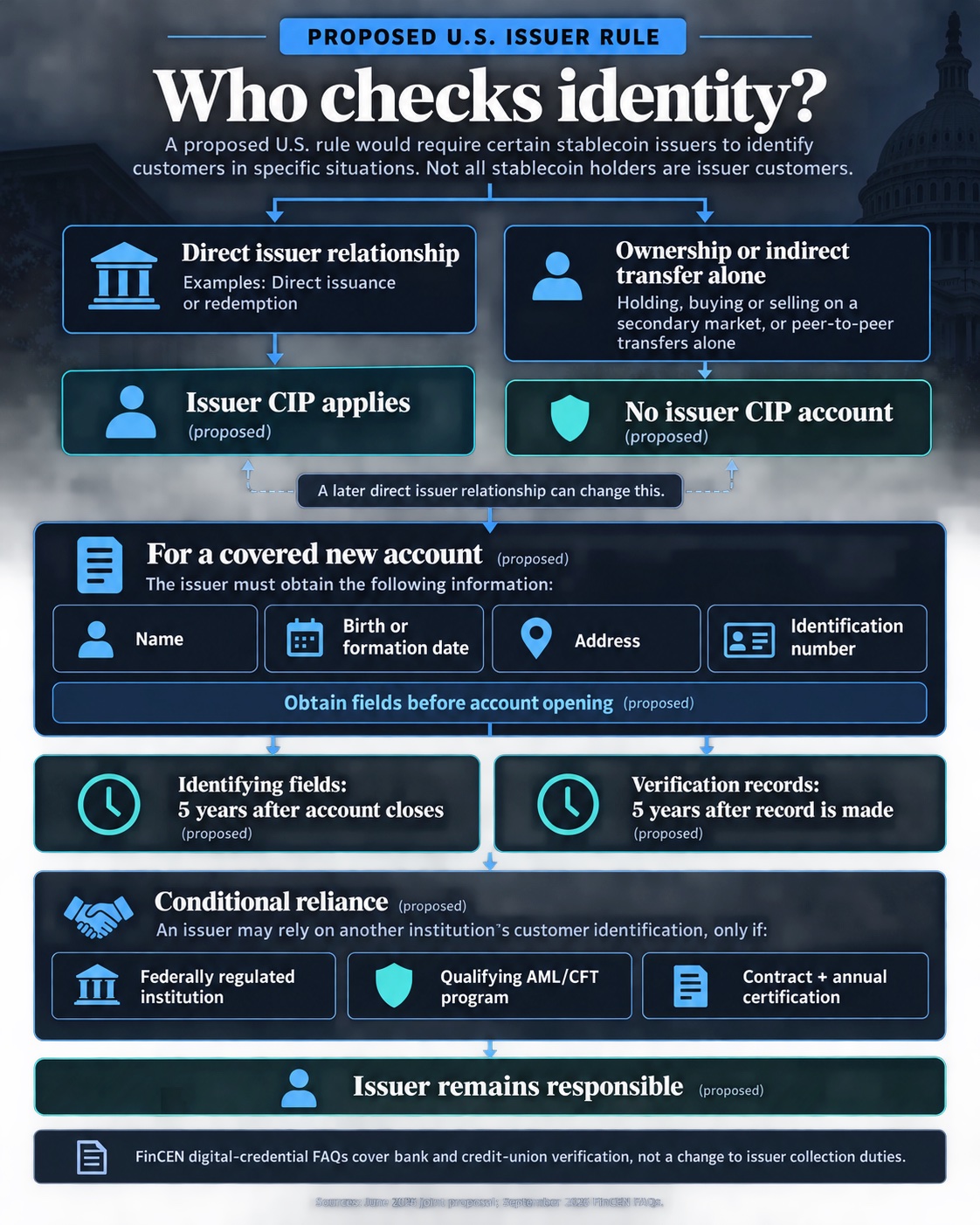
Flowchart of the proposed U.S. stablecoin issuer identity rule: direct issuer accounts require identifying fields and records, while ownership or indirect transfers alone do not; conditional reliance leaves the issuer responsible.Flowchart of the proposed U.S. stablecoin issuer identity rule: direct issuer accounts require identifying fields and records, while ownership or indirect transfers alone do not; conditional reliance leaves the issuer responsible.

FinCEN also said this month that banks and credit unions may use qualifying government-issued digital credentials, including mobile driver’s licenses, within their existing customer-identification programs.

See also  SEC’s top enforcer clashed over Trump cases before quitting: Report

Those mechanisms stop short of the portable model Peirce described. Verification technology can change how an institution confirms an identity without necessarily eliminating its obligation to obtain prescribed customer information or maintain records.

The fight moves to the final rule

Regulators have left that question open.

FinCEN and the banking agencies explicitly asked whether the final stablecoin rule should address digital identity systems or verifiable credentials and what benefits and risks would accompany their use.

They acknowledged that a nongovernmental credential could allow someone to prove who they are without revealing additional information, but declined to include specific verifiable-credential provisions in the proposed regulatory text.

That creates room for the final rules to determine how much duplicate collection survives.

Regulators could broaden the circumstances in which stablecoin issuers rely on identity checks conducted elsewhere, give clearer recognition to cryptographically verifiable credentials, or allow firms to retain evidence that required checks occurred without keeping additional copies of the underlying documents where the law permits.

Related Reading

US bank lobby wants stablecoin holders to open an account before cashing out

For stablecoin companies, the outcome will determine whether compliance requires building another generation of databases containing customer identity information or investing in systems designed to verify required attributes while holding less of the raw data themselves.

The GENIUS Act has already settled that regulated issuers must know their customers. The remaining rulemaking will determine how many companies need to keep copies of the information used to prove who those customers are.

Cryptos Hester honeypots KYC Peirce SECs
Share. Facebook Twitter Pinterest LinkedIn Tumblr Email

Related Posts

White House adviser defends President Trump’s crypto ties in wake of Clarity Act defeat

September 25, 2026

What Shortcomings Were Identified in Cryptocurrency Companies?

September 25, 2026

Former Polish Police Officer Charged as Zondacrypto Probe Searches Fuel Depot

September 25, 2026

Why TRUMP crypto’s recovery odds depend on the $1.93 support

September 25, 2026
Add A Comment
Leave A Reply Cancel Reply

Top Posts

A Turning Point for Web3 Developers

November 4, 2025

Bolivia’s Blockchain Proposal to Eliminate Corruption and Create a Digital Market

November 25, 2025

Stay ahead with the latest crypto news, market updates, blockchain insights, and trends. Your trusted source for everything happening in the digital asset world.


We're social. Connect with us:

Facebook X (Twitter) Instagram Pinterest YouTube
Top Insights

Neo SPCC launches public S3 gateway for NeoFS on MainNet

September 25, 2026

SEC’s Hester Peirce wants to end crypto’s KYC honeypots

September 25, 2026

Senate Fails to Advance Crypto Clarity Act After Key Negotiators Vote No

September 25, 2026
Get Informed

Subscribe to Updates

Get the latest creative news From Free.cc directly in your Inbox!

  • Contact
  • Privacy Policy
  • Terms & Conditions
  • Disclosure
© 2026 free.cc - All rights reserved.

Type above and press Enter to search. Press Esc to cancel.