Close Menu
  • Latest News
    • Bitcoin
    • Ethereum
    • Altcoins
    • Meme Coins
  • Tech
    • Blockchain
    • Security and Privacy
  • Web 3
    • Gaming
  • Legal
    • Legal and Regulatory
    • Adoption
  • Analysis
  • Learn
    • Education
    • Wallets and Exchanges
  • Tools
    • Market Overview
    • Exchange Tool
What's Hot

Mapping Financial Power In The Age Of Bitcoin

October 20, 2026

The crypto privacy rule Trump’s Treasury proposed, and Trump’s Treasury buried

October 20, 2026

Kraken Parent Payward Moves Into European Banking With Saldo Deal

October 20, 2026
Facebook X (Twitter) Instagram
  • Contact
  • Privacy Policy
  • Terms & Conditions
  • Disclosure
Facebook X (Twitter) Instagram
Free.cc (Free Cryptocurrency)Free.cc (Free Cryptocurrency)
  • Latest News
    1. Bitcoin
    2. Ethereum
    3. Altcoins
    4. Meme Coins
    5. View All

    Mapping Financial Power In The Age Of Bitcoin

    October 20, 2026

    Crypto wallet activity: Two dormant addresses move nearly $34M in Bitcoin

    October 20, 2026

    Michael Saylor Says Bitcoin Is Entering A New Bull Market Driven By Banks

    October 19, 2026

    Charles Hoskinson is personally building a new programming language for Cardano

    October 19, 2026

    Why Tom Lee Thinks Ethereum Treasury Firms Will Push ETH Past $10,000 In The Next 12 Months

    October 20, 2026

    Ethereum activity returns: Active addresses spike 89K as ETH tests $2,330 support

    October 20, 2026

    JPMorgan Expands JPM Coin to Ethereum for Institutional Payments

    October 19, 2026

    Ethereum ETFs shed $1B in 3 weeks – Can ETH buyers prevent breakdown?

    October 19, 2026

    Kraken Parent Payward Moves Into European Banking With Saldo Deal

    October 20, 2026

    Will Chainlink’s 431900 LINK Reserve haul outweigh ETF withdrawals?

    October 19, 2026

    Wormhole posts further losses – But THIS can trigger W’s bullish rebound

    October 19, 2026

    Solana’s Tokenized Asset Market Grows More Than Sixfold In A Year

    October 19, 2026

    Top 5 Memecoins to Watch in 2026: Hype, Utility, or Growth?

    October 14, 2026

    Did Jean Phil Go Viral First — or Was the Viral Persona Built to Launch a Memecoin?

    October 5, 2026

    Thinking Cat Gains Momentum After CASHCAT’s Breakout

    August 12, 2026

    What Tokens Could He Target?

    July 30, 2026

    Mapping Financial Power In The Age Of Bitcoin

    October 20, 2026

    The crypto privacy rule Trump’s Treasury proposed, and Trump’s Treasury buried

    October 20, 2026

    Kraken Parent Payward Moves Into European Banking With Saldo Deal

    October 20, 2026

    Kraken Unified Wallet puts eligible spot funds at risk

    October 20, 2026
  • Tech
    1. Blockchain
    2. Security and Privacy
    3. View All

    WisdomTree Launches Prime on Stellar Network

    October 20, 2026

    Chainlink Achieves $30 Trillion in Transaction Value

    October 19, 2026

    Growing Onchain Activity in Korea Highlights Optimism’s Role

    October 19, 2026

    SPYx Showcases Composability for Tokenized ETFs on Solana

    October 19, 2026

    Qubic Loses $1.3 Million in Wallet Raid Before Network Halts

    October 18, 2026

    Lopp’s Wrench Attack Map Hits 702 After AI-Assisted Search Work

    October 18, 2026

    Ledger Thieves Might Have a New Big Problem—Stealing From Criminals

    October 16, 2026

    Crypto Casino Gamdom Goes Dark After a $3 Million Wallet Hack

    October 15, 2026

    Mapping Financial Power In The Age Of Bitcoin

    October 20, 2026

    The crypto privacy rule Trump’s Treasury proposed, and Trump’s Treasury buried

    October 20, 2026

    Kraken Parent Payward Moves Into European Banking With Saldo Deal

    October 20, 2026

    Kraken Unified Wallet puts eligible spot funds at risk

    October 20, 2026
  • Web 3
    1. Gaming
    2. View All

    Top 12 NFT games every player should know about in August 2026

    September 22, 2026

    GameShame Studios founder details Raijin Protocol’s roadmap in NeoPod’s sixth AMA

    September 22, 2026

    Proof of Play to shut down after blockchain gaming thesis falls short

    September 22, 2026

    How BC.GAME is turning players into stakeholders

    September 22, 2026

    Mapping Financial Power In The Age Of Bitcoin

    October 20, 2026

    The crypto privacy rule Trump’s Treasury proposed, and Trump’s Treasury buried

    October 20, 2026

    Kraken Parent Payward Moves Into European Banking With Saldo Deal

    October 20, 2026

    Kraken Unified Wallet puts eligible spot funds at risk

    October 20, 2026
  • Legal
    1. Legal and Regulatory
    2. Adoption
    3. View All

    The crypto privacy rule Trump’s Treasury proposed, and Trump’s Treasury buried

    October 20, 2026

    EU Joins 8 Nations to Sign Warsaw Protocol on Crypto Crime

    October 19, 2026

    Lummis Challenges Democrats Over Opposition to Crypto Market Structure Bill

    October 19, 2026

    French Assembly Backs Tax on Crypto-to-Stablecoin Swaps by One Vote

    October 19, 2026

    Two firms control corporate Bitcoin buys, even as business adoption broadens

    October 16, 2026

    AI agents keep coming back for crypto as x402 wallet refill rate surges to 89%

    October 15, 2026

    Interactive Brokers moves into Ethereum’s $110 billion staking market as institutional demand accelerates

    October 14, 2026

    Ledger’s crypto wallet implant scare triggers Trezor reseller crackdown as security fears spread

    October 14, 2026

    Mapping Financial Power In The Age Of Bitcoin

    October 20, 2026

    The crypto privacy rule Trump’s Treasury proposed, and Trump’s Treasury buried

    October 20, 2026

    Kraken Parent Payward Moves Into European Banking With Saldo Deal

    October 20, 2026

    Kraken Unified Wallet puts eligible spot funds at risk

    October 20, 2026
  • Analysis

    Kraken Unified Wallet puts eligible spot funds at risk

    October 20, 2026

    Can KAS Rally Toward $0.19?

    October 19, 2026

    Binance SOXL price band explained after a 5.9% fall

    October 19, 2026

    Mastercard Stock Hits Record High Ahead of Q3 Earnings: What Investors Should Watch

    October 19, 2026

    Hedera (HBAR) Bulls Face a Critical Test as Bears Resist the Rally – Is a Return to $0.1 Still on the Horizon?

    October 19, 2026
  • Learn
    1. Education
    2. Wallets and Exchanges
    3. View All

    What Is Robinhood Chain? The Ethereum Layer-2 Network for Tokenized Stocks

    July 12, 2026

    What Is BChat? The Decentralized Messaging App Built for Privacy

    June 2, 2026

    What Is an AI Prompt Injection Attack? The Hidden Threat Hijacking Your Chatbots

    May 31, 2026

    What Is AI Jailbreaking? A Beginner’s Guide to the Cat-and-Mouse Game Behind Every Chatbot

    May 17, 2026

    Binance Pool shuts on November 10, with record access ending two weeks later

    October 18, 2026

    82 criminal charges follow armed crypto abduction in Toronto

    October 16, 2026

    Coins.ph users face app lockout as central bank intervenes

    October 15, 2026

    Coinbase rolls out 10x spot leverage, but blocks US retail from it

    October 9, 2026

    Mapping Financial Power In The Age Of Bitcoin

    October 20, 2026

    The crypto privacy rule Trump’s Treasury proposed, and Trump’s Treasury buried

    October 20, 2026

    Kraken Parent Payward Moves Into European Banking With Saldo Deal

    October 20, 2026

    Kraken Unified Wallet puts eligible spot funds at risk

    October 20, 2026
  • Tools
    • Market Overview
    • Exchange Tool
Free.cc (Free Cryptocurrency)Free.cc (Free Cryptocurrency)
Home»Legal and Regulatory»SEC’s Hester Peirce wants to end crypto’s KYC honeypots
SEC's Hester Peirce wants to end crypto’s KYC honeypots
Legal and Regulatory

SEC’s Hester Peirce wants to end crypto’s KYC honeypots

September 25, 2026No Comments6 Mins Read
Share
Facebook Twitter LinkedIn Pinterest Email

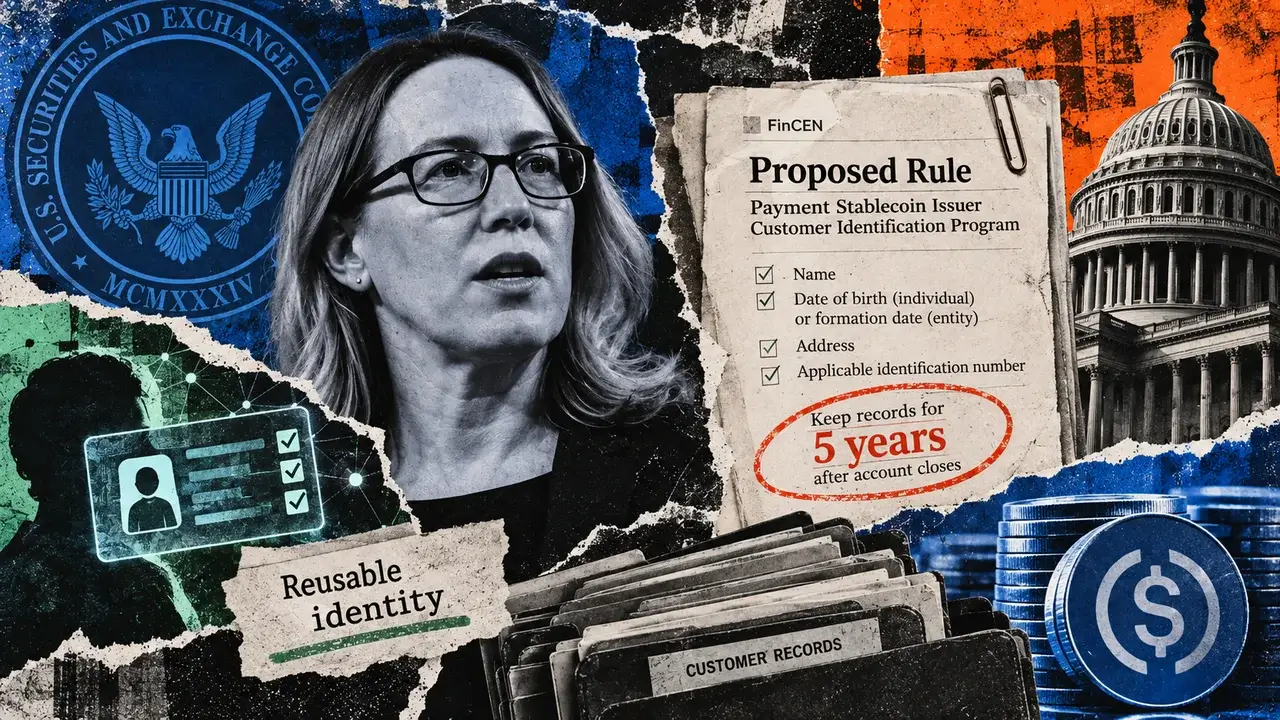
US Securities and Exchange Commission (SEC) Commissioner Hester Peirce wants financial firms to stop stockpiling customer data after breaches exposed the cost of mandatory identity collection.

This week, the SEC Commissioner called for wider use of reusable digital credentials that could establish facts about customers without requiring every financial institution to collect the underlying personal information again.

According to her:

“Today society is at a crossroads. Down one path lies the status quo: more data collection, more intermediary surveillance, more “know your customer’ requirements that turn our financial rails into a panopticon. Down the other path lies an opportunity to use new technologies to improve our ability to catch criminals while collecting less personal information than ever before, and monitoring more sparingly to protect Americans’ privacy.”

Her remarks follow recent security incidents at major financial platforms like Revolut that exposed identity documents, addresses, and other information these companies collect to meet customer-verification and anti-money-laundering requirements.

Peirce said regulators should reconsider whether institutions need particular pieces of information or merely need confirmation of the facts those records establish. Attribute-based credentials, she said, could prove whether someone meets an age requirement, holds a particular citizenship or appears on sanctions lists without revealing information such as their name, income or address.

“Does more than one firm need to collect it?” Peirce asked, arguing that technology already exists to reduce the information customers surrender and the number of institutions that receive it. She said the remarks represented her own views rather than those of the SEC.

The question is becoming more consequential as Washington builds a new compliance regime for stablecoins.

The GENIUS Act requires permitted payment stablecoin issuers to maintain customer-identification programs, and regulators are proposing rules that would continue requiring covered issuers to obtain and retain identifying information from customers.

See also  SEC chair says 'time is right' for pension funds to include crypto, CFTC head says digital assets set to flourish

Breaches turn KYC records into targets

Coinbase provided one of the clearest examples of the risk last year.

Attackers bribed contractors or employees working in overseas customer-support roles to obtain information from the exchange’s internal systems. Coinbase later disclosed that 69,461 customers were affected.

The compromised information included names, addresses, phone numbers, email addresses, partial Social Security numbers, government-issued identification images, account balances and transaction histories. Passwords and private keys were not stolen, but Coinbase warned that the information could be used in social-engineering attacks against customers.

Chief Executive Officer Brian Armstrong then turned the breach into an argument against how much information financial companies are required to retain.

“We don’t want to collect it, and our customers hate it,” Armstrong said while calling for lawmakers to reconsider the Bank Secrecy Act and anti-money-laundering requirements.

He also argued that Congress should review the laws or they should face a constitutional challenge, a position that goes considerably further than Peirce’s proposal to change how required information is collected and verified.

The problem resurfaced this month at Revolut through a different route.

The fintech company said an unauthorized party used a legitimate government-agency email domain to send fraudulent information requests.

Revolut disclosed customer information in response, including identity and contact details and copies of passports and driver’s licenses. Depending on the customer, the material could also include verification selfies, account statements, and transaction histories. Revolut said its systems and customer funds were unaffected.

The episodes illustrate the vulnerability Peirce is targeting: once institutions accumulate identity records, stealing money does not require breaching private keys or directly compromising financial accounts. Personal information can itself become an asset for extortion, impersonation, and subsequent attacks.

See also  How Japan's Crypto Travel Rule Amendment Gives FSA New Transaction Surveillance Powers
The Catalyst

What’s moving crypto. Why it matters.

Get CryptoSlate’s essential stories and what to watch next.

Published on Substack

Seven days a week. Unsubscribe anytime.

Whoops, looks like there was a problem. Please try again.

Check your inbox.

Your signup request was sent. If confirmation is required, follow the email from Substack.

Look in spam or promotions if you don’t see it.

Stablecoin rules preserve the collection model

The policy challenge is that US regulators are simultaneously extending customer-identification requirements to another part of the financial system.

Under the proposed GENIUS Act implementation, a permitted payment stablecoin issuer would generally have to obtain a customer’s name, date of birth or formation, address, and identification number before opening a covered account.

The identifying information would then be retained for five years after the account closes, while records describing verification methods and results would generally remain for five years after they are created.

The requirement does not cover every person who receives or holds a stablecoin. It targets customers establishing covered relationships with issuers, including relationships involving direct issuance or redemption.

Regulators say the requirements implement Congress’s direction that permitted stablecoin issuers be treated as financial institutions under the Bank Secrecy Act and maintain effective customer-identification programs designed to combat money laundering, terrorist financing and other illicit activity.

The proposal already leaves some room for technology. An issuer may use digital credentials as part of identity verification and, under specified conditions, rely on procedures performed by another regulated financial institution.
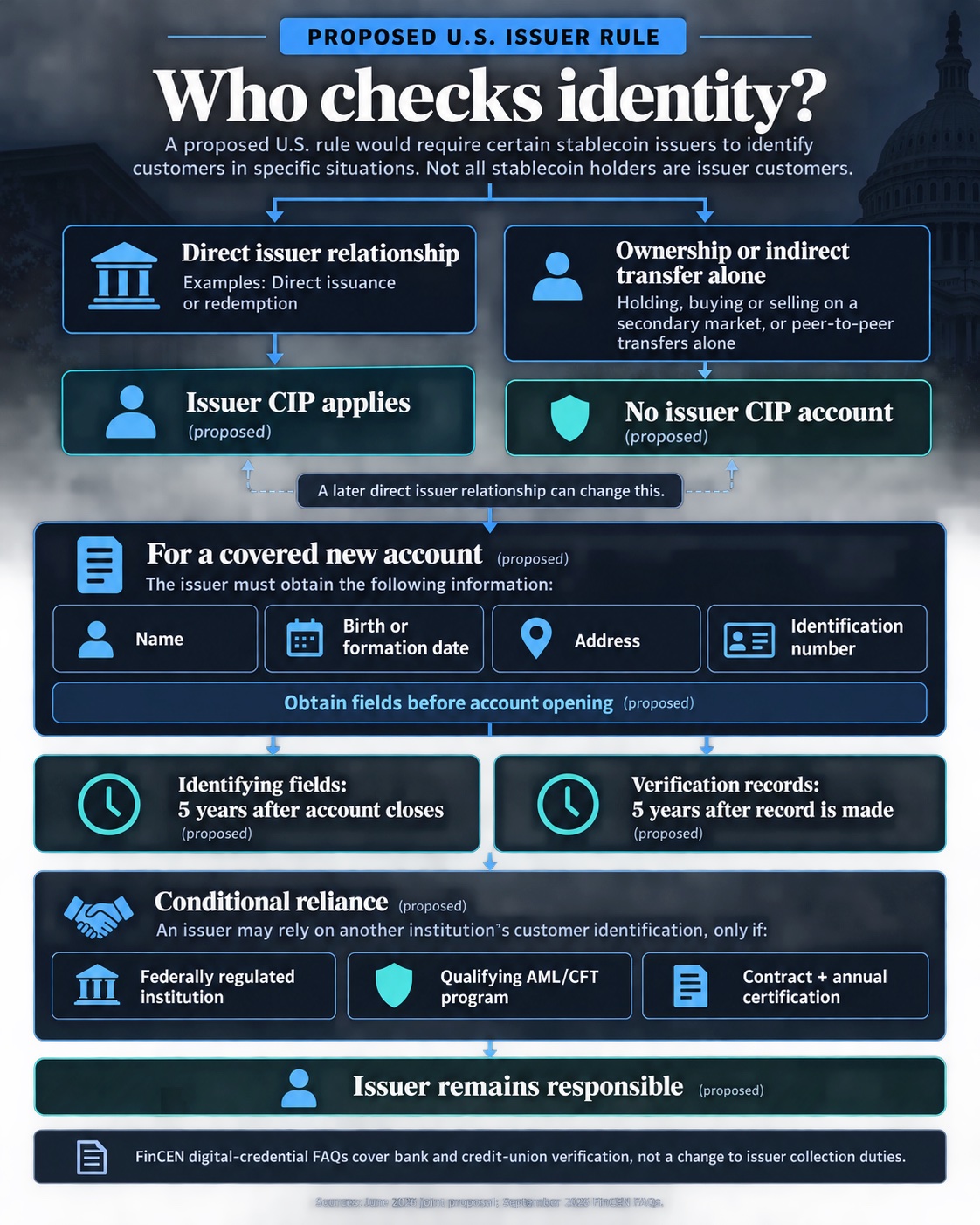
Flowchart of the proposed U.S. stablecoin issuer identity rule: direct issuer accounts require identifying fields and records, while ownership or indirect transfers alone do not; conditional reliance leaves the issuer responsible.Flowchart of the proposed U.S. stablecoin issuer identity rule: direct issuer accounts require identifying fields and records, while ownership or indirect transfers alone do not; conditional reliance leaves the issuer responsible.

FinCEN also said this month that banks and credit unions may use qualifying government-issued digital credentials, including mobile driver’s licenses, within their existing customer-identification programs.

See also  Crypto's market structure bill gets second shot with Senate's commodities-tied version

Those mechanisms stop short of the portable model Peirce described. Verification technology can change how an institution confirms an identity without necessarily eliminating its obligation to obtain prescribed customer information or maintain records.

The fight moves to the final rule

Regulators have left that question open.

FinCEN and the banking agencies explicitly asked whether the final stablecoin rule should address digital identity systems or verifiable credentials and what benefits and risks would accompany their use.

They acknowledged that a nongovernmental credential could allow someone to prove who they are without revealing additional information, but declined to include specific verifiable-credential provisions in the proposed regulatory text.

That creates room for the final rules to determine how much duplicate collection survives.

Regulators could broaden the circumstances in which stablecoin issuers rely on identity checks conducted elsewhere, give clearer recognition to cryptographically verifiable credentials, or allow firms to retain evidence that required checks occurred without keeping additional copies of the underlying documents where the law permits.

Related Reading

US bank lobby wants stablecoin holders to open an account before cashing out

For stablecoin companies, the outcome will determine whether compliance requires building another generation of databases containing customer identity information or investing in systems designed to verify required attributes while holding less of the raw data themselves.

The GENIUS Act has already settled that regulated issuers must know their customers. The remaining rulemaking will determine how many companies need to keep copies of the information used to prove who those customers are.

Cryptos Hester honeypots KYC Peirce SECs
Share. Facebook Twitter Pinterest LinkedIn Tumblr Email

Related Posts

The crypto privacy rule Trump’s Treasury proposed, and Trump’s Treasury buried

October 20, 2026

EU Joins 8 Nations to Sign Warsaw Protocol on Crypto Crime

October 19, 2026

Lummis Challenges Democrats Over Opposition to Crypto Market Structure Bill

October 19, 2026

French Assembly Backs Tax on Crypto-to-Stablecoin Swaps by One Vote

October 19, 2026
Add A Comment
Leave A Reply Cancel Reply

Top Posts

Crypto Markets Brace for Trump’s Tonight Event — Will TRUMP Price Pump or Sell-the-News Dump?

April 25, 2026

Is BTC Near a Bottom or Heading Toward $50K?

February 16, 2026

Stay ahead with the latest crypto news, market updates, blockchain insights, and trends. Your trusted source for everything happening in the digital asset world.


We're social. Connect with us:

Facebook X (Twitter) Instagram Pinterest YouTube
Top Insights

Mapping Financial Power In The Age Of Bitcoin

October 20, 2026

The crypto privacy rule Trump’s Treasury proposed, and Trump’s Treasury buried

October 20, 2026

Kraken Parent Payward Moves Into European Banking With Saldo Deal

October 20, 2026
Get Informed

Subscribe to Updates

Get the latest creative news From Free.cc directly in your Inbox!

  • Contact
  • Privacy Policy
  • Terms & Conditions
  • Disclosure
© 2026 free.cc - All rights reserved.

Type above and press Enter to search. Press Esc to cancel.