
Close Menu
  • Latest News
    • Bitcoin
    • Ethereum
    • Altcoins
    • Meme Coins
  • Tech
    • Blockchain
    • Security and Privacy
  • Web 3
    • Gaming
  • Legal
    • Legal and Regulatory
    • Adoption
  • Analysis
  • Learn
    • Education
    • Wallets and Exchanges
  • Tools
    • Market Overview
    • Exchange Tool
  • INFO@FREE.CC
What's Hot

GameFi is effectively dead as 93% of projects collapse

April 24, 2026

Ripple Joins BIS Taskforce For Cross Border Payments Expansion

April 24, 2026

The market repriced DeFi in just 48 hours

April 24, 2026
Facebook X (Twitter) Instagram
  • Contact
  • Privacy Policy
  • Terms & Conditions
  • Disclosure
Facebook X (Twitter) Instagram
Free.cc (Free Cryptocurrency)Free.cc (Free Cryptocurrency)
  • Latest News
    1. Bitcoin
    2. Ethereum
    3. Altcoins
    4. Meme Coins
    5. View All

    The market repriced DeFi in just 48 hours

    April 24, 2026

    Pantera Capital Urges Satsuma To Dump All Bitcoin As Shares Collapse 99%

    April 23, 2026

    Bitcoin funding hits 2023 lows – Why $80K is BTC’s next big test

    April 23, 2026

    Bitcoin Price Jumps Above $78K as Strong Demand Returns: Breakout Ahead?

    April 23, 2026

    Bitmine Stakes 61,232 ETH Worth $142M

    April 22, 2026

    Ethereum Targets Lower Range As Resistance Zone Comes Into Play

    April 22, 2026

    Ethereum Price Rises, But On-Chain Data Signals Weak Demand —What’s Next for ETH?

    April 21, 2026

    Ethereum’s Next Rally May Have Started: But No One Is Talking About It

    April 21, 2026

    Could Ripple XRP Power Cross-Border Payments? Russia’s Early Tests Suggest Potential

    April 23, 2026

    Crypto Billionaire Justin Sun Files Lawsuit Against Trump-Linked World Liberty Financial Over ‘Wrongfully’ Frozen Tokens

    April 23, 2026

    Ethereum Price Rejected Above $2,400, Upside Momentum Starts To Fade

    April 23, 2026

    CEO Calls CLARITY Act ‘Horrible Bill,’ Warns Of Prolonged Crypto Bear Market Ahead

    April 23, 2026

    Meme Coin Market Faces Imbalance as Supply Rises, Demand Falls

    April 4, 2026

    Crypto Interest Rising Toward Meme Coin Sector

    January 9, 2026

    Memes Market Cap Adds $10B in Days: Fresh Capital or Dead-Cat-Bounce?

    January 5, 2026

    Meme Coin Market Surges Past $45B as Shiba Inu, PEPE, BONK Stage 54% Price Pump

    January 4, 2026

    GameFi is effectively dead as 93% of projects collapse

    April 24, 2026

    Ripple Joins BIS Taskforce For Cross Border Payments Expansion

    April 24, 2026

    The market repriced DeFi in just 48 hours

    April 24, 2026

    Explosive Class Action Alleges False Advertising and Market Manipulation in Crypto AI Project

    April 23, 2026
  • Tech
    1. Blockchain
    2. Security and Privacy
    3. View All

    Ripple Joins BIS Taskforce For Cross Border Payments Expansion

    April 24, 2026

    ZetaChain Onboards Kimi and Alibaba Qwen as AI Models Go Cross-Chain

    April 23, 2026

    Monthly Active Addresses Explode – Analyzing the Surge in Layer-1 and Layer-2 Network Utility

    April 23, 2026

    AI agents that trade crypto autonomously are the next big shift in blockchain

    April 23, 2026

    How crypto futures markets are feeding ‘scam coin’ insider pump and dumps

    April 22, 2026

    North Korean Blamed for $290m KelpDAO Crypto Heist

    April 21, 2026

    Chainalysis Flags Critical Blind Spot in DeFi Security as $292M Exploit Bypasses Burn Verification

    April 21, 2026

    Ripple’s Schwartz Flags DeFi Bridge Trade-Offs After KelpDAO Incident

    April 21, 2026

    GameFi is effectively dead as 93% of projects collapse

    April 24, 2026

    Ripple Joins BIS Taskforce For Cross Border Payments Expansion

    April 24, 2026

    The market repriced DeFi in just 48 hours

    April 24, 2026

    Explosive Class Action Alleges False Advertising and Market Manipulation in Crypto AI Project

    April 23, 2026
  • Web 3
    1. Gaming
    2. View All

    GameFi is effectively dead as 93% of projects collapse

    April 24, 2026

    More than 90% of Web3 games failed after $15 billion boom as gamers never showed up: Caladan

    April 23, 2026

    Carbon 2.0: How dMRV Is Turning Carbon Credits Into Data-Driven Assets

    April 23, 2026

    UXLINK Taps ANOME Protocol to Redefine Web3 Gaming, SocialFi, and NFTFi

    April 23, 2026

    GameFi is effectively dead as 93% of projects collapse

    April 24, 2026

    Ripple Joins BIS Taskforce For Cross Border Payments Expansion

    April 24, 2026

    The market repriced DeFi in just 48 hours

    April 24, 2026

    Explosive Class Action Alleges False Advertising and Market Manipulation in Crypto AI Project

    April 23, 2026
  • Legal
    1. Legal and Regulatory
    2. Adoption
    3. View All

    Explosive Class Action Alleges False Advertising and Market Manipulation in Crypto AI Project

    April 23, 2026

    US admiral who blasted crypto is now running a Bitcoin node for America’s security

    April 23, 2026

    Mississippi Law School Requires AI Training as Courts Grapple With the Tech

    April 23, 2026

    Mob boss John Gotti’s grandson is headed to prison for a $1.1 million Covid fraud and crypto scheme

    April 23, 2026

    Oil tanker attacked after falling for crypto scam granting fake Strait of Hormuz safe passage

    April 21, 2026

    Six years after “DeFi Summer” is the sun already setting on the decentralized finance revolution?

    April 20, 2026

    Bitcoin network activity just hit an 8-year low — has Wall Street replaced retail in the market?

    April 19, 2026

    Charles Schwab is bringing uninsured Bitcoin to 39M clients

    April 19, 2026

    GameFi is effectively dead as 93% of projects collapse

    April 24, 2026

    Ripple Joins BIS Taskforce For Cross Border Payments Expansion

    April 24, 2026

    The market repriced DeFi in just 48 hours

    April 24, 2026

    Explosive Class Action Alleges False Advertising and Market Manipulation in Crypto AI Project

    April 23, 2026
  • Analysis

    US Bankers association push for 60 day pause to stop stablecoin rules going live

    April 23, 2026

    ZEC Price Prediction: Zcash Retests Key Level

    April 23, 2026

    Monero Price Analysis: XMR Presses $400 Resistance

    April 23, 2026

    Bitcoin’s uptrend towards $80,000 is increasingly attracting bears

    April 23, 2026

    Traders Bet on $100K Bitcoin Price as Breakout Rally Erases Weeks of Sideways Pain

    April 23, 2026
  • Learn
    1. Education
    2. Wallets and Exchanges
    3. View All

    What’s on the Ethereum Roadmap: Glamsterdam, Hegota and Beyond

    March 30, 2026

    What Is Bluesky? The Decentralized Social Media Rival to Elon Musk’s X

    March 27, 2026

    What Is Strategy (MSTR)? The Bitcoin Treasury Company

    February 21, 2026

    What Are Prediction Markets? How Polymarket, Kalshi and Myriad Work

    February 13, 2026

    Over 80% of Bitcoin ETF assets hit Coinbase custody choke point with $74B at risk

    April 13, 2026

    FTX begins $2.2B payout. Can Bitcoin absorb another liquidity test?

    March 31, 2026

    BlinkEx investment platform infrastructure – matching, risk controls, reliability

    March 21, 2026

    Over $2B in “lost” Bitcoin to hit markets this month creating sell pressure within fragile $67k–$74k range

    March 20, 2026

    GameFi is effectively dead as 93% of projects collapse

    April 24, 2026

    Ripple Joins BIS Taskforce For Cross Border Payments Expansion

    April 24, 2026

    The market repriced DeFi in just 48 hours

    April 24, 2026

    Explosive Class Action Alleges False Advertising and Market Manipulation in Crypto AI Project

    April 23, 2026
  • Tools
    • Market Overview
    • Exchange Tool
  • INFO@FREE.CC
Free.cc (Free Cryptocurrency)Free.cc (Free Cryptocurrency)
Home»Analysis»Google’s quantum breakthrough exposes over $ $600 billion in Bitcoin and Ethereum to risk
Analysis

Google’s quantum breakthrough exposes over $ $600 billion in Bitcoin and Ethereum to risk

March 31, 2026No Comments7 Mins Read
Share
Facebook Twitter LinkedIn Pinterest Email

A new paper from Google Quantum AI has sharply reduced the estimated hardware required to crack elliptic-curve cryptography used by Bitcoin and much of Ethereum, moving a long-running security debate closer to market terms.

At current market prices, the quantum computing risks could affect more than $600 billion in Bitcoin, Ethereum, and stablecoins.

The paper, co-authored by Google researchers, Ethereum Foundation researcher Justin Drake, and Stanford cryptographer Dan Boneh, says Shor’s algorithm for the 256-bit elliptic curve discrete logarithm problem can run with either no more than 1,200 logical qubits and 90 million Toffoli gates or no more than 1,450 logical qubits and 70 million Toffoli gates.

Google says those circuits could be executed on a superconducting, cryptographically relevant quantum computer with fewer than 500,000 physical qubits in a few minutes, roughly a 20-fold reduction from prior estimates of the number of physical qubits.

Notably, Google does not say such a machine exists today. Still, Ethereum Foundation’s Drake said his confidence in a so-called Q-day by 2032 had risen sharply and that he now sees at least a 10% chance that a quantum computer could recover a secp256k1 private key from an exposed public key by then.

Meanwhile, Google paired the paper with an unusual disclosure model, revealing that it engaged with the US government and used a zero-knowledge proof so outsiders could verify the resource estimates without receiving the underlying attack circuits.

The paper says progress in quantum computing has reached the point where publishing improved attack details in full has become less prudent, even as publishing trustworthy resource estimates remains necessary to motivate defenses.

As quantum ‘Q-Day' jumps to 2029, Ethereum faces a new fight over what to do with coins left in old wallets
Related Reading

As quantum ‘Q-Day’ jumps to 2029, Ethereum faces a new fight over what to do with coins left in old wallets

The Ethereum Foundation’s post-quantum roadmap argues that the real danger is a years-long struggle over how to move user wallets.

Mar 26, 2026 · Gino Matos

See also  Will today’s 1pm joint meeting change Bitcoin rules? ‘It’s a new day,’ say SEC–CFTC

Bitcoin’s problem is partly a race and partly a stockpile

For Bitcoin, the paper’s immediate market hook is timing. It models an “on-spend” attack in which a quantum machine derives a private key after a user reveals a public key by broadcasting a transaction, then tries to syndicate a competing transaction before the original payment is confirmed.

The paper says a fast-clock superconducting machine could reduce the live attack window to about 9 minutes from a primed state, close to Bitcoin’s roughly 10-minute average block time.
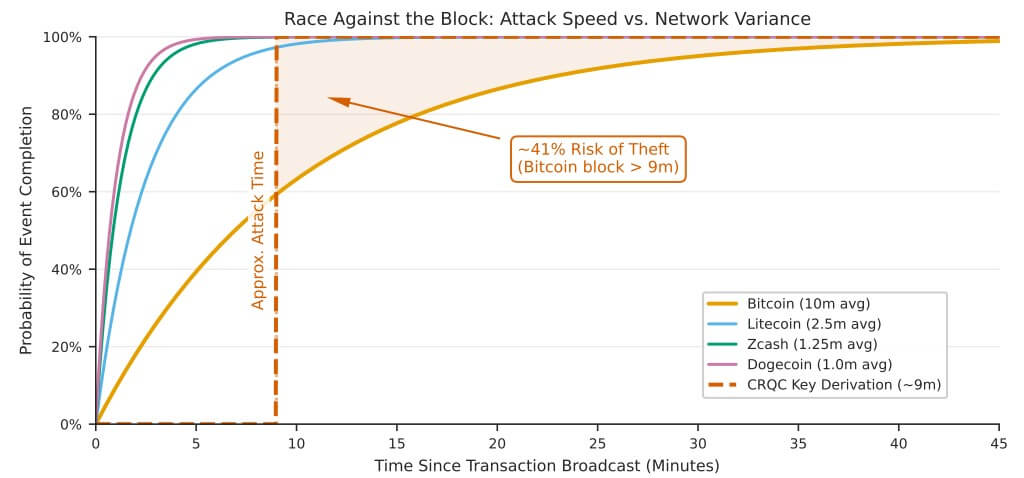
Bitcoin Quantum Computing Risk
Bitcoin Quantum Computing Risk (Source: Google)

Under the paper’s assumptions, that implies a theft success probability of slightly less than 41%.

Meanwhile, that is only one part of the Bitcoin story, as the paper pointed out that about 6.7 million BTC are sitting in vulnerable addresses. This is equivalent to roughly $444 billion, or nearly 32% of BTC’s total cap of 21 million coins.

Of this, the paper says old Pay-to-Public-Key scripts still secure more than 1.7 million BTC, worth about $112.6 billion at current market price, and that the total amount of dormant quantum-vulnerable Bitcoin may reach 2.3 million BTC across script types, or about $152.3 billion.

Those coins cannot all be migrated simply by asking current users to move funds, because many are thought to be abandoned, lost, or otherwise inactive.

Apart from that, the authors also argue that Taproot, despite its benefits for privacy and flexibility, reintroduced a quantum weakness because Pay-to-Taproot places the tweaked public key directly in the locking script.

They added that Grover-based attacks on Bitcoin mining remain impractical for decades, keeping the near-term focus on signatures rather than proof of work.

That leaves Bitcoin with two distinct problems. One is the risk of live transactions if a future fast-clock machine can reliably break keys within the settlement window. The other is a large stock of older or exposed coins that could become fixed targets in a post-CRQC world.

See also  Ethereum ICO Whale Turns $12K Into Millions

The paper explicitly states that every existing Bitcoin transaction type is vulnerable to on-spend attacks from a future fast-clock machine, while older P2PK outputs and modern P2TR outputs introduce at-rest exposure of their own.

This “quantum-safe” Bitcoin idea removes Taproot’s key-path — and raises fees on purpose
Related Reading

This “quantum-safe” Bitcoin idea removes Taproot’s key-path — and raises fees on purpose

If it ever activates, it’s opt-in and slow, because Bitcoin’s real constraint is coordination, not cryptography.

Feb 13, 2026 · Gino Matos

Ethereum’s quantum risk runs through wallets, validators, and tokenized assets

Meanwhile, the quantum risks for Ethereum are presented differently.

The paper says early fast-clock quantum computers are unlikely to launch the same kind of on-spend attack there because Ethereum produces blocks in deterministic 12-second slots, processes most transactions in less than a minute, and already relies heavily on private mempools.

Instead, the main quantum threat lies in at-rest attacks against long-lived accounts and the systems attached to them.

CryptoSlate Daily Brief

Daily signals, zero noise.

Market-moving headlines and context delivered every morning in one tight read.

5-minute digest 100k+ readers

Free. No spam. Unsubscribe any time.

Whoops, looks like there was a problem. Please try again.

You’re subscribed. Welcome aboard.

The paper estimates that a fast-clock attacker could crack the 1,000 highest-net-worth Ethereum accounts, holding about 20.5 million ETH, in less than nine days. At Tuesday’s ETH price of about $2,023.46, that comes to roughly $41.5 billion.
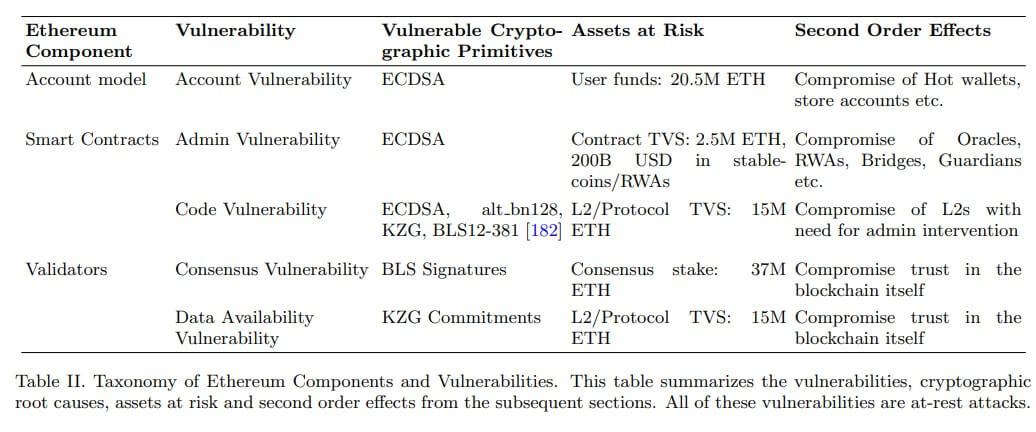
Ethereum Quantum Computing Risks
Ethereum Quantum Computing Risks (Source: Google)

Among the top 500 contract accounts by ETH balance, it says at least 70 accounts holding about 2.5 million ETH are exposed through administrative keys, a bucket worth about $5.1 billion at current prices, with a private-key derivation attack on those accounts taking less than 15 hours on a fast-clock machine.

Meanwhile, the larger institutional story sits behind those balances. The paper links that admin vulnerability to about $200 billion in stablecoins and tokenized real-world assets on Ethereum and says those keys can function as control points for issuers, bridges, oracle operators, and emergency guardians.

See also  Strategy slashes Bitcoin price target, prepares $1.4B cash reserve

The paper warned that a successful quantum attack on such accounts could allow arbitrary minting, false price feeds, frozen user funds, or drained liquidity pools, depending on the system. The paper says this is why standard asset-balance models understate the true value-at-risk.

It then widens the lens further. In its Ethereum risk taxonomy, the paper flags about 15 million ETH in Layer 2 and protocol value exposed through code and data-availability vulnerabilities, equal to roughly $30.4 billion at current prices, and about 37 million ETH in consensus stake exposed through BLS-signature-related risk, or about $74.9 billion.

Those figures overlap with other components of Ethereum’s architecture, but together they show why the paper treats Ethereum as a broader infrastructure problem rather than a wallet-security story.

The pressure shifts from theory to migration

Against this backdrop, the industry is left to ask whether blockchains, wallets, exchanges, and tokenized-asset issuers can migrate before the economics of attack shift.

Charles Guillemet, the Chief Technology Officer (CTO) at Ledger, said:

“The good news is that we already have the tools: Post Quantum Cryptography, now we need to migrate.”

However, the Google paper says the process will take years, and the industry cannot wait for perfect clarity on the exact arrival date of cryptographically relevant quantum computers.

According to the firm, it will require both protocol work and changes in wallet behavior, including reducing public-key exposure and ending key reuse wherever possible.

Essentially, vulnerable cryptocurrency communities should move to post-quantum cryptography without delay.

For Bitcoin, that means a race against a settlement window that no longer looks comfortably wide. For Ethereum, it means protecting not just coins but the much larger stack of contracts and tokenized claims now resting on the same vulnerable math.

Mentioned in this article
Billion Bitcoin Breakthrough Ethereum Exposes Googles Quantum Risk
Share. Facebook Twitter Pinterest LinkedIn Tumblr Email

Related Posts

US Bankers association push for 60 day pause to stop stablecoin rules going live

April 23, 2026

More than 90% of Web3 games failed after $15 billion boom as gamers never showed up: Caladan

April 23, 2026

US admiral who blasted crypto is now running a Bitcoin node for America’s security

April 23, 2026

Pantera Capital Urges Satsuma To Dump All Bitcoin As Shares Collapse 99%

April 23, 2026
Add A Comment
Leave A Reply Cancel Reply

Top Posts

Is RIVER Price Set to Exceed $45 or Enter a Cool-Off Period?

January 20, 2026

Custodiy and Fomo.in Partner to Bridge Web3 Infrastructure and Market Growth

November 30, 2025

Stay ahead with the latest crypto news, market updates, blockchain insights, and trends. Your trusted source for everything happening in the digital asset world.


We're social. Connect with us:

Facebook X (Twitter) Instagram Pinterest YouTube
Top Insights

GameFi is effectively dead as 93% of projects collapse

April 24, 2026

Ripple Joins BIS Taskforce For Cross Border Payments Expansion

April 24, 2026

The market repriced DeFi in just 48 hours

April 24, 2026
Get Informed

Subscribe to Updates

Get the latest creative news From Free.cc directly in your Inbox!

  • Contact
  • Privacy Policy
  • Terms & Conditions
  • Disclosure
© 2026 free.cc - All rights reserved.

Type above and press Enter to search. Press Esc to cancel.