
Close Menu
  • Latest News
    • Bitcoin
    • Ethereum
    • Altcoins
    • Meme Coins
  • Tech
    • Blockchain
    • Security and Privacy
  • Web 3
    • Gaming
  • Legal
    • Legal and Regulatory
    • Adoption
  • Analysis
  • Learn
    • Education
    • Wallets and Exchanges
  • Tools
    • Market Overview
    • Exchange Tool
What's Hot

Why some Bitcoin investors may be waiting for a drop to $42.4k

July 14, 2026

Coinbase Smart Wallet Verification Upgrade Targets The Multi-Chain UX Problem

July 14, 2026

Curve DAO Price Surges 10% as Breakout Sparks Hope of a 50% Rally

July 14, 2026
Facebook X (Twitter) Instagram
  • Contact
  • Privacy Policy
  • Terms & Conditions
  • Disclosure
Facebook X (Twitter) Instagram
Free.cc (Free Cryptocurrency)Free.cc (Free Cryptocurrency)
  • Latest News
    1. Bitcoin
    2. Ethereum
    3. Altcoins
    4. Meme Coins
    5. View All

    Why some Bitcoin investors may be waiting for a drop to $42.4k

    July 14, 2026

    Crypto ETFs Gaining Attention Amid Market Uncertainty

    July 14, 2026

    Michael Saylor’s Strategy Increases Cash Reserve by $450,000,000, Goes Third Consecutive Week Without Buying Any Bitcoin

    July 14, 2026

    Binance.US CEO says exchange is rebuilding, eyes return to 20% U.S. market share

    July 14, 2026

    Ethereum Bullish Signals Strengthen as Whale Accumulation, Lean Ethereum Roadmap Fuel Optimism

    July 13, 2026

    Which way is Ethereum headed? What to expect as bulls and bears fight for ETH

    July 13, 2026

    Ethereum Foundation Deploys AI Agents to Hunt Bugs in Protocol Code

    July 13, 2026

    Is Ethereum Price Entering an Accumulation Phase? Key Technical Signals to Watch

    July 13, 2026

    Coinbase Smart Wallet Verification Upgrade Targets The Multi-Chain UX Problem

    July 14, 2026

    VELVET crypto rallies 29% – Can 2,500 new holders sustain the rally?

    July 14, 2026

    Circle Secures OCC Approval for National Trust Bank to Custody USDC and Digital Assets

    July 14, 2026

    Here’s why Zcash’s Orchard flaw puts pre-disclosure trading under the spotlight

    July 13, 2026

    CASHCAT Soars 1,600% Amid Robinhood Memecoin Frenzy

    July 8, 2026

    Crypto Market Sectors Retreat as Meme Tokens Lead Daily Declines

    July 7, 2026

    Why Memecoins May Never Return to Their All-Time Highs

    July 4, 2026

    How Solana Meme Coin ANSEM Exploded 600x in One Day

    June 29, 2026

    Why some Bitcoin investors may be waiting for a drop to $42.4k

    July 14, 2026

    Coinbase Smart Wallet Verification Upgrade Targets The Multi-Chain UX Problem

    July 14, 2026

    Curve DAO Price Surges 10% as Breakout Sparks Hope of a 50% Rally

    July 14, 2026

    Crypto ETFs Gaining Attention Amid Market Uncertainty

    July 14, 2026
  • Tech
    1. Blockchain
    2. Security and Privacy
    3. View All

    Merck and Hashgraph Group launch Hedera-based product passport for EU compliance

    June 12, 2026

    COTI and Midnight Foundation Partner to Advance the Global Privacy Ecosystem

    June 11, 2026

    Cardano Gets Exposure From Olympics Committee

    June 11, 2026

    How Privacy and Composability Trade-Offs Differ

    June 11, 2026

    Robinhood Chain tokens are reportedly vanishing from wallets causing buyers to lose funds

    July 14, 2026

    One crypto wallet tied to a 20-year-old fraudster processed over $122M before Interpol closed in

    July 13, 2026

    Convicted scammer’s “seized” crypto moves to unknown wallets while in prison as DOJ failed to secure funds

    July 13, 2026

    Relay Protocol Warns of Robinhood Chain Honeypot Coins

    July 10, 2026

    Why some Bitcoin investors may be waiting for a drop to $42.4k

    July 14, 2026

    Coinbase Smart Wallet Verification Upgrade Targets The Multi-Chain UX Problem

    July 14, 2026

    Curve DAO Price Surges 10% as Breakout Sparks Hope of a 50% Rally

    July 14, 2026

    Crypto ETFs Gaining Attention Amid Market Uncertainty

    July 14, 2026
  • Web 3
    1. Gaming
    2. View All

    Yield Guild Games Sunsets YGG Play Publishing Unit, Cuts 35 Jobs

    July 7, 2026

    GO1 and Xiaohai Set up Potential Rematch at EWC 2026 Fatal Fury Bracket in Paris

    July 6, 2026

    CoinIQ Crypto Analysis: The Anti-FOMO Crypto App That Grades Coins Before You Buy

    July 3, 2026

    Hur Blockchain och NFT-teknologi Förändrar Kasinobranschen för Alltid

    June 29, 2026

    Why some Bitcoin investors may be waiting for a drop to $42.4k

    July 14, 2026

    Coinbase Smart Wallet Verification Upgrade Targets The Multi-Chain UX Problem

    July 14, 2026

    Curve DAO Price Surges 10% as Breakout Sparks Hope of a 50% Rally

    July 14, 2026

    Crypto ETFs Gaining Attention Amid Market Uncertainty

    July 14, 2026
  • Legal
    1. Legal and Regulatory
    2. Adoption
    3. View All

    Trump Pushes Senators To Pass Clarity Act in Wake of Lindsey Graham’s Death As Crypto Bill’s Polymarket Odds Dwindle

    July 14, 2026

    After MiCA deadline, majority of Binance users sent funds to self-custody not other compliant exchanges

    July 13, 2026

    Ripple CEO says SEC suit nearly pushed company to shut down

    July 13, 2026

    Crypto won the ETF fight but now the SEC is questioning if things have gone too far

    July 12, 2026

    Crypto exchanges are becoming the new distribution channel for Wall Street assets

    July 14, 2026

    Tether’s $20 billion mountain of gold – equal to a national reserve

    July 13, 2026

    A $407 million Treasury fund reveals how Wall Street is building crypto’s missing collateral layer

    July 12, 2026

    Trump’s crypto disclosure exposes an institutional problem that markets price in real time

    July 12, 2026

    Why some Bitcoin investors may be waiting for a drop to $42.4k

    July 14, 2026

    Coinbase Smart Wallet Verification Upgrade Targets The Multi-Chain UX Problem

    July 14, 2026

    Curve DAO Price Surges 10% as Breakout Sparks Hope of a 50% Rally

    July 14, 2026

    Crypto ETFs Gaining Attention Amid Market Uncertainty

    July 14, 2026
  • Analysis

    Curve DAO Price Surges 10% as Breakout Sparks Hope of a 50% Rally

    July 14, 2026

    Internet Computer (ICP) and Chainlink (LINK) Top AI Development Rankings—Could They Lead the Next Crypto Rally?

    July 14, 2026

    ALLO Price Jumps 40% While BILL Surges 45% as AI Crypto Narrative Accelerates

    July 14, 2026

    Decred Price Eyes $23 as Growing On-Chain Activity Meets Key Technical Barrier

    July 13, 2026

    CRCL Stock Could Revisit Its 52-Week Low: Here’s Why

    July 13, 2026
  • Learn
    1. Education
    2. Wallets and Exchanges
    3. View All

    What Is Robinhood Chain? The Ethereum Layer-2 Network for Tokenized Stocks

    July 12, 2026

    What Is BChat? The Decentralized Messaging App Built for Privacy

    June 2, 2026

    What Is an AI Prompt Injection Attack? The Hidden Threat Hijacking Your Chatbots

    May 31, 2026

    What Is AI Jailbreaking? A Beginner’s Guide to the Cat-and-Mouse Game Behind Every Chatbot

    May 17, 2026

    Hong Kong gives crypto platforms one year to ditch one-time passwords or cover user losses

    July 11, 2026

    Coinbase World Cup error shows prediction markets still have a proof problem

    July 7, 2026

    Coinbase helped build USDC – Why is it now backing the stablecoin trying to replace it, Open USD?

    July 3, 2026

    Robinhood’s expanding crypto bet meets a faster-moving prediction market boom

    July 2, 2026

    Why some Bitcoin investors may be waiting for a drop to $42.4k

    July 14, 2026

    Coinbase Smart Wallet Verification Upgrade Targets The Multi-Chain UX Problem

    July 14, 2026

    Curve DAO Price Surges 10% as Breakout Sparks Hope of a 50% Rally

    July 14, 2026

    Crypto ETFs Gaining Attention Amid Market Uncertainty

    July 14, 2026
  • Tools
    • Market Overview
    • Exchange Tool
Free.cc (Free Cryptocurrency)Free.cc (Free Cryptocurrency)
Home»Analysis»CZ called Hyperliquid’s no KYC model “awesome”
Analysis

CZ called Hyperliquid’s no KYC model “awesome”

June 24, 2026No Comments9 Mins Read
Share
Facebook Twitter LinkedIn Pinterest Email

Hyperliquid’s biggest advantage is starting to look like its cleanest legal risk: the no-KYC access model CZ says Binance cannot copy.

In a Galaxy Brains episode published June 18, Galaxy’s Alex Thorn spoke with Binance founder Changpeng Zhao about the crypto cycle, perps moving onshore, prediction markets, and Hyperliquid’s no-KYC model.

Thorn’s June 16 clip made the distinction clear: CZ praised Hyperliquid’s product, said Binance cannot compete with a niche built around no KYC and claimed decentralization, and said he would not run that model given his own experience.

The discussion has also evolved beyond CZ simply saying Binance cannot compete in Hyperliquid’s niche. Subsequent chatter focused on his saying Hyperliquid’s model was “awesome,” but also noted that he assumed the project had “good lawyers.” That remark exposed the regulatory dimension of the debate by tying the platform’s competitive edge directly to legal and compliance risk.

That distinction turns a product compliment into a market-structure problem. One derivatives platform now faces a broader conflict over which parts of on-chain perps-regulated exchanges can copy.

Hyperliquid’s moat includes more than faster trading, crypto-native design, or trader loyalty. It is the ability to offer perpetual futures-like markets with an access model that feels different from a centralized exchange operating under the compliance expectations now attached to major global venues.

If on-chain perps keep growing because they feel open, fast, and less intermediated, the policy conflict becomes whether that same openness can survive scrutiny of who is being served, what products are being offered, and who is responsible when a venue claims decentralization.
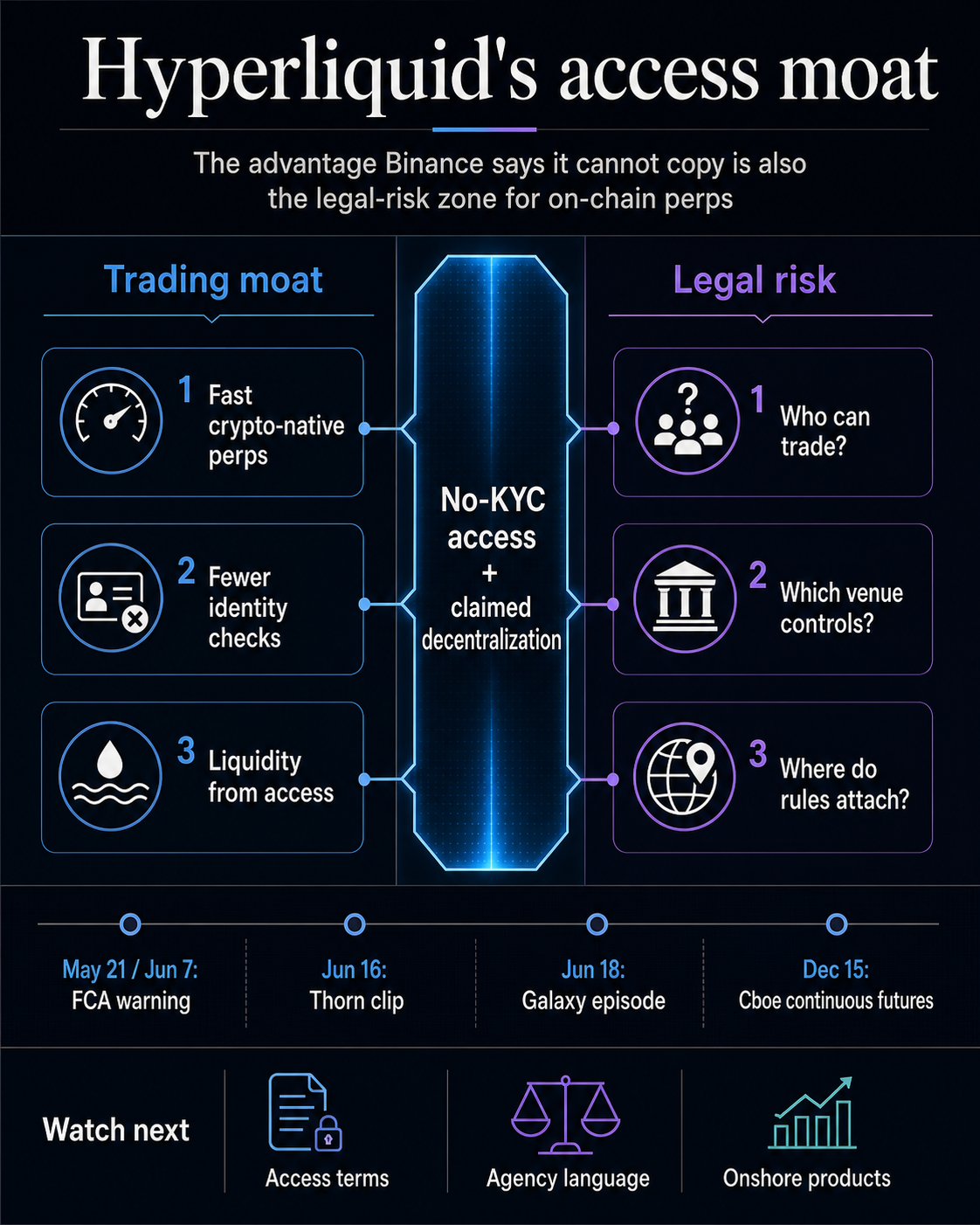
Infographic showing Hyperliquid's no-KYC access moat split between trading advantages and legal-risk questions.

The access advantage CZ pointed to

CZ’s answer carries weight because Binance is the exchange most associated with global crypto derivatives scale, and because he separated product admiration from operating risk. Hyperliquid can be good at what it does while running in a lane Binance does not want to enter.

That distinction is the core of the market-structure fight. Regulated venues can improve matching engines, extend trading hours, list more crypto-linked contracts, and design products that more closely resemble perpetual exposure.

The harder part to reproduce is the user experience of trading without the same identity checks, jurisdictional filters, or centralized compliance gates that come with regulated exchange status.

Hyperliquid’s own terms and onboarding documentation are therefore part of the operating risk. The exact wording around access, eligible users, restricted jurisdictions, and user obligations is where the trading model becomes a policy object.

A product can be technically decentralized in some ways and still draw scrutiny over who operates the interface, who promotes access, and how users from restricted markets are kept out.

See also  Trader Who Called 2021 Crypto Collapse Details Bullish Gold Price Target, Says Bitcoin Eyeing $110,000

The clearest implication of CZ’s remarks is that Hyperliquid is competing from a different risk position. Binance can compete on liquidity, listings, brand, and infrastructure.

It is much harder for Binance to compete by giving up the compliance posture that now defines its global operating model.

The practical consequence is simple. If no-KYC access is what traders value most, then the market leader in that lane may be the venue most exposed to the question of whether the model can keep scaling without becoming more like the exchanges it disrupted.

The access model also reaches beyond derivatives specialists. The trading edge sits in a user promise: fewer barriers between a trader and a leveraged market.

That promise can drive liquidity, but it also gives regulators a concrete place to examine who controls the market and which users are being reached.

Why the legal risk is already visible

The legal risk is concrete but bounded. CZ was offering his own view, not a regulatory finding, and the concrete official marker is a UK warning rather than a US action.

The UK’s Financial Conduct Authority has published a warning page for Hyperliquid, first posted on May 21 and updated on June 7, saying the firm may be providing or promoting financial services without permission and may be targeting people in the UK.

As of press time, the warning remains active and continues to frame Hyperliquid as an unauthorized firm that may be targeting UK users. It has become one of the clearest public examples of regulators treating a major on-chain perpetuals venue as more of a financial-services provider than a neutral software infrastructure.

Hyperliquid’s UK warning reveals the regulatory test behind its Wall Street push
Related Reading

Hyperliquid’s UK warning reveals the regulatory test behind its Wall Street push

Hyperliquid’s growing derivatives market has pulled in traders and drawn a UK warning.

Jun 6, 2026 · Oluwapelumi Adejumo

That warning already put Hyperliquid’s Wall Street ambitions under a regulatory lens, while CZ’s remarks add a different concern. Regulators may also ask whether the same no-KYC posture that makes the platform hard to match also makes it hard to normalize.

US history gives that risk sharper edges without making Hyperliquid the target of the same facts. In 2022, the CFTC brought its action against bZeroX and Ooki DAO, alleging illegal off-exchange digital-asset trading, registration failures, and Bank Secrecy Act violations tied to leveraged and margined retail commodity transactions.

The action carries a limited lesson: US derivatives regulators have previously argued that decentralized or DAO-linked structures can still fall within regulatory reach.

That precedent leaves Hyperliquid outside the facts of the case while showing why officials may focus on access. If a venue offers products that behave like derivatives and reaches users regulators believe should be protected or screened, the debate can shift from code and community to promotion, venue control, and accountability.

See also  US Bitcoin ETFs are on their longest inflow streak this year as funds hit near 7% of BTC supply

Decentralization claims carry a double edge. The more credibly a platform can demonstrate that it operates outside the conventional intermediary model, the stronger its argument against being treated as one.

The more users experience it through identifiable front ends, promotional channels, market incentives, and practical controls, the easier it becomes for regulators to ask who is actually responsible for the market.

For traders, decentralization becomes practical rather than rhetorical. The more a venue relies on visible interfaces, incentives, and user flows, the more officials can focus on the parts of the system that still appear to be governed by people, policies, and market design choices.

Onshore products change the comparison

The other half of the competitive risk is regulated market design. Galaxy’s episode description placed CZ’s Hyperliquid remarks alongside perps coming onshore at CME and CBOE.

The product gap between offshore crypto-native venues and regulated markets is not static.

CryptoSlate Daily Brief

Daily signals, zero noise.

Market-moving headlines and context delivered every morning in one tight read.

5-minute digest 100k+ readers

Free. No spam. Unsubscribe any time.

Whoops, looks like there was a problem. Please try again.

You’re subscribed. Welcome aboard.

Cboe announced in November 2025 that its futures exchange offering continuous futures for Bitcoin and Ether.

The exchange’s Bitcoin and Ether Continuous Futures are trading as U.S.-regulated products designed to provide perpetual-style exposure through long-dated contracts with daily funding adjustments.

The policy fight over crypto perpetual futures regulation and related venue-classification disputes has also intensified as prediction markets and perps-like products press against older market categories.
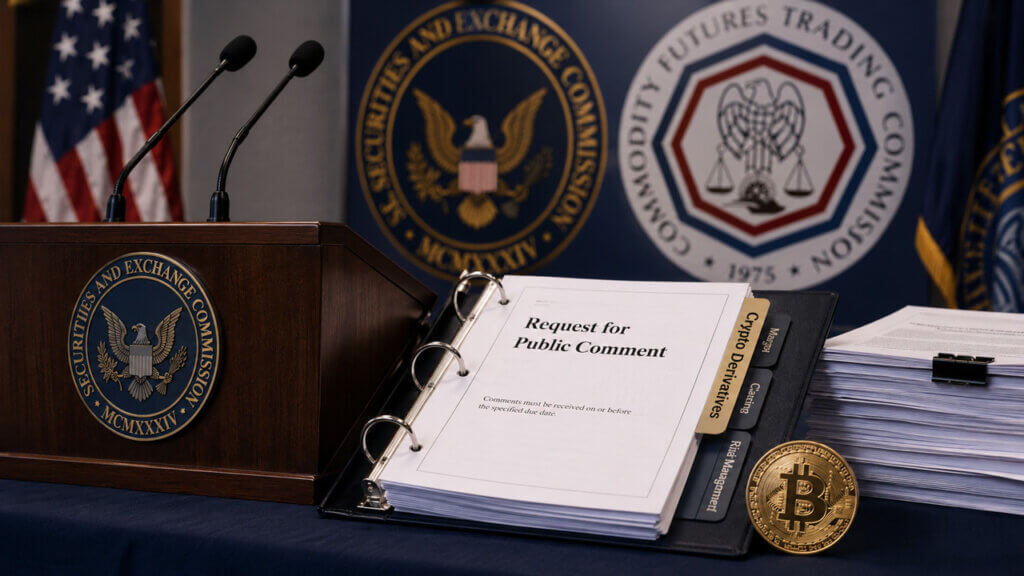
Crypto traders may finally get US perps, if regulators can agree on the rules
Related Reading

Crypto traders may finally get US perps, if regulators can agree on the rules

The SEC-CFTC comment process could decide which US venues can list crypto perps, event contracts, and hybrid derivatives.

Jun 21, 2026 · Liam ‘Akiba’ Wright

The comparison still depends on product design and legal status. Regulated continuous futures differ from Hyperliquid-style on-chain perps in custody, margining, venue control, access, and the operator’s legal status.

But the more regulated venues bring continuous crypto exposure onshore, the more competition shifts. Hyperliquid’s defense has to rest on the whole package, including access, on-chain settlement, and market culture, remaining meaningfully different.

CZ’s remarks land there. If regulated exchanges can close part of the product gap while preserving KYC and venue oversight, Hyperliquid’s advantage becomes more concentrated in the part regulated players least want to copy.

See also  Strategy selling? Saylor's Bitcoin transfer to Coinbase puts his treasury model under cash pressure

That is good for differentiation until it becomes the exact part regulators treat as unacceptable.

The policy fight around prediction markets adds another layer. As perps-like exposure, event contracts, and continuous futures move closer to regulated venues, agencies and courts will have more chances to define which products belong under which rules.

CME lawsuit challenges whether Kalshi’s Bitcoin leverage push can become an everything-exchange
Related Reading

CME lawsuit challenges whether Kalshi’s Bitcoin leverage push can become an everything-exchange

CME’s lawsuit against the CFTC over Kalshi’s Bitcoin perps shows how the fight over crypto derivatives is turning into a broader battle over who gets to build the next everything-exchange.

Jun 19, 2026 · Gino Matos

That makes the distinction between product shape and access model more important. Hyperliquid can win traders with a different experience, but that experience is exactly what makes future official language important.

A regulated venue can reduce the product gap without changing the access gap. That distinction is the reason CZ’s remarks cut through ordinary exchange rivalry.

If onshore markets keep improving, the remaining advantage shifts toward the feature that carries the most policy pressure: who can trade, from where, and under which checks.

Access changes would define the moat

Hyperliquid’s own public language now carries more weight: terms, onboarding, jurisdiction blocks, front-end controls, and any shift in how the platform describes user eligibility.

A move toward stronger identity checks or heavier geofencing could leave the product intact while testing how much of the moat came from access rather than execution.

Regulatory language would carry the second major marker. Another FCA-style warning, a US agency statement, a derivatives venue action, or a court fight over a perps-like product would carry more weight than generic debate over whether the platform is decentralized enough.

The important marker is what regulators identify as the problem: the product, the users reached, the operator, the interface, or the lack of checks.

The onshore market is the third marker. If CME, Cboe, Kalshi-style venues, or other regulated platforms keep adding crypto exposure that feels closer to perpetual trading, Hyperliquid will be competing against better legal certainty on one side and looser access on the other.

That is a powerful position only if traders continue to value the access premium more than the regulatory discount.

CZ’s remarks put that tension in unusually plain language. Hyperliquid’s moat may be real precisely because Binance cannot copy it.

The unresolved risk is whether the same moat can survive the legal pressure that follows when on-chain perps become too important for regulators and regulated exchanges to ignore.

awesome Called Hyperliquids KYC Model
Share. Facebook Twitter Pinterest LinkedIn Tumblr Email

Related Posts

Curve DAO Price Surges 10% as Breakout Sparks Hope of a 50% Rally

July 14, 2026

Internet Computer (ICP) and Chainlink (LINK) Top AI Development Rankings—Could They Lead the Next Crypto Rally?

July 14, 2026

ALLO Price Jumps 40% While BILL Surges 45% as AI Crypto Narrative Accelerates

July 14, 2026

Decred Price Eyes $23 as Growing On-Chain Activity Meets Key Technical Barrier

July 13, 2026
Add A Comment
Leave A Reply Cancel Reply

Top Posts

Oracle Unveils Digital Assets Platform for Banks

October 31, 2025

What’s Stopping Cardano (ADA) Price From Smashing $1?

September 20, 2025

Stay ahead with the latest crypto news, market updates, blockchain insights, and trends. Your trusted source for everything happening in the digital asset world.


We're social. Connect with us:

Facebook X (Twitter) Instagram Pinterest YouTube
Top Insights

Why some Bitcoin investors may be waiting for a drop to $42.4k

July 14, 2026

Coinbase Smart Wallet Verification Upgrade Targets The Multi-Chain UX Problem

July 14, 2026

Curve DAO Price Surges 10% as Breakout Sparks Hope of a 50% Rally

July 14, 2026
Get Informed

Subscribe to Updates

Get the latest creative news From Free.cc directly in your Inbox!

  • Contact
  • Privacy Policy
  • Terms & Conditions
  • Disclosure
© 2026 free.cc - All rights reserved.

Type above and press Enter to search. Press Esc to cancel.