

Close Menu
  • Latest News
    • Bitcoin
    • Ethereum
    • Altcoins
    • Meme Coins
  • Tech
    • Blockchain
    • Security and Privacy
  • Web 3
    • Gaming
  • Legal
    • Legal and Regulatory
    • Adoption
  • Analysis
  • Learn
    • Education
    • Wallets and Exchanges
  • Tools
    • Market Overview
    • Exchange Tool
What's Hot

OpenZeppelin and T-REX Network Introduce new Framework for Regulated Token Eligibility and Recovery

October 3, 2026

Visa Says Business Payments Now Drive 17% Of Stablecoin-Linked Card Volume

October 3, 2026

Wall Street giant BNY discusses infrastructure tie-up with Kraken parent Payward

October 3, 2026
Facebook X (Twitter) Instagram
  • Contact
  • Privacy Policy
  • Terms & Conditions
  • Disclosure
Facebook X (Twitter) Instagram
Free.cc (Free Cryptocurrency)Free.cc (Free Cryptocurrency)
  • Latest News
    1. Bitcoin
    2. Ethereum
    3. Altcoins
    4. Meme Coins
    5. View All

    Wall Street giant BNY discusses infrastructure tie-up with Kraken parent Payward

    October 3, 2026

    IMF Praises El Salvador But Tries To Scale Back Bitcoin Use

    October 3, 2026

    Bitcoin ETFs record $102M inflows – Why $85K matters for BTC now

    October 3, 2026

    Bitcoin Is Up, DeFi Is Recovering, So Why Doesn’t This Look Like a Bull Market Yet?

    October 3, 2026

    SEC Approves 3x Leveraged Bitcoin Ether & Other ETPs for Listing

    October 3, 2026

    Ethereum: Why ETH faces October reversal risk after 70% Q3 rally

    October 3, 2026

    Why Did Blast Decide to Wind Down Its L2?

    October 2, 2026

    Bitcoin Q3 Strength Faces a Tougher Q4 Test

    October 1, 2026

    Visa Says Business Payments Now Drive 17% Of Stablecoin-Linked Card Volume

    October 3, 2026

    Fidelity exec’s new 60/20/20 portfolio makes room for crypto – Here’s why

    October 3, 2026

    Can NEAR crypto rebound? THESE metrics could decide what’s next

    October 3, 2026

    Polymath And CineCity Explore Regulated Tokenized Film Investment Platform

    October 3, 2026

    Thinking Cat Gains Momentum After CASHCAT’s Breakout

    August 12, 2026

    What Tokens Could He Target?

    July 30, 2026

    The Next Meme Coin Winner Could Be Determined by Incentives, Not Memes

    July 30, 2026

    Why Is BOME’s Price Up Today? Finally, Capital Rotating to the Meme Coins?

    July 28, 2026

    OpenZeppelin and T-REX Network Introduce new Framework for Regulated Token Eligibility and Recovery

    October 3, 2026

    Visa Says Business Payments Now Drive 17% Of Stablecoin-Linked Card Volume

    October 3, 2026

    Wall Street giant BNY discusses infrastructure tie-up with Kraken parent Payward

    October 3, 2026

    FBI Top 10 Fugitive Sanctioned by OFAC for Crypto Laundering

    October 3, 2026
  • Tech
    1. Blockchain
    2. Security and Privacy
    3. View All

    OpenZeppelin and T-REX Network Introduce new Framework for Regulated Token Eligibility and Recovery

    October 3, 2026

    GMX Sponsors Arbitrum’s Open House Singapore as Buildathon

    October 3, 2026

    Ceteris Introduces Tokenized Stocks via Crypto Neobanks

    October 3, 2026

    New SIMD-0675 Proposal Aims to Streamline Block Production

    October 3, 2026

    Masked Robbers Threaten Pregnant Wife in UK Crypto Home Attack

    October 3, 2026

    Bitcoin Lightning Nodes Targeted as Core Lightning Sounds Alarm

    October 2, 2026

    The $459,000 Bot Hacker Was a Customer First, Researchers Say

    October 2, 2026

    Metamask Pulls Validators as Meager ETH Theft Sounds Big Alarm

    October 2, 2026

    OpenZeppelin and T-REX Network Introduce new Framework for Regulated Token Eligibility and Recovery

    October 3, 2026

    Visa Says Business Payments Now Drive 17% Of Stablecoin-Linked Card Volume

    October 3, 2026

    Wall Street giant BNY discusses infrastructure tie-up with Kraken parent Payward

    October 3, 2026

    FBI Top 10 Fugitive Sanctioned by OFAC for Crypto Laundering

    October 3, 2026
  • Web 3
    1. Gaming
    2. View All

    Top 12 NFT games every player should know about in August 2026

    September 22, 2026

    GameShame Studios founder details Raijin Protocol’s roadmap in NeoPod’s sixth AMA

    September 22, 2026

    Proof of Play to shut down after blockchain gaming thesis falls short

    September 22, 2026

    How BC.GAME is turning players into stakeholders

    September 22, 2026

    OpenZeppelin and T-REX Network Introduce new Framework for Regulated Token Eligibility and Recovery

    October 3, 2026

    Visa Says Business Payments Now Drive 17% Of Stablecoin-Linked Card Volume

    October 3, 2026

    Wall Street giant BNY discusses infrastructure tie-up with Kraken parent Payward

    October 3, 2026

    FBI Top 10 Fugitive Sanctioned by OFAC for Crypto Laundering

    October 3, 2026
  • Legal
    1. Legal and Regulatory
    2. Adoption
    3. View All

    FBI Top 10 Fugitive Sanctioned by OFAC for Crypto Laundering

    October 3, 2026

    CFTC wins $31M Fundsz fraud order as crypto scam losses mount worldwide

    October 3, 2026

    583 Companies Go Public in 18 Months, Says SEC Chairman

    October 3, 2026

    New SEC crypto rules threaten small advisers, but big firms win

    October 3, 2026

    Stablecoin issuers have replaced 40% of China’s lost US Treasury demand

    October 3, 2026

    Bitcoin’s $113,000 case strengthens as US regulators push 9 crypto actions

    October 2, 2026

    Bitget restores $300M fund after absorbing $388M security breach

    October 2, 2026

    Ripple’s biggest institutional bet may now be Brazil

    October 1, 2026

    OpenZeppelin and T-REX Network Introduce new Framework for Regulated Token Eligibility and Recovery

    October 3, 2026

    Visa Says Business Payments Now Drive 17% Of Stablecoin-Linked Card Volume

    October 3, 2026

    Wall Street giant BNY discusses infrastructure tie-up with Kraken parent Payward

    October 3, 2026

    FBI Top 10 Fugitive Sanctioned by OFAC for Crypto Laundering

    October 3, 2026
  • Analysis

    WLD Price Nears $0.70 Resistance — 3 On-Chain Signals Reveal the Next Move

    October 3, 2026

    Plunging GPU prices threaten AI hosts, and new hedges step in

    October 3, 2026

    Ethereum Price Faces $2,800 Wall Again — Are Whales Selling or Accumulating ETH?

    October 3, 2026

    Bull Market Targets for BTC, ETH, SOL, and XRP

    October 3, 2026

    Ethereum Price Faces A Critical $0.040 ETH/BTC Test

    October 2, 2026
  • Learn
    1. Education
    2. Wallets and Exchanges
    3. View All

    What Is Robinhood Chain? The Ethereum Layer-2 Network for Tokenized Stocks

    July 12, 2026

    What Is BChat? The Decentralized Messaging App Built for Privacy

    June 2, 2026

    What Is an AI Prompt Injection Attack? The Hidden Threat Hijacking Your Chatbots

    May 31, 2026

    What Is AI Jailbreaking? A Beginner’s Guide to the Cat-and-Mouse Game Behind Every Chatbot

    May 17, 2026

    Coinbase completes Deribit migration, ends INTX trading

    October 2, 2026

    Binance Funding Account ends direct crypto deposits

    October 1, 2026

    Coinbase just completed its US derivatives stack but its biggest bet still sits outside it

    September 30, 2026

    Bitget had 30 minutes to contain its hack before $290 million started moving

    September 30, 2026

    OpenZeppelin and T-REX Network Introduce new Framework for Regulated Token Eligibility and Recovery

    October 3, 2026

    Visa Says Business Payments Now Drive 17% Of Stablecoin-Linked Card Volume

    October 3, 2026

    Wall Street giant BNY discusses infrastructure tie-up with Kraken parent Payward

    October 3, 2026

    FBI Top 10 Fugitive Sanctioned by OFAC for Crypto Laundering

    October 3, 2026
  • Tools
    • Market Overview
    • Exchange Tool
Free.cc (Free Cryptocurrency)Free.cc (Free Cryptocurrency)
Home»Analysis»Crypto traders spend $9.7B on fees as the next Bitcoin drawdown will expose which on-chain costs are real
Analysis

Crypto traders spend $9.7B on fees as the next Bitcoin drawdown will expose which on-chain costs are real

April 20, 2026No Comments8 Mins Read
Share
Facebook Twitter LinkedIn Pinterest Email
Make CryptoSlate preferred on

Users paid $9.7 billion in on-chain fees in the first half of 2025, up 41% year over year and the second-highest total on record.

1kx projects more than $32 billion in on-chain fees for 2026, driven by accelerating application growth. That growth has pushed the word “revenue” into every crypto investor pitch deck, every sector report, and every valuation conversation.

The report added that a Bitcoin drawdown may stress-test protocol fees.

1kx’s April sector analysis finds that nearly every crypto fee category shows a positive correlation with BTC price. There is also wide dispersion across sectors, and the critical variable of downside beta is still unresolved.

The firm says a 0.6 correlation can mean very different things depending on whether sector fees fall at 0.8x Bitcoin’s pace or at 1.5x, and it identifies the decomposed upside versus downside fee sensitivity.

Bitcoin miner fees are close to zero as cost to mine nears $80,000 with difficulty about to drop 5%
Related Reading

Bitcoin miner fees are close to zero as cost to mine nears $80,000 with difficulty about to drop 5%

With fees contributing almost nothing, miners depend on price, efficiency, and cost control as the next reset approaches.

Apr 10, 2026 · Liam ‘Akiba’ Wright

In crypto, a fee line can look like a business in an up market and still trade like amplified BTC beta when macro fear arrives.
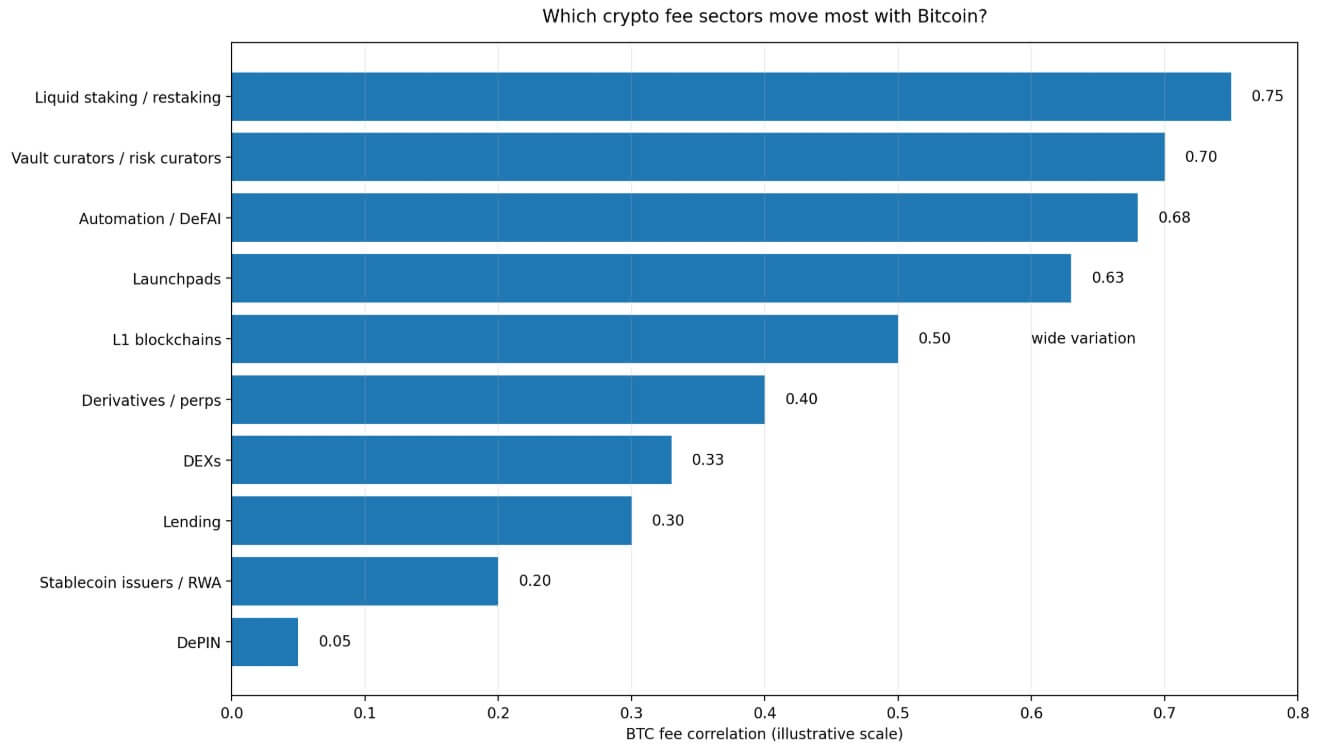
Crypto fees moving with Bitcoin
A horizontal bar chart ranks crypto fee sectors by BTC correlation, with liquid staking at 0.75 and DePIN at 0.05, the lowest reading shown.

The reflexive fee cluster

The sectors 1kx identifies as most correlated with Bitcoin price share a common economic architecture that improves when prices rise and deteriorates when they fall, often faster than the underlying asset itself.

Liquid staking and restaking sit at the top of that cluster, with their fee streams depending on yields that expand as borrowed capital and risk appetite grow and contract as they retreat.

Vault curators face the same pull, as assets flow in when price momentum is positive and out when sentiment reverses. Launchpads are the most acutely sentiment-driven category in the report, with launch activity accelerating in directional bull markets and stalling when confidence cracks.

Automation and DeFAI protocols, which earn fees tied to transaction activity and strategy deployment, also track the same directional pulse.

1kx says that layer-1 (L1) blockchains’ fee correlation to BTC varies widely, with many inheriting market direction through native token price movements and activity mix, while others show more independence depending on their application base.

See also  US Regulators Prepare Softer Crypto Rules as Market Confidence Builds

That variability makes the directional pull of token prices on on-chain activity mean most L1s still carry meaningful BTC sensitivity in their fee lines.

Reflexivity connects these categories, as their fees are largely an output of the same speculative, position-driven activity that drives Bitcoin itself.

When investors talk about fee growth in these sectors during an up market, they are partly describing business momentum and partly describing the same macro tailwind that lifted every risk asset in the portfolio.

The delivered-services layer

DePIN stands apart in 1kx’s framework as the lowest-correlation category, earning the distinction as the standout for non-directional crypto revenue exposure.

The reason is that DePIN fees track the dollar value of compute, bandwidth, storage, and other delivered services. Demand for those services comes from users with real operational needs, and while token prices affect incentive structures, they do not directly set the fee rate, as asset prices do for yield or launch activity.

1kx projects DePIN fees above $450 million in 2026, sustaining triple-digit growth.

Stablecoin issuers and real-world asset protocols sit in a similar lower-correlation band, with 1kx estimating their BTC correlation at roughly 0.2. Their fee economics depend more on issuance volume, reserve management, and AUM than on speculative trading alone.

A lower correlation indicates a fee structure less tied to BTC price direction. 1kx’s framework supports “more differentiated revenue exposure” and stops well short of claiming immunity to a selloff.

The more precise claim is that DePIN and issuance-linked businesses have a better structural case for defending their fee lines during a BTC-specific drawdown.

Sector group Main fee driver Behavior in an up market Likely stress in a drawdown Article takeaway
Liquid staking / restaking Yield, leverage, risk appetite Fees expand quickly Yields compress, activity fades Most reflexive
Vault curators AUM, momentum, inflows AUM rises with price Outflows can hit faster than BTC High downside sensitivity risk
Launchpads Sentiment, launch activity Strong in bull phases Launch volume can stall fast Highly cyclical
Automation / DeFAI Strategy deployment, transaction activity Benefits from active markets Usage may fall with risk appetite Directional fee exposure
DePIN Compute, bandwidth, storage demand Growth tied to service usage More insulated from BTC-specific shocks Most differentiated
Stablecoin / RWA Issuance, reserves, AUM More gradual growth Less directly tied to BTC moves Lower-correlation fee exposure
DEX / Lending / Perps Volume, rates, volatility, leverage Can benefit from activity Mixed; volatility helps, unwinds hurt Contested middle ground
See also  Bitcoin watches as US injects $3 billion into banks

Decentralized exchanges (DEXs), lending protocols, and perpetuals platforms occupy a contested middle ground. 1kx puts DEX median correlation at roughly 0.33 and lending at around 0.3, while derivatives show wide variation, sometimes exceeding 0.4.

Volatility can support trading volume even in down markets, providing these sectors with a partial buffer. Still, fee-rate compression and position unwinds during stress episodes make their revenue lines unstable in ways that simple average correlation fails to capture.

Why valuation is the real payoff

1kx’s broader revenue report shows that price-to-fee ratios across crypto sectors span several orders of magnitude. Blockchains had a median P/F ratio of 3,902x in the third quarter of 2025, with L1s at around 7,300x, compared with 17x for DeFi and finance.

DePIN’s median P/F ratio had fallen to 211x from roughly 1,000x a year earlier. Blockchain valuations still account for more than 90% of the analyzed fee-generating market cap, even though DeFi and finance produce most of the fees.

1kx also says fee changes lead valuations in DeFi and finance, and to a lesser extent in blockchains.

CryptoSlate Daily Brief

Daily signals, zero noise.

Market-moving headlines and context delivered every morning in one tight read.

5-minute digest 100k+ readers

Free. No spam. Unsubscribe any time.

Whoops, looks like there was a problem. Please try again.

You’re subscribed. Welcome aboard.

If that directional relationship holds on the downside, with fees dropping first and multiples compressing in the weeks that follow the initial price move, then a BTC drawdown that exposes fee fragility in high-correlation sectors could trigger a second-order valuation adjustment.

Investors who had assigned business-quality valuations to beta-exposed fee streams would face a rapid repricing.

The test gets deferred

If macro conditions keep easing, such as oil lower, Fed-cut expectations holding, and geopolitical risk fading, Bitcoin could keep holding firm in the mid-to-high $70,000s and push toward Citi’s 12-month base target of $112,000.

In that environment, fee lines across most sectors would continue to expand, and the downside beta would remain theoretical. 1kx projects application-led fee growth accelerating into 2026, with DeFi and finance expanding above 50% year over year.

See also  SUI Breakout Gains Momentum—Can the Price Surge Another 20% in May?

The risk in that scenario is that the market continues to treat cyclically strong fee growth as evidence of durable business quality. Launchpad activity stays elevated in a buoyant market, restaking yields look robust when risk appetite is healthy, and vault curators report strong AUM figures.

The audit gets postponed, and capital keeps flowing into sectors whose fee quality has never been tested under real stress. The environment of falling oil, easing inflation fears, and revived Fed-cut bets is exactly the kind of environment where that postponement extends.

February repeats at scale

On Feb. 5, Bitcoin fell 14.1% to an intraday low of $62,254.50 in a single session as risk sentiment weakened, tech stocks sold off, and ETF outflows accelerated.

The crypto market shed roughly $2 trillion from its October peak during that episode. Launchpad activity cooled, borrowed-capital positions unwound, and restaking yields compressed.

Fee lines that had looked impressive through the end of 2025 showed their directional dependence within a matter of weeks.

A repeat of that pattern would move the downside-beta question from 1kx’s stated next step to a live market event.

Sectors with reflexive fee structures would face the hardest examination, with the market looking for launchpads seeing launch volume decline, restaking yields compressing as borrowed capital exits, and vault curators watching AUM decline faster than token prices.

DePIN and issuance-linked businesses would still face headwinds, but their relative fee resilience would become legible in the data for the first time.

If fee changes drive valuations in DeFi and finance higher, the same mechanism works in reverse.
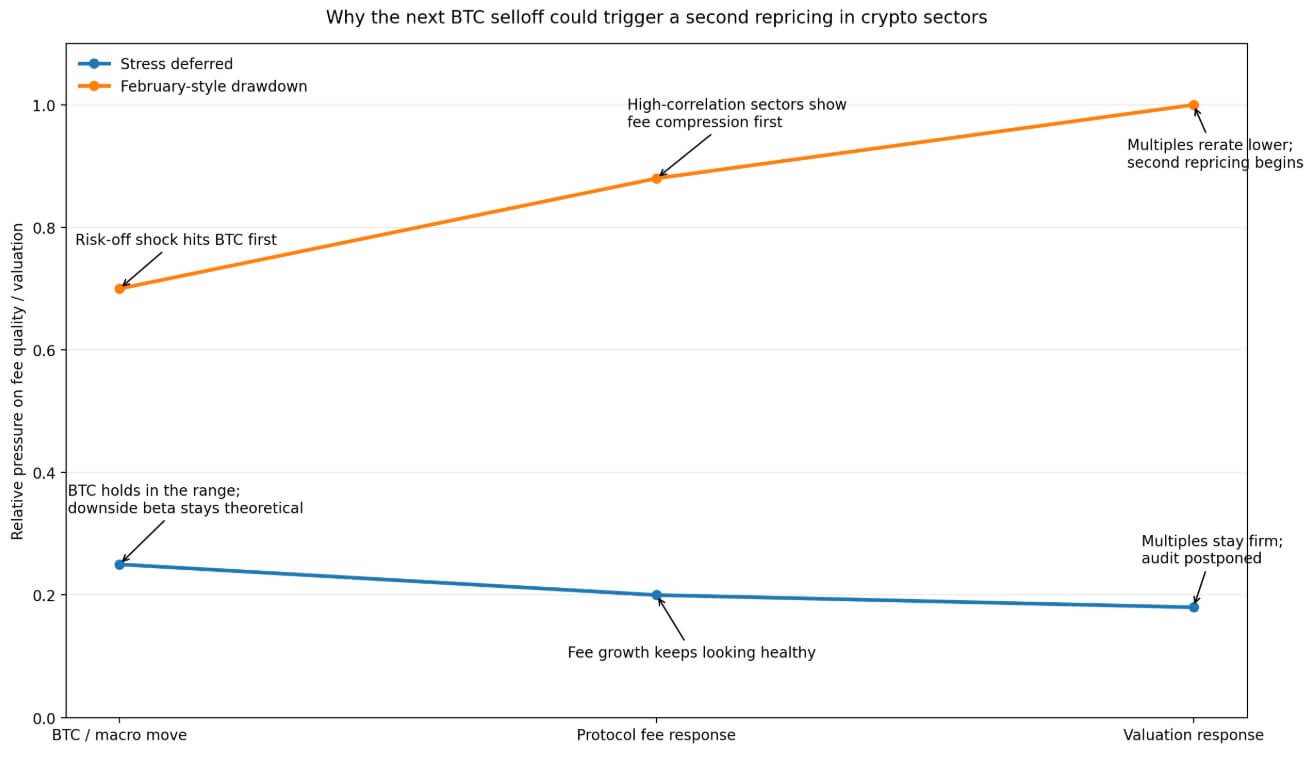
Bitcoin next selloff and its consequences
A two-path line chart shows a February-style drawdown triggering fee compression and multiple rerating, while the stress-deferred path keeps the valuation audit postponed.

Protocols that report fee compression in the first quarter of the next down cycle give the market a reason to compress their multiples before the full macro picture has even resolved.

Investors who had assigned business-quality valuations to beta-exposed fee streams would face a rapid repricing.

Bitcoin is currently around $78,000, holding near the top of its recent range from the April geopolitical relief rally, exactly the window in which the fee-quality question sits unresolved.

9.7B Bitcoin Costs Crypto drawdown expose Fees OnChain Real spend traders
Share. Facebook Twitter Pinterest LinkedIn Tumblr Email

Related Posts

FBI Top 10 Fugitive Sanctioned by OFAC for Crypto Laundering

October 3, 2026

WLD Price Nears $0.70 Resistance — 3 On-Chain Signals Reveal the Next Move

October 3, 2026

IMF Praises El Salvador But Tries To Scale Back Bitcoin Use

October 3, 2026

CFTC wins $31M Fundsz fraud order as crypto scam losses mount worldwide

October 3, 2026
Add A Comment
Leave A Reply Cancel Reply

Top Posts

npm Package Lottie-Player Compromised in Supply Chain Attack

September 16, 2025

Is a Short Squeeze Brewing Above $0.072?

July 24, 2026

Stay ahead with the latest crypto news, market updates, blockchain insights, and trends. Your trusted source for everything happening in the digital asset world.


We're social. Connect with us:

Facebook X (Twitter) Instagram Pinterest YouTube
Top Insights

OpenZeppelin and T-REX Network Introduce new Framework for Regulated Token Eligibility and Recovery

October 3, 2026

Visa Says Business Payments Now Drive 17% Of Stablecoin-Linked Card Volume

October 3, 2026

Wall Street giant BNY discusses infrastructure tie-up with Kraken parent Payward

October 3, 2026
Get Informed

Subscribe to Updates

Get the latest creative news From Free.cc directly in your Inbox!

  • Contact
  • Privacy Policy
  • Terms & Conditions
  • Disclosure
© 2026 free.cc - All rights reserved.

Type above and press Enter to search. Press Esc to cancel.