
Close Menu
  • Latest News
    • Bitcoin
    • Ethereum
    • Altcoins
    • Meme Coins
  • Tech
    • Blockchain
    • Security and Privacy
  • Web 3
    • Gaming
  • Legal
    • Legal and Regulatory
    • Adoption
  • Analysis
  • Learn
    • Education
    • Wallets and Exchanges
  • Tools
    • Market Overview
    • Exchange Tool
What's Hot

Polymarket faces Australia’s binary options wall as ASIC signals strict scrutiny for any applicant

November 1, 2026

Request Network Launches Unified Dashboard for Multi-Merchant Payment Management

November 1, 2026

Five Wallets Drained in About Four Minutes

November 1, 2026
Facebook X (Twitter) Instagram
  • Contact
  • Privacy Policy
  • Terms & Conditions
  • Disclosure
Facebook X (Twitter) Instagram
Free.cc (Free Cryptocurrency)Free.cc (Free Cryptocurrency)
  • Latest News
    1. Bitcoin
    2. Ethereum
    3. Altcoins
    4. Meme Coins
    5. View All

    SEC Charges Two Companies In $130 Million Crypto Trading Scheme

    November 1, 2026

    Assessing the odds of Bitcoin’s price holding on to $75K support level

    November 1, 2026

    Crypto Market Loses $360 B in October as SOL, ETH Lead Losses

    November 1, 2026

    What To Know About The $6.3 Billion Binance Hack

    November 1, 2026

    Ethereum faces 420K ETH supply overhang, yet bulls remain hopeful – Why?

    November 1, 2026

    Ethereum whales withdraw $29M despite bearish signals – Will ETH recover?

    October 31, 2026

    Ethereum wallet permission used in Binance attack, Blockaid says

    October 31, 2026

    Ethereum ETFs lose $170M in three days as ETH faces further price pressure – Can bulls step in?

    October 29, 2026

    Polygon Adds Agent Payment Limits to Open Money Stack

    November 1, 2026

    Coinbase stock crashes 10% despite $719M Q3 profit – Here’s why

    November 1, 2026

    XRP exchange reserves drop by 250M tokens – Is a price recovery ahead?

    October 31, 2026

    USDD Reports Strong Treasury Performance, Growth in Key Metrics, and Ecosystem Expansion

    October 31, 2026

    Top 5 Memecoins to Watch in 2026: Hype, Utility, or Growth?

    October 14, 2026

    Did Jean Phil Go Viral First — or Was the Viral Persona Built to Launch a Memecoin?

    October 5, 2026

    Thinking Cat Gains Momentum After CASHCAT’s Breakout

    August 12, 2026

    What Tokens Could He Target?

    July 30, 2026

    Polymarket faces Australia’s binary options wall as ASIC signals strict scrutiny for any applicant

    November 1, 2026

    Request Network Launches Unified Dashboard for Multi-Merchant Payment Management

    November 1, 2026

    Five Wallets Drained in About Four Minutes

    November 1, 2026

    SEC Charges Two Companies In $130 Million Crypto Trading Scheme

    November 1, 2026
  • Tech
    1. Blockchain
    2. Security and Privacy
    3. View All

    Request Network Launches Unified Dashboard for Multi-Merchant Payment Management

    November 1, 2026

    What the wallet update brings to XLM users

    November 1, 2026

    Chainlink Oracle Network Surpasses 20 Billion Verified Messages and $36.42 Trillion in Transaction Value

    November 1, 2026

    Base Sets November 5 for Denim’s 200ms Mainnet Blocks

    November 1, 2026

    Five Wallets Drained in About Four Minutes

    November 1, 2026

    Michael Saylor Sees Stronger Crypto Security After Binance’s $6.3 Billion Hack

    November 1, 2026

    Binance Says BTC, ETH, XRP and 7 Other Cryptos Fully Backed After Hack

    November 1, 2026

    AI Gives Crypto Hackers Machine Speed as Billions Sit at Risk

    October 31, 2026

    Polymarket faces Australia’s binary options wall as ASIC signals strict scrutiny for any applicant

    November 1, 2026

    Request Network Launches Unified Dashboard for Multi-Merchant Payment Management

    November 1, 2026

    Five Wallets Drained in About Four Minutes

    November 1, 2026

    SEC Charges Two Companies In $130 Million Crypto Trading Scheme

    November 1, 2026
  • Web 3
    1. Gaming
    2. View All

    FLOKI Ships Valhalla 1.13.2 ‘Special Delivery’ to Players on Mainnet

    October 27, 2026

    Top 12 NFT games every player should know about in August 2026

    September 22, 2026

    GameShame Studios founder details Raijin Protocol’s roadmap in NeoPod’s sixth AMA

    September 22, 2026

    Proof of Play to shut down after blockchain gaming thesis falls short

    September 22, 2026

    Polymarket faces Australia’s binary options wall as ASIC signals strict scrutiny for any applicant

    November 1, 2026

    Request Network Launches Unified Dashboard for Multi-Merchant Payment Management

    November 1, 2026

    Five Wallets Drained in About Four Minutes

    November 1, 2026

    SEC Charges Two Companies In $130 Million Crypto Trading Scheme

    November 1, 2026
  • Legal
    1. Legal and Regulatory
    2. Adoption
    3. View All

    Polymarket faces Australia’s binary options wall as ASIC signals strict scrutiny for any applicant

    November 1, 2026

    India’s ED Probes Mudrex, Instadapp Over Alleged FEMA Violations

    November 1, 2026

    Bank of England opens consultation on tokenized collateral for clearing

    November 1, 2026

    Brazil’s Halloween eve crypto deadline brings more tricks than treats

    November 1, 2026

    Why Ripple’s $16 trillion payment volume isn’t boosting XRP

    October 31, 2026

    Ripple is heading for its best year ever while XRP faces its worst since 2022

    October 29, 2026

    BNY offers XRP custody, but only 1 rollout type exists

    October 28, 2026

    Ripple connects XRP Ledger to a £22 billion investment giant while chasing the next wave of corporate money

    October 27, 2026

    Polymarket faces Australia’s binary options wall as ASIC signals strict scrutiny for any applicant

    November 1, 2026

    Request Network Launches Unified Dashboard for Multi-Merchant Payment Management

    November 1, 2026

    Five Wallets Drained in About Four Minutes

    November 1, 2026

    SEC Charges Two Companies In $130 Million Crypto Trading Scheme

    November 1, 2026
  • Analysis

    Bitcoin’s recovery faces rising derivatives exposure and $643 million in ETF outflows

    November 1, 2026

    Could Bulls Lose $10 Before Bulls Regain Control?

    October 31, 2026

    Can RENDER Price Prediction Put $3 Back in Reach?

    October 31, 2026

    Prediction markets lift Robinhood as crypto revenue slumps

    October 31, 2026

    Stacks Price Rallies as Bitcoin Staking Gains Traction: What Comes Next?

    October 31, 2026
  • Learn
    1. Education
    2. Wallets and Exchanges
    3. View All

    What Is Robinhood Chain? The Ethereum Layer-2 Network for Tokenized Stocks

    July 12, 2026

    What Is BChat? The Decentralized Messaging App Built for Privacy

    June 2, 2026

    What Is an AI Prompt Injection Attack? The Hidden Threat Hijacking Your Chatbots

    May 31, 2026

    What Is AI Jailbreaking? A Beginner’s Guide to the Cat-and-Mouse Game Behind Every Chatbot

    May 17, 2026

    Binance hackers deploy never-seen-before laundering tactics to conceal $6.3 billion theft

    November 1, 2026

    Westpac limits crypto exchange deposits driven by fraud rules

    October 31, 2026

    Uniswap launches TJAR fee tool, but only fast searchers capture the hidden arbitrage profit

    October 31, 2026

    Binance uncovers more breach points in $6 billion hack

    October 30, 2026

    Polymarket faces Australia’s binary options wall as ASIC signals strict scrutiny for any applicant

    November 1, 2026

    Request Network Launches Unified Dashboard for Multi-Merchant Payment Management

    November 1, 2026

    Five Wallets Drained in About Four Minutes

    November 1, 2026

    SEC Charges Two Companies In $130 Million Crypto Trading Scheme

    November 1, 2026
  • Tools
    • Market Overview
    • Exchange Tool
Free.cc (Free Cryptocurrency)Free.cc (Free Cryptocurrency)
Home»Wallets and Exchanges»Coinbase says AI support tests fell from weeks to minutes
Wallets and Exchanges

Coinbase says AI support tests fell from weeks to minutes

October 7, 2026No Comments7 Mins Read
Share
Facebook Twitter LinkedIn Pinterest Email

Coinbase says it can now complete a support-testing cycle of roughly 90 cases in 30–45 minutes, work that previously took one to two weeks of manual setup and execution. The figure, disclosed by its engineers on Sept. 21, gives Coinbase CEO Brian Armstrong’s push for an AI-native company a concrete example of automation reducing repetitive work.

The system, called Autopilot, tests the procedures that support bots follow when handling customer problems. It also retains human approval before procedure changes reach production. The next test for Armstrong’s operating model is whether faster procedure development produces reliable support and accountable actions on customer accounts.

Customers need their account problems resolved correctly and their data accessed only with proper authority. Coinbase’s disclosures describe work to address both needs, while leaving the effect on customers unmeasured. Approving changes, restricting permissions and measuring real results remain operating responsibilities as the company automates more work.

Where the time saving comes from

Armstrong announced an approximately 14% workforce reduction in his May 5 memo, citing both a weak crypto market and AI changing how employees work. He proposed fewer management layers, leaders who also contribute directly, smaller AI-native teams and experiments with one-person teams.

Related Reading

700 people at Coinbase just got fired as CEO blames cost reset on AI and market volatility

The September engineering account moves that operating argument into a specific support process. Coinbase says its bots look up account state, take bounded actions and escalate problems requiring greater judgment to a person. Autopilot helps maintain the procedures those bots follow.

Its testing service creates isolated test users and mock account states, simulates conversations, records transcripts and tool results, and grades what happened against expected behavior. Agents can help generate tests; a repeatable runner executes them. Coinbase says it shipped a hybrid system combining the service, GitHub Actions release gates and a user interface that engineering and non-engineering teams can use.

That division explains why the time comparison is useful. Repeatedly setting up test accounts, driving conversations and collecting results is work a shared service can perform consistently. Faster validation could make it practical to check procedure changes more often, provided the cases and expected outcomes remain appropriate.

See also  Coinbase fixed-rate Bitcoin loans: Liquidation risk

The reported comparison measures the validation cycle, leaving customer response times and staffing savings outside its scope. Connecting that cycle to the workforce reduction would require evidence of which tasks were displaced and the resulting costs.

A shorter testing cycle gives Coinbase more capacity to evaluate changes. Whether that capacity produces better support depends on what the tests cover, what reviewers do with their findings and how the resulting procedures perform after deployment.

Autopilot uses adversarial conversations as well as tests of expected behavior. Coinbase says an AI model scores those conversations, but acknowledges that the judge can be wrong. Scores feed human review and release gates rather than independently deciding that a procedure is ready.

The release boundary separates a proposed procedure from one that a support bot can use with customers. Agents can suggest changes, while a person must approve production writes and enablement.

That is a safeguard against an automated quality loop promoting its own work without review. It also means review remains an operating responsibility as the system accelerates.

The approval scope should be read precisely. Coinbase’s statement concerns changes to the support procedures and their enablement. It does not say a human approves every action a deployed bot takes on an individual customer’s account.

Further automation remains unfinished. Coinbase says discovery, authoring, testing and analysis exist, while orchestration from an identified performance gap to a promoted procedure is still being developed. A fully shared contract for conversation summaries also remains unfinished.

That leaves integration work alongside the automation gain. A system that identifies a weak flow, generates a revision and tests it still needs reliable information passed between those steps and an accountable decision about release.

Permission to act is a separate control

Coinbase’s Aug. 18 internal-operations disclosure addresses another part of customer protection: who can access customer data and who can change it.

The company describes Control Center as a separate shared platform for support, compliance, legal, risk and engineering. Coinbase has not specified its coverage of Autopilot. Within the platform, authorization, audit records, approvals and rate limits sit in front of the underlying services.

See also  Can Bulls Defend Support and Avoid a 50% Plunge?

Its permission checks consider both the requested action and the particular customer. Missing customer context on a customer-scoped operation means denial. Access is tied to assigned cases, limited to the customers involved and set to expire.

The Catalyst

What’s moving crypto. Why it matters.

Get CryptoSlate’s essential stories and what to watch next.

Published on Substack

Seven days a week. Unsubscribe anytime.

Whoops, looks like there was a problem. Please try again.

Check your inbox.

Your signup request was sent. If confirmation is required, follow the email from Substack.

Look in spam or promotions if you don’t see it.

For designated sensitive changes, including refunds, account-state changes and limit overrides, the platform separates proposing a change from executing it. The proposal enters review, the required approvals must arrive, and a separate executor then performs the change. Failures are reserved for human handling.
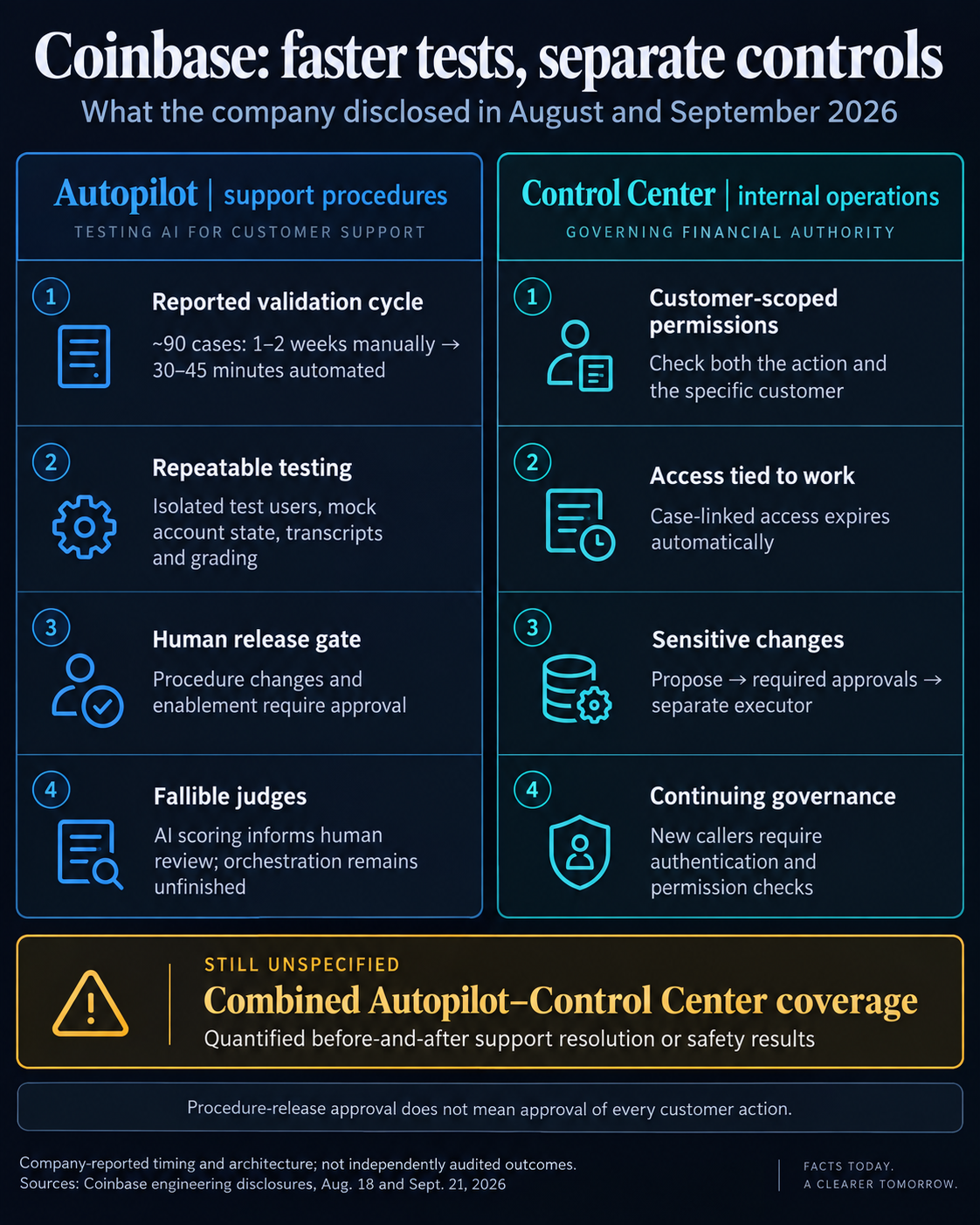
Coinbase reports a faster 90-case support-validation cycle while retaining human release approval; separate customer-scoped access and sensitive-change controls leave combined coverage and customer outcomes unspecified.Coinbase reports a faster 90-case support-validation cycle while retaining human release approval; separate customer-scoped access and sensitive-change controls leave combined coverage and customer outcomes unspecified.

Those controls answer questions that conversational testing cannot answer on its own. A procedure can describe the expected response, while an authorization system determines whether the caller may reach the relevant customer data. Approval rules determine whether a sensitive change can proceed.

Control Center also makes the continuing work explicit. Coinbase says new client types, including automated agents, must be brought under the authorization, audit and rate-limiting rules, with authentication boundaries revalidated as callers change.

Establishing how these controls apply to support automation would require a clearer account of which bots and actions pass through the permission and approval checks. The relevant coverage measure is the set of customer operations governed by those rules.

For the AI-native operating model, the consequence is straightforward: adding automated callers still requires someone to maintain the rules governing their authority. The architecture can make that work more consistent. Its effectiveness still depends on keeping each new caller within the rules.

Case-linked access provides a concrete example: permissions must continue to match the assigned work as cases and callers change. The account boundary needs to hold alongside faster procedure development.

See also  A Quantum Computer Could One Day Break Crypto Security — Coinbase Is Preparing Now

Related Reading

Ethereum co-founder Vitalik Buterin argues that local AI can protect your privacy without losing speed

More testing needs an outcome measure

The same need to connect activity to outcomes extends to Coinbase’s separate Continuous Adversarial Testing (CAT) security platform. On Sept. 15, Coinbase reported more than 150,000 scans of its production estate since mid-2026, including over 128,000 pull-request reviews, and more penetration-test findings being fixed. Those reported activities and fixes provide security context.

Related Reading

Coinbase, Strategy, and Blockstream back AI access push after vetted Bitcoin researcher gets blocked

The distinction between testing and deployed performance is also central to the National Institute of Standards and Technology’s (NIST) July 2024 generative-AI risk profile. The voluntary framework recommends evaluating systems in real-world scenarios because controlled testing may miss problems and discusses measurement gaps between laboratory and deployment conditions. The framework offers a general standard for evaluating these claims.

Autopilot already points toward customer measures. Coinbase says customer-intent labels, resolution and customer-satisfaction signals help identify weak high-volume support flows. That suggests the company recognizes that completing tests and solving customer problems are different measures.

Yet the September disclosure does not publish quantified before-and-after customer-resolution or safety results. The useful next evidence would connect the deployed procedures to those outcomes, alongside the share of relevant support activity covered by the testing and permission systems.

Resolution quality would help show whether automation solves the customer’s problem. Escalation performance would help show whether cases requiring human judgment reach it. Evidence about unauthorized actions and errors would address protection more directly than the time required to run a test suite.

The reported 30–45-minute validation cycle is a concrete example of work being automated. The disclosed approval gates and access restrictions make accountability part of the operating model. Demonstrating the value to customers requires connecting both to results in live support, while carrying the review and governance work that the disclosed systems still require.

Coinbase Fell minutes support tests weeks
Share. Facebook Twitter Pinterest LinkedIn Tumblr Email

Related Posts

Five Wallets Drained in About Four Minutes

November 1, 2026

Assessing the odds of Bitcoin’s price holding on to $75K support level

November 1, 2026

Binance hackers deploy never-seen-before laundering tactics to conceal $6.3 billion theft

November 1, 2026

Coinbase stock crashes 10% despite $719M Q3 profit – Here’s why

November 1, 2026
Add A Comment
Leave A Reply Cancel Reply

Top Posts

Syndicate Labs winds down after 5 years, citing a shrinking rollup market

May 23, 2026

XLM Rises 6% to Recover From Weekend Plunge

October 13, 2025

Stay ahead with the latest crypto news, market updates, blockchain insights, and trends. Your trusted source for everything happening in the digital asset world.


We're social. Connect with us:

Facebook X (Twitter) Instagram Pinterest YouTube
Top Insights

Polymarket faces Australia’s binary options wall as ASIC signals strict scrutiny for any applicant

November 1, 2026

Request Network Launches Unified Dashboard for Multi-Merchant Payment Management

November 1, 2026

Five Wallets Drained in About Four Minutes

November 1, 2026
Get Informed

Subscribe to Updates

Get the latest creative news From Free.cc directly in your Inbox!

  • Contact
  • Privacy Policy
  • Terms & Conditions
  • Disclosure
© 2026 free.cc - All rights reserved.

Type above and press Enter to search. Press Esc to cancel.