
Close Menu
  • Latest News
    • Bitcoin
    • Ethereum
    • Altcoins
    • Meme Coins
  • Tech
    • Blockchain
    • Security and Privacy
  • Web 3
    • Gaming
  • Legal
    • Legal and Regulatory
    • Adoption
  • Analysis
  • Learn
    • Education
    • Wallets and Exchanges
  • Tools
    • Market Overview
    • Exchange Tool
What's Hot

Oliver Investigates Trump’s Crypto Ventures

July 29, 2026

Is the Web3 startup extinction event here, as Wall Street silently inherits crypto architecture?

July 29, 2026

Audiera loses KEY support – Can BEAT recover from a 24% crash?

July 29, 2026
Facebook X (Twitter) Instagram
  • Contact
  • Privacy Policy
  • Terms & Conditions
  • Disclosure
Facebook X (Twitter) Instagram
Free.cc (Free Cryptocurrency)Free.cc (Free Cryptocurrency)
  • Latest News
    1. Bitcoin
    2. Ethereum
    3. Altcoins
    4. Meme Coins
    5. View All

    Oliver Investigates Trump’s Crypto Ventures

    July 29, 2026

    Coinbase wants to be Canada’s ‘everything exchange,’ but says clearer rules are needed first

    July 29, 2026

    SEC Chairman Wants To Advance Crypto Clarity Act

    July 29, 2026

    Bitcoin whales buy 19K BTC – Can $61K keep the recovery alive?

    July 29, 2026

    A Breakthrough in Crypto Encryption Timescales

    July 29, 2026

    Why is crypto down today? $24B market cap loss exposes cracks in recovery

    July 28, 2026

    Tom Lee Reveals Why CLARITY Act Matters for Bitcoin, Ethereum, XRP and Crypto

    July 28, 2026

    Ethereum ETFs add $96M – Are institutions favoring ETH over Bitcoin?

    July 28, 2026

    Audiera loses KEY support – Can BEAT recover from a 24% crash?

    July 29, 2026

    AAVE faces $100 test after Revolut’s $6.44M transfer: Can buyers stay in control?

    July 29, 2026

    Kraken Brings CFTC-Regulated Perpetual Futures To US Traders

    July 28, 2026

    Ondo extends RWA dominance with new network – But will institutions use it?

    July 28, 2026

    Why Is BOME’s Price Up Today? Finally, Capital Rotating to the Meme Coins?

    July 28, 2026

    Brian Armstrong Warns Traders After BRIAN Meme Coin Surges and Crashes

    July 21, 2026

    $1.2 Billion Exits Memecoins: Binance Data Signals Heavy Sell-Off

    July 14, 2026

    CASHCAT Soars 1,600% Amid Robinhood Memecoin Frenzy

    July 8, 2026

    Oliver Investigates Trump’s Crypto Ventures

    July 29, 2026

    Is the Web3 startup extinction event here, as Wall Street silently inherits crypto architecture?

    July 29, 2026

    Audiera loses KEY support – Can BEAT recover from a 24% crash?

    July 29, 2026

    Your AI Chats May Be Showing up in Google Search — One Sharing Feature Made It Possible

    July 29, 2026
  • Tech
    1. Blockchain
    2. Security and Privacy
    3. View All

    Merck and Hashgraph Group launch Hedera-based product passport for EU compliance

    June 12, 2026

    COTI and Midnight Foundation Partner to Advance the Global Privacy Ecosystem

    June 11, 2026

    Cardano Gets Exposure From Olympics Committee

    June 11, 2026

    How Privacy and Composability Trade-Offs Differ

    June 11, 2026

    Your AI Chats May Be Showing up in Google Search — One Sharing Feature Made It Possible

    July 29, 2026

    Michael Saylor Says Bitcoin Can Grow 100-Fold, Warns Rule Changes Could Threaten Its Future

    July 29, 2026

    Apple’s App Store promoted fake Bitcoin wallet that stole $1.8M after developer spent a year warning them

    July 29, 2026

    A Quantum Computer Could One Day Break Crypto Security — Coinbase Is Preparing Now

    July 26, 2026

    Oliver Investigates Trump’s Crypto Ventures

    July 29, 2026

    Is the Web3 startup extinction event here, as Wall Street silently inherits crypto architecture?

    July 29, 2026

    Audiera loses KEY support – Can BEAT recover from a 24% crash?

    July 29, 2026

    Your AI Chats May Be Showing up in Google Search — One Sharing Feature Made It Possible

    July 29, 2026
  • Web 3
    1. Gaming
    2. View All

    Ichimoku Cloud Explained for Beginners: How to Read the “One-Glance” Indicator

    July 22, 2026

    How to Research a Crypto Coin Before You Buy (2026 Guide)

    July 17, 2026

    Top AI Logo Generators for Web3 Founders in 2026

    July 17, 2026

    Top 11 NFT games to play in July 2026

    July 16, 2026

    Oliver Investigates Trump’s Crypto Ventures

    July 29, 2026

    Is the Web3 startup extinction event here, as Wall Street silently inherits crypto architecture?

    July 29, 2026

    Audiera loses KEY support – Can BEAT recover from a 24% crash?

    July 29, 2026

    Your AI Chats May Be Showing up in Google Search — One Sharing Feature Made It Possible

    July 29, 2026
  • Legal
    1. Legal and Regulatory
    2. Adoption
    3. View All

    Crypto holders face a July 29 Maine deadline as state manual conflicts on when abandoned funds trigger seizure

    July 28, 2026

    How a crypto exchange secretly hid $53M in stolen crypto to prevent a bank run – as the SEC targets its directors

    July 28, 2026

    SEC warning over crypto yield vaults puts DeFi’s secret human controllers in the crosshairs

    July 27, 2026

    Lawsuit claims 3.8M dormant BTC using police lost-and-found rules as Congress races to stop it with CLARITY

    July 27, 2026

    Multi-trillion-dollar offshore engine driving 90% of crypto trading arrives in America

    July 26, 2026

    The $25 million Bitcoin glitch hiding inside Wall Street’s clearinghouses

    July 26, 2026

    The $1T network settling millions while banks sleep on weekends

    July 25, 2026

    Investors rejected crypto basket ETFs and now this $1.9 trillion manager is putting the reason to the test

    July 17, 2026

    Oliver Investigates Trump’s Crypto Ventures

    July 29, 2026

    Is the Web3 startup extinction event here, as Wall Street silently inherits crypto architecture?

    July 29, 2026

    Audiera loses KEY support – Can BEAT recover from a 24% crash?

    July 29, 2026

    Your AI Chats May Be Showing up in Google Search — One Sharing Feature Made It Possible

    July 29, 2026
  • Analysis

    SOL Price Eyes Breakout as Morgan Stanley Launches Solana ETP

    July 28, 2026

    ZEC Price Climbs After Zcash Ironwood Upgrade Goes Live

    July 28, 2026

    TRON Holds Multi-Year Bullish Trend as Institutional Adoption Accelerates—Can TRX Price Reach $1?

    July 28, 2026

    BOME Price Is Heating Up Again—Here’s Why

    July 28, 2026

    Key Reasons Behind the Sell-Off

    July 28, 2026
  • Learn
    1. Education
    2. Wallets and Exchanges
    3. View All

    What Is Robinhood Chain? The Ethereum Layer-2 Network for Tokenized Stocks

    July 12, 2026

    What Is BChat? The Decentralized Messaging App Built for Privacy

    June 2, 2026

    What Is an AI Prompt Injection Attack? The Hidden Threat Hijacking Your Chatbots

    May 31, 2026

    What Is AI Jailbreaking? A Beginner’s Guide to the Cat-and-Mouse Game Behind Every Chatbot

    May 17, 2026

    Is the Web3 startup extinction event here, as Wall Street silently inherits crypto architecture?

    July 29, 2026

    Federal court shields Kalshi and Polymarket from Minnesota’s felony crackdown days before deadline

    July 28, 2026

    Lawsuit claims BitMEX used server freezes and internal trading to seize 622 Bitcoin ahead of its September closure

    July 28, 2026

    BitMart’s sudden shutdown triggers withdrawal delays and on-chain panic, echoing the ghosts of 2022

    July 27, 2026

    Oliver Investigates Trump’s Crypto Ventures

    July 29, 2026

    Is the Web3 startup extinction event here, as Wall Street silently inherits crypto architecture?

    July 29, 2026

    Audiera loses KEY support – Can BEAT recover from a 24% crash?

    July 29, 2026

    Your AI Chats May Be Showing up in Google Search — One Sharing Feature Made It Possible

    July 29, 2026
  • Tools
    • Market Overview
    • Exchange Tool
Free.cc (Free Cryptocurrency)Free.cc (Free Cryptocurrency)
Home»Security and Privacy»AI scams in crypto approach breaking point – OpenAI’s new image model shows why they could get worse
AI scams in crypto approach breaking point – OpenAI’s new image model shows why they could get worse
Security and Privacy

AI scams in crypto approach breaking point – OpenAI’s new image model shows why they could get worse

April 27, 2026No Comments8 Mins Read
Share
Facebook Twitter LinkedIn Pinterest Email

A crypto founder had his laptop compromised when he joined what appeared to be a Microsoft Teams call with Pierre Kaklamanos, a Cardano Foundation contact he had spoken with before.

When “Pierre” reached out about Atrium and sent a Teams invite, nothing looked out of place. On the call, the face and voice matched what he remembered, and two other apparent foundation members were present.

When the call lagged and dropped him, a prompt told him his Teams software was out of date and needed reinstalling through Terminal. He ran the command, then shut the laptop off because the battery was dying, which limited the damage in retrospect.

He describes himself as “quite technically savvy,” which is part of the point that the attack worked because the context felt legitimate.

Social engineers have always relied on familiarity, and executing that at scale once required either a compromised account or weeks of text-based rapport-building.

The video call was the authentication layer, the thing victims learned to trust, and replicating it is now within reach.

Fake update

Microsoft documented campaigns in February and March 2026 in which malicious files masqueraded as workplace apps, such as msteams.exe and zoomworkspace.clientsetup.exe, with phishing lures that mimicked legitimate Teams and Zoom meeting workflows.

In a separate warning, Microsoft described “ClickFix”-style prompts targeting macOS users, instructing them to paste commands into Terminal and targeting browser passwords, crypto wallets, cloud credentials, and developer keys.

The fake Teams update fits both patterns simultaneously.

Google Cloud’s Mandiant unit described a crypto-focused intrusion built on the same structure. A compromised Telegram account, a spoofed Zoom meeting, what witnesses described as a deepfake-style executive video, and troubleshooting commands that launched the infection.

Mandiant said it could not independently verify which AI model, if any, generated the video, but confirmed the group used fake meetings and AI tools during social engineering.

On Apr. 24, the real Pierre Kaklamanos posted on X saying his Telegram had been hacked and that someone was impersonating him, along with “a few other people in the industry this week.”

He told followers to avoid clicking links or booking meetings through the account and to verify contact through LinkedIn direct messages.

By then, the founder had already messaged the account suggesting they switch to Google Meet. Whoever controlled Pierre’s Telegram account replied that he had gotten busy and asked to reschedule, with the attacker still managing the persona once the call ended.

See also  White House advances plan to bring crypto and alternative assets to 401(k)

That exchange turns the incident from an isolated embarrassment into a live campaign signal that the method is active, the account compromise is the entry point, and the relationship history is the weapon.

Stage What the victim saw Why it looked legitimate What the attacker was likely trying to achieve
Initial outreach “Pierre” reached out about Atrium and suggested a call The victim had spoken with Pierre before, including on video Reopen an existing trust relationship instead of starting from a cold approach
Meeting setup A Microsoft Teams invite for the next day Teams is a normal business workflow and the topic was plausible Move the target into a controlled environment that felt routine
Live call Familiar face, familiar voice, plus two other apparent Cardano Foundation members The social context matched the victim’s memory of prior interactions Lower suspicion and make the call itself feel like verification
Call disruption Lagging, instability, then getting kicked out Technical glitches are common in video calls Create frustration and set up the fake “fix” as a normal troubleshooting step
Fake update prompt A message saying Teams was out of date and needed reinstalling through Terminal Software update prompts are familiar, and the user rarely used Teams Get the victim to execute a malicious command directly
Command execution The victim ran the command, then shut down the laptop because the battery was dying The workflow still felt like a routine app fix at that moment Launch the infection chain and gain access to credentials or device data
Post-call follow-up The victim suggested switching to Google Meet; the attacker said he got busy and asked to reschedule The persona continued behaving like a real contact after the failed attempt Keep the relationship alive for another attempt and avoid immediate suspicion

Why generative media changes the threat surface

The founder said he now believes the call may have involved AI-generated or manipulated video. Forensic confirmation of the tools is lacking, and the OpenAI connection here is governed by its own safety documentation.

OpenAI launched its 4o image generation model on Mar. 25, describing it as capable of “precise, accurate, photorealistic outputs,” and released the ChatGPT Images 2.0 System Card on Apr. 21.

See also  Can IP Crypto Rebound After Its Sharp 80% Q4 Collapse?

The firm stated that the model’s “heightened realism” could, absent safeguards, enable more convincing deepfakes of real people, places, or events. One of the leading AI labs has now put on record that its own image model raises the ceiling on what a convincing fake can look like.

The World Economic Forum said in January 2026 that generative AI lowers the barrier to phishing while raising its credibility, through realistic deepfake audio and video that can evade both detection systems and human scrutiny.

INTERPOL declared financial fraud one of the world’s most severe and rapidly evolving transnational crimes in March 2026, identifying deepfake videos, audio, and chatbots as tools that make impersonation of trusted people easier to carry out at scale.

Chainalysis estimated that crypto scams and fraud reached $17 billion in 2025, with impersonation scams up 1,400% year over year and AI-enabled scams generating 4.5 times as much revenue as traditional methods.
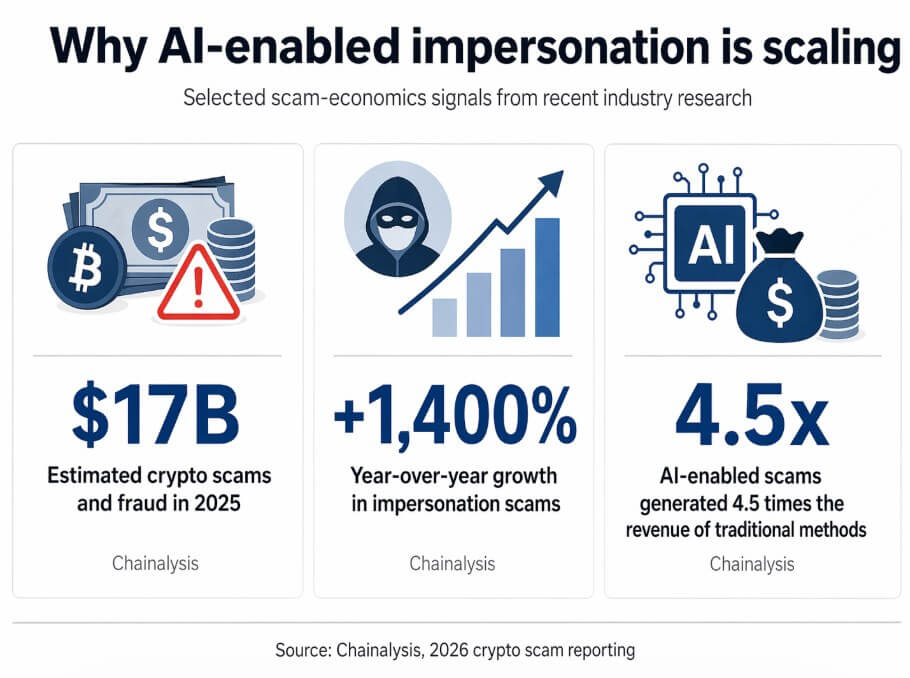
AI scams boosting amount stolen
Chainalysis data shows crypto scams reached $17 billion in 2025, impersonation scams up 1,400%, and AI-enabled scams generating 4.5 times traditional revenue.

Crypto attracts this class of attack because it combines high-value targets, fast settlement rails, and an informal communications culture in which Telegram introductions and ad hoc video calls between founders are routine.

Mandiant documented that the group behind the crypto Zoom intrusion targeted software firms, developers, venture firms, and executives across payments, brokerage, staking, and wallet infrastructure.

Mandiant noted that the victim’s data could be used to seed future social engineering, with each compromise generating material for the next.

Two paths forward

Zoom announced on Apr. 17 a partnership to add real-time human verification to meetings, a “Verified Human” badge, and a “Deep Face Waiting Room,” treating participant authenticity as a product problem.

Gartner predicts that by 2027, 50% of enterprises will invest in disinformation-security products or TrustOps strategies, up from less than 5% today.

In the bull case, that buildout reaches critical mass quickly enough that attackers must defeat multiple independent trust layers to complete a conversion, and the economics of impersonation campaigns deteriorate.

In the bear case, the timeline compresses before defenses do. Gartner warned that AI agents may halve the time required to exploit account takeovers by 2027, narrowing the window for human hesitation or security team intervention.

See also  Bitcoin bullish bets now a bargain as weekly loss underlines bearish trend: Crypto Daybook Americas

Deloitte estimated that generative AI-enabled fraud losses in the US alone could climb from roughly $12 billion in 2023 to $40 billion by 2027.

Scenario What changes What stays vulnerable Implication for crypto firms
Bull case Verification tools spread quickly: human-verification badges, liveness checks, stronger internal trust rails, and more formal approval workflows Informal founder-to-founder chats, legacy messaging habits, and ad hoc scheduling still create openings Attackers face more friction and lower conversion rates because they must defeat several trust layers instead of one
Bear case AI-generated impersonation improves faster than defenses are adopted; fake meetings and fake troubleshooting become standard playbooks Public-facing executives, Telegram-based outreach, video-first verification habits, and staff under time pressure Relationship hijacking becomes routine, and each compromise creates material for the next scam
What success looks like Sensitive requests get verified across separate channels, with known numbers, shared passphrases, hardware keys, or pre-agreed internal systems Social pressure, urgency, and trust in familiar faces and voices cannot be fully removed Firms reduce the chance that one spoofed call can lead directly to compromise
What failure looks like Teams rely on the call itself as proof of identity, even as deepfake and impersonation tools improve Video remains persuasive even when it is no longer reliable as authentication Crypto organizations become easier to target because executives are both high-value victims and reusable lure assets

Every public-facing crypto executive becomes both a target and a lure asset, a source of voice recordings, video clips, and relationship graphs that attackers can deploy against the next victim.

Zoom is building liveness checks into meetings, Microsoft is documenting attack chains that impersonate its own software, and the FBI has warned that malicious actors are already using AI-generated voice and text to impersonate trusted contacts, advising against assuming a message is authentic because it appears to come from a known person.

Verification now requires independent rails, such as a known phone number, a hardware key, a shared passphrase established before any meeting, or a pre-agreed internal channel that no attacker has accessed.

The post AI scams in crypto approach breaking point – OpenAI’s new image model shows why they could get worse appeared first on CryptoSlate.

approach Breaking Crypto Image Model OpenAIs point scams Shows Worse
Share. Facebook Twitter Pinterest LinkedIn Tumblr Email

Related Posts

Oliver Investigates Trump’s Crypto Ventures

July 29, 2026

Is the Web3 startup extinction event here, as Wall Street silently inherits crypto architecture?

July 29, 2026

Your AI Chats May Be Showing up in Google Search — One Sharing Feature Made It Possible

July 29, 2026

A Breakthrough in Crypto Encryption Timescales

July 29, 2026
Add A Comment
Leave A Reply Cancel Reply

Top Posts

Bitcoin Price at Crucial Crossroads As Its Correlation With Yen Hits Record High: What’s Next?

January 8, 2026

ETERBASE Crypto-Exchange Hit in $5m Heist

November 2, 2025

Stay ahead with the latest crypto news, market updates, blockchain insights, and trends. Your trusted source for everything happening in the digital asset world.


We're social. Connect with us:

Facebook X (Twitter) Instagram Pinterest YouTube
Top Insights

Oliver Investigates Trump’s Crypto Ventures

July 29, 2026

Is the Web3 startup extinction event here, as Wall Street silently inherits crypto architecture?

July 29, 2026

Audiera loses KEY support – Can BEAT recover from a 24% crash?

July 29, 2026
Get Informed

Subscribe to Updates

Get the latest creative news From Free.cc directly in your Inbox!

  • Contact
  • Privacy Policy
  • Terms & Conditions
  • Disclosure
© 2026 free.cc - All rights reserved.

Type above and press Enter to search. Press Esc to cancel.