

You might have heard about BIP-110; here’s why this fork is not just bad for Bitcoin, but it is built on a misunderstanding of what a Bitcoin node is and what it is good for. As well as why, because of this misunderstanding, BIP-110 will fail.
This article is a Take. Opinions expressed are entirely the author’s and do not necessarily reflect those of BTC Inc or Bitcoin Magazine.
BIP-110 is a Bitcoin Improvement Proposal titled as a Reduced Data Temporary Softfork. The BIP proposes a consensus change to Bitcoin, which attempts to limit the types and amounts of arbitrary data that can be added to consensus-valid transactions by limiting a wide range of Bitcoin’s scripting capabilities. BIP-110 is led by a pseudonymous developer known as Dathon Ohm and is widely supported by the Knots community, an alternative implementation of Bitcoin led by one of Bitcoin Core’s earliest contributors, Luke Dashjr and its supporters.
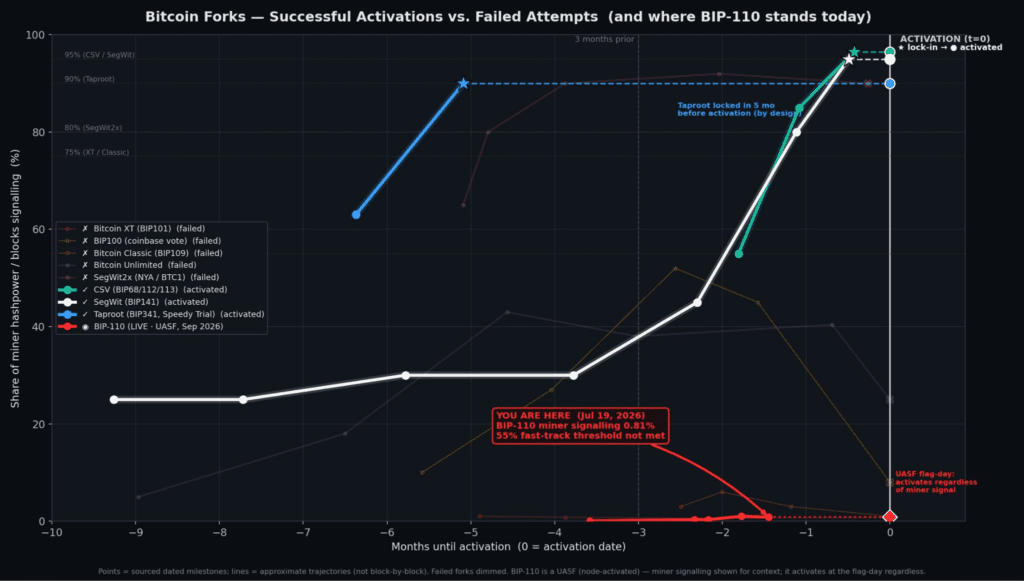
The BIP-110 consensus change is headed towards a mandatory signaling period in the coming weeks and thus a potential fork with the main consensus rules as implemented in Bitcoin Core. The proposal needs to gain a great deal of support from miners within the coming weeks to change Bitcoin consensus. As of the time of writing, miner signaling for BIP-110 stands at less than one percent.
The Knots community, widely made up of Bitcoiners running nodes on machines like Start9 and Umbrel, has rallied around Knots in protest of a series of development decisions made by Bitcoin Core, the primary open source development community and reference implementation of Bitcoin. While a majority of senior Bitcoin developers are either opposed or apathetic to the changes proposed by BIP-110, the movement has gained enough steam to become an ongoing topic of discussion on social media.
Supporters of BIP-110 believe that by running Bitcoin full nodes that signal for the consensus change, they alone can change Bitcoin. Here are the main concepts being debated, the biggest misconceptions about Bitcoin consensus, what a Bitcoin node is, and why BIP-110 is almost certain to fail.
The Power and Limits of a Bitcoin Node
Many of the disagreements and misconceptions in this recent cultural conflict within Bitcoin revolve around the idea of a Bitcoin full node. Influencers like Knut Svanholm, author and podcaster, have elevated the role of the full node to heights perhaps too close to the sun.
Knut recently tweeted: “Every person on Earth is a node in the Bitcoin network. Most to a minuscule extent, of course, but every node is first and foremost a person, not a machine. Which tools we use to interact with the network (and, by extension, to which extent they influence the network) is entirely dependent on the choices we make.”
Statements of this sort are poetically beautiful, philosophically grand, romantic even, but nevertheless technically incoherent and fundamentally meaningless. Knut’s tweet attempts to redefine what a ‘Bitcoin node’ means and fails at it, instead diluting the value of the term entirely. He might as well have said that every atom in the universe is a Bitcoin node, since apparently to him the term is all-encompassing.
Knut, though well-intentioned, is wrong. A Bitcoin node is something very specific. It is a full copy of all of Bitcoin’s transaction history, block headers and transaction-related data. Its purpose is very specific: to let users verify the integrity of Bitcoin’s supply and transaction history in relation to Bitcoin’s consensus rules.
Bitcoin nodes grant users a variety of benefits, such as privacy. Third-party wallet providers query their copy of the Bitcoin blockchain for the user’s balance and serve it back to the user via the wallet app. Most mobile wallets function this way, with users asking a third-party server for their balances; some, very few, can connect to a user-run local Bitcoin node, in which case the user’s public addresses and balances are not shared with any third-party wallet company.
Another benefit Bitcoin nodes grant users is the ability to check whether they are in consensus with the rest of the network, staying in sync. If the user mines Bitcoin or contributes any significant amount of hashing power to Bitcoin’s proof-of-work network, the node also provides the opportunity to assemble a block, choosing which transactions go into it. This is only possible if the user manages to mine a Bitcoin block, which is quite an achievement today, given the difficulty and steep competition.
Even new kinds of mining pools like Ocean, which attempt to decentralize block template production, letting retail miners have more influence over which transactions enter the chain, still need enough hashing power to win the proof-of-work race, resulting in sporadic blocks being mined and thus limited influence over the blockchain.
Bitcoin nodes also relay transactions across the network, with tens of thousands of them communicating via a flood network; this results in a censorship-resistant system where a small number of nodes can get controversial transactions to miners, bypassing any kind of filters, as demonstrated by Peter Todd’s relay libre. Thus, Bitcoin nodes can not easily filter which transactions enter the blockchain.
Even a large majority of Bitcoin nodes alone can not, however, change Bitcoin consensus. Not without having a large amount of economic activity entering the Bitcoin network through them, as exchanges do on behalf of millions of users. Not without having the protocol and application developer community behind them. Not without having the investor community behind them. Bitcoin is not a node democracy, contrary to popular memes today.
Bitcoin nodes do not grant you ‘citizenship’ in the ‘Bitcoin nation’. Satoshi Nakamoto was quite clear about this in the Bitcoin white paper. Bitcoin’s ultimate security and governance structure is: one CPU cycle, one vote, not one Bitcoin node, one vote. And miners, who run the CPU cycles over Bitcoin’s proof-of-work, are very sensitive to investor sentiment and the broader developer community, resulting in a distributed global protocol for money that is very difficult to change.
Bitcoin nodes ultimately let you know if you are connected to the network with the most accumulated proof-of-work and that its consensus rules are being followed, but a node alone does not let you change the consensus rules. Users who change the consensus rules of their Bitcoin node are, by definition, no longer running Bitcoin. As a result, changing Bitcoin consensus as a node runner is very difficult, and that’s a feature, not a bug. Bitcoin is money for enemies.
History and Bitcoin Consensus Games
Deep work has been done, trying to understand Bitcoin consensus, its various pillars and interest groups. Ren Crypto Fish, Steve Lee and Lyn Alden identified six of them in BCAP, an open-source effort to analyze Bitcoin consensus and risks in protocol upgrades. BCAP identified stakeholders such as Economic Nodes, Investors, Media Influencers, Miners and Protocol Developers, and Users and Application Developers
Historically, in the case of a consensus crisis, it is true that Bitcoin nodes have been used to signal support for one version of Bitcoin over another. Fork events like 2017’s Bitcoin Cash fork are often cited as examples of economic nodes winning against opposition by miners. 2017’s legendary User Activated Soft Fork (UASF) faced major opposition in theory; a large majority of mining pools and their corresponding collective hashrate supported the Segwit2x version of Bitcoin, with many exchanges and corporations having signed the infamous New York Agreement.
The Bitcoin node-supported soft fork won nonetheless, bluffing the Segwit2x version from a contested blockchain altogether. But that’s the thing: while the Bitcoin nodes technically won, they did so by having massive support from protocol developers, investors and media influencers: these nodes really had economic weight and rough consensus. BIP-110, on the other hand, does not have the protocol developers, nor does it have enough investors behind it. Michael Saylor has come out against it, with many industry leaders also openly opposing it or staying out of the matter entirely.
In fact, during the Bitcoin Cash fork, the limits of retail Bitcoin nodes were clearly understood. A Bitcoin node run by an exchange is orders of magnitude more influential than that of a retail user, as it introduces large amounts of new transactions to the Bitcoin network. The Bitcoin node of a major mining pool is far more influential than that of a hobbyist solo miner, as it more often assembles blocks and chooses which transactions settle to the blockchain.
Most Bitcoiners outside of exchanges use mobile wallets to access their Bitcoin. Such users and investors can ‘vote’ with their money, so to speak, by moving their bitcoins and economic activity elsewhere, be it to a wallet that supports their vision of Bitcoin, or their own full node. But while users remain on mobile wallets that talk to third-party nodes, those users have little individual influence over Bitcoin consensus. And the vast majority of mobile wallets are using a Bitcoin core-compatible back end.
The same goes for exchanges; their users effectively delegate consensus decisions to the exchange operators. In some cases, exchanges have put consensus issues to a user vote, weighed by their total holdings, returning that decision to end users weighed by capital; we may see this happen again with BIP-110.
Votes of the sort have started happening with Foundry today. One of the biggest Bitcoin mining pools in the world, Foundry, recently emailed its miners informing them that they can vote on the proposal with their hashrate. A high enough support could result in Foundry signaling for BIP-110, though that remains unlikely. Users who do not vote will effectively signal against BIP-110, defending the status quo. Thus apathy about the topic of BIP-110 would be a win for Bitcoin Core by default. BIP-110 supporters need to culturally win over a majority of the Foundry hash rate, who then must act to vote against the Bitcoin Core developer consensus, the most popular Bitcoin implementation and best supported codebase.
Today, miners are not signaling support for BIP-110 in any significant way. In fact, according to some data, this is one of the least supported soft fork attempts by miner signaling in Bitcoin’s history. Less than one percent of the blocks mined in the current difficulty adjustment period are signaling for BIP110.
Concluding Thoughts
BIP-110 has so far failed to gain consensus across major interest groups within Bitcoin; neither developers, investors, miners, nor large economic nodes support the consensus change. The result is likely to be a chain split in the coming weeks, which could have significant consequences for lightning wallets running on BIP-110-compliant nodes, ultimately resulting in a new, yet small blockchain that would probably have to change the proof-of-work used to stay alive.