Close Menu
  • Latest News
    • Bitcoin
    • Ethereum
    • Altcoins
    • Meme Coins
  • Tech
    • Blockchain
    • Security and Privacy
  • Web 3
    • Gaming
  • Legal
    • Legal and Regulatory
    • Adoption
  • Analysis
  • Learn
    • Education
    • Wallets and Exchanges
  • Tools
    • Market Overview
    • Exchange Tool
  • INFO@FREE.CC
What's Hot

Samson Mow says bitcoin bottom is in, but analysts remain divided

June 28, 2026

Bitcoin just slipped below the bear-market line traders cannot ignore

June 28, 2026

Congress blocks introduction of any CBDC in the next 4 years – but the fight over digital money is just starting

June 28, 2026
Facebook X (Twitter) Instagram
  • Contact
  • Privacy Policy
  • Terms & Conditions
  • Disclosure
Facebook X (Twitter) Instagram
Free.cc (Free Cryptocurrency)Free.cc (Free Cryptocurrency)
  • Latest News
    1. Bitcoin
    2. Ethereum
    3. Altcoins
    4. Meme Coins
    5. View All

    Samson Mow says bitcoin bottom is in, but analysts remain divided

    June 28, 2026

    Trezor Academy Releases Documentary On Africa’s Bitcoin Economy, Opens Education Donations

    June 28, 2026

    Crypto bear market isn’t over? AI’s $20B capital rotation says so

    June 28, 2026

    What Robinhood’s recent layoffs say about the current state of crypto investments

    June 28, 2026

    Humanity Protocol, Kelp DAO stolen funds commingle – Same attacker?

    June 28, 2026

    Ethereum ETFs see $12.85M outflows – Why ETH bulls face an uphill battle

    June 28, 2026

    Tether Surpasses Ethereum: A Historic Shift

    June 26, 2026

    Ethereum faces renewed selling pressure: Can key support hold this time?

    June 26, 2026

    Major whale shorts $4.92M in ZEC – Can Zcash rebound to $520?

    June 28, 2026

    XRP Prepares for July Bounce-Back as Price History Points to

    June 28, 2026

    Hyperliquid demand deepens as institutions chase staking yields – Just a fad?

    June 28, 2026

    Whale Activity Shows High-Leverage Short Positions Re-Opened

    June 27, 2026

    Dogecoin Cash Files U.S. Patent for DOGP Blockchain Framework

    June 15, 2026

    How SIREN Went From AI Memecoin to Boom-and-Bust

    June 8, 2026

    Meme Coin Market Faces Imbalance as Supply Rises, Demand Falls

    April 4, 2026

    Crypto Interest Rising Toward Meme Coin Sector

    January 9, 2026

    Samson Mow says bitcoin bottom is in, but analysts remain divided

    June 28, 2026

    Bitcoin just slipped below the bear-market line traders cannot ignore

    June 28, 2026

    Congress blocks introduction of any CBDC in the next 4 years – but the fight over digital money is just starting

    June 28, 2026

    Trezor Academy Releases Documentary On Africa’s Bitcoin Economy, Opens Education Donations

    June 28, 2026
  • Tech
    1. Blockchain
    2. Security and Privacy
    3. View All

    Merck and Hashgraph Group launch Hedera-based product passport for EU compliance

    June 12, 2026

    COTI and Midnight Foundation Partner to Advance the Global Privacy Ecosystem

    June 11, 2026

    Cardano Gets Exposure From Olympics Committee

    June 11, 2026

    How Privacy and Composability Trade-Offs Differ

    June 11, 2026

    $47 Million in Illicit Crypto Seized as Europol Cracks Down on Global Cybercrime Networks

    June 27, 2026

    Microsoft Warns of New USB-Based Malware Targeting Crypto Users

    June 21, 2026

    Fake GitHub Stars and AI Videos Mask a Crypto Clipper

    June 18, 2026

    Zcash Climbs 80% Since June 5 as Traders Shrug off Orchard Bug Fears – Bitcoin News

    June 18, 2026

    Samson Mow says bitcoin bottom is in, but analysts remain divided

    June 28, 2026

    Bitcoin just slipped below the bear-market line traders cannot ignore

    June 28, 2026

    Congress blocks introduction of any CBDC in the next 4 years – but the fight over digital money is just starting

    June 28, 2026

    Trezor Academy Releases Documentary On Africa’s Bitcoin Economy, Opens Education Donations

    June 28, 2026
  • Web 3
    1. Gaming
    2. View All

    NFT Marketplace Volume Is Concentrating Around the Biggest Players

    June 26, 2026

    Loaded Lions’ Mane City Mobile Heads to iOS and Android as Sign-Ups Begin

    June 23, 2026

    Nexus Acquires Homegrown App Marketplace One Store, Expanding into Global Web3 Game Hub

    June 21, 2026

    GoMining Rolls Out GoBTC Pay SDK for Bitcoin Merchant Payments

    June 20, 2026

    Samson Mow says bitcoin bottom is in, but analysts remain divided

    June 28, 2026

    Bitcoin just slipped below the bear-market line traders cannot ignore

    June 28, 2026

    Congress blocks introduction of any CBDC in the next 4 years – but the fight over digital money is just starting

    June 28, 2026

    Trezor Academy Releases Documentary On Africa’s Bitcoin Economy, Opens Education Donations

    June 28, 2026
  • Legal
    1. Legal and Regulatory
    2. Adoption
    3. View All

    Congress blocks introduction of any CBDC in the next 4 years – but the fight over digital money is just starting

    June 28, 2026

    European crypto users are being paid to move before MiCA closes the door

    June 28, 2026

    The UK softened stablecoin rules, but may still be capping its own market

    June 28, 2026

    Outdated bank rules may keep crypto outside the banks now allowed to hold it

    June 27, 2026

    USDT gets a Brazil payment route to 170 million people by making crypto disappear

    June 26, 2026

    UK bond fund ownership records move onto Ethereum and Solana accessible 24/7

    June 26, 2026

    Chainlink’s latest stablecoin push targets the capital stuck in bank FX settlement

    June 25, 2026

    Latest bear market victim shows how quickly DeFi users are left behind when crypto projects move on

    June 24, 2026

    Samson Mow says bitcoin bottom is in, but analysts remain divided

    June 28, 2026

    Bitcoin just slipped below the bear-market line traders cannot ignore

    June 28, 2026

    Congress blocks introduction of any CBDC in the next 4 years – but the fight over digital money is just starting

    June 28, 2026

    Trezor Academy Releases Documentary On Africa’s Bitcoin Economy, Opens Education Donations

    June 28, 2026
  • Analysis

    Bitcoin just slipped below the bear-market line traders cannot ignore

    June 28, 2026

    Can Tokenization Narratives Finally Lift Crypto Prices?

    June 27, 2026

    VELVET Price Explodes 250% After Traders Wrote It Off

    June 27, 2026

    Ethereum’s oldest wallets are selling into the $1,500 demand line buyers cannot dodge

    June 27, 2026

    dogwifhat (WIF) Price Rebounds Into Key Supply Zone — Can Bulls Trigger a 30% Breakout?

    June 27, 2026
  • Learn
    1. Education
    2. Wallets and Exchanges
    3. View All

    What Is BChat? The Decentralized Messaging App Built for Privacy

    June 2, 2026

    What Is an AI Prompt Injection Attack? The Hidden Threat Hijacking Your Chatbots

    May 31, 2026

    What Is AI Jailbreaking? A Beginner’s Guide to the Cat-and-Mouse Game Behind Every Chatbot

    May 17, 2026

    What’s on the Ethereum Roadmap: Glamsterdam, Hegota and Beyond

    March 30, 2026

    HYPE ETFs quietly pulled $161M in one month as Wall Street buys crypto’s on-chain exchange bet

    June 15, 2026

    Crypto exchanges are opening a two-front war for the stock market

    June 12, 2026

    Crypto’s killer app may be selling stocks after its own tokens failed retail

    June 10, 2026

    Vitalik wants DeFi price crashes to stop triggering automatic liquidations

    June 4, 2026

    Samson Mow says bitcoin bottom is in, but analysts remain divided

    June 28, 2026

    Bitcoin just slipped below the bear-market line traders cannot ignore

    June 28, 2026

    Congress blocks introduction of any CBDC in the next 4 years – but the fight over digital money is just starting

    June 28, 2026

    Trezor Academy Releases Documentary On Africa’s Bitcoin Economy, Opens Education Donations

    June 28, 2026
  • Tools
    • Market Overview
    • Exchange Tool
  • INFO@FREE.CC
Free.cc (Free Cryptocurrency)Free.cc (Free Cryptocurrency)
Home»Legal and Regulatory»Congress blocks introduction of any CBDC in the next 4 years – but the fight over digital money is just starting
Cracked XRP logo surrounded by red shards symbolizing crypto market selloff and investor capitulation.
Legal and Regulatory

Congress blocks introduction of any CBDC in the next 4 years – but the fight over digital money is just starting

June 28, 2026No Comments9 Mins Read
Share
Facebook Twitter LinkedIn Pinterest Email

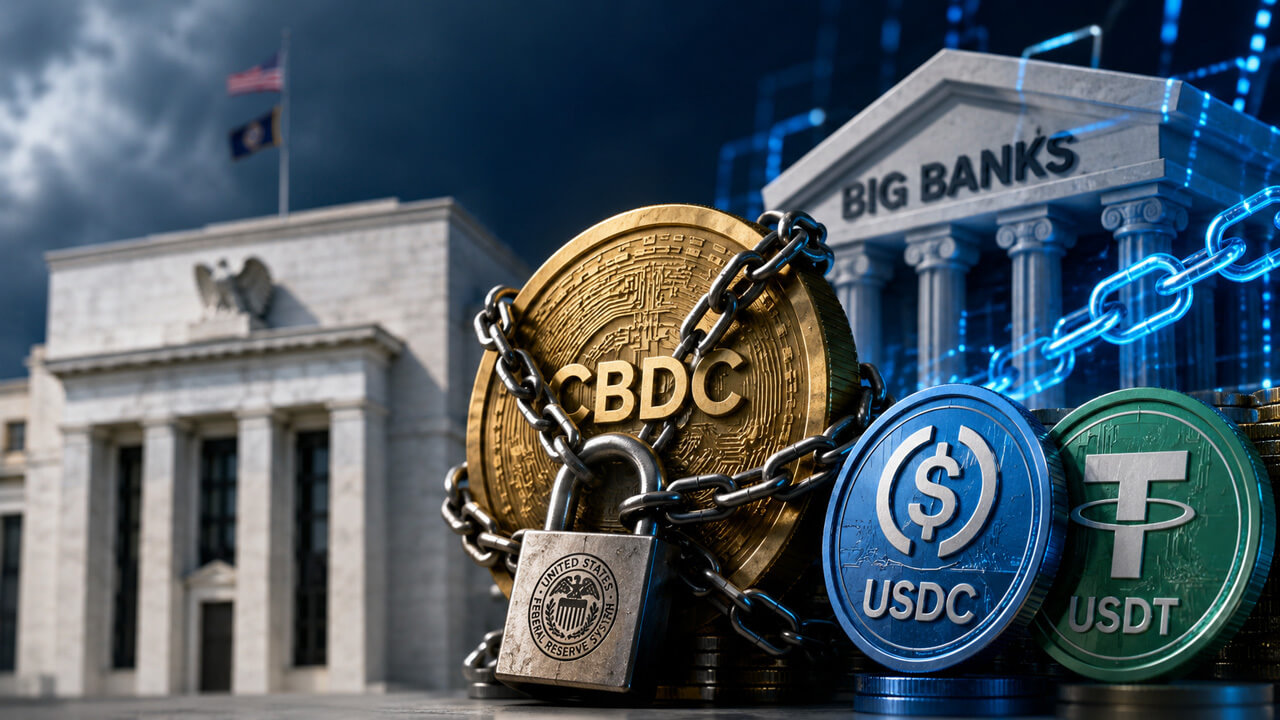
Congress just blocked the Federal Reserve from issuing a CBDC, and the companies benefiting most are private stablecoin issuers like Circle and Tether.

The 21st Century ROAD to Housing Act passed the Senate 85-5 on June 22 and cleared the House 358-32 the next day, and folded inside that housing package is a four-year ban on a Fed-issued central bank digital currency.

On the surface, it’s a clean win for crypto, because a government digital dollar would have competed head-on with private dollar tokens, and now it can’t arrive until 2031 at the earliest.

But the catch is that the Fed was never close to launching one. So Congress has blocked a competitor that wasn’t coming, while the contest that counts is taking shape inside the banking system. America’s largest banks are building a digital-money network of their own, and it could do much of what stablecoins promise while keeping cash on bank balance sheets.

What ended this week was the government’s path to a digital dollar, and the private race to build one carried right on, running straight through the commercial banks.

The CBDC ban blocks a rival that was never on its way

Most of the money people already use is digital. When you open a banking app and see a balance, that figure isn’t cash sitting in a vault with your name on it. It’s a bank deposit, a claim on the bank, money the bank owes you, and lets you spend with a card or send by transfer.

Physical cash is the one form of public money that comes straight from the government through the Fed. Everything else you hold day-to-day is a promise from a private company.

A central bank digital currency would add a third kind of money to that mix. The Fed defines a CBDC as a digital dollar that’s a direct liability of the central bank and available to the general public. It would be government-issued digital cash, a balance backed by the Fed itself and spendable from a phone.

Most of the world is already pursuing some version of this: China runs a digital yuan at scale, the European Central Bank is preparing a digital euro for a 2029 launch, and well over 100 countries are researching or piloting it.

Supporters of a digital dollar argue it could make payments faster and cheaper, and reach people the banking system leaves out. Opponents see something closer to a surveillance tool, a payment system the government could monitor and shut down, and one that would pull deposits and business away from banks and private dollar tokens alike.

See also  How SEC Chair Paul Atkins Plans to Shape Digital Asset Regulation

It now seems that the second camp won. Fed Chair Kevin Warsh called a US CBDC a “bad policy choice” at his confirmation hearing, Treasury Secretary Scott Bessent said a digital dollar was “off the table,” and Trump signed an executive order against it back in January 2025.

The provision in the housing bill turns that political consensus into law through the end of 2030, and even after that, the Fed would need fresh authorization from Congress to revive the project.

This is obviously very appealing to stablecoin issuers. A stablecoin is a digital token designed to represent one dollar, issued by a private company and backed by reserves of cash and short-term Treasury bills. Circle’s USDC and Tether’s USDT dominate the category, together making up more than 80% of a market now worth roughly $320 billion.

These companies got their federal rulebook last summer with the GENIUS Act, which requires one-to-one reserves, monthly disclosures, and bars issuers from paying interest to holders. A CBDC would have entered the market with the central bank’s balance sheet and credibility behind it, the kind of competitor no private issuer could match.

Freezing it for four years clears the field, and the bill even carves out an explicit exemption for open, private dollar tokens to ensure stablecoins remain outside the ban.

The reason that win counts for less than it looks is that the Fed had no retail digital dollar in the pipeline. It produced research papers and ran a small pilot at the Boston Fed, and that was pretty much the extent of it. Killing a product that nobody was shipping removes a threat that lived only on paper.

Stablecoin issuers still avoided a powerful rival in theory, and that’s worth something for an industry whose entire pitch is regulatory certainty. The harder fight was always going to come from a direction the housing bill doesn’t touch.

The competitor that’s actually being built

The real challenge to stablecoins is coming from the banks. JPMorgan, Citigroup, Bank of America, and Wells Fargo, along with more than a dozen other lenders, are building a shared network for tokenized deposits, operated through The Clearing House, the bank-owned payments company.

They’re targeting the first half of 2027 for launch. Some banks call the project “the bridge,” others call it “the chain.”

A tokenized deposit is an ordinary bank deposit recorded on a blockchain. The money remains a bank liability, retains its FDIC eligibility, and stays within the same regulated system it does today, while gaining the features that made stablecoins useful: instant settlement, round-the-clock movement, and programmable payments.

See also  Digital treasuries under pressure but Ethereum stands strong

The banks found their legal opening in the same stablecoin law that helped Circle and Tether. The GENIUS Act excludes deposits recorded on a digital ledger from its definition of a payment stablecoin, so a bank can move customer money on new rails and still call it a deposit. The FDIC reinforced the line in April, noting that money parked as stablecoin reserves wouldn’t carry pass-through insurance to the token holder, while a tokenized deposit keeps ordinary deposit protection.

That gives you three flavors of digital dollar competing for the same job. Stablecoins are digital dollars from crypto companies, tokenized deposits are digital dollars from banks, and a CBDC would have been digital dollars from the central bank. The housing bill removed the third option for four years and left the first two to fight it out.

Banks are fighting because deposits are the core of their business. When money sits in checking and savings accounts, banks lend against it, and that cheap funding is what makes the business work. A large cash migration into stablecoins would drain that base.

US banking groups warned Congress last year that the wrong rules could push up to $6.6 trillion out of the deposit system, thereby shrinking lending capacity and raising borrowing costs. JPMorgan CEO Jamie Dimon has fought hard against letting stablecoin platforms pay anything that looks like yield for the same reason. The tokenized deposit network is the constructive half of that response. The banks want digital money to keep up with crypto, and they want it to stay bank money.

Plenty of policymakers think the banks are positioned to win this. Bank of England official Megan Greene argued at a conference in late May that tokenized deposits will probably take over from stablecoins within five years, and that we might one day wonder why we spent so long talking about stablecoins at all. She framed it as a race between three animals, with the CBDC as the slow tortoise, stablecoins as the quick hare, and tokenized deposits as the rhino she’d bet on.

Fed Governor Christopher Waller pushed back at the same event, defending stablecoins as healthy payment competition with nothing dangerous about them. The split shows how unsettled the question remains, even among those who regulate it.

There are real reasons to stay skeptical of the bank network, too. Bank of America’s payments chief admitted clients aren’t “beating down the door” for tokenized deposits yet, and the network has no blockchain vendor selected and a launch still more than a year out.

See also  Singapore High Court Greenlights Crypto Exchange WazirX’s Restructuring Scheme Following Last Year’s Massive $230,000,000 Hack

Most early users are expected to be large multinational companies handling treasury and cross-border payments, which means tokenized deposits may remain a wholesale tool for big institutions for a while, leaving stablecoins to dominate the open, public side of crypto.

Adoption takes time, and a 2027 target leaves a long runway for stablecoin firms to lock in merchants, fintech apps, and payroll systems first.

This contest will eventually shape how fast money moves, who controls the rails it moves on, and whether you can earn anything on a digital cash balance. Stablecoins already settle in seconds, any hour, any day. Banks want tokenized deposits to match that speed while keeping the money in accounts that look and behave like the ones people have now.

The version that wins broad adoption will decide whether everyday digital dollars run on open crypto networks or inside closed bank systems, and whether they pay you a share of the interest those reserves earn.

That’s the fight the housing bill pushed down the road. The bill settled one thing cleanly: the Fed can’t issue a retail CBDC before 2031. The bigger decision now belongs to crypto companies and banks: which of them will issue the digital dollars Americans actually end up using. That choice will turn on the rules regulators are still writing, including how much yield each side can offer and how heavily each gets supervised.

There’s even a small wrinkle in whether the ban becomes law on schedule. President Trump abruptly canceled the planned signing ceremony on June 24, tying it to a separate voting bill he wants passed first, though House leaders expect him to sign the housing package within days regardless. The political theater around the signature will keep going, but the substance underneath it points in the same direction either way.

The Fed’s CBDC is frozen, and most of the country won’t notice because it was never coming anyway. But the digital dollars people actually use are faster than the CBDC debate suggested. Congress froze the government’s version, and the private versions kept racing, with the banks already set for launch.

The post Congress blocks introduction of any CBDC in the next 4 years – but the fight over digital money is just starting appeared first on CryptoSlate.

blocks CBDC Congress digital fight Introduction money Starting Years
Share. Facebook Twitter Pinterest LinkedIn Tumblr Email

Related Posts

European crypto users are being paid to move before MiCA closes the door

June 28, 2026

The UK softened stablecoin rules, but may still be capping its own market

June 28, 2026

Outdated bank rules may keep crypto outside the banks now allowed to hold it

June 27, 2026

Ripple got RLUSD into Japan, now the stablecoin race begins as Circle and Nomura join

June 27, 2026
Add A Comment
Leave A Reply Cancel Reply

Top Posts

OKX Wallet, City Protocol Partner to Unlock Cross-Chain RWA Access

December 5, 2025

Crypto-Mining Malware Found on 4000+ Sites

November 24, 2025

Stay ahead with the latest crypto news, market updates, blockchain insights, and trends. Your trusted source for everything happening in the digital asset world.


We're social. Connect with us:

Facebook X (Twitter) Instagram Pinterest YouTube
Top Insights

Samson Mow says bitcoin bottom is in, but analysts remain divided

June 28, 2026

Bitcoin just slipped below the bear-market line traders cannot ignore

June 28, 2026

Congress blocks introduction of any CBDC in the next 4 years – but the fight over digital money is just starting

June 28, 2026
Get Informed

Subscribe to Updates

Get the latest creative news From Free.cc directly in your Inbox!

  • Contact
  • Privacy Policy
  • Terms & Conditions
  • Disclosure
© 2026 free.cc - All rights reserved.

Type above and press Enter to search. Press Esc to cancel.