
Close Menu
  • Latest News
    • Bitcoin
    • Ethereum
    • Altcoins
    • Meme Coins
  • Tech
    • Blockchain
    • Security and Privacy
  • Web 3
    • Gaming
  • Legal
    • Legal and Regulatory
    • Adoption
  • Analysis
  • Learn
    • Education
    • Wallets and Exchanges
  • Tools
    • Market Overview
    • Exchange Tool
What's Hot

Bitcoin sees $771M in whale withdrawals – Why BTC could reclaim $84K

October 24, 2026

Coinbase to drop this Japanese yen stablecoin years after its price crash sparked investor lawsuits

October 24, 2026

Trump didn‘t mention ‘crypto’ once in White House cybercrime roundtable

October 24, 2026
Facebook X (Twitter) Instagram
  • Contact
  • Privacy Policy
  • Terms & Conditions
  • Disclosure
Facebook X (Twitter) Instagram
Free.cc (Free Cryptocurrency)Free.cc (Free Cryptocurrency)
  • Latest News
    1. Bitcoin
    2. Ethereum
    3. Altcoins
    4. Meme Coins
    5. View All

    Bitcoin sees $771M in whale withdrawals – Why BTC could reclaim $84K

    October 24, 2026

    When Will BTC Hit $100K Again?

    October 24, 2026

    Chinese Prosecutors Seek Confiscation of 61,896 BTC Seized in UK From Massive Fraud: Report

    October 24, 2026

    Robinhood (HOOD) sees surge in Bitcoin (BTC), Gold prediction markets as traders move beyond sports

    October 23, 2026

    Ethereum’s Glamsterdam testnet hits setback – Why Solana remains ahead

    October 23, 2026

    ETH Slips Below $2,400 as ETF Outflows and Market Sell-Off Pressure Bulls

    October 22, 2026

    Ethereum: Can $61M in whale withdrawals help ETH bulls regain control?

    October 22, 2026

    Ethereum staking hits record highs – So why are yields falling?

    October 22, 2026

    IRYS crypto jumps nearly 580% as traders betting against it lose $21M

    October 24, 2026

    Ethereum Delays Glamsterdam Test On Hoodi Over Smart Contract Compatibility Questions

    October 23, 2026

    Cosmos crypto defies market weakness – Can ATOM rally toward $2?

    October 23, 2026

    Chainlink’s $1.02M whale buy: An early Q4 signal or an isolated bet?

    October 23, 2026

    Top 5 Memecoins to Watch in 2026: Hype, Utility, or Growth?

    October 14, 2026

    Did Jean Phil Go Viral First — or Was the Viral Persona Built to Launch a Memecoin?

    October 5, 2026

    Thinking Cat Gains Momentum After CASHCAT’s Breakout

    August 12, 2026

    What Tokens Could He Target?

    July 30, 2026

    Bitcoin sees $771M in whale withdrawals – Why BTC could reclaim $84K

    October 24, 2026

    Coinbase to drop this Japanese yen stablecoin years after its price crash sparked investor lawsuits

    October 24, 2026

    Trump didn‘t mention ‘crypto’ once in White House cybercrime roundtable

    October 24, 2026

    OpenStocks’ BNB Chain Tokens Offer Price Exposure, Not Private Shares

    October 24, 2026
  • Tech
    1. Blockchain
    2. Security and Privacy
    3. View All

    OpenStocks’ BNB Chain Tokens Offer Price Exposure, Not Private Shares

    October 24, 2026

    SBI and Shinhan Card Partner on Blockchain Payments

    October 24, 2026

    Malaysia central bank launches DLT platform for tokenized bonds

    October 23, 2026

    Pyth Pro Powers New Loan Pools with WIF, PUMP, and SOL

    October 23, 2026

    Bitcoin Core Changes Security Policy as AI Makes Vulnerabilities Easier to Find

    October 23, 2026

    Coinbase, Bitgo Say Unaffected by PHP Flaw; Binance’s CZ Urges Caution

    October 22, 2026

    Crypto Thieves Hijack Ngrave Alerts and Walk Away With $2.56M

    October 21, 2026

    Zcash Proposes New Privacy Layer to Guard Swaps From Quantum Risks

    October 20, 2026

    Bitcoin sees $771M in whale withdrawals – Why BTC could reclaim $84K

    October 24, 2026

    Coinbase to drop this Japanese yen stablecoin years after its price crash sparked investor lawsuits

    October 24, 2026

    Trump didn‘t mention ‘crypto’ once in White House cybercrime roundtable

    October 24, 2026

    OpenStocks’ BNB Chain Tokens Offer Price Exposure, Not Private Shares

    October 24, 2026
  • Web 3
    1. Gaming
    2. View All

    Top 12 NFT games every player should know about in August 2026

    September 22, 2026

    GameShame Studios founder details Raijin Protocol’s roadmap in NeoPod’s sixth AMA

    September 22, 2026

    Proof of Play to shut down after blockchain gaming thesis falls short

    September 22, 2026

    How BC.GAME is turning players into stakeholders

    September 22, 2026

    Bitcoin sees $771M in whale withdrawals – Why BTC could reclaim $84K

    October 24, 2026

    Coinbase to drop this Japanese yen stablecoin years after its price crash sparked investor lawsuits

    October 24, 2026

    Trump didn‘t mention ‘crypto’ once in White House cybercrime roundtable

    October 24, 2026

    OpenStocks’ BNB Chain Tokens Offer Price Exposure, Not Private Shares

    October 24, 2026
  • Legal
    1. Legal and Regulatory
    2. Adoption
    3. View All

    Trump didn‘t mention ‘crypto’ once in White House cybercrime roundtable

    October 24, 2026

    New OCC stablecoin rule resets redemptions, and banks face big shifts

    October 24, 2026

    ABA Bankers Criticize US OCC’s GENIUS Act Rule Update

    October 24, 2026

    Treasury Secretary Bessent likens GENIUS Act to Lincoln-era banking reform

    October 24, 2026

    Germany’s main savings bank network launches Bitcoin trading

    October 21, 2026

    Two firms control corporate Bitcoin buys, even as business adoption broadens

    October 16, 2026

    AI agents keep coming back for crypto as x402 wallet refill rate surges to 89%

    October 15, 2026

    Interactive Brokers moves into Ethereum’s $110 billion staking market as institutional demand accelerates

    October 14, 2026

    Bitcoin sees $771M in whale withdrawals – Why BTC could reclaim $84K

    October 24, 2026

    Coinbase to drop this Japanese yen stablecoin years after its price crash sparked investor lawsuits

    October 24, 2026

    Trump didn‘t mention ‘crypto’ once in White House cybercrime roundtable

    October 24, 2026

    OpenStocks’ BNB Chain Tokens Offer Price Exposure, Not Private Shares

    October 24, 2026
  • Analysis

    Bitcoin ETFs shed $635 million as BTC tests their holdings’ estimated $81,500 cost basis

    October 24, 2026

    Can QNT Rebound Toward $373?

    October 23, 2026

    Can Rising Social Dominance Push PEPE Coin Higher?

    October 23, 2026

    Uniswap adds seven trading sources as 0x disputes its protection from malicious hooks

    October 23, 2026

    Fake election polls expose a Kalshi loophole that could leave traders paying for fraud

    October 23, 2026
  • Learn
    1. Education
    2. Wallets and Exchanges
    3. View All

    What Is Robinhood Chain? The Ethereum Layer-2 Network for Tokenized Stocks

    July 12, 2026

    What Is BChat? The Decentralized Messaging App Built for Privacy

    June 2, 2026

    What Is an AI Prompt Injection Attack? The Hidden Threat Hijacking Your Chatbots

    May 31, 2026

    What Is AI Jailbreaking? A Beginner’s Guide to the Cat-and-Mouse Game Behind Every Chatbot

    May 17, 2026

    Coinbase to drop this Japanese yen stablecoin years after its price crash sparked investor lawsuits

    October 24, 2026

    Coinbase Ireland’s cash safeguards fell €5 million short before 2024 fix

    October 23, 2026

    SideSwap reopens Bitcoin swaps while Liquid reserves stay locked

    October 22, 2026

    Binance bStocks collateral pricing moves to 24/7

    October 21, 2026

    Bitcoin sees $771M in whale withdrawals – Why BTC could reclaim $84K

    October 24, 2026

    Coinbase to drop this Japanese yen stablecoin years after its price crash sparked investor lawsuits

    October 24, 2026

    Trump didn‘t mention ‘crypto’ once in White House cybercrime roundtable

    October 24, 2026

    OpenStocks’ BNB Chain Tokens Offer Price Exposure, Not Private Shares

    October 24, 2026
  • Tools
    • Market Overview
    • Exchange Tool
Free.cc (Free Cryptocurrency)Free.cc (Free Cryptocurrency)
Home»Analysis»Google’s quantum breakthrough exposes over $ $600 billion in Bitcoin and Ethereum to risk
Analysis

Google’s quantum breakthrough exposes over $ $600 billion in Bitcoin and Ethereum to risk

March 31, 2026No Comments7 Mins Read
Share
Facebook Twitter LinkedIn Pinterest Email

A new paper from Google Quantum AI has sharply reduced the estimated hardware required to crack elliptic-curve cryptography used by Bitcoin and much of Ethereum, moving a long-running security debate closer to market terms.

At current market prices, the quantum computing risks could affect more than $600 billion in Bitcoin, Ethereum, and stablecoins.

The paper, co-authored by Google researchers, Ethereum Foundation researcher Justin Drake, and Stanford cryptographer Dan Boneh, says Shor’s algorithm for the 256-bit elliptic curve discrete logarithm problem can run with either no more than 1,200 logical qubits and 90 million Toffoli gates or no more than 1,450 logical qubits and 70 million Toffoli gates.

Google says those circuits could be executed on a superconducting, cryptographically relevant quantum computer with fewer than 500,000 physical qubits in a few minutes, roughly a 20-fold reduction from prior estimates of the number of physical qubits.

Notably, Google does not say such a machine exists today. Still, Ethereum Foundation’s Drake said his confidence in a so-called Q-day by 2032 had risen sharply and that he now sees at least a 10% chance that a quantum computer could recover a secp256k1 private key from an exposed public key by then.

Meanwhile, Google paired the paper with an unusual disclosure model, revealing that it engaged with the US government and used a zero-knowledge proof so outsiders could verify the resource estimates without receiving the underlying attack circuits.

The paper says progress in quantum computing has reached the point where publishing improved attack details in full has become less prudent, even as publishing trustworthy resource estimates remains necessary to motivate defenses.

As quantum ‘Q-Day' jumps to 2029, Ethereum faces a new fight over what to do with coins left in old wallets
Related Reading

As quantum ‘Q-Day’ jumps to 2029, Ethereum faces a new fight over what to do with coins left in old wallets

The Ethereum Foundation’s post-quantum roadmap argues that the real danger is a years-long struggle over how to move user wallets.

Mar 26, 2026 · Gino Matos

See also  Bank Lobbyists Strike Out Against Clarity Act, Say Bill Would Risk ‘Flight of Bank Deposits' Into Payment Stablecoins

Bitcoin’s problem is partly a race and partly a stockpile

For Bitcoin, the paper’s immediate market hook is timing. It models an “on-spend” attack in which a quantum machine derives a private key after a user reveals a public key by broadcasting a transaction, then tries to syndicate a competing transaction before the original payment is confirmed.

The paper says a fast-clock superconducting machine could reduce the live attack window to about 9 minutes from a primed state, close to Bitcoin’s roughly 10-minute average block time.
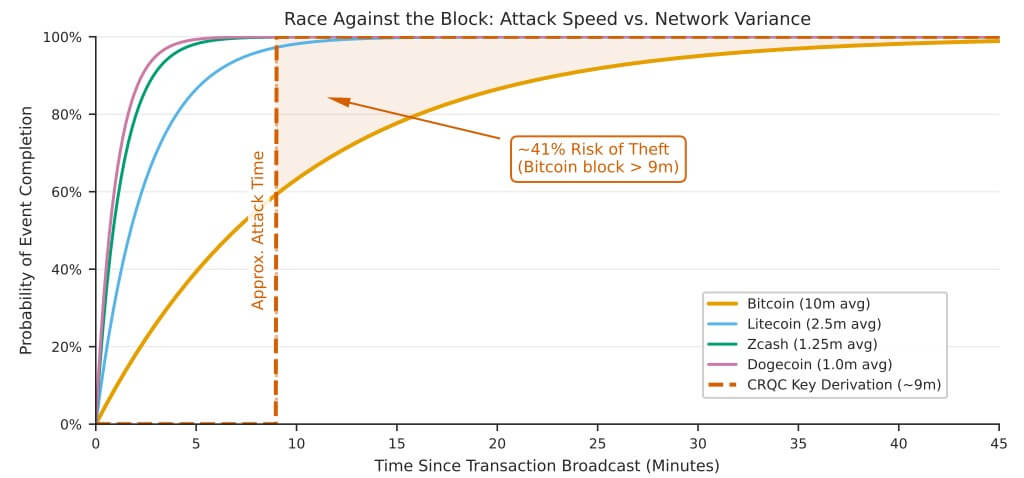
Bitcoin Quantum Computing Risk
Bitcoin Quantum Computing Risk (Source: Google)

Under the paper’s assumptions, that implies a theft success probability of slightly less than 41%.

Meanwhile, that is only one part of the Bitcoin story, as the paper pointed out that about 6.7 million BTC are sitting in vulnerable addresses. This is equivalent to roughly $444 billion, or nearly 32% of BTC’s total cap of 21 million coins.

Of this, the paper says old Pay-to-Public-Key scripts still secure more than 1.7 million BTC, worth about $112.6 billion at current market price, and that the total amount of dormant quantum-vulnerable Bitcoin may reach 2.3 million BTC across script types, or about $152.3 billion.

Those coins cannot all be migrated simply by asking current users to move funds, because many are thought to be abandoned, lost, or otherwise inactive.

Apart from that, the authors also argue that Taproot, despite its benefits for privacy and flexibility, reintroduced a quantum weakness because Pay-to-Taproot places the tweaked public key directly in the locking script.

They added that Grover-based attacks on Bitcoin mining remain impractical for decades, keeping the near-term focus on signatures rather than proof of work.

That leaves Bitcoin with two distinct problems. One is the risk of live transactions if a future fast-clock machine can reliably break keys within the settlement window. The other is a large stock of older or exposed coins that could become fixed targets in a post-CRQC world.

See also  ARB Up 4% Today- Is a Major Reversal Finally Starting?

The paper explicitly states that every existing Bitcoin transaction type is vulnerable to on-spend attacks from a future fast-clock machine, while older P2PK outputs and modern P2TR outputs introduce at-rest exposure of their own.

This “quantum-safe” Bitcoin idea removes Taproot’s key-path — and raises fees on purpose
Related Reading

This “quantum-safe” Bitcoin idea removes Taproot’s key-path — and raises fees on purpose

If it ever activates, it’s opt-in and slow, because Bitcoin’s real constraint is coordination, not cryptography.

Feb 13, 2026 · Gino Matos

Ethereum’s quantum risk runs through wallets, validators, and tokenized assets

Meanwhile, the quantum risks for Ethereum are presented differently.

The paper says early fast-clock quantum computers are unlikely to launch the same kind of on-spend attack there because Ethereum produces blocks in deterministic 12-second slots, processes most transactions in less than a minute, and already relies heavily on private mempools.

Instead, the main quantum threat lies in at-rest attacks against long-lived accounts and the systems attached to them.

CryptoSlate Daily Brief

Daily signals, zero noise.

Market-moving headlines and context delivered every morning in one tight read.

5-minute digest 100k+ readers

Free. No spam. Unsubscribe any time.

Whoops, looks like there was a problem. Please try again.

You’re subscribed. Welcome aboard.

The paper estimates that a fast-clock attacker could crack the 1,000 highest-net-worth Ethereum accounts, holding about 20.5 million ETH, in less than nine days. At Tuesday’s ETH price of about $2,023.46, that comes to roughly $41.5 billion.
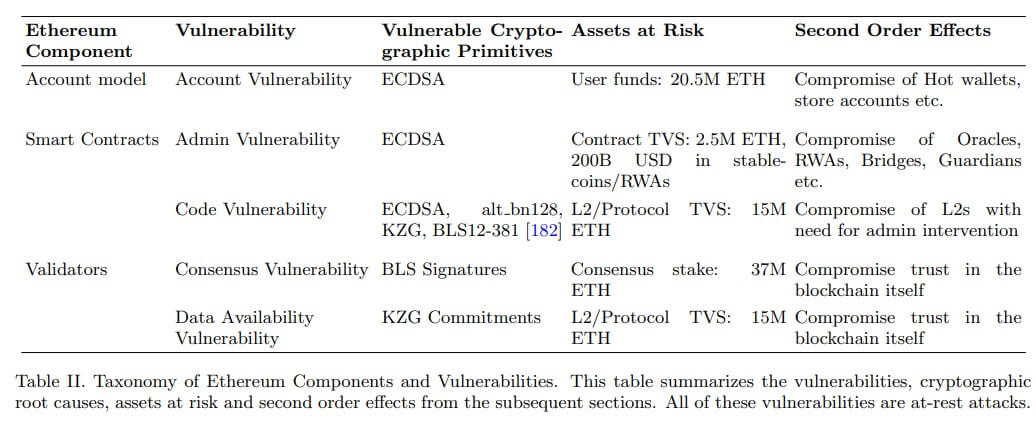
Ethereum Quantum Computing Risks
Ethereum Quantum Computing Risks (Source: Google)

Among the top 500 contract accounts by ETH balance, it says at least 70 accounts holding about 2.5 million ETH are exposed through administrative keys, a bucket worth about $5.1 billion at current prices, with a private-key derivation attack on those accounts taking less than 15 hours on a fast-clock machine.

Meanwhile, the larger institutional story sits behind those balances. The paper links that admin vulnerability to about $200 billion in stablecoins and tokenized real-world assets on Ethereum and says those keys can function as control points for issuers, bridges, oracle operators, and emergency guardians.

See also  Hyperliquid’s UK warning reveals the regulatory test behind its Wall Street push

The paper warned that a successful quantum attack on such accounts could allow arbitrary minting, false price feeds, frozen user funds, or drained liquidity pools, depending on the system. The paper says this is why standard asset-balance models understate the true value-at-risk.

It then widens the lens further. In its Ethereum risk taxonomy, the paper flags about 15 million ETH in Layer 2 and protocol value exposed through code and data-availability vulnerabilities, equal to roughly $30.4 billion at current prices, and about 37 million ETH in consensus stake exposed through BLS-signature-related risk, or about $74.9 billion.

Those figures overlap with other components of Ethereum’s architecture, but together they show why the paper treats Ethereum as a broader infrastructure problem rather than a wallet-security story.

The pressure shifts from theory to migration

Against this backdrop, the industry is left to ask whether blockchains, wallets, exchanges, and tokenized-asset issuers can migrate before the economics of attack shift.

Charles Guillemet, the Chief Technology Officer (CTO) at Ledger, said:

“The good news is that we already have the tools: Post Quantum Cryptography, now we need to migrate.”

However, the Google paper says the process will take years, and the industry cannot wait for perfect clarity on the exact arrival date of cryptographically relevant quantum computers.

According to the firm, it will require both protocol work and changes in wallet behavior, including reducing public-key exposure and ending key reuse wherever possible.

Essentially, vulnerable cryptocurrency communities should move to post-quantum cryptography without delay.

For Bitcoin, that means a race against a settlement window that no longer looks comfortably wide. For Ethereum, it means protecting not just coins but the much larger stack of contracts and tokenized claims now resting on the same vulnerable math.

Mentioned in this article
Billion Bitcoin Breakthrough Ethereum Exposes Googles Quantum Risk
Share. Facebook Twitter Pinterest LinkedIn Tumblr Email

Related Posts

Bitcoin sees $771M in whale withdrawals – Why BTC could reclaim $84K

October 24, 2026

Bitcoin ETFs shed $635 million as BTC tests their holdings’ estimated $81,500 cost basis

October 24, 2026

Can QNT Rebound Toward $373?

October 23, 2026

Bitcoin Core Changes Security Policy as AI Makes Vulnerabilities Easier to Find

October 23, 2026
Add A Comment
Leave A Reply Cancel Reply

Top Posts

Michaël Van de Poppe Keeps $300K Bitcoin Target Alive, Says $1M Is Still Possible 

June 10, 2026

Hacked Binance WeChat Sparks 900% Mubarakah Token Surge

December 10, 2025

Stay ahead with the latest crypto news, market updates, blockchain insights, and trends. Your trusted source for everything happening in the digital asset world.


We're social. Connect with us:

Facebook X (Twitter) Instagram Pinterest YouTube
Top Insights

Bitcoin sees $771M in whale withdrawals – Why BTC could reclaim $84K

October 24, 2026

Coinbase to drop this Japanese yen stablecoin years after its price crash sparked investor lawsuits

October 24, 2026

Trump didn‘t mention ‘crypto’ once in White House cybercrime roundtable

October 24, 2026
Get Informed

Subscribe to Updates

Get the latest creative news From Free.cc directly in your Inbox!

  • Contact
  • Privacy Policy
  • Terms & Conditions
  • Disclosure
© 2026 free.cc - All rights reserved.

Type above and press Enter to search. Press Esc to cancel.