Close Menu
  • Latest News
    • Bitcoin
    • Ethereum
    • Altcoins
    • Meme Coins
  • Tech
    • Blockchain
    • Security and Privacy
  • Web 3
    • Gaming
  • Legal
    • Legal and Regulatory
    • Adoption
  • Analysis
  • Learn
    • Education
    • Wallets and Exchanges
  • Tools
    • Market Overview
    • Exchange Tool
  • INFO@FREE.CC
What's Hot

Crypto leaked by South Korean tax officials stolen a second time

March 6, 2026

Pi Network Co-Founder Unveils Crucial KYC Updates Every Pioneer Needs to Know

March 6, 2026

How Extreme Negative Funding Is Priming XRP For A High-Velocity Trend Reversal

March 6, 2026
Facebook X (Twitter) Instagram
  • Contact
  • Privacy Policy
  • Terms & Conditions
  • Disclosure
Facebook X (Twitter) Instagram
Free.cc (Free Cryptocurrency)Free.cc (Free Cryptocurrency)
  • Latest News
    1. Bitcoin
    2. Ethereum
    3. Altcoins
    4. Meme Coins
    5. View All

    The Core Issue: Consensus Cleanup

    March 6, 2026

    Canada launches new multi-crypto ETF as banks enter the sector

    March 6, 2026

    Bitcoin Price Debate Ignites as Bull Trap Warning Clashes With On-Chain Data

    March 6, 2026

    Bitcoin Primed for Rally Through March if History Repeats, According to Benjamin Cowen – But There’s a Catch

    March 5, 2026

    Top Analyst Reveals What’s Next For Bitcoin, Ethereum and XRP

    March 5, 2026

    Ethereum Price Analysis: Institutional Buying Returns as Whales Accumulate

    March 5, 2026

    Ethereum Hovers at $2,150 — Can ETH Price Rally to $2,400 or Stall Below $2,200?

    March 5, 2026

    Vitalik Buterin Admits Ethereum Hasn’t Meaningfully Improved People’s Lives

    March 5, 2026

    How Extreme Negative Funding Is Priming XRP For A High-Velocity Trend Reversal

    March 6, 2026

    Bitcoin Liquidity Set To Expand With Morgan Stanley BTC ETF Option

    March 6, 2026

    Bitcoin Suppressed By Shadow Banking Rehypothecation: Saylor

    March 5, 2026

    XRP Price Retests Decade-Old Trendline That Previously Triggered 630%+ Rallies

    March 5, 2026

    Crypto Interest Rising Toward Meme Coin Sector

    January 9, 2026

    Memes Market Cap Adds $10B in Days: Fresh Capital or Dead-Cat-Bounce?

    January 5, 2026

    Meme Coin Market Surges Past $45B as Shiba Inu, PEPE, BONK Stage 54% Price Pump

    January 4, 2026

    US Ranks #1 in CoinGecko Global Meme Coin Interest Report

    December 18, 2025

    Crypto leaked by South Korean tax officials stolen a second time

    March 6, 2026

    Pi Network Co-Founder Unveils Crucial KYC Updates Every Pioneer Needs to Know

    March 6, 2026

    How Extreme Negative Funding Is Priming XRP For A High-Velocity Trend Reversal

    March 6, 2026

    The Core Issue: Consensus Cleanup

    March 6, 2026
  • Tech
    1. Blockchain
    2. Security and Privacy
    3. View All

    Pi Network Co-Founder Unveils Crucial KYC Updates Every Pioneer Needs to Know

    March 6, 2026

    Startale App Integrates Kyo Finance to Power Seamless Swaps on Soneium

    March 6, 2026

    ICB Network and Mokoko AI Entail Strategic Partnership to Transform Web3 Gaming Infrastructure

    March 6, 2026

    Atlasbrary and Flux Partner to Boost Scalable Web3

    March 5, 2026

    Leaked Database Sheds Light on Iranian Crypto Sanctions Evasion

    March 4, 2026

    DOJ seizures of $580M expose how crypto investment scams scaled into shift work with quotas and scripts

    March 3, 2026

    Aeternum Botnet Shifts Command Control to Polygon Blockchain

    February 27, 2026

    Former Defense Contractor Boss Gets 7+ Years for Selling Zero Days

    February 26, 2026

    Crypto leaked by South Korean tax officials stolen a second time

    March 6, 2026

    Pi Network Co-Founder Unveils Crucial KYC Updates Every Pioneer Needs to Know

    March 6, 2026

    How Extreme Negative Funding Is Priming XRP For A High-Velocity Trend Reversal

    March 6, 2026

    The Core Issue: Consensus Cleanup

    March 6, 2026
  • Web 3
    1. Gaming
    2. View All

    METYA Partners With Kult Games to Expand Web3 Gaming Ecosystem

    March 6, 2026

    AurumX Collaborates with FishWar to Redefine Web3-Based Gaming Economies

    March 5, 2026

    C. Thi Nguyen: Prioritizing enjoyment over efficiency in games, the pitfalls of social media scoring systems, and how metrics can obscure true value

    March 4, 2026

    NFTs as Programmable Ownership Layers | Web3 Infrastructure Explained

    March 3, 2026

    Crypto leaked by South Korean tax officials stolen a second time

    March 6, 2026

    Pi Network Co-Founder Unveils Crucial KYC Updates Every Pioneer Needs to Know

    March 6, 2026

    How Extreme Negative Funding Is Priming XRP For A High-Velocity Trend Reversal

    March 6, 2026

    The Core Issue: Consensus Cleanup

    March 6, 2026
  • Legal
    1. Legal and Regulatory
    2. Adoption
    3. View All

    Crypto leaked by South Korean tax officials stolen a second time

    March 6, 2026

    Reform UK tops donations with millions from Thailand-based crypto investor: Report

    March 6, 2026

    Donald Trump’s crypto legacy in two words: Paul Atkins

    March 6, 2026

    International finance watchdog warns stablecoins are increasingly used in sanctions evasion and money laundering

    March 5, 2026

    XRP and XRPL get a credibility lift from Ripple’s expanding footprint

    March 5, 2026

    XRP rewrites the playbook for altcoin ETF approvals to surge in late 2026 after a wave of futures listings

    March 4, 2026

    Bitcoin ETF custody concentrates power in one place, and now a single operational failure causes dangerous ripples

    March 3, 2026

    Revolut’s stablecoin test targets its 12M UK users

    March 3, 2026

    Crypto leaked by South Korean tax officials stolen a second time

    March 6, 2026

    Pi Network Co-Founder Unveils Crucial KYC Updates Every Pioneer Needs to Know

    March 6, 2026

    How Extreme Negative Funding Is Priming XRP For A High-Velocity Trend Reversal

    March 6, 2026

    The Core Issue: Consensus Cleanup

    March 6, 2026
  • Analysis

    XRP Price Consolidates Under $1.5 — What Could Drive the Next Move to $2?

    March 5, 2026

    Israel’s weekly $3B Iran war cost equals over 41,000 Bitcoin

    March 5, 2026

    Chainlink Price Gains Attention After Visa e-HKD Pilot and LINK Chart Signals Possible Breakout

    March 5, 2026

    Can the Bulls Push the Price to $1.16 as $1 Resistance is Back in Focus

    March 5, 2026

    Bitcoin investors may not need altcoins to diversify if tokenized stocks move on-chain

    March 5, 2026
  • Learn
    1. Education
    2. Wallets and Exchanges
    3. View All

    What Is Strategy (MSTR)? The Bitcoin Treasury Company

    February 21, 2026

    What Are Prediction Markets? How Polymarket, Kalshi and Myriad Work

    February 13, 2026

    What Is Farcaster? The Decentralized Social Media Protocol

    February 10, 2026

    What Is Venice AI? The Privacy-Focused Chatbot

    January 13, 2026

    Crypto platform aims to let retail investors buy IPO shares at the same price as Wall Street insiders

    March 6, 2026

    The company holding all Bitcoin ETF coins is losing money, resurfacing questions about centralization

    February 21, 2026

    The Bitcoin CME gap will now close forever in May leaving a return to $84k hanging

    February 21, 2026

    Robinhood’s $221 million crypto revenue drop shows crypto winter isn’t on chain and retail already moved

    February 16, 2026

    Crypto leaked by South Korean tax officials stolen a second time

    March 6, 2026

    Pi Network Co-Founder Unveils Crucial KYC Updates Every Pioneer Needs to Know

    March 6, 2026

    How Extreme Negative Funding Is Priming XRP For A High-Velocity Trend Reversal

    March 6, 2026

    The Core Issue: Consensus Cleanup

    March 6, 2026
  • Tools
    • Market Overview
    • Exchange Tool
  • INFO@FREE.CC
Free.cc (Free Cryptocurrency)Free.cc (Free Cryptocurrency)
Home»Adoption»JP Morgan bets on Ethereum for its MONY fund
Adoption

JP Morgan bets on Ethereum for its MONY fund

December 17, 2025No Comments7 Mins Read
Share
Facebook Twitter LinkedIn Pinterest Email

JP Morgan Chase & Co. has formally entered the contest for on-chain cash, and the prize is not just a new product line. It is the billions of dollars in institutional capital that now sit in zero-yield stablecoins and early tokenized funds.

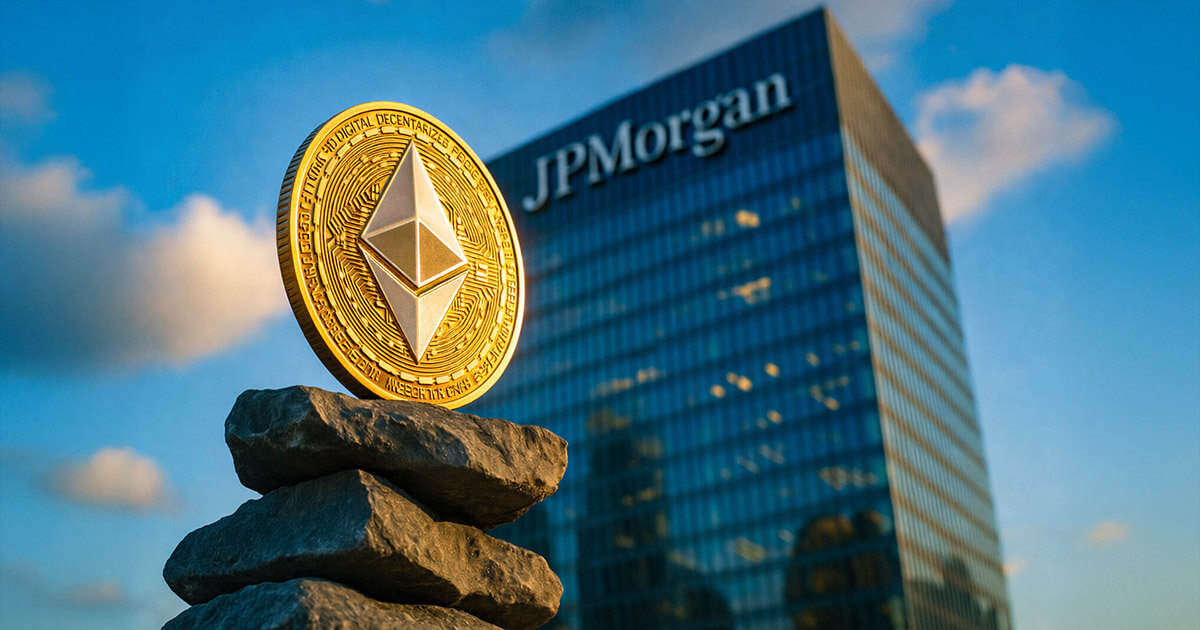
On Dec. 15, the $4 trillion banking giant launched the My OnChain Net Yield Fund (MONY) on the Ethereum blockchain, in its attempt to pull back liquidity into a structure it controls and regulators recognize.

MONY wraps a traditional money-market fund in a token that can live on public rails, pairing the speed of crypto with the one feature payment stablecoins such as Tether and Circle cannot legally offer under new US rules: yield.

That makes MONY less a DeFi experiment than JP Morgan’s attempt to redefine what “cash on-chain” means for large, KYC’d pools of capital.

It also puts the bank in more direct competition with BlackRock’s BUIDL and the broader tokenized Treasuries sector, which has grown into a mid–tens of billions market as institutions look for yield-bearing, blockchain-native cash equivalents.

How GENIUS tilts the field

To understand the timing, one has to start with the GENIUS Act, the US stablecoin law passed earlier this year.

The statute created a full licensing regime for payment stablecoins and, crucially, banned issuers from paying interest to token holders simply for holding the token.

As a result, the core business model for regulated dollar stablecoins is now codified: issuers hold reserves in safe assets, collect the yield, and pass none of it through directly.

For corporate treasurers and crypto funds that hold large stablecoin balances for weeks or months, that embeds a structural opportunity cost. In a world where front-end rates hover in the mid-single digits, that “stablecoin tax” can run at roughly 4–5% per year on idle balances.

MONY is designed to sit outside that perimeter. It is structured as a Rule 506(c) private placement money-market fund, not a payment stablecoin.

That means it is treated as a security, sold only to accredited investors, and invested in US Treasuries and fully collateralized Treasury repos.

See also  XRP finds new life in lending and regulated markets amid BTC stall

As a money fund, it is structured to pass most of the underlying income back to shareholders after fees, not to trap the entire yield at the issuer level.

Crypto research firm Asva Capital noted:

“Tokenized money-market funds solve a key problem: idle stablecoins earning zero yield.”

By letting qualified investors subscribe and redeem in either cash or USDC via JP Morgan’s Morgan Money platform, MONY effectively creates a two-step workflow.

This allows the investors to use USDC or other payment tokens for transactions, then rotate into MONY when the priority shifts to holding and earning.

For JP Morgan, this is not a side bet. The bank seeded MONY with around $100 million of its own capital and is marketing it directly into its global liquidity client base.

As John Donohue, head of Global Liquidity at JP Morgan Asset Management, put it, the firm expects other global systemically important banks to follow.

So, the message is that tokenization has progressed past pilots; it is now a delivery mechanism for core cash products.

The collateral contest

The economic logic becomes clearer when you look at collateral, not wallets.

Crypto derivatives markets, prime brokerage platforms and OTC desks require margin and collateral around the clock.

Historically, stablecoins like USDT and USDC have been the default because they are fast and broadly accepted. They are not, however, capital efficient in a high-rate regime.

Tokenized money funds are built to fill that gap. Instead of parking $100 million in stablecoins that earn nothing, a fund or trading desk can hold $100 million of MMF tokens that track a conservative portfolio of short-term government assets and still move at blockchain speed between vetted venues.

BlackRock’s BUIDL product has already shown how that can evolve. Once it gained acceptance as collateral on large exchanges’ institutional rails, it stopped being “tokenization as demo” and became part of the funding stack.

MONY is aimed at the same corridor, but with a different perimeter.

While BUIDL has pushed aggressively into crypto-native platforms through partnerships with tokenization specialists, JP Morgan is tying MONY tightly to its own Kinexys Digital Assets stack and the existing Morgan Money distribution network.

See also  With $1B in open interest XRP and Solana are the new institutional trades

So, the pitch for MONY is not to the offshore, high-frequency trading crowd. It is to pensions, insurers, asset managers and corporates that already use money-market funds and JP Morgan’s liquidity platforms today.

Donohue has argued that tokenization can “fundamentally change the speed and efficiency of transactions.” In practical terms, that means shrinking settlement windows for collateral moves from T+1 into intraday, and doing it without moving out of the banking and fund-regulation perimeter.

Moreover, the risk for stablecoins is not that they disappear. It is that a meaningful slice of the large, institutional balances that currently sit in USDC or USDT for collateral and treasury purposes migrate into tokenized MMFs instead, leaving stablecoins more concentrated in payments and open DeFi.

The Ethereum signal

Perhaps the clearest signal in MONY’s design is the choice of Ethereum as its base chain.

JP Morgan has run private ledgers and permissioned networks for years; putting a flagship cash product on a public blockchain is an acknowledgment that liquidity, tooling and counterparties have converged there.

Thomas Lee of BitMine views the move as a watershed moment, stating simply that “Ethereum is the future of finance.” This is a claim now supported by the fact that the world’s largest bank is deploying its flagship tokenized cash product on the network.

However, the “public” blockchain launch here comes with an asterisk. MONY is still a 506(c) security.

This means that its tokens can only sit in allowlisted, KYC’d wallets, and transfers are controlled to comply with securities law and the fund’s own restrictions. That effectively splits on-chain dollar instruments into two overlapping layers.

On the permissionless layer, retail users, high-frequency traders and DeFi protocols will continue to rely on Tether, USDC and similar tokens. Their value proposition is censorship resistance, universal composability and ubiquity across protocols and chains.

On the permissioned layer, MONY and peer funds like BUIDL and Goldman’s and BNY Mellon’s tokenized MMFs offer regulated, yield-bearing cash equivalents to institutions that care more about audit trails, governance and counterparty risk than about permissionless composability. Their liquidity is thinner but more curated; their use cases are narrower but higher-value per dollar.

See also  Ethereum Coils For A Breakout As IH&S + Heavy Accumulation Emerges

Considering this, JP Morgan is betting that the next meaningful wave of on-chain volume will come from that second group: treasurers who want Ethereum’s speed and integration without taking on the regulatory ambiguity that still surrounds a large part of DeFi.

A defensive pivot

Ultimately, MONY looks less like a revolution against the existing system and more like a defensive pivot inside it.

For a decade, fintech and crypto firms chipped away at banks’ payment, FX and custody businesses. Stablecoins then went after the most fundamental layer: deposits and cash management, offering a digital bearer-like alternative that could sit outside bank balance sheets entirely.

By launching a tokenized money-market fund on public rails, JP Morgan is trying to pull some of that migration back inside its own perimeter, even if it means cannibalizing parts of its traditional deposit base.

George Gatch, CEO of J.P. Morgan Asset Management, has emphasized “active management and innovation” as the core of the offering, implicitly contrasting it with the passive float-skimming model of stablecoin issuers.

Meanwhile, bank is not alone. BlackRock, Goldman Sachs and BNY Mellon have already moved into tokenized MMFs and tokenized cash-equivalent products.

So, JP Morgan’s entry shifts that trend from early experimentation to open competition among incumbents over who will own institutional “digital dollars” on public chains.

If that competition succeeds, the effect will not be the end of stablecoins or the triumph of DeFi.

Instead, it would be a quiet re-bundling as the settlement rails will be public, and the instruments running on them will look a lot like traditional money-market funds.

However, the institutions earning a spread on the world’s cash will, once again, be the same Wall Street names that dominated the pre-tokenization era.

Mentioned in this article
Bets Ethereum Fund MONY Morgan
Share. Facebook Twitter Pinterest LinkedIn Tumblr Email

Related Posts

Bitcoin Liquidity Set To Expand With Morgan Stanley BTC ETF Option

March 6, 2026

Top Analyst Reveals What’s Next For Bitcoin, Ethereum and XRP

March 5, 2026

XRP and XRPL get a credibility lift from Ripple’s expanding footprint

March 5, 2026

Ethereum Price Analysis: Institutional Buying Returns as Whales Accumulate

March 5, 2026
Add A Comment
Leave A Reply Cancel Reply

Top Posts

HYPE Price Hits ATH on ETF and Stablecoin Momentum

September 12, 2025

US regulators release joint statement teasing 24/7 capital markets

September 9, 2025

Stay ahead with the latest crypto news, market updates, blockchain insights, and trends. Your trusted source for everything happening in the digital asset world.


We're social. Connect with us:

Facebook X (Twitter) Instagram Pinterest YouTube
Top Insights

Crypto leaked by South Korean tax officials stolen a second time

March 6, 2026

Pi Network Co-Founder Unveils Crucial KYC Updates Every Pioneer Needs to Know

March 6, 2026

How Extreme Negative Funding Is Priming XRP For A High-Velocity Trend Reversal

March 6, 2026
Get Informed

Subscribe to Updates

Get the latest creative news From Free.cc directly in your Inbox!

  • Contact
  • Privacy Policy
  • Terms & Conditions
  • Disclosure
© 2026 free.cc - All rights reserved.

Type above and press Enter to search. Press Esc to cancel.