Close Menu
  • Latest News
    • Bitcoin
    • Ethereum
    • Altcoins
    • Meme Coins
  • Tech
    • Blockchain
    • Security and Privacy
  • Web 3
    • Gaming
  • Legal
    • Legal and Regulatory
    • Adoption
  • Analysis
  • Learn
    • Education
    • Wallets and Exchanges
  • Tools
    • Market Overview
    • Exchange Tool
What's Hot

Caroline D. Pham Delivers Keynote on Crypto Regulation

October 25, 2026

Peter Schiff’s ‘$75K Bitcoin call’ meets a vital week: Fed, inflation, and ETF outflows loom

October 25, 2026

Swell Pauses swETH and rswETH Deposits and Withdrawals

October 25, 2026
Facebook X (Twitter) Instagram
  • Contact
  • Privacy Policy
  • Terms & Conditions
  • Disclosure
Facebook X (Twitter) Instagram
Free.cc (Free Cryptocurrency)Free.cc (Free Cryptocurrency)
  • Latest News
    1. Bitcoin
    2. Ethereum
    3. Altcoins
    4. Meme Coins
    5. View All

    Bitcoin Core Ends Long Embargoes For Bugs AI Can Rediscover

    October 25, 2026

    Bitcoin – Why Coinbase warns BTC could fall to $75K amid macro risks

    October 25, 2026

    China to Seize 61,896 Bitcoin in $5.6 Billion Fraud Case

    October 25, 2026

    New York AG Pursues $1,300,000,0000 From Crypto Pyramid Scheme Targeting Prayer Groups

    October 25, 2026

    Ethereum outflows hit 4-month high – Why ETH price still risks $2,300

    October 24, 2026

    Initia halts L1 and rollups after $2.7 million exploit — What happened?

    October 24, 2026

    Ethereum’s deflationary edge fades – Is an ETH/BTC breakout still possible?

    October 24, 2026

    Ethereum’s Glamsterdam testnet hits setback – Why Solana remains ahead

    October 23, 2026

    Peter Schiff’s ‘$75K Bitcoin call’ meets a vital week: Fed, inflation, and ETF outflows loom

    October 25, 2026

    Analyzing why Uniswap’s network growth hit a 4-year high despite UNI’s 5.4% drop

    October 25, 2026

    Lighter crypto dips 11% – Will $2.2M buybacks spark LIT’s rebound?

    October 25, 2026

    How Quack AI’s 22% price crash puts Q’s $0.06 support in focus

    October 24, 2026

    Top 5 Memecoins to Watch in 2026: Hype, Utility, or Growth?

    October 14, 2026

    Did Jean Phil Go Viral First — or Was the Viral Persona Built to Launch a Memecoin?

    October 5, 2026

    Thinking Cat Gains Momentum After CASHCAT’s Breakout

    August 12, 2026

    What Tokens Could He Target?

    July 30, 2026

    Caroline D. Pham Delivers Keynote on Crypto Regulation

    October 25, 2026

    Peter Schiff’s ‘$75K Bitcoin call’ meets a vital week: Fed, inflation, and ETF outflows loom

    October 25, 2026

    Swell Pauses swETH and rswETH Deposits and Withdrawals

    October 25, 2026

    Bitcoin Core Ends Long Embargoes For Bugs AI Can Rediscover

    October 25, 2026
  • Tech
    1. Blockchain
    2. Security and Privacy
    3. View All

    Swell Pauses swETH and rswETH Deposits and Withdrawals

    October 25, 2026

    The Future of Asset Tokenization

    October 25, 2026

    Israel Eyes Blockchain as Netanyahu Warns of US Military Aid Cuts

    October 25, 2026

    Aero Launches on OP Mainnet, Boosting Liquidity for OP

    October 25, 2026

    Electrum Wallet Attack Hid Bitcoin Theft Behind a Fee Increase

    October 25, 2026

    Keystone Wallet Data Breach Exposes Buyers’ Addresses to Scammers

    October 25, 2026

    X 100 Global Loses Millions as Three-Seat Senate Is Hijacked

    October 25, 2026

    New York demands $1.3B from NovaTech and 11,000 victims face delay

    October 24, 2026

    Caroline D. Pham Delivers Keynote on Crypto Regulation

    October 25, 2026

    Peter Schiff’s ‘$75K Bitcoin call’ meets a vital week: Fed, inflation, and ETF outflows loom

    October 25, 2026

    Swell Pauses swETH and rswETH Deposits and Withdrawals

    October 25, 2026

    Bitcoin Core Ends Long Embargoes For Bugs AI Can Rediscover

    October 25, 2026
  • Web 3
    1. Gaming
    2. View All

    Top 12 NFT games every player should know about in August 2026

    September 22, 2026

    GameShame Studios founder details Raijin Protocol’s roadmap in NeoPod’s sixth AMA

    September 22, 2026

    Proof of Play to shut down after blockchain gaming thesis falls short

    September 22, 2026

    How BC.GAME is turning players into stakeholders

    September 22, 2026

    Caroline D. Pham Delivers Keynote on Crypto Regulation

    October 25, 2026

    Peter Schiff’s ‘$75K Bitcoin call’ meets a vital week: Fed, inflation, and ETF outflows loom

    October 25, 2026

    Swell Pauses swETH and rswETH Deposits and Withdrawals

    October 25, 2026

    Bitcoin Core Ends Long Embargoes For Bugs AI Can Rediscover

    October 25, 2026
  • Legal
    1. Legal and Regulatory
    2. Adoption
    3. View All

    Caroline D. Pham Delivers Keynote on Crypto Regulation

    October 25, 2026

    SEC swaps “AI” for “super intelligence” in 2027 exam priorities

    October 25, 2026

    SEC flags tokenization as high-risk area in 2027 market examinations

    October 25, 2026

    Pentagon bans personnel from using insider information to trade on prediction markets

    October 25, 2026

    3.3M users gain HSBC RedCoin, yet 1 strict rule blocks them

    October 24, 2026

    Germany’s main savings bank network launches Bitcoin trading

    October 21, 2026

    Two firms control corporate Bitcoin buys, even as business adoption broadens

    October 16, 2026

    AI agents keep coming back for crypto as x402 wallet refill rate surges to 89%

    October 15, 2026

    Caroline D. Pham Delivers Keynote on Crypto Regulation

    October 25, 2026

    Peter Schiff’s ‘$75K Bitcoin call’ meets a vital week: Fed, inflation, and ETF outflows loom

    October 25, 2026

    Swell Pauses swETH and rswETH Deposits and Withdrawals

    October 25, 2026

    Bitcoin Core Ends Long Embargoes For Bugs AI Can Rediscover

    October 25, 2026
  • Analysis

    Crypto Strategist Who Nailed 2025 Bitcoin Top Warns BTC Could Drop Below $70,000 – Here’s His Price Target

    October 25, 2026

    Arthur Hayes exits Maelstrom’s crypto trading positions

    October 25, 2026

    Can ENA Reach $0.55 After Ethena’s OKX Launch?

    October 24, 2026

    NYSE’s owner is backing 24/7 stock tokens without Wall Street’s usual price rules

    October 24, 2026

    Can INJ Reach $70 After Injective’s Washington Meetings?

    October 24, 2026
  • Learn
    1. Education
    2. Wallets and Exchanges
    3. View All

    What Is Robinhood Chain? The Ethereum Layer-2 Network for Tokenized Stocks

    July 12, 2026

    What Is BChat? The Decentralized Messaging App Built for Privacy

    June 2, 2026

    What Is an AI Prompt Injection Attack? The Hidden Threat Hijacking Your Chatbots

    May 31, 2026

    What Is AI Jailbreaking? A Beginner’s Guide to the Cat-and-Mouse Game Behind Every Chatbot

    May 17, 2026

    Kraken drops Monero spending questions; XMR cap stays

    October 25, 2026

    Bitcoin’s $80,000 recovery faces liquidity questions as Binance’s Tether flows swing $14 billion

    October 24, 2026

    Coinbase to drop this Japanese yen stablecoin years after its price crash sparked investor lawsuits

    October 24, 2026

    Coinbase Ireland’s cash safeguards fell €5 million short before 2024 fix

    October 23, 2026

    Caroline D. Pham Delivers Keynote on Crypto Regulation

    October 25, 2026

    Peter Schiff’s ‘$75K Bitcoin call’ meets a vital week: Fed, inflation, and ETF outflows loom

    October 25, 2026

    Swell Pauses swETH and rswETH Deposits and Withdrawals

    October 25, 2026

    Bitcoin Core Ends Long Embargoes For Bugs AI Can Rediscover

    October 25, 2026
  • Tools
    • Market Overview
    • Exchange Tool
Free.cc (Free Cryptocurrency)Free.cc (Free Cryptocurrency)
Home»Security and Privacy»How crypto futures markets are feeding ‘scam coin’ insider pump and dumps
How crypto futures markets are feeding ‘scam coin’ insider pump and dumps
Security and Privacy

How crypto futures markets are feeding ‘scam coin’ insider pump and dumps

April 22, 2026No Comments7 Mins Read
Share
Facebook Twitter LinkedIn Pinterest Email

RAVE briefly crossed a $6.7 billion valuation on Apr. 18 before collapsing nearly 95% in hours. The market infrastructure surrounding the token, consisting of thin float, concentrated supply, and a live perpetual market, drove the scale of both the rally and the destruction.

ZachXBT alleged that insiders controlled more than 90% of RAVE’s supply, with roughly 75% in a single wallet and approximately 10% more spread across two connected wallets.

Binance and Bitget both publicly acknowledged they were investigating, and OKX’s Star Xu stated that his exchange’s risk engine registered no disruption and added a $25,000 bounty to support ZachXBT’s investigation.

RaveDAO publicly denied responsibility.
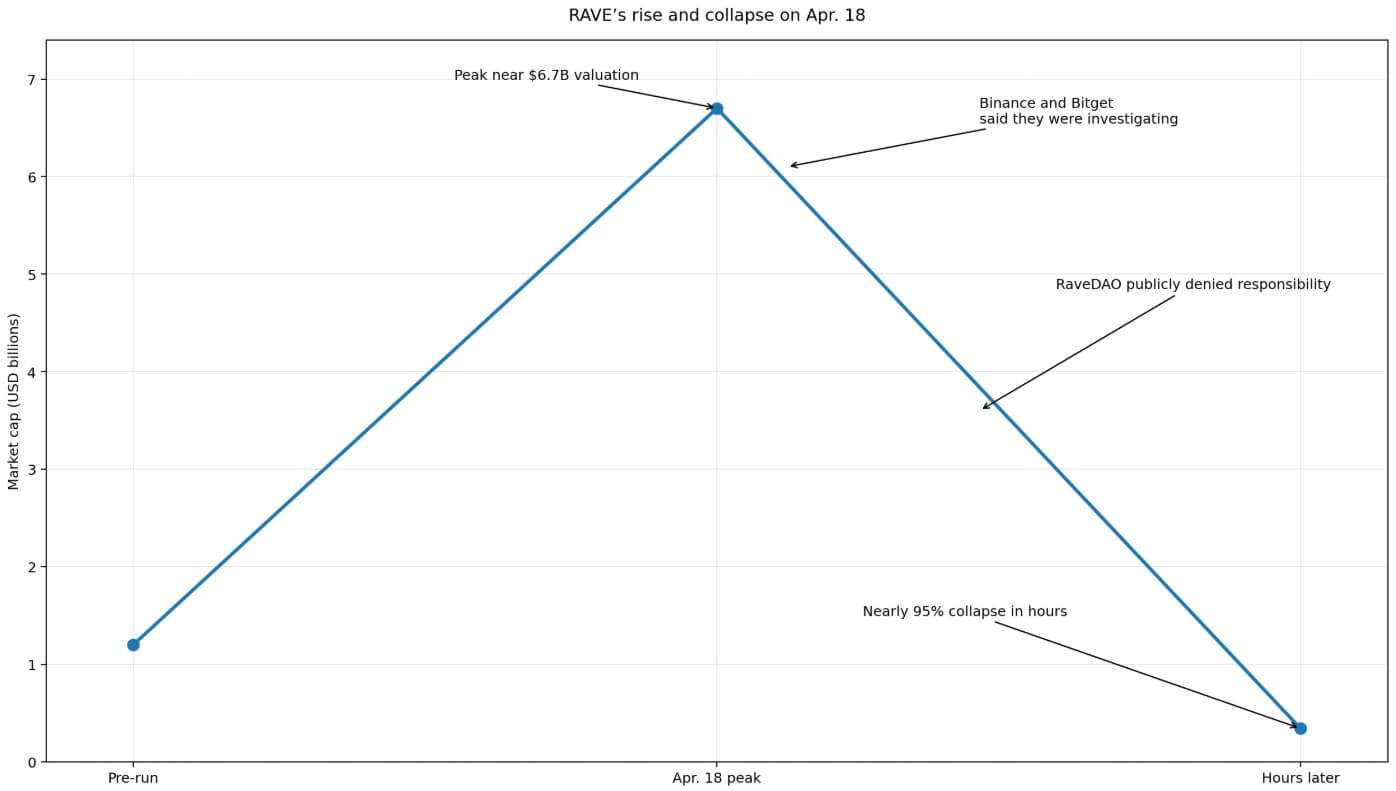
RAVE rise and collapse through perpetual markets
RAVE’s market cap surged from approximately $1.2 billion to a peak of $6.7 billion on Apr. 18 before collapsing nearly 95% within hours.

The mechanism

What traders call “scam coins” is often a repeatable derivatives structure.

The loop runs when a token with concentrated supply and a tiny effective float receives a perpetual market listing. Bearish traders pile into shorts, and a small push in thin spot liquidity triggers forced buying that sends the price vertical.

When the token’s valuation increases severalfold, concentrated holders sell into that forced bid.

Binance’s own Mar. 25 market maker red flags guide explicitly warned about coordinated sell-offs across platforms, volume that does not match price behavior, price spikes in thin liquidity, and shallow order books that make prices easier to push artificially.

CoinGlass data from the post-crash period shows approximately $3.36 billion in 24-hour futures volume versus $138.9 million in spot volume, a 24.7x derivatives-to-spot ratio. Open interest of roughly $105.7 million represented about 67.3% of the market cap.

If roughly 85% of supply could not realistically trade, RAVE’s open interest exceeded the mark-to-market value of its effective float.

Using CoinGlass’ post-crash price of approximately $0.625, 15% of a one-billion-token supply yields an effective float of approximately $93.8 million, which is lower than the $105.7 million in open interest sitting on top of it.

See also  UK's FCA Requires "Cooling-Off Periods" and Risk Warnings as Crypto ETNs Resume

That data point falls short of proving manipulation, but it describes a market in which derivative exposure had outgrown the cash market beneath it.

The same structure for three different tokens

On Mar. 23, SIREN’s open interest climbed to approximately $105 million before retreating to $65 million as short positions faced liquidation. Binance and Bybit together recorded roughly $7.1 million in liquidations during that period.

More than 59% of positions still leaned short once the initial squeeze concluded, leaving the market structurally exposed to another round of forced covering.

Phemex reported that one wallet cluster controlled roughly 88% of SIREN’s supply and flagged a funding rate of -0.2989%, one of the clearest visible signs of a crowded-short setup. CoinGlass now places SIREN’s futures-to-spot turnover at approximately 40.5x.

A deeply negative funding rate means short-position holders pay longs to maintain their trades. When that condition coexists with concentrated spot supply and thin real float, price discovery effectively moves to the derivatives layer, and whoever controls the cash market can choose when to squeeze.

ARIA illustrates the exit side, as the token addresses suspected of manipulating ARIA sold 45.64 million tokens for approximately 5.42 million USDT. The token fell 91%, with market cap collapsing from roughly $315 million to $38.5 million.

Even with that collapse behind it, CoinGlass shows ARIA’s futures-to-spot turnover at approximately 12.0x, with open interest at roughly 77.7% of remaining market cap.

RAVE, SIREN, and ARIA map the same investigative structure, the squeeze in progress, and the post-dump residue at three different moments.

Token Stage in the loop Supply concentration Futures/spot ratio OI / market-cap signal Key squeeze/dump evidence Outcome
RAVE Investigative structure / scandal phase ~75% in one wallet; ~10% in two connected wallets; ~85% estimated out of public circulation 24.7x OI ~$105.7M vs. effective float ~$93.8M — derivatives exceeded the tradable cash market ZachXBT alleged insider control of 90%+ of supply; pre-rally exchange deposits; 32M-token withdrawal during rally; Binance and Bitget launched investigations Peaked at ~$6.7B valuation; collapsed ~95% in hours
SIREN Squeeze in progress One wallet cluster controlling ~88% of supply 40.5x OI reached ~$105M at squeeze peak; fell to ~$65M after liquidations Funding rate of -0.2989% (extreme crowded-short signal); ~$7.1M liquidated across Binance and Bybit; 59%+ of positions still short post-squeeze Squeeze executed; market remained majority-short and structurally exposed to repeat
ARIA Post-dump unwind Not publicly disclosed 12.0x OI ~77.7% of remaining market cap after collapse On-chain analysts identified wallets that sold 45.64M tokens for ~5.42M USDT into the forced bid Fell 91%; market cap dropped from ~$315M to ~$38.5M
See also  Dinari Taps Chainlink to Tokenize S&P DJI's Upcoming Crypto Market Index

The infrastructure enabling the most effective moves in each episode runs through venues that had already published guidance explicitly describing those very moves.

Binance’s Mar. 25 guide and its public acknowledgment of the RAVE investigation both come from the same institution managing the same business tension. Listing volatile, thin-float assets with perpetual markets generates fee revenue at scale.

The 24.7x, 40.5x, and 12.0x futures-to-spot ratios for RAVE, SIREN, and ARIA also represent revenue figures. Futures volume on RAVE alone hit roughly $3.36 billion in a single day post-crash.

Exchanges can point to surveillance and investigation as evidence of responsibility, while retail traders can point to the listings themselves as evidence of the opposite.

Two paths from here

If venues adopt float-aware listing standards, with minimum circulation thresholds, wallet-concentration screens, and lower leverage caps on thin-book assets, the frequency of these episodes drops.

Binance’s Mar. 25 red flag framework already gives exchanges a ready-made rationale for such requirements.

The constructive case rests on RAVE becoming the episode that moves listing standards from informal guidance to enforceable policy, because the reputational cost of another high-profile investigation finally exceeds the listing fee revenue.

The opposite path is equally coherent, as the incentive structure that produced RAVE, SIREN, and ARIA is intact. Concentrated holders can repeatedly use exchange deposits, narrative catalysts, and crowded short positioning to force liquidations.

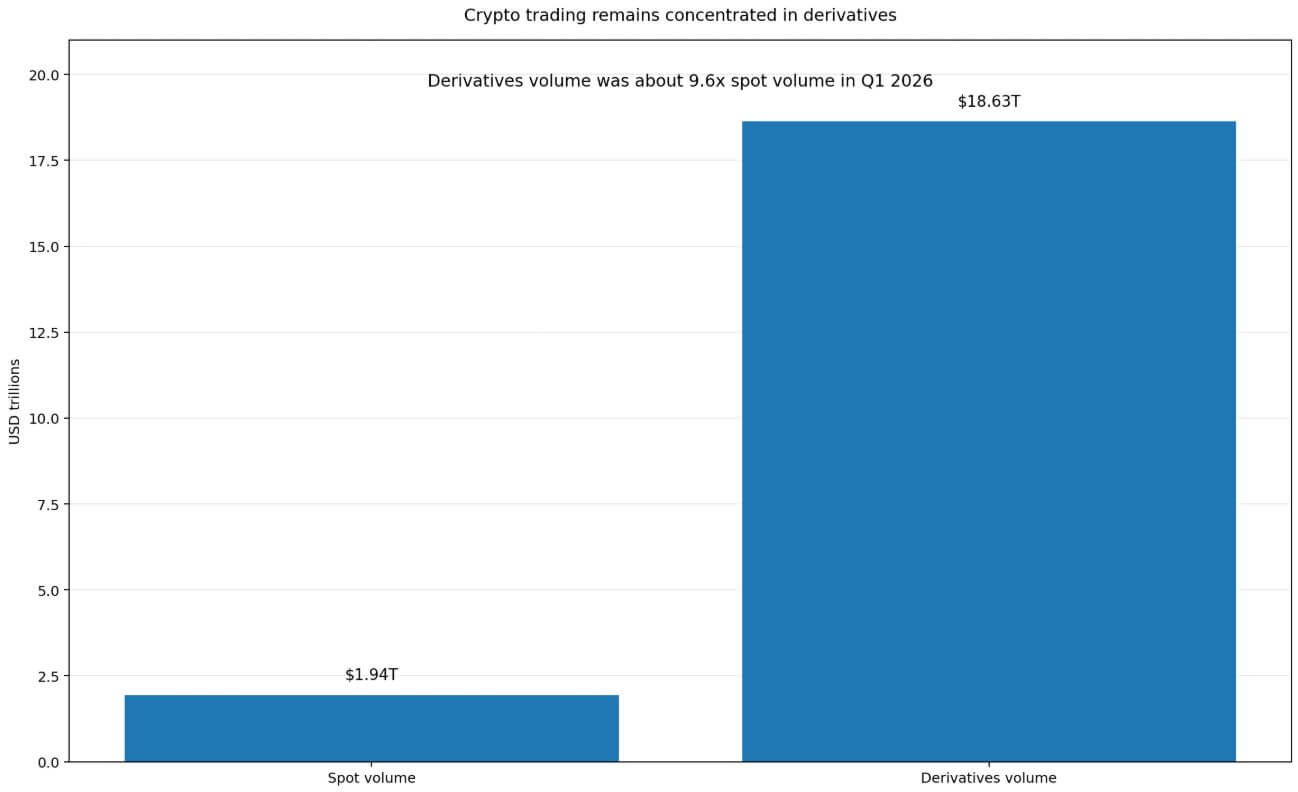
A separate CoinGlass market share report found that crypto trading activity in the first quarter was still overwhelmingly concentrated in derivatives, with roughly $18.63 trillion in derivatives volume versus $1.94 trillion in spot volume.
See also  A $7 billion crypto ETF plumbing boom just ran into the IRS
Crypto trading spot vs perpetual markets
Crypto derivatives volume reached $18.63 trillion in Q1 2026, approximately 9.6 times the $1.94 trillion recorded in spot volume.

If no hard float or depth requirements emerge, the practical warning sign for traders becomes a recognizable cluster consisting of top-wallet concentration above 80%, futures-to-spot turnover crossing double digits, extreme negative funding, and price action that corresponds to no identifiable catalyst.

That cluster describes what the three episodes had in common: one wallet cluster controlling an outright majority of supply, real tradable float governing price sensitivity, exchange deposits tied to project-linked wallets preceding the rally, and withdrawals arriving during the forced bid.

Retail shorts who identify that concentration, do the on-chain work, and position correctly can still be right on every fundamental point and lose because their timing is exposed to forced buying they cannot predict.

That asymmetry is a feature of listing perp markets on assets where a small number of wallets can dictate the effective supply available to the cash market.

Major venues have now publicly acknowledged that at least one such episode warranted an investigation.

The post How crypto futures markets are feeding ‘scam coin’ insider pump and dumps appeared first on CryptoSlate.

Coin Crypto dumps feeding Futures Insider markets PUMP scam
Share. Facebook Twitter Pinterest LinkedIn Tumblr Email

Related Posts

Caroline D. Pham Delivers Keynote on Crypto Regulation

October 25, 2026

Crypto Strategist Who Nailed 2025 Bitcoin Top Warns BTC Could Drop Below $70,000 – Here’s His Price Target

October 25, 2026

Electrum Wallet Attack Hid Bitcoin Theft Behind a Fee Increase

October 25, 2026

Pentagon bans personnel from using insider information to trade on prediction markets

October 25, 2026
Add A Comment
Leave A Reply Cancel Reply

Top Posts

Crypto Council for Innovation launches coalition to push for regulatory clarity on vaults

June 8, 2026

CreatorX And VitalVEDA Partner To Unlock New DApp Opportunities Across Creator Engagement, Health Wellness, And Web3 Communities

May 12, 2026

Stay ahead with the latest crypto news, market updates, blockchain insights, and trends. Your trusted source for everything happening in the digital asset world.


We're social. Connect with us:

Facebook X (Twitter) Instagram Pinterest YouTube
Top Insights

Caroline D. Pham Delivers Keynote on Crypto Regulation

October 25, 2026

Peter Schiff’s ‘$75K Bitcoin call’ meets a vital week: Fed, inflation, and ETF outflows loom

October 25, 2026

Swell Pauses swETH and rswETH Deposits and Withdrawals

October 25, 2026
Get Informed

Subscribe to Updates

Get the latest creative news From Free.cc directly in your Inbox!

  • Contact
  • Privacy Policy
  • Terms & Conditions
  • Disclosure
© 2026 free.cc - All rights reserved.

Type above and press Enter to search. Press Esc to cancel.