
Close Menu
  • Latest News
    • Bitcoin
    • Ethereum
    • Altcoins
    • Meme Coins
  • Tech
    • Blockchain
    • Security and Privacy
  • Web 3
    • Gaming
  • Legal
    • Legal and Regulatory
    • Adoption
  • Analysis
  • Learn
    • Education
    • Wallets and Exchanges
  • Tools
    • Market Overview
    • Exchange Tool
What's Hot

New SIMD-0675 Proposal Aims to Streamline Block Production

October 3, 2026

New SEC crypto rules threaten small advisers, but big firms win

October 3, 2026

Bitcoin Is Up, DeFi Is Recovering, So Why Doesn’t This Look Like a Bull Market Yet?

October 3, 2026
Facebook X (Twitter) Instagram
  • Contact
  • Privacy Policy
  • Terms & Conditions
  • Disclosure
Facebook X (Twitter) Instagram
Free.cc (Free Cryptocurrency)Free.cc (Free Cryptocurrency)
  • Latest News
    1. Bitcoin
    2. Ethereum
    3. Altcoins
    4. Meme Coins
    5. View All

    Bitcoin Is Up, DeFi Is Recovering, So Why Doesn’t This Look Like a Bull Market Yet?

    October 3, 2026

    Bank group sues U.S. regulator over granting crypto trust charters

    October 3, 2026

    When The Banks Don’t Work, Bitcoin Does: Report

    October 3, 2026

    Bitcoin clears $85K, but is ‘Uptober’ setting up a bull trap?

    October 3, 2026

    Ethereum: Why ETH faces October reversal risk after 70% Q3 rally

    October 3, 2026

    Why Did Blast Decide to Wind Down Its L2?

    October 2, 2026

    Bitcoin Q3 Strength Faces a Tougher Q4 Test

    October 1, 2026

    Ethereum beats Bitcoin by 42.71% in Q3 – Can ETH do it again?

    October 1, 2026

    Can NEAR crypto rebound? THESE metrics could decide what’s next

    October 3, 2026

    Polymath And CineCity Explore Regulated Tokenized Film Investment Platform

    October 3, 2026

    XLM price prediction – Why Stellar’s $0.21 rebound could trigger a 9% rally

    October 2, 2026

    XRP’s $1.54 breakout test meets Ripple’s 1B token unlock – Can demand absorb supply?

    October 2, 2026

    Thinking Cat Gains Momentum After CASHCAT’s Breakout

    August 12, 2026

    What Tokens Could He Target?

    July 30, 2026

    The Next Meme Coin Winner Could Be Determined by Incentives, Not Memes

    July 30, 2026

    Why Is BOME’s Price Up Today? Finally, Capital Rotating to the Meme Coins?

    July 28, 2026

    New SIMD-0675 Proposal Aims to Streamline Block Production

    October 3, 2026

    New SEC crypto rules threaten small advisers, but big firms win

    October 3, 2026

    Bitcoin Is Up, DeFi Is Recovering, So Why Doesn’t This Look Like a Bull Market Yet?

    October 3, 2026

    Daines Unveils Crypto Tax Bill Pairing Payment Relief With Wash-Sale Rules

    October 3, 2026
  • Tech
    1. Blockchain
    2. Security and Privacy
    3. View All

    New SIMD-0675 Proposal Aims to Streamline Block Production

    October 3, 2026

    State Street Fund Goes Live on Stellar

    October 3, 2026

    Blockchains Unlock an Explosion of New Markets

    October 3, 2026

    Cloak Launches Payroll Feature for Private Onchain

    October 2, 2026

    Masked Robbers Threaten Pregnant Wife in UK Crypto Home Attack

    October 3, 2026

    Bitcoin Lightning Nodes Targeted as Core Lightning Sounds Alarm

    October 2, 2026

    The $459,000 Bot Hacker Was a Customer First, Researchers Say

    October 2, 2026

    Metamask Pulls Validators as Meager ETH Theft Sounds Big Alarm

    October 2, 2026

    New SIMD-0675 Proposal Aims to Streamline Block Production

    October 3, 2026

    New SEC crypto rules threaten small advisers, but big firms win

    October 3, 2026

    Bitcoin Is Up, DeFi Is Recovering, So Why Doesn’t This Look Like a Bull Market Yet?

    October 3, 2026

    Daines Unveils Crypto Tax Bill Pairing Payment Relief With Wash-Sale Rules

    October 3, 2026
  • Web 3
    1. Gaming
    2. View All

    Top 12 NFT games every player should know about in August 2026

    September 22, 2026

    GameShame Studios founder details Raijin Protocol’s roadmap in NeoPod’s sixth AMA

    September 22, 2026

    Proof of Play to shut down after blockchain gaming thesis falls short

    September 22, 2026

    How BC.GAME is turning players into stakeholders

    September 22, 2026

    New SIMD-0675 Proposal Aims to Streamline Block Production

    October 3, 2026

    New SEC crypto rules threaten small advisers, but big firms win

    October 3, 2026

    Bitcoin Is Up, DeFi Is Recovering, So Why Doesn’t This Look Like a Bull Market Yet?

    October 3, 2026

    Daines Unveils Crypto Tax Bill Pairing Payment Relief With Wash-Sale Rules

    October 3, 2026
  • Legal
    1. Legal and Regulatory
    2. Adoption
    3. View All

    New SEC crypto rules threaten small advisers, but big firms win

    October 3, 2026

    Daines Unveils Crypto Tax Bill Pairing Payment Relief With Wash-Sale Rules

    October 3, 2026

    Tax on Bitcoin Gains? Dutch Government to Introduce Capital Gains Tax From 2028

    October 3, 2026

    Bitwise CIO says Clarity Act failure gave crypto ‘better rules faster’

    October 3, 2026

    Stablecoin issuers have replaced 40% of China’s lost US Treasury demand

    October 3, 2026

    Bitcoin’s $113,000 case strengthens as US regulators push 9 crypto actions

    October 2, 2026

    Bitget restores $300M fund after absorbing $388M security breach

    October 2, 2026

    Ripple’s biggest institutional bet may now be Brazil

    October 1, 2026

    New SIMD-0675 Proposal Aims to Streamline Block Production

    October 3, 2026

    New SEC crypto rules threaten small advisers, but big firms win

    October 3, 2026

    Bitcoin Is Up, DeFi Is Recovering, So Why Doesn’t This Look Like a Bull Market Yet?

    October 3, 2026

    Daines Unveils Crypto Tax Bill Pairing Payment Relief With Wash-Sale Rules

    October 3, 2026
  • Analysis

    Bull Market Targets for BTC, ETH, SOL, and XRP

    October 3, 2026

    Ethereum Price Faces A Critical $0.040 ETH/BTC Test

    October 2, 2026

    AAVE Price Surges 8% as Whale Activity Spikes — Can AAVE Break $200?

    October 2, 2026

    PropAMMs lower Solana trade costs, and public pool returns crash

    October 2, 2026

    Wall Street arrived in NEAR just as a $4 billion-a-month app got hacked

    October 2, 2026
  • Learn
    1. Education
    2. Wallets and Exchanges
    3. View All

    What Is Robinhood Chain? The Ethereum Layer-2 Network for Tokenized Stocks

    July 12, 2026

    What Is BChat? The Decentralized Messaging App Built for Privacy

    June 2, 2026

    What Is an AI Prompt Injection Attack? The Hidden Threat Hijacking Your Chatbots

    May 31, 2026

    What Is AI Jailbreaking? A Beginner’s Guide to the Cat-and-Mouse Game Behind Every Chatbot

    May 17, 2026

    Coinbase completes Deribit migration, ends INTX trading

    October 2, 2026

    Binance Funding Account ends direct crypto deposits

    October 1, 2026

    Coinbase just completed its US derivatives stack but its biggest bet still sits outside it

    September 30, 2026

    Bitget had 30 minutes to contain its hack before $290 million started moving

    September 30, 2026

    New SIMD-0675 Proposal Aims to Streamline Block Production

    October 3, 2026

    New SEC crypto rules threaten small advisers, but big firms win

    October 3, 2026

    Bitcoin Is Up, DeFi Is Recovering, So Why Doesn’t This Look Like a Bull Market Yet?

    October 3, 2026

    Daines Unveils Crypto Tax Bill Pairing Payment Relief With Wash-Sale Rules

    October 3, 2026
  • Tools
    • Market Overview
    • Exchange Tool
Free.cc (Free Cryptocurrency)Free.cc (Free Cryptocurrency)
Home»Analysis»US Bankers association push for 60 day pause to stop stablecoin rules going live
Analysis

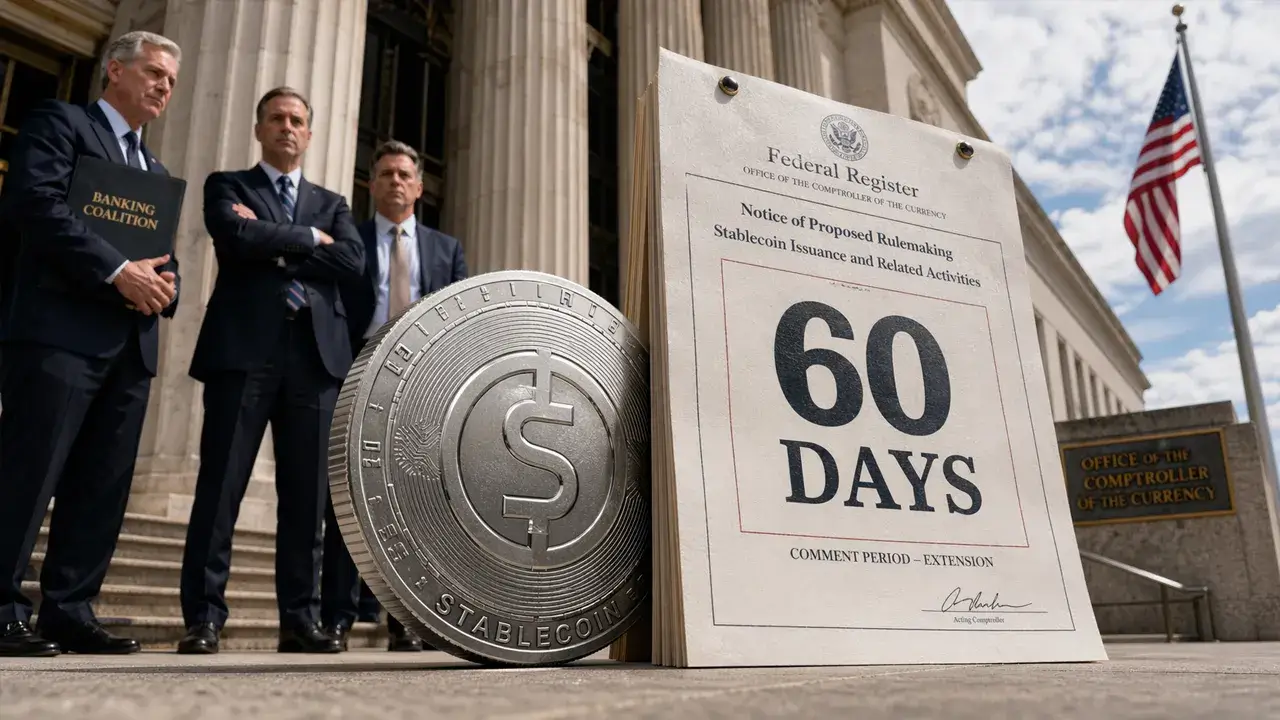
US Bankers association push for 60 day pause to stop stablecoin rules going live

April 23, 2026No Comments7 Mins Read
Share
Facebook Twitter LinkedIn Pinterest Email
Make CryptoSlate preferred on

US banking groups are pressing regulators to slow parts of the federal rollout of the GENIUS Act, opening a new front in their broader fight over how far stablecoins should be allowed to move into territory long dominated by bank deposits.

On April 22, the American Bankers Association (ABA) and three other banking trade groups asked the Treasury Department and the Federal Deposit Insurance Corp. to delay the public comment deadlines for three proposed rules implementing the GENIUS Act.

The associations requested that the agencies wait until 60 days after the Office of the Comptroller of the Currency (OCC) finalizes its own regulatory framework.

This procedural request could push the activation of the federal stablecoin law back by several months.

Treasury’s first GENIUS rule tightens Washington’s grip on who can scale stablecoins
Related Reading

Treasury’s first GENIUS rule tightens Washington’s grip on who can scale stablecoins

The proposal leaves states with a narrow lane while pushing large stablecoin issuers toward federal control.

Apr 2, 2026 · Gino Matos

Notably, the move arrives just as traditional banks are actively pressing Senate lawmakers to tighten limits on stablecoin rewards in the broader Digital Asset Market Clarity Act, or CLARITY, signaling a coordinated, dual-front effort to constrain the digital asset sector.

At the core of both conflicts is a fundamental economic stake: Commercial lenders want stablecoins confined strictly to serving as payment rails.

They view allowing stablecoins to function as yield-bearing cash alternatives as a structural threat that could siphon capital from traditional deposits, severely disrupting the deposit-funded lending models that underpin the US credit system.

Why the Banks are seeking more time on GENIUS rules

The GENIUS Act, signed into law last year, established a baseline for stablecoin issuance but requires finalized administrative rules to take effect.

The OCC serves as the primary regulator for nonbank stablecoin issuers under the law and has proposed a foundational framework that remains pending.

The banking associations are arguing that three overlapping federal proposals are “substantively tethered” to the OCC’s primary rule.

See also  Quantra Partners with SumPlus to Push Forward AI-Led RWA Infrastructure

These include a Treasury Department rule evaluating whether a state’s regulatory regime is equivalent to the federal standard; an FDIC rule outlining requirements for agency-regulated issuers and banks; and a joint directive from the Financial Crimes Enforcement Network (FINCEN) and the Office of Foreign Assets Control (OFAC) covering anti-money-laundering and sanctions compliance.

In their communication to the agencies, the banking groups contended that a fragmented comment process with staggered deadlines across interdependent proposals would undermine the goal of regulatory consistency.

They argued that public feedback would be more comprehensive if stakeholders could evaluate all the proposed rules against a finalized OCC framework.

However, the practical effect of granting this extension would be a substantial delay. Under the statute, the GENIUS Act takes effect 120 days after final regulations are issued, or 18 months after enactment.

By tethering the Treasury and FDIC timelines to the OCC’s delayed schedule, the banking sector is effectively attempting to slow the deployment of regulated, nonbank stablecoin infrastructure.

The fight over stablecoin rewards is stalling another crypto bill

While the commercial lending sector seeks to slow the regulatory rollout of the GENIUS Act, it is also engaged in a fierce lobbying effort to alter the CLARITY Act.

The banking industry is aggressively contesting provisions that would permit third-party platforms to offer yields on stablecoins. Essentially, this escalates what might appear to be a technical dispute into a battle over the future of interest-bearing cash substitutes.

The GENIUS Act expressly forbade stablecoin issuers from paying interest directly to holders.

However, it left a pathway for secondary arrangements where trading platforms and other third-party platforms could pay rewards for holding stablecoins on their platforms. The banking industry is advocating for a total ban on such incentives.

As a result, the ABA has launched an intensive public relations campaign, including premium advertising in Washington publications, to eliminate this perceived loophole.

The messaging warns lawmakers that allowing stablecoins to generate yield poses a direct threat to the viability of local community lending markets.

See also  Liquidity Builds Near $100K Bitcoin and $3,500 Ethereum—Can Prices Reach the Zone?

Those arguments recently encountered opposition from federal economists. A 21-page analysis published by the White House Council of Economic Advisers concluded that implementing a comprehensive ban on stablecoin rewards would increase traditional bank lending by just $2.1 billion, representing a negligible 0.02% of outstanding loans.

The CEA report also estimated that a full yield ban would cost consumers approximately $800 million.

This data has significantly weakened the banking industry’s central argument that unrestricted stablecoin yield represents a structural vulnerability for the traditional banking system.

However, ABA answered that the White House was measuring the wrong problem. In its view, the analysis focused on today’s roughly $300 billion stablecoin market instead of modeling a future in which reward-bearing stablecoins scale up and compete more directly with the nation’s much larger deposit base.

CryptoSlate Daily Brief

Daily signals, zero noise.

Market-moving headlines and context delivered every morning in one tight read.

5-minute digest 100k+ readers

Free. No spam. Unsubscribe any time.

Whoops, looks like there was a problem. Please try again.

You’re subscribed. Welcome aboard.

That difference in framing is central to the political fight. Crypto firms are arguing over present utility, while banks are arguing over future displacement.

What is holding up the CLARITY Act?

The dispute over yield has become the primary bottleneck stalling the CLARITY Act’s progression through the Senate Banking Committee.

The legislation aims to establish comprehensive jurisdictional boundaries between federal market regulators and create a pathway for digital assets to be treated as non-securities once their networks are sufficiently decentralized.

Negotiations to resolve the stablecoin dispute remain fluid. Sens. Thom Tillis and Angela Alsobrooks have reportedly reached an agreement in principle that would prohibit yield paid solely for holding a stablecoin while allowing narrowly defined, activity-based rewards tied to payments and platform usage.

However, the final text of that compromise has yet to be publicly released, effectively freezing the legislative process. Tillis recently indicated that the committee should delay scheduling any markup sessions into May, a move that introduces severe timing constraints for the bill.

See also  Zcash skyrockets 380% as privacy becomes crypto's hot topic

While the stablecoin rewards issue is the most visible hurdle, lawmakers are also quietly navigating a handful of other unresolved disputes, including exemptions for noncustodial developers and limits on the SEC’s relief authority.

With the Senate floor calendar increasingly congested by an election year, the markup delay into May significantly heightens the risk that the CLARITY Act will run out of legislative time before the end of the session.

Notably, US lawmaker Senator Cynthia Lummis has warned that the legislation could be delayed till 2030 if it is not passed this year. Meanwhile, crypto bettors on Polymarket believe there is less than 50% chance of the bill’s passage this year.

Why banks are fighting on both fronts

The banking industry’s coordinated action across both pieces of legislation illuminates a clear commercial strategy. Traditional financial institutions are navigating a rapidly closing window to shape the market structure of digital assets before they become fully entrenched in the broader economy.

If the GENIUS Act sets the foundational operating framework for nonbank stablecoin issuers, and the CLARITY Act preserves the economic incentives for consumers through exchange-based rewards, traditional banks will face a vastly different competitive landscape.

In that scenario, tokenized dollars transition from being simple mechanisms for trading digital assets into highly useful, interest-bearing instruments that compete directly with bank deposits.

By seeking to delay the rulemaking process for the GENIUS Act, the banking sector gains valuable time.

By simultaneously lobbying to strip yield provisions from the CLARITY Act, they are attempting to neutralize the primary economic incentive that would drive consumers away from traditional savings accounts.

Essentially, their objective is to ensure that stablecoins are strictly confined to serving as payment rails.

In doing so, commercial banks are attempting to erect a regulatory moat around their deposit-funded lending models, protecting the core mechanism of traditional finance from decentralized competition.

Association Bankers day Live Pause Push Rules Stablecoin Stop
Share. Facebook Twitter Pinterest LinkedIn Tumblr Email

Related Posts

New SEC crypto rules threaten small advisers, but big firms win

October 3, 2026

Daines Unveils Crypto Tax Bill Pairing Payment Relief With Wash-Sale Rules

October 3, 2026

State Street Fund Goes Live on Stellar

October 3, 2026

Stablecoin issuers have replaced 40% of China’s lost US Treasury demand

October 3, 2026
Add A Comment
Leave A Reply Cancel Reply

Top Posts

Ripple Technology Expands Global Stablecoin Transfers

December 3, 2025

SWEEP Tokenized Fund Launch Set for Early 2026 on Solana

December 13, 2025

Stay ahead with the latest crypto news, market updates, blockchain insights, and trends. Your trusted source for everything happening in the digital asset world.


We're social. Connect with us:

Facebook X (Twitter) Instagram Pinterest YouTube
Top Insights

New SIMD-0675 Proposal Aims to Streamline Block Production

October 3, 2026

New SEC crypto rules threaten small advisers, but big firms win

October 3, 2026

Bitcoin Is Up, DeFi Is Recovering, So Why Doesn’t This Look Like a Bull Market Yet?

October 3, 2026
Get Informed

Subscribe to Updates

Get the latest creative news From Free.cc directly in your Inbox!

  • Contact
  • Privacy Policy
  • Terms & Conditions
  • Disclosure
© 2026 free.cc - All rights reserved.

Type above and press Enter to search. Press Esc to cancel.