
Table of Contents
When Is Midnight Launching?How Does Midnight Work?What Makes Midnight Different From Other Privacy Blockchains?What Is The $NIGHT Token?What Can You Build On Midnight?How Does Midnight Connect To Cardano?ConclusionResourcesFrequently Asked Questions
Midnight is a privacy-focused blockchain developed by Input Output Global (IOG) and Cardano founder Charles Hoskinson that uses zero-knowledge proofs to enable selective disclosure of data. The platform operates as a partner chain to Cardano and allows users to prove facts about their data without revealing the data itself, addressing a fundamental problem in blockchain adoption: how to use distributed ledgers while maintaining privacy required for regulated industries like healthcare and finance.
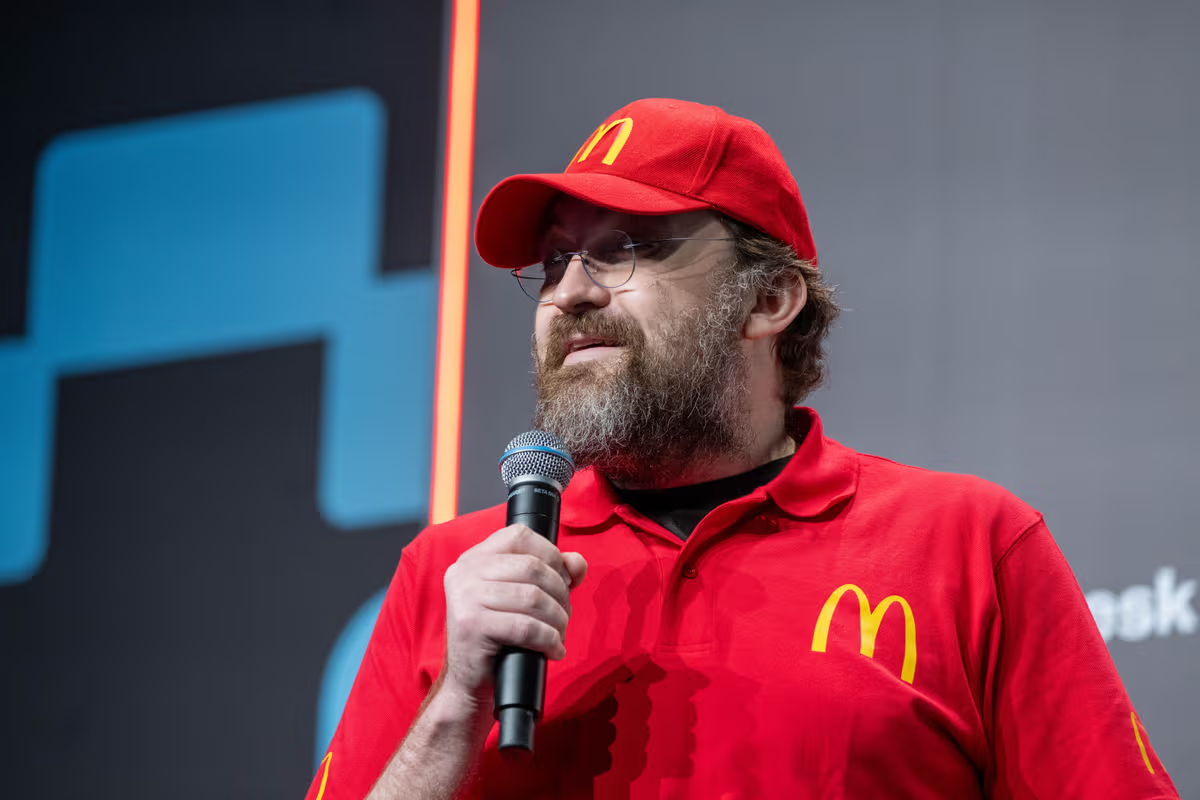
Charles Hoskinson delivers a speech at CoinDesk Consensus Hong Kong 2026 (Image: CoinDesk)
Hoskinson announced during his keynote at Consensus Hong Kong in February 2025 that Midnight will officially launch during the final week of March. The project has secured partnerships with Google and Telegram to help run the network.
When Is Midnight Launching?
The Midnight mainnet is scheduled to go live in the final week of March 2025. This timeline represents years of development by IOG, the same company behind Cardano’s research-driven approach to blockchain technology.
Alongside the mainnet launch, Hoskinson unveiled Midnight City Simulation, an interactive platform hosted at midnight.city that demonstrates how the blockchain handles privacy through selective disclosure.
The simulation uses AI-driven agents that interact unpredictably to create a steady flow of transactions, showing how the network handles real-world demand and scales accordingly. Public access to the simulation was restricted until February 26, 2025.
The $NIGHT token, Midnight’s native utility token, already launched in December 2024 on multiple exchanges including OKX, Bybit, and MEXC. The token experienced typical launch volatility but recovered sharply and moved toward a $1 billion valuation in its first weeks. Early token distribution came through the Glacier airdrop, the first of several release periods scheduled through 2026.
How Does Midnight Work?
Midnight operates as a fourth-generation proof-of-stake blockchain that uses recursive zk-SNARKs (Zero-Knowledge Succinct Non-Interactive Arguments of Knowledge) to enable private computation on public infrastructure. The technical architecture separates what gets stored publicly on the blockchain from what remains private in user-controlled storage.
Dual-State Architecture
Unlike traditional blockchains where every transaction is permanently visible to all participants, Midnight maintains two parallel states running simultaneously.
The public state functions like a normal blockchain. Transaction proofs, smart contract code, and any intentionally public information get stored on-chain where all network participants can see them. This provides the transparency and verifiability that make blockchains useful for coordination between parties that don’t trust each other.
The private state consists of encrypted data stored locally by users that never gets exposed to the network. Personal information, business data, medical records, or any sensitive content remains confidential in user-controlled storage rather than being broadcast to validators and permanently recorded on a public ledger.
The key innovation is the bridge between these two states. Using zero-knowledge cryptography, Midnight can verify computations without seeing the input data, prove statements are true without revealing why they’re true, generate compact proofs of just 128 bytes regardless of computation complexity, and validate these proofs in milliseconds on-chain.
Zero-Knowledge Proofs Explained
Zero-knowledge proofs are cryptographic methods that allow one party to prove to another that a statement is true without revealing any information beyond the validity of the statement itself.
On Midnight, this technology enables practical applications. A healthcare system can prove a patient qualifies for treatment without revealing their complete medical history. A financial application can verify an account has sufficient balance without exposing the actual amount. A voting system can prove someone is eligible to vote without revealing their identity.
The process works through a specific transaction flow. Users perform computations on their private data locally, never exposing it to the network.
The Midnight runtime generates a zero-knowledge proof of this computation, creating mathematical evidence that the computation was performed correctly without revealing the inputs. This proof, along with any intended public outputs, gets submitted to the blockchain.
Network validators verify the proof using the zk-SNARK verification algorithm, which takes only milliseconds despite the complexity of the original computation.
What Makes Midnight Different From Other Privacy Blockchains?
Midnight takes a fundamentally different approach compared to legacy privacy coins like Monero or Zcash, which prioritize total anonymity. Instead of making everything private by default, Midnight enables selective disclosure, allowing users to choose exactly what information to reveal and to whom.
Selective Disclosure vs Total Anonymity
The platform implements what Hoskinson calls “rational privacy” through multiple disclosure views. Public view shows what anyone can see on the blockchain. Auditor view reveals additional information to authorized parties like regulators or compliance officers. God view provides complete transparency for debugging or extreme compliance scenarios.
This architecture addresses a critical problem that prevented earlier privacy blockchains from mainstream adoption: regulatory compliance.
Frameworks like GDPR in Europe, CCPA in California, and HIPAA for healthcare require tight control over personal data, but they also require the ability to share specific information with authorized parties when legally required. Total anonymity makes compliance impossible. Total transparency violates privacy laws. Midnight provides the middle ground.
The design philosophy acknowledges that public data is often desirable and essential in decentralized systems. Users want to join smart contracts freely, and contracts are designed without knowing who will use them ahead of time. This requires some sharing of data.
An auctioneer wants to show what’s being auctioned and perhaps the current highest bid, while a buyer wants to keep their identity secret. An insurance company may list policies publicly while clients keep policy details private.
Compact Programming Language
Midnight introduces Compact, a domain-specific language based on TypeScript that makes privacy-preserving smart contracts accessible to mainstream developers. This represents one of the first efforts to make zero-knowledge development accessible to non-cryptographers.
Instead of requiring deep cryptographic expertise to build privacy-enabled applications, developers write familiar code that automatically compiles to zero-knowledge circuits. Compact forces developers to specify what remains private and what appears publicly on-chain, making privacy decisions explicit in the code rather than an afterthought.
This accessibility is a practical requirement if Midnight expects to gain adoption beyond a niche user base of cryptography specialists. Ethereum succeeded partly because Solidity made smart contract development accessible to regular programmers. Compact attempts to do the same for zero-knowledge applications.
What Is The $NIGHT Token?
$NIGHT is Midnight’s native utility token with a total supply of 24 billion tokens. The token serves a specific technical purpose in the network’s economic model rather than functioning as a simple payment currency.
$NIGHT And DUST Mechanism
Midnight implements an unusual token mechanism where $NIGHT tokens generate DUST, a renewable resource that powers all transactions on the network. Think of $NIGHT as solar panels that continuously generate electricity. Just as solar panels produce energy when exposed to sunlight, $NIGHT tokens continuously generate DUST when designated to a DUST address.
DUST is not a token itself but a shielded network resource used exclusively to pay transaction fees. The amount of DUST you can store is proportional to your $NIGHT balance. DUST decays when disconnected from its generating $NIGHT tokens. This mechanism provides operational predictability. As long as you hold $NIGHT, you can execute transactions without worrying about volatile gas prices like those on Ethereum.
This design solves a problem that plagues many blockchains: unpredictable transaction costs. During periods of high network usage, gas prices on Ethereum have spiked to hundreds of dollars per transaction, making the network unusable for many applications. Midnight’s $NIGHT-generates-DUST model ensures that transaction costs remain predictable and proportional to stake rather than subject to auction dynamics.
Token Distribution Model
Midnight launched with an unconventional cross-chain allocation model that distributes 100% of $NIGHT‘s supply across eight major ecosystems: Bitcoin, Ethereum, Solana, BNB Chain, Cardano, and three others. This approach intentionally pulls users from multiple blockchain communities into a shared privacy environment rather than isolating activity inside Cardano alone.
The distribution occurred through the Glacier airdrop to eligible addresses across these ecosystems, with additional allocation mechanisms including computational tasks called the “scavenger hunt” where participants solve problems for token rewards.
The project released a MiCA-compliant whitepaper for its token distribution, addressing European regulatory requirements from the outset.
What Can You Build On Midnight?
Midnight targets use cases where privacy is legally required or commercially necessary, opening blockchain technology to applications that cannot operate on fully transparent ledgers.
Healthcare And Regulated Data
Healthcare systems face strict regulations around patient data under frameworks like HIPAA in the United States and GDPR in Europe. Traditional blockchains make compliance impossible because they permanently expose all transaction data to anyone running a node.
On Midnight, healthcare applications can exchange patient data using policy-based access rules. Smart contracts enforce who can see what information, while zero-knowledge proofs confirm eligibility, participation, or compliance.
Sensitive medical records never appear on-chain, but proofs verify required conditions like treatment eligibility or insurance coverage without revealing complete medical histories.
A practical example: a patient visiting a specialist could prove they have the necessary referral from their primary care doctor without revealing their entire medical history to the specialist’s office. The specialist receives cryptographic proof of the referral’s validity without accessing unrelated medical information.
Finance And Compliant Privacy
Financial institutions need privacy for competitive and legal reasons but also face regulatory requirements for reporting and auditing. Public blockchains expose transaction amounts, frequencies, and counterparties to competitors and the public. Private databases lack the transparency that makes blockchain useful for coordination between untrusting parties.
Midnight enables financial applications to perform private transfers while meeting regulatory requirements through selective disclosure.
A bank can prove it maintains required capital reserves without revealing specific customer balances. A trading desk can settle transactions without exposing its positions to competitors while still providing auditors with required information.
The platform also supports decentralized finance applications that need privacy options. Traditional DeFi on transparent blockchains suffers from MEV (maximal extractable value) where traders front-run transactions they can see in the mempool. Midnight’s architecture allows for private order submission while keeping market prices public.
Governance And Identity
Midnight supports selective disclosure credentials and private voting systems. Users can prove membership, eligibility, or participation without revealing their full identity or activity history. Final results remain publicly verifiable while individual actions stay private.
Consider a corporate governance scenario where shareholders vote on company decisions. On a public blockchain, everyone can see how each shareholder voted, potentially creating pressure or retaliation.
On Midnight, the system can prove each vote came from an eligible shareholder with the correct number of shares while keeping individual voting decisions private. The final tally remains verifiable without compromising voter privacy.
How Does Midnight Connect To Cardano?
Midnight operates as a partner chain to Cardano rather than a layer-2 scaling solution. Worth noting, partner chains are independent blockchains with their own validators and consensus mechanisms that maintain bridges to the primary chain for asset transfers.
The network maintains a native bridge to Cardano for moving assets between the chains. This enables interoperability where users can hold assets on Cardano’s transparent ledger but move them to Midnight when privacy is needed, then back to Cardano when transparency is preferred.
Midnight uses a hybrid UTXO and account-based architecture. At its foundation, the blockchain operates on a UTXO model like Bitcoin and Cardano, which enables natural parallelism and privacy features. $NIGHT tokens exist as UTXOs on the ledger. On top of this UTXO foundation, Midnight introduces a smart contract layer that can operate using account-based patterns like Ethereum, allowing developers to maintain complex state in contracts.
This hybrid approach means developers aren’t forced into one paradigm. They can use UTXO patterns for efficient parallel processing and privacy-enabled value transfer, while using account-based patterns in smart contracts for complex state management.
A decentralized exchange, for example, could maintain its order book and market-making logic in transparent smart contracts while executing actual token swaps as atomic UTXO transactions that leverage parallelism and optional privacy.
Validators participate in Midnight through proof-of-stake consensus, contributing to network security while earning rewards. The same validators process both standard public transactions that function like traditional blockchain operations and shielded transactions that use zero-knowledge proofs to maintain privacy.
Conclusion
Midnight provides a privacy-focused blockchain platform that addresses regulatory compliance requirements through selective disclosure rather than total anonymity. The platform uses zero-knowledge proofs to enable verification of computations without exposing underlying data, maintains dual public and private state architecture, and introduces Compact programming language to make privacy-preserving development accessible to mainstream developers.
With partnerships from Google and Telegram, a March 2025 mainnet launch, and integration with Cardano’s existing ecosystem, Midnight enters the market as IOG’s attempt to bring privacy capabilities to blockchain use cases in healthcare, finance, governance, and identity management. The $NIGHT token’s distribution across eight blockchain ecosystems and its DUST generation mechanism for predictable transaction costs represent the technical foundation for the network’s operation.
Resources
-
Report by CoinDesk 1: Privacy-focused Midnight blockchain to go live next month, says Cardano’s Charles Hoskinson
-
Report by CoinDesk 2: Cardano Ecosystem Gets a Privacy Boost as Midnight’s $NIGHT Goes Live
-
Midnight docs: About Midnight
-
Midnight website: General info