

On April 21st and 22nd 2026, during a Senate Armed Services Committee, Admiral Samuel Paparo of U.S. Indo-Pacific Command made comments on Bitcoin’s utility in cybersecurity for the country’s military, calling it a “valuable computer science tool as power projection,” and disclosing that INCOPACOM is running a Bitcoin node in their experiments with the protocol.
The comments by the INCOPACOM Commander came just days after the Islamic Republic of Iran demanded payment in Bitcoin for safe passage across the Strait of Hormuz. The mention of “power projection” echoed the work of a famous and controversial Bitcoiner, Jason Lowery, author of Softwar: A Novel Theory on Power Projection, MIT Fellow and Special Assistant to the Commander of INDOPACOM.
In his work — which involved an MIT thesis and book expanding on his work — Lowery discussed the cybersecurity value of Bitcoin and its unique ability to deliver “power projection” in cyberspace, a landscape of national security and military operations that otherwise lacks traditional deterrence options.
The book gained significant popularity and earned Lowery both fans and critics across the Bitcoin industry, but was later taken down from distribution by Lowery at the request of his superiors. An event that suggested to some that the book might have something important enough that the U.S. military wants to keep it quiet.
But what is this unique value that Bitcoin brings to military matters, and what does “Power Projection” in this context actually mean?
According to Department of Defense’s 2002 Dictionary of Military and Associated Terms, power projection is; “The ability of a nation to apply all or some of its elements of national power – political, economic, informational, or military – to rapidly and effectively deploy and sustain forces in and from multiple dispersed locations to respond to crises, to contribute to deterrence, and to enhance regional stability.” In other words, the ability of a nation to influence the behavior of other nations or political entities of interest, at a range beyond its national borders. Examples can range from diplomatic to economic influence, as well as military capabilities such as long-range missiles, drones or a powerful navy.
The word deterrence is also doing a lot of work here. The DoD defines it as: “The prevention from action by fear of the consequences. Deterrence is a state of mind brought about by the existence of a credible threat of unacceptable counteraction.”
Lowery brings Bitcoin into the world of deterrence in the physical world by presenting a particularly interesting insight. That just as microchips are essentially wires moving electric power in “encoded logic” inside a computer’s motherboard, so can the globe’s electric grid be seen as a kind of “macrochip”, with giant wires moving large amounts of electricity from power sources across nations and throughout the world. These macrochips now also have logic gates in the form of Bitcoin mines — Lowery argues — they consume large quantities of energy, converting it into the scarce digital asset, which can be programmed via Bitcoin script.
The Bitcoin macrochip could, in theory, bind cybersecurity matters to the physical world, since energy output is one of the most important and expensive resources a nation can muster. While governments can print paper money at will, summoning massive amounts of electricity to influence something like Bitcoin’s proof of work competition is orders of magnitude more difficult and is the basis of Bitcoin’s resilience.
Bitcoin’s Multisignature Deterrence
The most obvious and powerful demonstration of Bitcoin’s “embedded logic” security is the invention of multisignature Bitcoin wallets, which safeguard much of the Bitcoin wealth today.
Multisignature wallets require multiple predefined private keys to sign valid transactions before Bitcoin can be transferred, making it possible to geographically decentralize the storage of Bitcoin private keys across space and jurisdictions.
Multisig challenges hackers not just to hack one key pair, but multiple, across multiple locations under time constraints, since users have the advantage of legitimate access to those keys and can potentially move the bitcoin quickly in response to a threat. Hackers must gain access to enough keys while also fooling alarms and safeguards, avoiding getting caught. Multisig imposes high costs on attackers and, as such, might very well fit the definition of ‘deterrence’. It may even fit the definition of ‘power projection’ as Bitcoin funds can be kept secure and available to be sent when needed anywhere in the world, thanks to Bitcoin’s other networking-based censorship resistance qualities.
This differs from traditional finance and its centralized databases since Banks can freeze and confiscate assets from their rightful owners when pressured politically, as seen in cases like that of Cyprus and their 40% bail in, or the United States’ confiscation of Russia’s foreign treasury reserves held in European custody.
But INDOPACOM did not explicitly talk about Bitcoin, the asset, in their comments; they seemed to think Bitcoin’s proof of work protocol could secure data and networks external to the Bitcoin asset. But the Bitcoin script, the logic internal to the Bitcoin blockchain, only governs BTC, its internal asset.
For external networks to benefit from Bitcoin’s powerful proof of work macrochip, they would have to be anchored to Bitcoin somehow, and that’s where much of Lowery’s thesis starts to stall out. He does, however, develop this idea further by proposing the “Electro-Cyber Dome”.
Cyber Security Threats and the Electro-Cyber Dome
In Software 2.5, Lowery argues that “software system security vulnerabilities are derived from insufficient constraints on control signals” sent to networked machines. An example of this might be fake login attempts that cost a website more computer resources to authenticate than they cost attackers to send. Lowery adds that such vulnerabilities “can be exploited in such a way that it puts software into insecure or hazardous states.” Examples of such network security exploits include, but are not limited to:
- Email spam and comment spam — superfluous emails and comments that flood inboxes or forums.
- Sybil attacks — creation of large numbers of fake identities to manipulate systems.
- Bots and troll farms — automated or coordinated accounts used to amplify malicious activity.
- Weaponized misinformation/disinformation campaigns — flooding networks with false or manipulated information.
- Distributed Denial-of-Service (DDoS) attacks — flooding networks with superfluous control signals (service requests) to overwhelm bandwidth.
- Forged or replayed control signals — impersonating legitimate commands, orders, or data that put software into insecure/hazardous states.
- Systemic exploitation of administrative permissions/insider abuse — exploitation of trust-based hierarchies where high-privilege accounts can be compromised or misused.
Lowery suggests that other networks could defend themselves against all of these threats to some significant degree using proof of work (POW) protocols like Bitcoin’s.
In the Bitcoin white paper, Satoshi Nakamoto defined Bitcoin’s POW quite elegantly: “The proof-of-work involves scanning for a value that when hashed, such as with SHA-256, the hash begins with a number of zero bits. The average work required is exponential in the number of zero bits required and can be verified by executing a single hash.”
Nakamoto specifically references Adam Back’s “Hash Cash, A Denial of Service Counter-Measure”, which was designed to make email spam costly by requiring computers sending an email to produce a POW stamp of a difficulty defined by the recipient of the email. Recipient servers would need to keep a list of stamps already used, in order to prevent reuse of the same work by attackers, aka to prevent “double-spending” attacks. These stamps, however, were not transferable, a quality which some cypherpunks wanted in their pursuit of digital money. Hal Finney was one such engineer who furthered the field by inventing RPOW, or reusable proof of work.
RPOW essentially tokenized POW stamps via a centralized server that kept track and facilitated transfers. One of Nakamoto’s key innovations was decentralizing this server and its list of spent stamps, in the form of the blockchain, while also defining a global difficulty algorithm that all Bitcoin miners must satisfy, rather than relative difficulty targets chosen by each website at will.
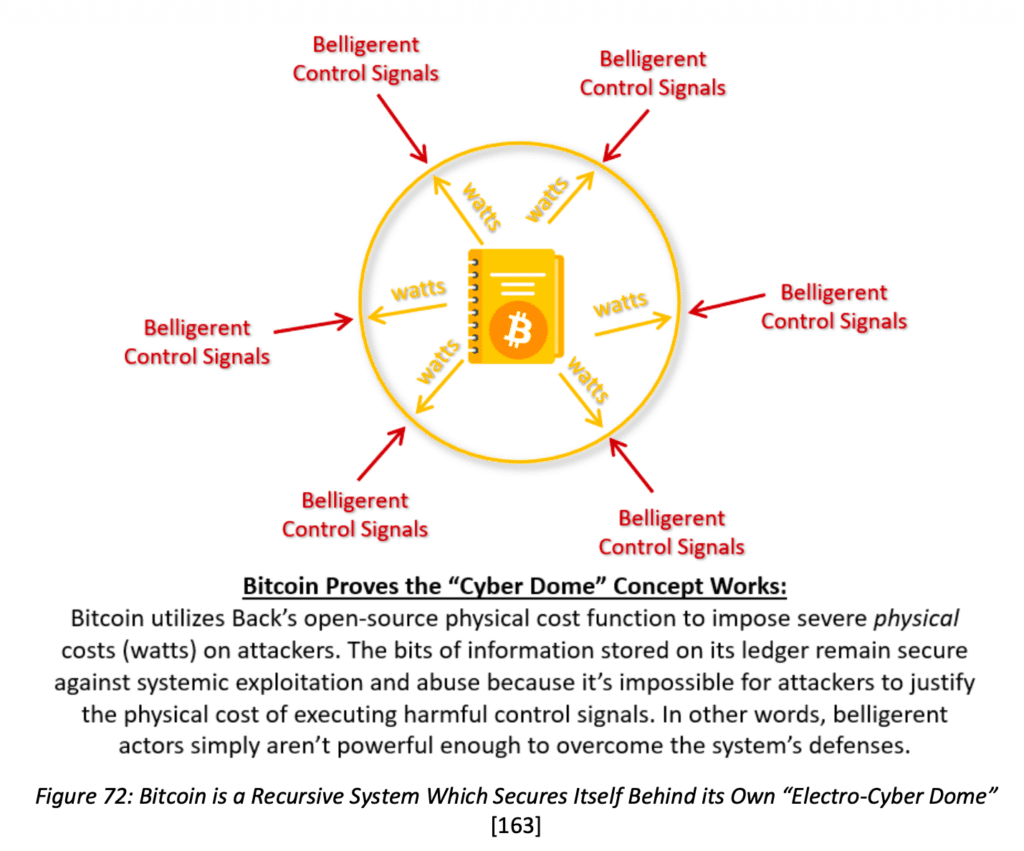
Lowery, in his concept of the Electro-Cyber Dome, is essentially talking about Hash Cash. He specifically says that servers can choose the difficulty target they see fit, and never proposes that the Dome would or should use Bitcoin’s SHA-256 protocol, though it is implied in his idea of the macrochip. What he does do is use Bitcoin as the principal example of such a cybersecurity network actually working at scale; “We know for sure that electro-cyber domes can function successfully as a security protocol because this is what Bitcoin uses to secure itself and its own bits of information against systemic exploitation.”
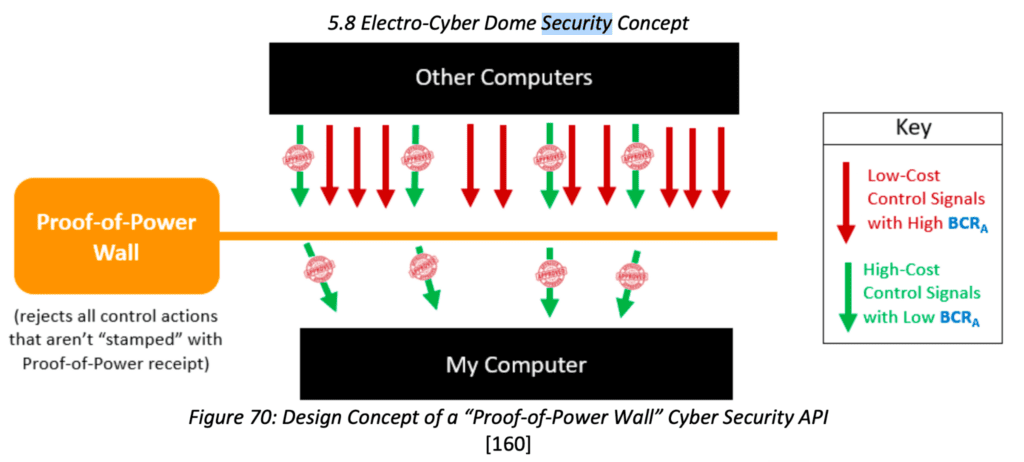
Lowery goes further than defense, pointing out that as such systems gain adoption, a concept of aggression becomes possible by large miners, he writes; “it should be noted that this wouldn’t be a strictly “defensive” power projection capability…People with access to proof-of-power can theoretically “smash” through these electro-cyber dome defenses if desired. Thus, proof-of-power protocols are not strictly “defense only” protocols as some have argued. A top threat to people using physical cost function protocols like Bitcoin is other people using the same protocol (hence why Nakamoto mentions the word “attack” 25 times in an 8-page whitepaper, each time referring to people running the same protocol).”
Criticisms of Lowery’s Softwar Thesis
Lowery’s Softwar thesis can be fairly described as controversial within the Bitcoin community. It’s optimistic take that large portions of military conflict could instead be settled via hash rate wars in some future has been described by Shinobi at Bicoin Magazine as “delusional”.
Broadly speaking, critics reject the idea that data or networks external to Bitcoin can be secured in any way with Bitcoin’s technology stack, be it its POW, its blockchain or its native asset. Jameson Lopp did a multi-part review of Lowery’s thesis and book, praising many aspects of the thesis but ultimately dismissing its conclusions, saying that: “Softwar falls short on acting as a blueprint for how we should build the future.”
The most obvious question to me is whether using SHA-256 proof of work to gatekeep access to networks outside of Bitcoin makes sense in the first place, or if it could even be considered using Bitcoin. If the Electro-Cyber Dome is not demanding a high enough POW difficulty to mine any Bitcoin, if it does not use Bitcoin’s target difficulty, its asset or its blockchain, then is it using Bitcoin?
Furthermore, given that China has the bulk of the ASIC manufacturing industry for Bitcoin mining, would INDOPACOM — the U.S. military branch in charge of keeping the Indo Pacific in check — really want to secure its cyber networks with algorithms that China mass produces chips to brute force? That seems like an awkward decision to make at best, and is more likely to lead them to consider alternative POW algorithms. But at that point, they certainly would not be using Bitcoin and would lose the macrochip argument. It would instead be using classic Hash Cash, and maybe that’s the lesson in this story. Lowery’s affinity with Bitcoin might be more of a marketing strategy and a shout-out to an industry that inspired him, rather than the actual tool that INDOPACOM might end up using.
The Happy Middle Ground
In the gap between theory, implementation, and criticisms of Software style ideas, there exist some projects that serve as young but curious examples of how Bitcoin can secure more than money.
SimpleProof, an Open Time Stamps-based Bitcoin notary of sorts, has been using the blockchain to record hashes of data, demonstrating that a certain version existed at a certain time. This very narrow use of Bitcoin as a time-stamping server helped defend one side of the Guatemala elections a few years ago from accusations of fraud by the opposition, resulting in real political consequences for the country.
Michael Saylor, on the other hand, led the creation of what some have called the Orange Checkmark protocol on top of Bitcoin. This tech stack, which can be found on Github, is a privacy preserving Bitcoin native decentralized digital identity system. It gained some interest from the Bitcoin community when it was announced a couple of years ago, but it does not appear to have gained any adoption.
Finally and ironically enough, Jameson Lopp, perhaps Lowery’s most verbose critic with three dedicated articles on the topic, actually implemented a proof-of-work-based spam protection mechanism on his website for a submission form, which, according to Lopp, works well. So if even he can see the use of these old ideas, even if just based on Hash Cash, then perhaps we will one day see Bitcoin-like technologies used to secure the networks and data of the world.