
Close Menu
  • Latest News
    • Bitcoin
    • Ethereum
    • Altcoins
    • Meme Coins
  • Tech
    • Blockchain
    • Security and Privacy
  • Web 3
    • Gaming
  • Legal
    • Legal and Regulatory
    • Adoption
  • Analysis
  • Learn
    • Education
    • Wallets and Exchanges
  • Tools
    • Market Overview
    • Exchange Tool
  • INFO@FREE.CC
What's Hot

US Treasury’s $10B scam warning shows why crypto is racing to police itself

June 24, 2026

Analyst Who Nailed 2025 Bitcoin Peak Predicts BTC Surge to $100,000 – But Not This Year

June 24, 2026

Congress Sends Anti-CBDC Housing Bill To Trump After House Vote

June 24, 2026
Facebook X (Twitter) Instagram
  • Contact
  • Privacy Policy
  • Terms & Conditions
  • Disclosure
Facebook X (Twitter) Instagram
Free.cc (Free Cryptocurrency)Free.cc (Free Cryptocurrency)
  • Latest News
    1. Bitcoin
    2. Ethereum
    3. Altcoins
    4. Meme Coins
    5. View All

    Analyst Who Nailed 2025 Bitcoin Peak Predicts BTC Surge to $100,000 – But Not This Year

    June 24, 2026

    Michael Saylor’s MSTR should pause its bitcoin (BTC) buying and rebuild cash

    June 24, 2026

    Congress Schedules CLARITY Act Hearing For July 17

    June 24, 2026

    Analyzing Bitcoin’s 15% June decline despite $43mln in whale buys

    June 24, 2026

    Ethereum USD Price Remains Stuck Below $1,800 as Bullish Momentum Fades

    June 24, 2026

    Why is Crypto Crashing Hard Today? BTC, ETH and XRP Fall 5%

    June 23, 2026

    Top 3 Analysts Reveal Ethereum Price Targets 

    June 23, 2026

    Why Is the Crypto Market Crashing Today?

    June 23, 2026

    Congress Sends Anti-CBDC Housing Bill To Trump After House Vote

    June 24, 2026

    KOSPI Shock Sends Fresh Warning Across Bitcoin And Risk Asse

    June 24, 2026

    Spot Bitcoin And Ether ETFs Bleed $134M As Institutions De-R

    June 24, 2026

    Ethereum Foundation Executive Says MEV Is Becoming Crypto’s

    June 23, 2026

    Dogecoin Cash Files U.S. Patent for DOGP Blockchain Framework

    June 15, 2026

    How SIREN Went From AI Memecoin to Boom-and-Bust

    June 8, 2026

    Meme Coin Market Faces Imbalance as Supply Rises, Demand Falls

    April 4, 2026

    Crypto Interest Rising Toward Meme Coin Sector

    January 9, 2026

    US Treasury’s $10B scam warning shows why crypto is racing to police itself

    June 24, 2026

    Analyst Who Nailed 2025 Bitcoin Peak Predicts BTC Surge to $100,000 – But Not This Year

    June 24, 2026

    Congress Sends Anti-CBDC Housing Bill To Trump After House Vote

    June 24, 2026

    Michael Saylor’s MSTR should pause its bitcoin (BTC) buying and rebuild cash

    June 24, 2026
  • Tech
    1. Blockchain
    2. Security and Privacy
    3. View All

    Merck and Hashgraph Group launch Hedera-based product passport for EU compliance

    June 12, 2026

    COTI and Midnight Foundation Partner to Advance the Global Privacy Ecosystem

    June 11, 2026

    Cardano Gets Exposure From Olympics Committee

    June 11, 2026

    How Privacy and Composability Trade-Offs Differ

    June 11, 2026

    Microsoft Warns of New USB-Based Malware Targeting Crypto Users

    June 21, 2026

    Fake GitHub Stars and AI Videos Mask a Crypto Clipper

    June 18, 2026

    Zcash Climbs 80% Since June 5 as Traders Shrug off Orchard Bug Fears – Bitcoin News

    June 18, 2026

    Rokarolla Trojan Combines Banking Fraud With Device Surveillance

    June 16, 2026

    US Treasury’s $10B scam warning shows why crypto is racing to police itself

    June 24, 2026

    Analyst Who Nailed 2025 Bitcoin Peak Predicts BTC Surge to $100,000 – But Not This Year

    June 24, 2026

    Congress Sends Anti-CBDC Housing Bill To Trump After House Vote

    June 24, 2026

    Michael Saylor’s MSTR should pause its bitcoin (BTC) buying and rebuild cash

    June 24, 2026
  • Web 3
    1. Gaming
    2. View All

    Loaded Lions’ Mane City Mobile Heads to iOS and Android as Sign-Ups Begin

    June 23, 2026

    Nexus Acquires Homegrown App Marketplace One Store, Expanding into Global Web3 Game Hub

    June 21, 2026

    GoMining Rolls Out GoBTC Pay SDK for Bitcoin Merchant Payments

    June 20, 2026

    Real Finance Launches $ASSET Rewards Campaign to Support RWA Ecosystem Growth

    June 19, 2026

    US Treasury’s $10B scam warning shows why crypto is racing to police itself

    June 24, 2026

    Analyst Who Nailed 2025 Bitcoin Peak Predicts BTC Surge to $100,000 – But Not This Year

    June 24, 2026

    Congress Sends Anti-CBDC Housing Bill To Trump After House Vote

    June 24, 2026

    Michael Saylor’s MSTR should pause its bitcoin (BTC) buying and rebuild cash

    June 24, 2026
  • Legal
    1. Legal and Regulatory
    2. Adoption
    3. View All

    US Treasury’s $10B scam warning shows why crypto is racing to police itself

    June 24, 2026

    Centralized Wall Street gatekeepers to control investors’ route into tokenized stocks through old pipes

    June 23, 2026

    Europe’s Swedish krona stablecoin arrives with a warning: dollar liquidity may already be too far ahead

    June 22, 2026

    Kraken Fed account fight could shape how crypto firms get direct payment access

    June 22, 2026

    Latest bear market victim shows how quickly DeFi users are left behind when crypto projects move on

    June 24, 2026

    South Korean digital bank with 15M users turns to Solana stablecoins for overseas transfers

    June 24, 2026

    Ripple gives RLUSD a MiCA foothold in Europe and route into African payments

    June 23, 2026

    $8.5M DeFi vault pulled overnight: The wake-up call for traders chasing high yields

    June 23, 2026

    US Treasury’s $10B scam warning shows why crypto is racing to police itself

    June 24, 2026

    Analyst Who Nailed 2025 Bitcoin Peak Predicts BTC Surge to $100,000 – But Not This Year

    June 24, 2026

    Congress Sends Anti-CBDC Housing Bill To Trump After House Vote

    June 24, 2026

    Michael Saylor’s MSTR should pause its bitcoin (BTC) buying and rebuild cash

    June 24, 2026
  • Analysis

    Ethereum Foundation cuts 20% of staff as ETH sinks 44% YTD despite record usage

    June 24, 2026

    CZ called Hyperliquid’s no KYC model “awesome”

    June 24, 2026

    Dogecoin Heads Toward Yearly Lows as Selling Pressure Builds — What’s Next for DOGE Price?

    June 24, 2026

    Solana is subsidizing high-volume traders before on-chain markets prove the activity can stick

    June 24, 2026

    Worldcoin Sell-Off Deepens, But Bullish Momentum Remains Intact — What’s Next for WLD Price?

    June 23, 2026
  • Learn
    1. Education
    2. Wallets and Exchanges
    3. View All

    What Is BChat? The Decentralized Messaging App Built for Privacy

    June 2, 2026

    What Is an AI Prompt Injection Attack? The Hidden Threat Hijacking Your Chatbots

    May 31, 2026

    What Is AI Jailbreaking? A Beginner’s Guide to the Cat-and-Mouse Game Behind Every Chatbot

    May 17, 2026

    What’s on the Ethereum Roadmap: Glamsterdam, Hegota and Beyond

    March 30, 2026

    HYPE ETFs quietly pulled $161M in one month as Wall Street buys crypto’s on-chain exchange bet

    June 15, 2026

    Crypto exchanges are opening a two-front war for the stock market

    June 12, 2026

    Crypto’s killer app may be selling stocks after its own tokens failed retail

    June 10, 2026

    Vitalik wants DeFi price crashes to stop triggering automatic liquidations

    June 4, 2026

    US Treasury’s $10B scam warning shows why crypto is racing to police itself

    June 24, 2026

    Analyst Who Nailed 2025 Bitcoin Peak Predicts BTC Surge to $100,000 – But Not This Year

    June 24, 2026

    Congress Sends Anti-CBDC Housing Bill To Trump After House Vote

    June 24, 2026

    Michael Saylor’s MSTR should pause its bitcoin (BTC) buying and rebuild cash

    June 24, 2026
  • Tools
    • Market Overview
    • Exchange Tool
  • INFO@FREE.CC
Free.cc (Free Cryptocurrency)Free.cc (Free Cryptocurrency)
Home»Legal and Regulatory»US Treasury’s $10B scam warning shows why crypto is racing to police itself
Cybersecurity analyst monitoring illicit financial networks and digital asset transactions behind a virtual security shield, representing anti-money laundering enforcement and financial crime prevention.
Legal and Regulatory

US Treasury’s $10B scam warning shows why crypto is racing to police itself

June 24, 2026No Comments8 Mins Read
Share
Facebook Twitter LinkedIn Pinterest Email

On June 23, the US Treasury sanctioned nine individuals and 26 entities linked to the Prince Group transnational criminal organization and proposed expanding its Huione Group rule to include H-Pay Service PLC and any successor entity, tying both actions to Southeast Asia scam networks that cost Americans at least $10 billion in 2024.

OPSeC, announced by the DeFi Education Fund in partnership with Security Alliance (SEAL) and Asymmetric Research, frames itself as the credible internal answer to that convergence.

The same day, OPSeC went public with a pledge to harden the industry’s protocols, signing practices, and infrastructure.

In Washington’s legislative vocabulary, crypto fraud, DeFi exploits, stablecoin rails, and laundering infrastructure collapse into a single risk category the moment a bill is being drafted.

Treasury described digital asset investment fraud as one of the most common and lucrative schemes run by these operations, and its 2026 National Money Laundering Risk Assessment explicitly flags the sector.

FinCEN described Huione Group as a key node for laundering proceeds from cyber heists and virtual currency investment scams, and policymakers writing broad illicit finance rules have consistently grouped under-secured protocols alongside the scam operators that exploit them.

The coalition’s pledge positions operational security as both an engineering discipline and a policy-facing standard.
Its stated workstreams include a shared security resource hub, regular convenings of protocol teams and security firms, and a direct bridge to policy through lawmaker-facing educational events as crypto legislation moves through Congress.

OPSeC is trying to make DeFi’s security posture legible to policymakers before those policymakers define it for them.
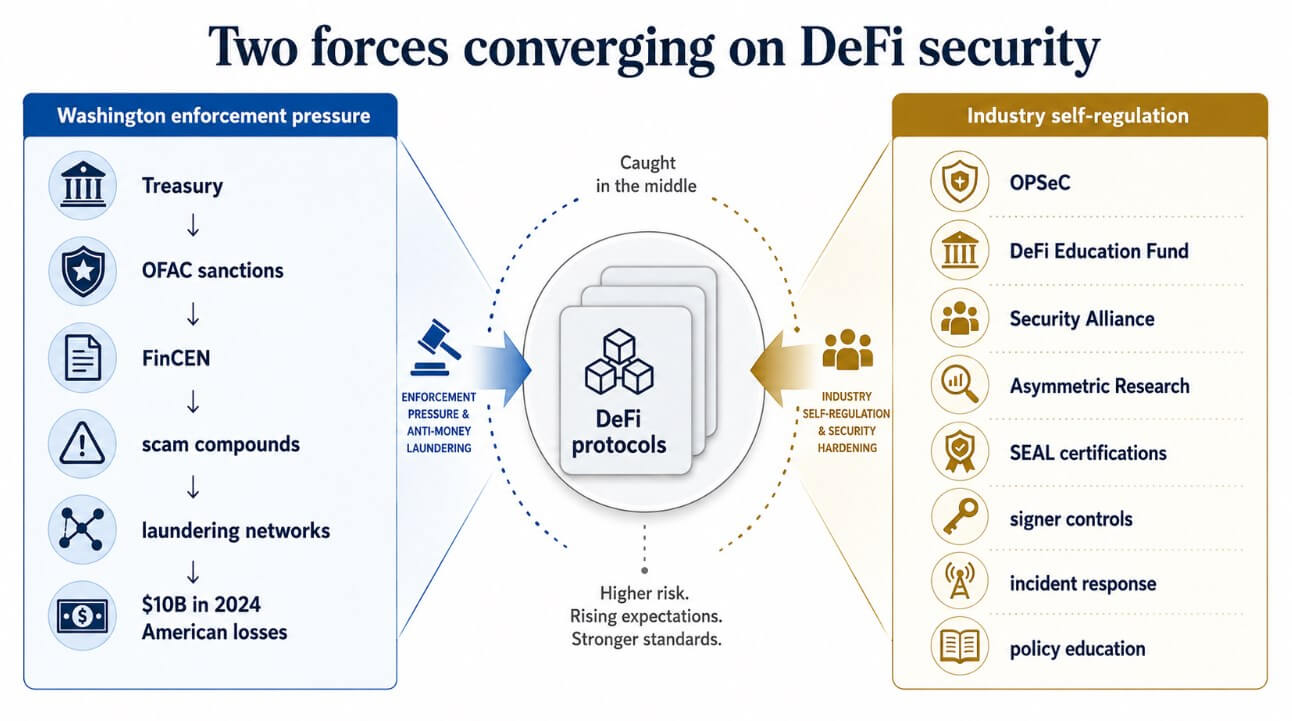
Two forces converging on crypto and DeFi security
A diagram shows Treasury enforcement actions and industry-led security initiatives converging on DeFi protocols from opposite sides.

The threat model expanded

April 2026 made it harder to argue against a coalition like OPSeC, with nearly $630 million drained across at least 27 reported DeFi exploits, led by Drift and KelpDAO and concentrated in signer, bridge, and infrastructure failure points.

The $285 million Drift Protocol hack, the largest DeFi exploit of 2026, grew out of a six-month social engineering operation that took just 12 minutes to execute once the groundwork was in place.

Attackers attributed with medium-high confidence to the North Korean state-sponsored group UNC4736 attended crypto conferences in person, built genuine professional relationships with Drift contributors, and manipulated real Security Council members into pre-signing hidden authorizations.

See also  Federal judge temporarily halts Tennessee's bid to shut down Kalshi sports contracts

A zero-time-lock governance migration three days before the drain eliminated the protocol’s last intervention window.

The forensic review identified three intrusion vectors: a malicious code repository cloned by a contributor, a fake TestFlight application, and a VSCode/Cursor vulnerability that executed arbitrary code silently when the repository was opened, all operating entirely outside the scope of smart contract audits.

Old DeFi security frame New threat vector Example from article Why traditional audits miss it
Smart-contract bugs Social engineering Drift attackers built relationships with contributors and council members Human trust exploitation occurs outside contract logic
Smart-contract bugs Compromised signers Hidden authorizations were allegedly pre-signed Valid signatures can execute malicious outcomes
Smart-contract bugs Malicious developer tooling Fake TestFlight app, malicious repo, VSCode/Cursor execution path The exploit path begins on contributor devices
Smart-contract bugs Governance/timelock failures Drift’s zero-timelock migration removed intervention window Governance configuration is operational architecture
Smart-contract bugs Bridge verifier weakness KelpDAO’s single-verifier LayerZero bridge route Cross-chain validation risk sits above individual contract audits
Smart-contract bugs RPC / infrastructure compromise KelpDAO manipulation of validation logic through infrastructure Infrastructure trust assumptions are not always audited like code

TRM Labs attributed roughly $577 million in stolen crypto through April 2026 to North Korean hackers, equivalent to 76% of all global cryptocurrency hack losses in that period, concentrated in just two attacks.
The $292 million KelpDAO breach took a different technical route, exploiting a single-verifier design in a LayerZero bridge by compromising RPC infrastructure and manipulating cross-chain validation logic, but it operated on the same human and infrastructural layer that code audits were never built to reach.

OpenZeppelin’s own analysis argues that recent losses increasingly originate in the operational layers around protocols, including signing infrastructure, governance, cross-chain dependencies, and human controls, rather than contract code alone.

SEAL’s certification framework, launched in 2026 through accredited auditors, was built around that breakdown. It evaluates whether a protocol can defend itself, detect incidents, and respond when things go wrong by covering multisig operations, treasury management, incident response, DNS security, DevOps infrastructure, and identity and account controls.

See also  JPMorgan CEO Jamie Dimon takes aim at the Clarity Act over crypto deposit risks

OPSeC’s policy function provides a venue for those standards to become legible to legislators rather than remain internal industry infrastructure.

The AI complication

Two credible, opposing readings of DeFi’s defensibility have been running through the security community since late May.

On May 26, Manuel Aráoz, co-founder and former CTO of OpenZeppelin, declared that he considers all of DeFi unsafe, citing AI coding agents that are “superhuman at finding vulnerabilities,” and advised friends and family to exit positions in Aave, MakerDAO, and Compound.

He argues that defenders must close every exploitable flaw, while attackers need only one, and that AI agents have made that asymmetry unmanageable by running vulnerability searches in parallel, around the clock, across thousands of contracts simultaneously.

OpenZeppelin’s current CEO, Demian Brener, publicly distanced the company from Aráoz’s exit thesis, framing AI as a defensive capability alongside an offensive one, and reaffirming the firm’s commitment to continuous, AI-augmented security.

OpenZeppelin’s own analysis similarly argues that the most significant losses of the past two years increasingly originated in operational layers around protocols, including social engineering, signing infrastructure, governance, and cross-chain dependencies.

AI agents are nonetheless moving the remaining technical attack surface toward attackers, and Aráoz’s directional read holds even if his conclusion overstates it.

An AI-accelerated code exploitation environment adds a layer that certification programs covering DNS security and multisig operations cannot close on their own; together, these two framings define the outer boundaries of what OPSeC can and cannot accomplish.

The enforcement test

SEAL Certifications set a deliberately demanding standard of six domains covering multisig governance, treasury architecture, incident response playbooks, DNS registry controls, DevOps infrastructure, and identity management, assessed by accredited auditors and recorded as on-chain attestations.

Most protocols undergoing certification will identify gaps that require remediation before they pass. A certification framework that demands a signer registry, tested incident response drills, and DNS configuration records is an enforceable bar.

OPSeC’s value over the next twelve months will be determined by whether that bar gets enforced.

The bull case is that OPSeC connects with SEAL Certifications to build a security-premium market. Protocols demonstrating operational discipline through phishing-resistant signer controls, time-locked governance, 24/7 incident monitoring, and DNS registry locks trade at a lower risk discount than protocols that rely solely on code audits.

See also  The worst may lie ahead. BTC price chart revisits historic pattern: Crypto Daybook Americas

Capital follows attestation, and the standard becomes self-enforcing because it becomes economically meaningful.

Scenario over next 12 months What would confirm it Market implication Policy implication
Bull case: security premium forms OPSeC signers adopt SEAL-style certification, publish attestations, and remediate gaps Certified protocols trade at lower risk discounts; capital favors verifiable security Industry gets evidence that self-regulation can work
Base case: coordination improves, but enforcement stays soft OPSeC becomes a policy and education hub, but compliance data remains limited Security becomes a narrative differentiator, not a pricing standard Lawmakers still view DeFi risk through mixed evidence
Bear case: pledgeware narrative wins Another nine-figure signer, bridge, or social-engineering exploit lands before measurable standards emerge DeFi risk premium widens; BTC and simpler exposures outperform complex protocols Treasury/FinCEN framing dominates legislative debate
Black swan: AI-assisted exploit links to sanctioned laundering rails Major exploit is tied to state actors, scam-compound infrastructure, or sanctioned payment networks Broad crypto selloff; exchanges and stablecoin issuers de-risk aggressively Washington folds DeFi security, AML, and sanctions into one enforcement category

The bear case is that a fresh nine-figure signer exploit lands before OPSeC produces measurable compliance data, policymakers treat the coalition as pledge language, and the illicit-finance legislative debate hardens around the worst-case assumptions Treasury’s June 23 action put back on the table.

The contest is over who defines what “securing DeFi” means: the industry through verifiable operational standards, or Washington through enforcement categories that fold a compromised multisig signer and a scam compound in Cambodia into a single regulatory risk class.

Treasury has stated that it will continue to take aggressive steps against illicit abuse in the digital asset industry. OPSeC’s window to answer with evidence is open, and it has a closing time.

The post US Treasury’s $10B scam warning shows why crypto is racing to police itself appeared first on CryptoSlate.

10B Crypto Police Racing scam Shows Treasurys Warning
Share. Facebook Twitter Pinterest LinkedIn Tumblr Email

Related Posts

Latest bear market victim shows how quickly DeFi users are left behind when crypto projects move on

June 24, 2026

KOSPI Shock Sends Fresh Warning Across Bitcoin And Risk Asse

June 24, 2026

Gold Price Drop Sparks Debate Over Crypto Outlook As Kiyosaki Awaits Buy Signal

June 24, 2026

European Union’s ESMA Orders Unlicensed Crypto Firms To Exit EU Market As MiCA Deadline Arrives

June 23, 2026
Add A Comment
Leave A Reply Cancel Reply

Top Posts

David Sacks Calls on Banks After Crypto Policy Shift

March 3, 2026

From 130K to 846,842 BTC – How Saylor shaped Strategy’s Bitcoin bet

June 22, 2026

Stay ahead with the latest crypto news, market updates, blockchain insights, and trends. Your trusted source for everything happening in the digital asset world.


We're social. Connect with us:

Facebook X (Twitter) Instagram Pinterest YouTube
Top Insights

US Treasury’s $10B scam warning shows why crypto is racing to police itself

June 24, 2026

Analyst Who Nailed 2025 Bitcoin Peak Predicts BTC Surge to $100,000 – But Not This Year

June 24, 2026

Congress Sends Anti-CBDC Housing Bill To Trump After House Vote

June 24, 2026
Get Informed

Subscribe to Updates

Get the latest creative news From Free.cc directly in your Inbox!

  • Contact
  • Privacy Policy
  • Terms & Conditions
  • Disclosure
© 2026 free.cc - All rights reserved.

Type above and press Enter to search. Press Esc to cancel.