
President Donald Trump’s family has turned crypto into one of the most lucrative businesses tied to its name, outpacing some of the companies that spent years building the digital asset market.
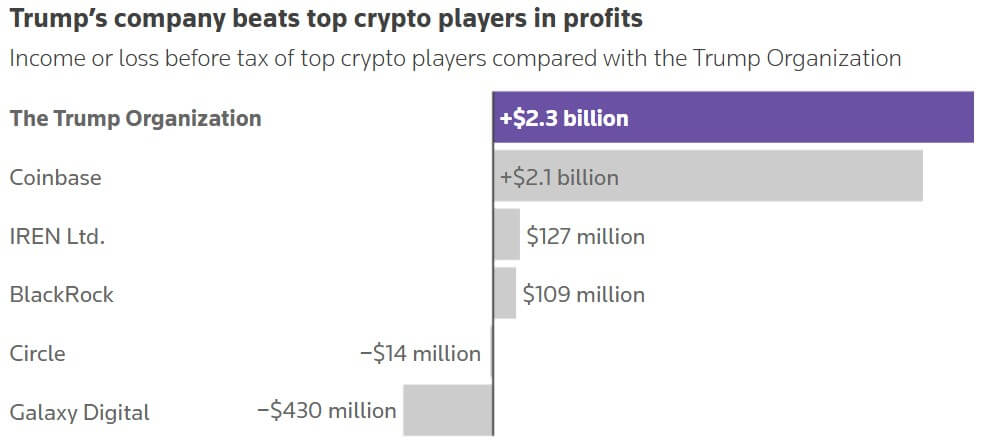
Between the post-election momentum of November 2024 and April 2026, ventures tied to the US President generated roughly $2.3 billion in pretax crypto income, Reuters reported.
To understand the sheer scale of this capital extraction, one must look at the foundational pillars of the industry during that same window.
For context, the Trump firm’s gains exceeded Coinbase’s $2.1 billion in income over the same period, as well as earnings from major crypto operators across mining, stablecoins, exchange-traded funds, and market infrastructure.
IREN, the largest Bitcoin miner by market value, earned $127 million during the period. BlackRock’s Bitcoin ETF business, built around IBIT, the world’s largest spot Bitcoin fund, generated an estimated $109 million.
Meanwhile, Circle, the issuer of USDC stablecoin, lost $14 million, while Galaxy Digital, a major crypto company, posted a $430 million loss.
Unlike Coinbase or BlackRock, the Trump Organization did not compete on trading latency, deep liquidity, or assets under management.
Instead, it leveraged an entirely different business model: an asymmetrical risk structure where the family deployed minimal personal capital, yet captured massive upside via token sales, founder allocations, and equity stakes.
However, the market dynamic has proven entirely zero-sum. Data indicates that the $2.3 billion captured by the president’s family mirrors the $2.25 billion in estimated net losses absorbed by the retail and public-market investors who bought into these ventures.
Monetizing the Trump name
World Liberty Financial accounted for the largest share of the Trump family’s reported crypto revenue.
The project began selling governance tokens in October 2024, with Trump and his sons promoted as central figures. Donald Trump Jr. and Eric Trump traveled to pitch World Liberty’s vision of a financial system outside traditional banks, while the company positioned itself as a decentralized finance and stablecoin platform.
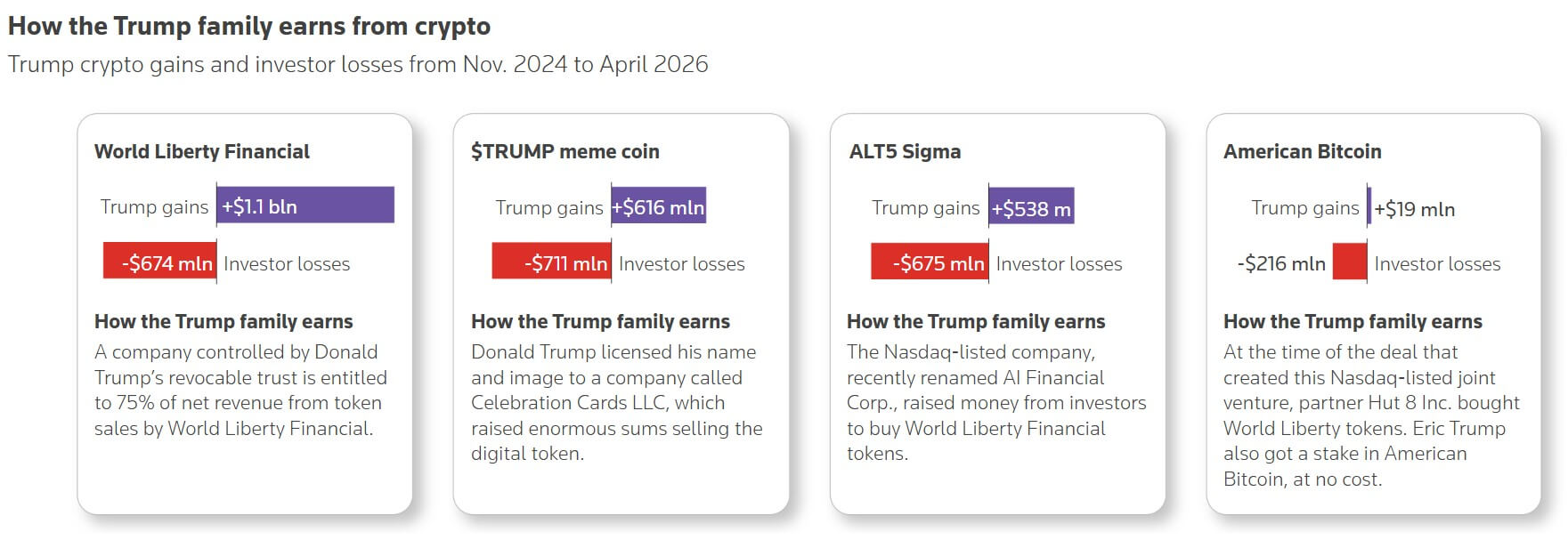
The project’s economics gave the family a direct claim on token sale revenue. DT Marks DEFI LLC, a corporate entity linked to the family, secured a contractual right to 75% of token sale proceeds after expenses, generating an estimated $987 million for the family.
That structure allowed the family to collect revenue from the primary token sale, limiting its exposure to later market declines.
However, the token Buyers faced a different outcome. World Liberty investors were sitting on roughly $674 million in losses by the end of April, weighed down by long lockup periods and a sharp decline in the token’s post-listing value.
Meanwhile, a similar pattern emerged with the TRUMP meme coin. The token launched shortly before Trump’s second inauguration and became a speculative vehicle tied to the president’s political brand rather than an asset with clear underlying utility.
Blockchain analysis of exchange transfers suggested the project generated more than $1.2 billion in total revenue, including an estimated $616 million for the Trump family.
Like WLFI, retail buyers absorbed the losses as the token fell from highs of $75.35, leaving investors with more than $700 million in losses.
Wall Street opened another route into the trade
Trump-linked crypto gains also moved through public companies, extending the trade beyond tokens and into brokerage accounts.
ALT5 Sigma, a small Nasdaq-listed company now known as AI Financial Corp., became one of the clearest examples. The company raised $750 million by selling new shares and used $717 million to buy World Liberty tokens. Reuters reported that more than $500 million from that purchase flowed to the Trump family through World Liberty’s revenue-sharing structure.
The deal gave public-market investors indirect exposure to World Liberty through a listed stock. Eric Trump and Donald Trump Jr. later rang the Nasdaq opening bell after the transaction closed, turning the token purchase into a Wall Street event.
The stock then collapsed. Reuters reported that ALT5’s share price fell from more than $9 in August 2025 to 75 cents by the end of April, leaving investors with about $675 million in losses.
The family’s economics were separate from that decline because its gain came from World Liberty’s sale of tokens to ALT5. Outside shareholders carried the risk of the listed company’s falling share price.
American Bitcoin offered another public-market channel. The Bitcoin mining and treasury company, backed by Donald Trump Jr. and Eric Trump, gained a Nasdaq listing in 2025.
Reuters reported that the Trump brothers received stakes in American Bitcoin at no monetary cost. Eric Trump’s stake was still worth more than $70 million at the end of April, even after a sharp decline in the stock. Donald Trump Jr.’s stake was not disclosed.
Outside investors again absorbed the losses. American Bitcoin shares fell from $11 at their September launch to $1.15 at the end of April, Reuters reported, wiping out more than $200 million for investors.
The listed-company deals expanded the reach of the Trump crypto business as investors who may never have bought a meme coin or governance token directly were able to take exposure through ordinary equities.
However, the result was the same financial split: Trump-linked entities captured early value, while public investors were left exposed to falling market prices.
Ethics questions follow the money
These market maneuvers are occurring against a complex regulatory backdrop. The current administration has actively championed digital assets, pushing stablecoin legislation and directing federal agencies to adopt a “light-touch” framework.
While this macro policy pivot has undeniably benefited the broader crypto sector, the direct financial windfall enjoyed by the First Family has triggered unprecedented ethical alarms.
Watchdogs argue that while the mechanisms of these corporate maneuvers appear strictly legal under current law, they represent a profound conflict of interest that monetizes an industry the executive branch is actively deregulating.
This intersection of policy and personal profit has drawn fierce legislative blowback.
Democratic lawmakers, spearheaded by Senator Elizabeth Warren, have petitioned agencies like the CFTC and SEC, arguing that the administration’s deep financial entanglements in crypto and prediction markets severely compromise federal rule-making, subordinating public protection to the president’s personal balance sheet.
However, the White House continues to categorically dismiss these allegations, maintaining that the administration’s sole objective is securing American dominance in the global digital asset race.
Representatives for World Liberty have similarly pushed back, framing the protocol as a purely private fintech enterprise rather than a political vehicle.
Yet, beyond the partisan rhetoric, the ledger is remarkably clear. By treating the presidency as a premium licensing asset, the Trump family has executed one of the most efficient capital extraction strategies in modern financial history, leaving a trail of underwater retail investors holding the bill.