

If you’ve ever bought a stock and assumed you “owned it” the moment you hit confirm, you’ve already met the least glamorous part of markets: settlement.
Settlement is the back-end handoff where the system ensures that the buyer’s cash and the seller’s security actually swap places for good, with no take-backs and no missing pieces.
Markets still spend an odd amount of their day waiting for ledgers to match, for cash to arrive, for collateral to land in the right account, and for the middlemen that run the machinery to say, yes, that’s final.
Tokenization has promised to shrink that dead time for years, but it hasn’t had a clean answer to a basic question.
When a security moves on-chain, what does the core market utility do with its official books, and what does the cash leg look like when it has to behave like regulated money instead of a vibes-based stablecoin?
CryptoSlate has already covered the two news pegs separately: the SEC staff’s no-action path for DTCC’s tokenization service and the idea that it can compress settlement timelines.
It has also covered JPMorgan’s MONY fund as a bid to define “cash on-chain” for KYC’d capital.
This deep dive keeps the facts intact but stitches the two into one story, because that’s where the reader payoff sits.
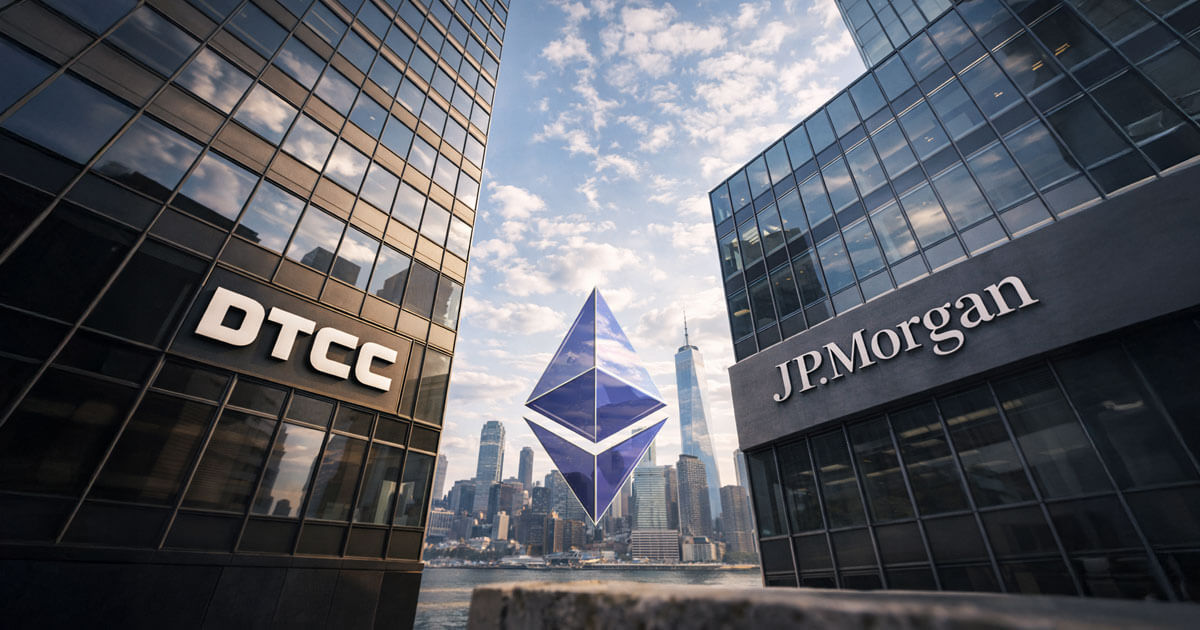
DTCC is trying to make tokenized securities entitlements legible to the system that already runs U.S. settlement, while JPMorgan is trying to make on-chain cash management legible to the people who already run liquidity.
Put them together, and the fantasy finally gets a schedule: not “everything goes on-chain tomorrow,” but a narrow, bank-and-broker-friendly path where cash-like tokens and DTC-recognized entitlements can start meeting each other without anyone pretending regulation doesn’t exist.
DTCC’s pilot is about who’s credited, not where the token sits
DTCC stands for the Depository Trust & Clearing Corporation, and it’s the backbone utility that sits behind U.S. post-trade processing.
DTC, short for The Depository Trust Company, is the DTCC subsidiary that acts as the central securities depository for most U.S. stocks, ETFs, and Treasurys, meaning it’s where the Street’s positions ultimately get recorded and reconciled.
Start with what DTC is actually doing, because the headline version is easy to misread.
DTC is the part of DTCC that keeps the official scoreboard for what big market participants hold inside the depository system, and most investors only touch it indirectly through their broker.
Your broker is the DTC participant; you’re the customer sitting one level down, with your position reflected on your broker’s books.
The SEC staff no-action letter is framed as informal approval for a time-limited rollout with reporting, while keeping the underlying securities on DTC’s existing custody rails.
The letter relates to a “Preliminary Base Version” of DTC’s tokenization service that would represent certain DTC-held positions as tokens and allow those tokens to move between approved blockchain addresses, while DTC still tracks every move so its books remain the source of truth.
That’s not a new stock-issuance regime, and it isn’t a crypto-native cap table rewrite either.
It’s DTC allowing the representation to move on-chain, but keeping the official record inside the market’s existing settlement utility.
The word “entitlement” is the key to making this understandable.
In this setup, the token isn’t trying to replace the U.S. legal definition of a security.
It’s a controlled digital representation of the position a DTC participant already has, designed so it can move through a blockchain-style rail while DTC still knows, at every step, which participant is credited and whether the move is valid.
The constraints are the point, and they’re why this is even thinkable inside regulated markets.
Tokens can only be transferred to “Registered Wallets,” and DTC says it plans to make available a list of public and private ledgers on which participants may register blockchain addresses as Registered Wallets.
The service also doesn’t lock the market into a single chain or a single set of smart contracts, at least not in the preliminary version.
The no-action letter describes DTC’s “objective, neutral, and publicly available requirements” for supported blockchains and tokenization protocols.
Those requirements are designed to ensure tokens only move to Registered Wallets and that DTC can respond to conditions requiring reversal, including erroneous entries, lost tokens, or malfeasance.
That reversibility language is where regulated tokenization stops sounding like a crypto slogan and starts sounding like operations.
A market utility can’t run a core service it can’t control or undo.
So the pilot is being built around the idea that tokens can move fast, but they also have to move inside a governance perimeter that can unwind mistakes and handle legal reality when it shows up.
DTC even describes mechanics designed to avoid “double spend,” including a structure where securities credited to a digital omnibus account aren’t transferable until a corresponding token is burned.
DTC is saying it wants the token side and the traditional ledger side tied together tightly enough that you don’t get an “extra copy” of the same entitlement floating around.
The eligible asset set is also deliberately boring, and boring is how infrastructure survives.
DTCC’s announcement describes a defined set of highly liquid assets, including Russell 1000 stocks, major-index ETFs, and U.S. Treasury bills, notes, and bonds.
In other words, the pilot starts where liquidity is deep, operational conventions are well understood, and the cost of a misstep isn’t existential market chaos.
DTCC’s public timeline pins the practical launch to the second half of 2026, and its announcement describes the no-action relief as authorizing the tokenization service on pre-approved blockchains for three years.
That three-year window is the real countdown clock: it’s long enough to onboard participants, test controls, and prove resiliency, but short enough that everyone involved knows they’re being graded.
JPMorgan’s MONY fills the missing leg: cash that can sit on-chain and still act respectable
Even if DTC gets tokenized entitlements working, tokenization doesn’t feel real until cash behaves the same way.
That’s where MONY matters, but not because it’s a clever new wrapper for yield.
It matters because it’s a cash-management product built to live on Ethereum without pretending it’s permissionless.
CryptoSlate’s earlier coverage made that framing explicit: MONY is less a DeFi experiment than a bid to redefine what “cash on-chain” means for large, KYC’d pools of capital.
JPMorgan’s own press release makes the structure plain: MONY is a 506(c) private placement fund, available to qualified investors through Morgan Money, with investors receiving tokens at their blockchain addresses.
The fund invests only in traditional U.S. Treasury securities and repurchase agreements fully collateralized by U.S. Treasury securities, offers daily dividend reinvestment, and lets investors subscribe and redeem using cash or stablecoins through Morgan Money.
In other words, it’s the familiar money-market promise (liquidity, short-duration government paper, steady income) delivered in a format that can travel on public rails.
If you don’t live in money-market land, here’s the simple idea: a money-market fund is where big pools of cash park when they want to earn a short-term rate without taking on much risk.
The “cash” in modern markets is usually a claim on a bundle of short-dated government-backed instruments.
MONY is that, but wrapped as a token so it can be held and moved in a blockchain environment, under the product’s rules, without turning every transfer into a manual process.
That last part is the punchline.
On-chain cash equivalents have mostly meant stablecoins, which are great at being everywhere and terrible at behaving like a treasury desk’s favorite parking spot when rates are high and idle balances are large.
MONY doesn’t ask clients to pick a side in a culture war.
It offers a thing treasurers already buy, but in a form that can move with fewer cutoffs and fewer excuses.
The fund was seeded with $100 million, and access is aimed at wealthy individuals and institutions, with high minimums that keep it firmly in the accredited-and-up lane.
That detail matters because it shows the first wave of “tokenized finance” isn’t built for retail wallets, but for balance sheets that already live inside compliance and custody workflows.
MONY is cash management for people who already have a pretty thick treasury policy binder.
Now connect MONY back to DTCC’s pilot, and you can see where 2026 is going.
DTCC is building a way to move tokenized entitlements across supported ledgers while DTC tracks transfers for its official record.
JPMorgan is putting a yield-bearing, Treasury-backed instrument on Ethereum that can be held as a token and, within its own transfer restrictions, moved peer-to-peer and used more broadly as collateral in blockchain environments.
This is where we get the answer to the question, “When does it hit my broker account?”
The first visible effects probably won’t be tokenized blue-chip equities offered to retail.
They’ll be the parts brokers and treasurers can adopt without rewriting everything: cash sweep products that can move under clearer rules, and collateral that can be repositioned inside permitted venues without the usual operational lag.
DTCC says it anticipates beginning rollout in the second half of 2026, and that timing is the anchor for when large intermediaries can start integrating tokenized entitlements.
The sequencing almost writes itself because the incentives line up with the constraints.
Institutions will get access first because they can register wallets, integrate custody, and live with allowlists and audit trails.
Retail will get access later, mostly through broker interfaces that hide the chain the same way they already hide clearinghouse membership.
The more interesting question isn’t whether the rails exist.
It’s who gets to drive on them, and which assets are worth moving first when every transfer still has to pass through compliance, custody, and operational controls that don’t care how futuristic your smart contract looks.
Tokenization’s sales pitch has always been speed.
DTCC and JPMorgan are selling something narrower and more believable: a way for securities and cash to meet in the middle without breaking the rules that keep markets functioning.
DTCC’s pilot says tokenized entitlements can move, but only between registered participants on supported ledgers, with reversibility baked in.
MONY says on-chain cash equivalents can pay yield and live on Ethereum, but still stay inside the perimeter of a regulated fund sold to qualified investors through a bank platform.
If this works, the win won’t be a sudden migration of everything on-chain.
It’ll be a slow realization that the dead time between “cash” and “security” has been a product feature for decades, and it doesn’t have to be.
The post These two financial giants just set Ethereum’s on-chain schedule, but Wall Street relies on a controversial “undo” button appeared first on CryptoSlate.