
Close Menu
  • Latest News
    • Bitcoin
    • Ethereum
    • Altcoins
    • Meme Coins
  • Tech
    • Blockchain
    • Security and Privacy
  • Web 3
    • Gaming
  • Legal
    • Legal and Regulatory
    • Adoption
  • Analysis
  • Learn
    • Education
    • Wallets and Exchanges
  • Tools
    • Market Overview
    • Exchange Tool
What's Hot

Bitcoin ETF Outflows Hit $1.44B as BlackRock’s IBIT Faces Heavy Selling

November 12, 2026

SEC enforcement actions fall 24%, crypto cases in spotlight

November 12, 2026

XRP sharks add 16.8K wallets as price nears critical $1 support: Can buyers defend it?

November 12, 2026
Facebook X (Twitter) Instagram
  • Contact
  • Privacy Policy
  • Terms & Conditions
  • Disclosure
Facebook X (Twitter) Instagram
Free.cc (Free Cryptocurrency)Free.cc (Free Cryptocurrency)
  • Latest News
    1. Bitcoin
    2. Ethereum
    3. Altcoins
    4. Meme Coins
    5. View All

    Bitcoin ETF Outflows Hit $1.44B as BlackRock’s IBIT Faces Heavy Selling

    November 12, 2026

    How Sam Altman-Backed Meanwhile Is Disrupting The $20T Life Insurance Industry

    November 12, 2026

    $1.04B out of Bitcoin ETFs – Short term holders plunge into net unrealized losses

    November 12, 2026

    Israel Discount Bank to Launch Bitcoin, Ethereum Trading in Its Ap

    November 12, 2026

    Ethereum – What BitMine’s $6.3B loss reveals about building treasury around ETH

    November 12, 2026

    BlackRock’s crypto portfolio falls by nearly $5 billion so far in November 2026

    November 11, 2026

    Ether ETFs Shed $184.6M in a Day as BlackRock Leads Redemptions

    November 11, 2026

    Is Ethereum’s slide below $2250 sign of ‘impatience of markets’?

    November 10, 2026

    XRP sharks add 16.8K wallets as price nears critical $1 support: Can buyers defend it?

    November 12, 2026

    ARK Invest Trims Block and Bullish Positions as Bitcoin ETF Outflows Continue

    November 12, 2026

    Binance gives HYPE and TRX the same 75x cap – Which faces more risk?

    November 12, 2026

    Quant won The Clearing House deal – Will QNT slip below THIS?

    November 11, 2026

    Top 5 Memecoins to Watch in 2026: Hype, Utility, or Growth?

    October 14, 2026

    Did Jean Phil Go Viral First — or Was the Viral Persona Built to Launch a Memecoin?

    October 5, 2026

    Thinking Cat Gains Momentum After CASHCAT’s Breakout

    August 12, 2026

    What Tokens Could He Target?

    July 30, 2026

    Bitcoin ETF Outflows Hit $1.44B as BlackRock’s IBIT Faces Heavy Selling

    November 12, 2026

    SEC enforcement actions fall 24%, crypto cases in spotlight

    November 12, 2026

    XRP sharks add 16.8K wallets as price nears critical $1 support: Can buyers defend it?

    November 12, 2026

    Whitechain Moves to Ethereum Layer 2 on Optimism’s OP Stack, Keeping WBT as Gas Token

    November 12, 2026
  • Tech
    1. Blockchain
    2. Security and Privacy
    3. View All

    Whitechain Moves to Ethereum Layer 2 on Optimism’s OP Stack, Keeping WBT as Gas Token

    November 12, 2026

    Ondo Claims the Tokenisation Leadership on the Back of Securitize’s Shrinking Assets

    November 12, 2026

    Talos’ NEAR Intents integration brings cross-chain liquidity to institutions

    November 12, 2026

    Bhutan’s Ethereum digital identity verifies credentials without putting data on-chain

    November 12, 2026

    Bitcoin Core Discloses High-Severity Security Bug That Could Halt Mining Nodes

    November 12, 2026

    Near AI Confirms Security Breach Affecting 100 Users and 18 Agents

    November 11, 2026

    Apple iOS Vulnerability Puts Crypto Wallets at Risk as Binance Issues Warning

    November 11, 2026

    Pompliano Says a Bitcoin ETF Beats Hardware Wallets on Security

    November 10, 2026

    Bitcoin ETF Outflows Hit $1.44B as BlackRock’s IBIT Faces Heavy Selling

    November 12, 2026

    SEC enforcement actions fall 24%, crypto cases in spotlight

    November 12, 2026

    XRP sharks add 16.8K wallets as price nears critical $1 support: Can buyers defend it?

    November 12, 2026

    Whitechain Moves to Ethereum Layer 2 on Optimism’s OP Stack, Keeping WBT as Gas Token

    November 12, 2026
  • Web 3
    1. Gaming
    2. View All

    FLOKI Ships Valhalla 1.13.2 ‘Special Delivery’ to Players on Mainnet

    October 27, 2026

    Top 12 NFT games every player should know about in August 2026

    September 22, 2026

    GameShame Studios founder details Raijin Protocol’s roadmap in NeoPod’s sixth AMA

    September 22, 2026

    Proof of Play to shut down after blockchain gaming thesis falls short

    September 22, 2026

    Bitcoin ETF Outflows Hit $1.44B as BlackRock’s IBIT Faces Heavy Selling

    November 12, 2026

    SEC enforcement actions fall 24%, crypto cases in spotlight

    November 12, 2026

    XRP sharks add 16.8K wallets as price nears critical $1 support: Can buyers defend it?

    November 12, 2026

    Whitechain Moves to Ethereum Layer 2 on Optimism’s OP Stack, Keeping WBT as Gas Token

    November 12, 2026
  • Legal
    1. Legal and Regulatory
    2. Adoption
    3. View All

    SEC enforcement actions fall 24%, crypto cases in spotlight

    November 12, 2026

    Kalshi Faces Possible CFTC Charges Over Contract Filings

    November 12, 2026

    FSB pressures Turkey regulators to lock down foreign stablecoins

    November 12, 2026

    Giancarlo says US crypto can thrive without the Clarity Act

    November 12, 2026

    Millions watched Kalshi’s election odds without betting a dollar

    November 7, 2026

    Why Ripple’s $16 trillion payment volume isn’t boosting XRP

    October 31, 2026

    Ripple is heading for its best year ever while XRP faces its worst since 2022

    October 29, 2026

    BNY offers XRP custody, but only 1 rollout type exists

    October 28, 2026

    Bitcoin ETF Outflows Hit $1.44B as BlackRock’s IBIT Faces Heavy Selling

    November 12, 2026

    SEC enforcement actions fall 24%, crypto cases in spotlight

    November 12, 2026

    XRP sharks add 16.8K wallets as price nears critical $1 support: Can buyers defend it?

    November 12, 2026

    Whitechain Moves to Ethereum Layer 2 on Optimism’s OP Stack, Keeping WBT as Gas Token

    November 12, 2026
  • Analysis

    XRP Price Reversal Ahead? Whale Buying Accelerates Near $1 Support

    November 12, 2026

    Why Is Crypto Crashing? Kevin O’Leary and Raoul Pal Reveal Major Reasons

    November 12, 2026

    Bitcoin’s recovery faces a $75,600 trap

    November 12, 2026

    Binance hacker’s XRP stockpile rapidly crashes driven by Bitcoin swaps

    November 12, 2026

    Expert Lists Key Conditions for Bitcoin to Rally to $100,000

    November 12, 2026
  • Learn
    1. Education
    2. Wallets and Exchanges
    3. View All

    What Is Robinhood Chain? The Ethereum Layer-2 Network for Tokenized Stocks

    July 12, 2026

    What Is BChat? The Decentralized Messaging App Built for Privacy

    June 2, 2026

    What Is an AI Prompt Injection Attack? The Hidden Threat Hijacking Your Chatbots

    May 31, 2026

    What Is AI Jailbreaking? A Beginner’s Guide to the Cat-and-Mouse Game Behind Every Chatbot

    May 17, 2026

    Binance CFO leaves the company to tokenize real assets

    November 11, 2026

    NYSE brings stocks to Avalanche, but bans direct wallets

    November 11, 2026

    Any Bitcoin recovery faces a cash problem as Binance’s stablecoins fall to $32 billion

    November 10, 2026

    Mercado Bitcoin plans viewing, not withdrawals

    November 10, 2026

    Bitcoin ETF Outflows Hit $1.44B as BlackRock’s IBIT Faces Heavy Selling

    November 12, 2026

    SEC enforcement actions fall 24%, crypto cases in spotlight

    November 12, 2026

    XRP sharks add 16.8K wallets as price nears critical $1 support: Can buyers defend it?

    November 12, 2026

    Whitechain Moves to Ethereum Layer 2 on Optimism’s OP Stack, Keeping WBT as Gas Token

    November 12, 2026
  • Tools
    • Market Overview
    • Exchange Tool
Free.cc (Free Cryptocurrency)Free.cc (Free Cryptocurrency)
Home»Legal and Regulatory»SEC and CFTC actions define DeFi control lines
SEC and CFTC actions define DeFi control lines
Legal and Regulatory

SEC and CFTC actions define DeFi control lines

September 22, 2026No Comments7 Mins Read
Share
Facebook Twitter LinkedIn Pinterest Email

SEC Commissioner Hester Peirce drew a sharp line around decentralized finance on Sept. 17. She said investors need no exemption to use permissionless smart contracts for peer-to-peer trading. The SEC and CFTC actions examined here set separate limits on intermediary control.

The unresolved question is how much control a software provider can retain before it begins to resemble a regulated intermediary.

Peirce’s statement expressed her own position. A binding definition from the US Securities and Exchange Commission would require Commission action. The SEC’s tokenized-securities order and a separate staff statement leave her phrase “truly decentralized” undefined. Their specific provisions focus on custody, access, software parameters, fees, recommendations, routing and execution.

Each action operates under a different statute and carries a different legal effect. Together, they show how federal regulators are examining the authority that identifiable providers retain. A unified federal decentralization test remains absent.

Related Reading

SEC and CFTC bypass Congress to open crypto access after CLARITY fails – with a catch

The SEC traces control from the market to the frontend

The SEC’s Sept. 17 tokenized-securities order is an order of the Commission. It creates temporary, conditional relief for a defined Tokenized Securities Venue, or TSV, using automated market maker pools for permissioned trading in Tokenized NMS Stocks.

A TSV under the order performs two functions: It provides one or more AMM pools for permissioned participants, and it sets standards governing who may access those pools.

The order gives “provides” a functional meaning for that exemption. Selecting and designating a pool can count. Deploying its trading contract, changing its rules or parameters, setting its fees, or retaining authority to pause trading can also establish provision or control. Solely performing the administrative task of encoding a whitelist falls outside that definition.

Automation leaves several consequential choices in human hands. People may still choose the venue, set fees, pause activity or decide who gets in. Peirce placed the order outside decentralized finance and described genuinely permissionless software as a different model. The permissioned venue illustrates why operational powers matter even when smart contracts execute trades.

The interface creates another layer of control.

An April statement from the SEC’s Division of Trading and Markets describes when staff would refrain from objecting to certain crypto asset securities interface providers operating without broker-dealer registration under Section 15. Its legal effect is limited: The statement represents staff, has no legal force, creates no new obligations and will be considered withdrawn five years after April 13, 2026 absent intervening Commission action.

See also  SEC Submits Crypto Proposal to White House OMB

The covered interfaces help users prepare transactions through self-custodial wallets. The user holds the keys, chooses or customizes transaction parameters, signs the transaction and transmits the instructions. Multiple displayed execution routes must be filterable or sortable using objective factors. When an interface displays one route, users must be able to view alternatives when they exist. Software used to prepare instructions or display route information must operate on pre-disclosed, objective and independently verifiable parameters.

The staff position excludes functions that more closely resemble brokerage. It excludes a provider that solicits a specific crypto asset securities transaction, recommends an investment, holds or accesses user assets, executes or settles a transaction, or takes or routes an order.

How the provider is paid also matters. Staff says it would refrain from objecting when a user pays a flat fee or percentage transaction charge that is objectively determined, consistently applied and neutral among products, routes, venues and counterparties. Payments from another party based on the size, value or occurrence of a transaction fall outside the position.

These conditions make the frontend part of the regulatory analysis. Default settings, route rankings, preferred venues and fee incentives can steer users even when the user signs the final transaction from a self-custodial wallet.

Related Reading

Why the SEC just gave self custody crypto apps 5 years to get traditional broker licenses

The CFTC permits more promotion under a narrower registration position

The CFTC’s Sept. 17 announcement and Staff Letter 26-25 state a staff no-action position. The Market Participants Division said it would refrain from recommending enforcement against qualifying passive-software providers for failing to register as introducing brokers, or against relevant personnel for failing to register as associated persons.

The Catalyst

What’s moving crypto. Why it matters.

Get CryptoSlate’s essential stories and what to watch next.

Published on Substack

Seven days a week. Unsubscribe anytime.

Whoops, looks like there was a problem. Please try again.

See also  CLARITY Act faces White House blitz as Treasury and SEC flood Senate with coordinated pressure this week

Check your inbox.

Your signup request was sent. If confirmation is required, follow the email from Substack.

Look in spam or promotions if you don’t see it.

The position applies when users transact on a designated contract market directly as members or indirectly through a futures commission merchant or introducing broker that is a DCM member. It is based on the presented facts, leaves Commission authority intact and may be changed, suspended or terminated by the Division.

Its covered activities allow more promotion and compensation than the SEC interface position. A provider may promote particular derivatives, direct users toward specific registered firms, charge users transaction-based fees and receive a share of a registrant’s revenue.

The provider must remain hands-off in several important respects. Users must be able to reach the registrant directly. The provider is barred from custody or control of customer property, explicit buy or sell signals, affirmative involvement in a particular order, and discretion over routing or execution.

The relief also depends on disclosures, marketing controls, written undertakings with registrants, recordkeeping and notices to the Division. These requirements preserve accountability while the software provider remains outside introducing-broker registration.

Related Reading

Phantom pulls on-chain perps into the US wallet war ahead of July 9 deadline

The main differences concern six forms of control.
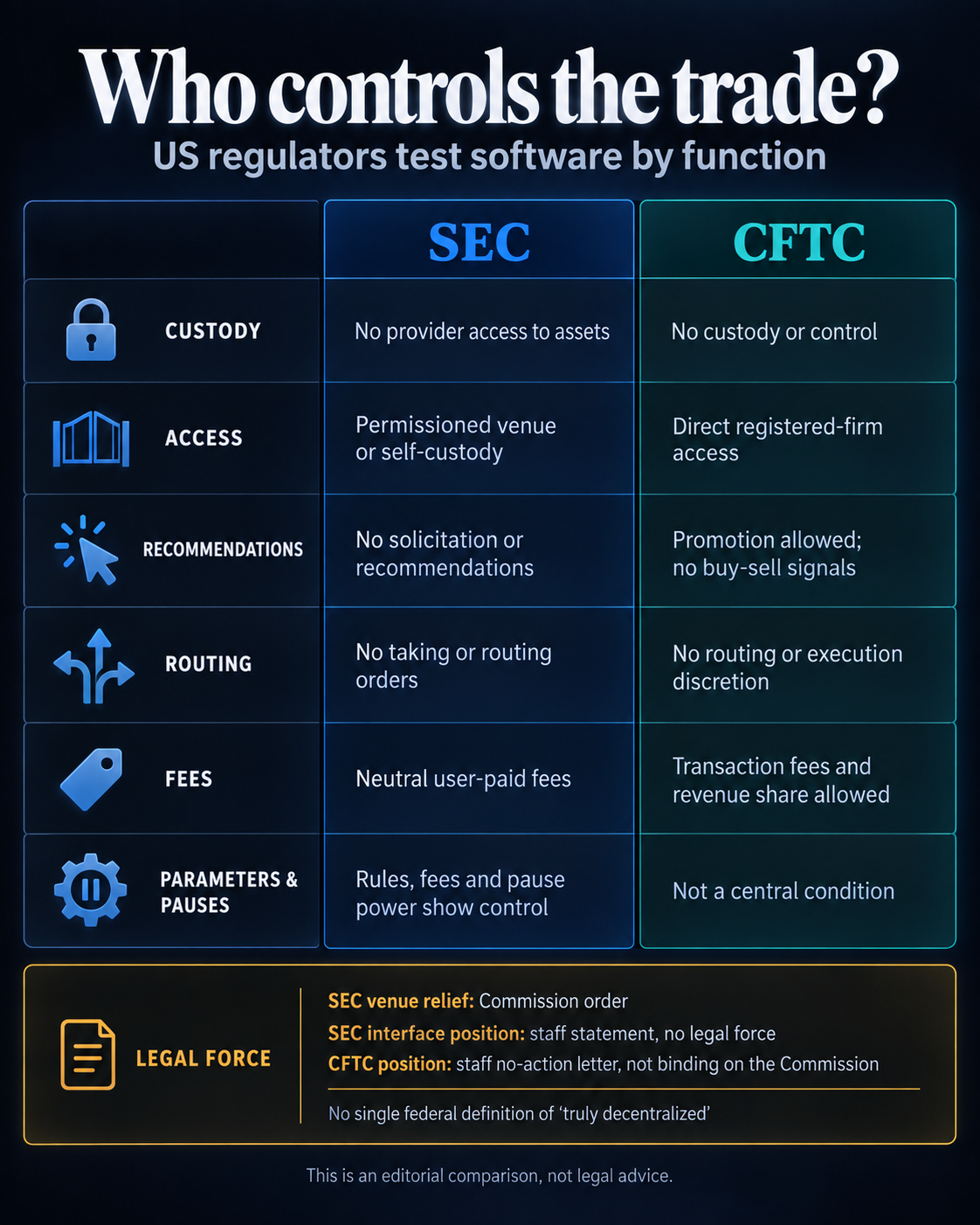
Comparison of SEC and CFTC control tests for custody, access, recommendations, routing, fees, parameters and pause authorityComparison of SEC and CFTC control tests for custody, access, recommendations, routing, fees, parameters and pause authority

Area of control SEC order or staff position CFTC staff position Scope of the condition
Custody The interface provider is barred from holding or accessing user assets The provider is barred from custody or control of customer property Each staff position requires separation from customer property
Access A TSV sets participant standards; an interface discloses venue limits Users trade on a DCM directly or through a member FCM or IB and retain direct access to the registrant Each document specifies its own access structure
Recommendations The interface position excludes specific-transaction solicitation and investment recommendations Promotion may be allowed; explicit buy or sell signals are excluded The staff positions draw different lines around steering
Routing The interface provider is barred from taking or routing orders; displayed alternatives use objective parameters User-directed transmission may occur; provider discretion over routing or execution is barred The SEC position excludes order routing, while the CFTC position centers on discretion
Fees User-paid charges must be objectively determined and neutral Transaction fees and registrant revenue sharing may be allowed Compensation is treated within each statutory setting
Parameters and pauses Changing pool rules, parameters or fees, or pausing trading can mean a person provides the pool The letter gives these powers no central role The SEC factor belongs to the order’s specific venue exemption
See also  Owe Martin Andresen charged with laundering $2M in crypto into gold bars

Every factor operates inside its source document’s narrow scope. The Commission order governs one securities-venue model. SEC staff states its Section 15 position for covered interfaces. CFTC staff offers conditional enforcement forbearance within the registered derivatives market.

Technical design matters alongside disclosures, access arrangements, marketing limits, recordkeeping and retained authority. The relevant mix changes across securities venues, crypto interfaces and derivatives software.

Who decides what counts as “truly decentralized”

Peirce supplies a principle: Removing the trusted intermediary weakens the regulatory rationale built around that intermediary. Her individual statement carries no power to establish a Commission category.

Authority is divided across the actions described here. The Commission defines the scope of its TSV order. The SEC’s Division of Trading and Markets applies its own nonbinding Section 15 position. The CFTC’s Market Participants Division decides whether presented facts fit its conditional enforcement posture. Each judgment answers a question arising under a particular statute and form of relief.

A protocol, its governance process and its frontend may occupy different points on the control spectrum. The core protocol may be difficult to alter while an interface remains curated, fee-taking and capable of steering users. Software may also connect users to regulated firms while leaving orders, assets and execution outside the provider’s discretion.

For builders and users, the practical inquiry begins with specific powers: Who controls access and assets? Who can recommend, route or execute a transaction? Who sets fees or changes software parameters? Who can pause the system? The governing statute and the actor exercising those powers then determine which regulator and legal standard apply.

“Truly decentralized” remains Peirce’s description. Federal law provides no matching legal category. These SEC and CFTC actions produce a fact-specific map of retained authority, with separate boundaries for the Commission order and each staff position.

Actions CFTC Control DeFi Define Lines SEC
Share. Facebook Twitter Pinterest LinkedIn Tumblr Email

Related Posts

SEC enforcement actions fall 24%, crypto cases in spotlight

November 12, 2026

Kalshi Faces Possible CFTC Charges Over Contract Filings

November 12, 2026

FSB pressures Turkey regulators to lock down foreign stablecoins

November 12, 2026

Giancarlo says US crypto can thrive without the Clarity Act

November 12, 2026
Add A Comment
Leave A Reply Cancel Reply

Top Posts

XRP Price Fear Explodes Again, But Analyst Says There’s More to the Story

May 29, 2026

NHN KCP Teams With Ava Labs for Avalanche Payments Chain

April 16, 2026

Stay ahead with the latest crypto news, market updates, blockchain insights, and trends. Your trusted source for everything happening in the digital asset world.


We're social. Connect with us:

Facebook X (Twitter) Instagram Pinterest YouTube
Top Insights

Bitcoin ETF Outflows Hit $1.44B as BlackRock’s IBIT Faces Heavy Selling

November 12, 2026

SEC enforcement actions fall 24%, crypto cases in spotlight

November 12, 2026

XRP sharks add 16.8K wallets as price nears critical $1 support: Can buyers defend it?

November 12, 2026
Get Informed

Subscribe to Updates

Get the latest creative news From Free.cc directly in your Inbox!

  • Contact
  • Privacy Policy
  • Terms & Conditions
  • Disclosure
© 2026 free.cc - All rights reserved.

Type above and press Enter to search. Press Esc to cancel.