

Coinbase reported Oct. 29 that its prediction markets business had surpassed $200 million in annualized net revenue, adding another income stream as crypto trading platforms seek growth beyond digital asset transactions.
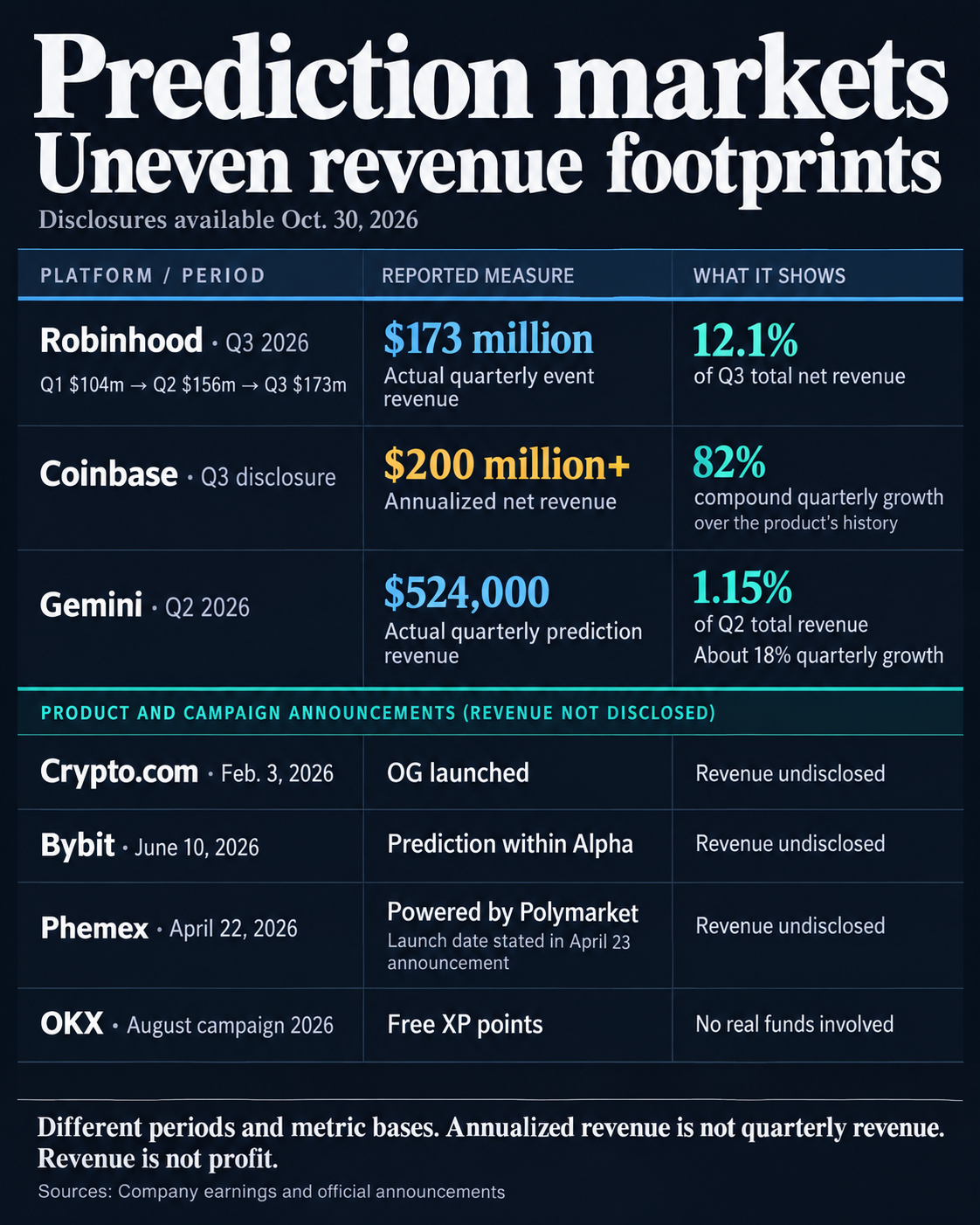
The disclosure followed Robinhood’s third-quarter results, in which event contracts generated $173 million against $120 million from cryptocurrencies. Robinhood’s crypto revenue fell 55% from a year earlier, giving its event business an immediate financial role.
The earnings show prediction markets becoming a source of platform revenue, but they represent a substantial quarterly contribution at Robinhood, a growing annualized measure at Coinbase, and a much smaller business in Gemini’s earlier results.
The revenue picture across platforms
Robinhood earned $104 million from event contracts in the first quarter, $156 million in the second and $173 million in the third, according to its earnings materials and latest results.
Those quarters sum to $433 million in revenue for the first nine months of 2026, and quarterly revenue rose about 66% from the first to the third quarter. Third-quarter event-contract revenue accounted for about 12.1% of Robinhood’s $1,424 million in total net revenue.
The crossover with crypto had already happened in the second quarter, when event contracts brought in $156 million and cryptocurrency transactions generated $100 million.
Coinbase’s earnings presentation defines its prediction-market milestone as quarterly annualized net revenue for the most recent qualifying quarter.
The company also reported 82% compound quarterly growth in prediction-market revenue over the product’s operating history. Daily traders increased more than 60% quarter over quarter, while prediction users also generated incremental spot trading volume.
Chief Financial Officer Alesia Haas said the additional revenue was less correlated with crypto volatility and helped make Coinbase more resilient across market cycles.
Gemini’s second-quarter filing reported $524,000 in prediction-market revenue for the three months ended June 30, about 1.2% of total revenue of $45 million.
First-half prediction revenue of $968,000 implies a first-quarter contribution of $444,000, representing approximately 18% quarterly growth.
Gemini earns transaction fees when prediction trades execute, yet its broader diversification in the second quarter came principally from services: services revenue grew 149% year over year, while exchange revenue fell 38%. Predictions were still a small part of that financial picture.
Expansion beyond the earnings reports
Other venues expanded their prediction offerings earlier in 2026, although the cited announcements did not disclose revenue contributions.
Crypto.com launched its OG prediction-market platform on Feb. 3. CEO Kris Marszalek cited 40-fold weekly growth in its prediction-market business over six months, without specifying the metric or reporting revenue.
Bybit Prediction launched within Bybit Alpha on June 10, initially focused on football. Phemex’s April 23 announcement identified an April 22 launch powered by Polymarket and said its first markets were live.
OKX’s Outcomes League campaign, published in August, used free, nonmonetary points with no real funds involved.
Robinhood warned that enforcement actions, litigation or changes in law could prevent it from continuing to offer event contracts.
The next test is whether these businesses deliver recurring revenue at a scale that changes each platform’s dependence on crypto trading.