

Close Menu
  • Latest News
    • Bitcoin
    • Ethereum
    • Altcoins
    • Meme Coins
  • Tech
    • Blockchain
    • Security and Privacy
  • Web 3
    • Gaming
  • Legal
    • Legal and Regulatory
    • Adoption
  • Analysis
  • Learn
    • Education
    • Wallets and Exchanges
  • Tools
    • Market Overview
    • Exchange Tool
What's Hot

583 Companies Go Public in 18 Months, Says SEC Chairman

October 3, 2026

Ethereum Price Faces $2,800 Wall Again — Are Whales Selling or Accumulating ETH?

October 3, 2026

New SIMD-0675 Proposal Aims to Streamline Block Production

October 3, 2026
Facebook X (Twitter) Instagram
  • Contact
  • Privacy Policy
  • Terms & Conditions
  • Disclosure
Facebook X (Twitter) Instagram
Free.cc (Free Cryptocurrency)Free.cc (Free Cryptocurrency)
  • Latest News
    1. Bitcoin
    2. Ethereum
    3. Altcoins
    4. Meme Coins
    5. View All

    Bitcoin Is Up, DeFi Is Recovering, So Why Doesn’t This Look Like a Bull Market Yet?

    October 3, 2026

    Bank group sues U.S. regulator over granting crypto trust charters

    October 3, 2026

    When The Banks Don’t Work, Bitcoin Does: Report

    October 3, 2026

    Bitcoin clears $85K, but is ‘Uptober’ setting up a bull trap?

    October 3, 2026

    Ethereum: Why ETH faces October reversal risk after 70% Q3 rally

    October 3, 2026

    Why Did Blast Decide to Wind Down Its L2?

    October 2, 2026

    Bitcoin Q3 Strength Faces a Tougher Q4 Test

    October 1, 2026

    Ethereum beats Bitcoin by 42.71% in Q3 – Can ETH do it again?

    October 1, 2026

    Can NEAR crypto rebound? THESE metrics could decide what’s next

    October 3, 2026

    Polymath And CineCity Explore Regulated Tokenized Film Investment Platform

    October 3, 2026

    XLM price prediction – Why Stellar’s $0.21 rebound could trigger a 9% rally

    October 2, 2026

    XRP’s $1.54 breakout test meets Ripple’s 1B token unlock – Can demand absorb supply?

    October 2, 2026

    Thinking Cat Gains Momentum After CASHCAT’s Breakout

    August 12, 2026

    What Tokens Could He Target?

    July 30, 2026

    The Next Meme Coin Winner Could Be Determined by Incentives, Not Memes

    July 30, 2026

    Why Is BOME’s Price Up Today? Finally, Capital Rotating to the Meme Coins?

    July 28, 2026

    583 Companies Go Public in 18 Months, Says SEC Chairman

    October 3, 2026

    Ethereum Price Faces $2,800 Wall Again — Are Whales Selling or Accumulating ETH?

    October 3, 2026

    New SIMD-0675 Proposal Aims to Streamline Block Production

    October 3, 2026

    New SEC crypto rules threaten small advisers, but big firms win

    October 3, 2026
  • Tech
    1. Blockchain
    2. Security and Privacy
    3. View All

    New SIMD-0675 Proposal Aims to Streamline Block Production

    October 3, 2026

    State Street Fund Goes Live on Stellar

    October 3, 2026

    Blockchains Unlock an Explosion of New Markets

    October 3, 2026

    Cloak Launches Payroll Feature for Private Onchain

    October 2, 2026

    Masked Robbers Threaten Pregnant Wife in UK Crypto Home Attack

    October 3, 2026

    Bitcoin Lightning Nodes Targeted as Core Lightning Sounds Alarm

    October 2, 2026

    The $459,000 Bot Hacker Was a Customer First, Researchers Say

    October 2, 2026

    Metamask Pulls Validators as Meager ETH Theft Sounds Big Alarm

    October 2, 2026

    583 Companies Go Public in 18 Months, Says SEC Chairman

    October 3, 2026

    Ethereum Price Faces $2,800 Wall Again — Are Whales Selling or Accumulating ETH?

    October 3, 2026

    New SIMD-0675 Proposal Aims to Streamline Block Production

    October 3, 2026

    New SEC crypto rules threaten small advisers, but big firms win

    October 3, 2026
  • Web 3
    1. Gaming
    2. View All

    Top 12 NFT games every player should know about in August 2026

    September 22, 2026

    GameShame Studios founder details Raijin Protocol’s roadmap in NeoPod’s sixth AMA

    September 22, 2026

    Proof of Play to shut down after blockchain gaming thesis falls short

    September 22, 2026

    How BC.GAME is turning players into stakeholders

    September 22, 2026

    583 Companies Go Public in 18 Months, Says SEC Chairman

    October 3, 2026

    Ethereum Price Faces $2,800 Wall Again — Are Whales Selling or Accumulating ETH?

    October 3, 2026

    New SIMD-0675 Proposal Aims to Streamline Block Production

    October 3, 2026

    New SEC crypto rules threaten small advisers, but big firms win

    October 3, 2026
  • Legal
    1. Legal and Regulatory
    2. Adoption
    3. View All

    583 Companies Go Public in 18 Months, Says SEC Chairman

    October 3, 2026

    New SEC crypto rules threaten small advisers, but big firms win

    October 3, 2026

    Daines Unveils Crypto Tax Bill Pairing Payment Relief With Wash-Sale Rules

    October 3, 2026

    Tax on Bitcoin Gains? Dutch Government to Introduce Capital Gains Tax From 2028

    October 3, 2026

    Stablecoin issuers have replaced 40% of China’s lost US Treasury demand

    October 3, 2026

    Bitcoin’s $113,000 case strengthens as US regulators push 9 crypto actions

    October 2, 2026

    Bitget restores $300M fund after absorbing $388M security breach

    October 2, 2026

    Ripple’s biggest institutional bet may now be Brazil

    October 1, 2026

    583 Companies Go Public in 18 Months, Says SEC Chairman

    October 3, 2026

    Ethereum Price Faces $2,800 Wall Again — Are Whales Selling or Accumulating ETH?

    October 3, 2026

    New SIMD-0675 Proposal Aims to Streamline Block Production

    October 3, 2026

    New SEC crypto rules threaten small advisers, but big firms win

    October 3, 2026
  • Analysis

    Ethereum Price Faces $2,800 Wall Again — Are Whales Selling or Accumulating ETH?

    October 3, 2026

    Bull Market Targets for BTC, ETH, SOL, and XRP

    October 3, 2026

    Ethereum Price Faces A Critical $0.040 ETH/BTC Test

    October 2, 2026

    AAVE Price Surges 8% as Whale Activity Spikes — Can AAVE Break $200?

    October 2, 2026

    PropAMMs lower Solana trade costs, and public pool returns crash

    October 2, 2026
  • Learn
    1. Education
    2. Wallets and Exchanges
    3. View All

    What Is Robinhood Chain? The Ethereum Layer-2 Network for Tokenized Stocks

    July 12, 2026

    What Is BChat? The Decentralized Messaging App Built for Privacy

    June 2, 2026

    What Is an AI Prompt Injection Attack? The Hidden Threat Hijacking Your Chatbots

    May 31, 2026

    What Is AI Jailbreaking? A Beginner’s Guide to the Cat-and-Mouse Game Behind Every Chatbot

    May 17, 2026

    Coinbase completes Deribit migration, ends INTX trading

    October 2, 2026

    Binance Funding Account ends direct crypto deposits

    October 1, 2026

    Coinbase just completed its US derivatives stack but its biggest bet still sits outside it

    September 30, 2026

    Bitget had 30 minutes to contain its hack before $290 million started moving

    September 30, 2026

    583 Companies Go Public in 18 Months, Says SEC Chairman

    October 3, 2026

    Ethereum Price Faces $2,800 Wall Again — Are Whales Selling or Accumulating ETH?

    October 3, 2026

    New SIMD-0675 Proposal Aims to Streamline Block Production

    October 3, 2026

    New SEC crypto rules threaten small advisers, but big firms win

    October 3, 2026
  • Tools
    • Market Overview
    • Exchange Tool
Free.cc (Free Cryptocurrency)Free.cc (Free Cryptocurrency)
Home»Analysis»KelpDAO’s $292M hack sparks $10B bank run across DeFi
Analysis

KelpDAO’s $292M hack sparks $10B bank run across DeFi

April 20, 2026No Comments7 Mins Read
Share
Facebook Twitter LinkedIn Pinterest Email
Make CryptoSlate preferred on

A $292 million exploit at KelpDAO set off a broad retreat across decentralized finance over the weekend, draining roughly $10 billion across the DeFi industry and forcing multiple protocols to freeze markets tied to rsETH.

The breach began late Saturday when an attacker drained about 116,500 rsETH from KelpDAO’s cross-chain bridge. The stolen tokens were worth about $292 million at the time, according to CryptoSlate data.

KelpDAO issues rsETH to users who deposit ETH into its liquid restaking system. The platform then deploys those ETH through the restaking platform EigenLayer to generate additional yield on top of standard staking returns.

KelpDAO’s loss now stands as the largest DeFi exploit of 2026 in the report, surpassing earlier attacks this year.

EigenLayer's native token  debut sees high stakes activity from crypto whales
Related Reading

EigenLayer’s native token debut sees high stakes activity from crypto whales

The digital asset has a fully diluted valuation of $6.5 billion, according to CoinMarketCap.

Oct 1, 2024 · Oluwapelumi Adejumo

How KelpDAO was exploited for $292 million

rsETH circulates across the broader market via LayerZero, a cross-chain messaging network that moves instructions and assets between blockchains.

Yearn Finance core developer Banteg explained that the exploit hit the route linking Unichain to the Ethereum mainnet.

According to the on-chain analyst, the attacker pushed through a fraudulent message that the system accepted as valid, prompting the Ethereum-side adapter to release pre-funded rsETH reserves.

This route was configured as a one-of-one decentralized verifier network path without secondary verifiers that could have flagged the transaction.

Banteng stated that the malicious transaction, identified as nonce 308, was verified and delivered at 17:35 UTC.

Following the attack, the KelpDAO’s emergency multisignature wallet froze the protocol’s core contracts. This blocked two further attempts that together could have removed another roughly $100 million in rsETH.

The initial stolen funds were moved through Tornado Cash, obscuring the trail before the protocol’s response could contain the damage.

Meanwhile, the drained reserve-backed wrapped rsETH circulated across secondary networks, including Base, Arbitrum, Linea, Blast, Mantle, and Scroll. Once those reserves were depleted, users holding rsETH off Ethereum faced rising uncertainty around redemption and backing.

See also  Bitcoin Cools Off After Explosive Gains—Here’s Where the Real Run Could Kick In!

And that pressure quickly fed into the rest of the market.

Aave takes the heaviest blow

The most severe aftershock hit Aave, the largest crypto lending platform, where the attacker allegedly deposited the stolen rsETH as collateral.

During the attack window, Aave’s pricing oracles continued to read rsETH near its normal peg, allowing the protocol to issue 106,467 ETH against the compromised collateral.

That left the platform facing a potential $236 million bad-debt exposure and triggered a rush for the exits.

Data from DeFiLlama showed Aave’s total value locked dropped from more than $26 billion to about $20 billion as users withdrew funds.
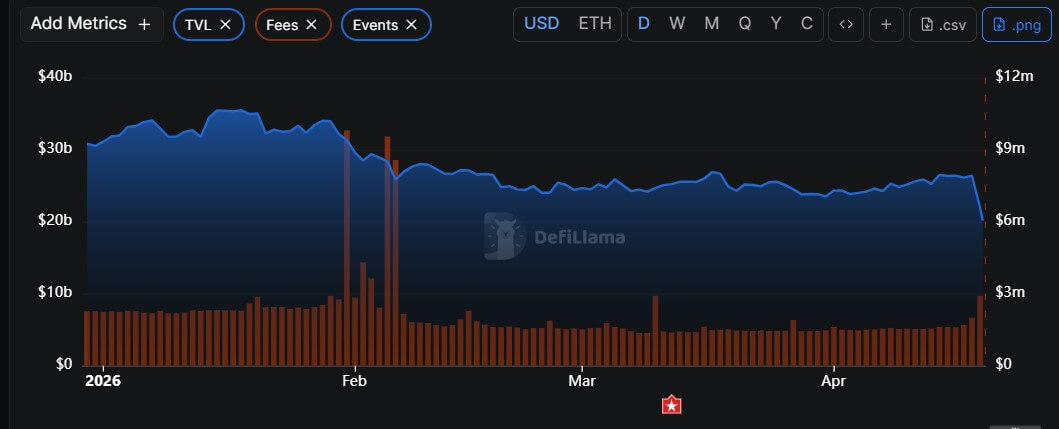
Aave's TVL
Aave’s TVL (Source: DeFiLlama)

The drawdown amounted to one of the sharpest pullbacks on the platform in recent memory and turned a bridge exploit into a liquidity event for the largest lending venue in DeFi.

On-chain analysts revealed that large ETH holders on the DeFi platform accelerated the move.

For context, TRON founder Justin Sun reportedly withdrew more than 65,580 ETH, worth about $154 million, in a single transaction.

As these kinds of withdrawals mounted, Aave’s ETH utilization rate reached 100%, leaving all available Ether on the platform either borrowed or withdrawn.

Meanwhile, the pressure also spilled into Aave’s market price. The AAVE governance token fell more than 18% as traders priced in the possibility of deeper losses.

This was exacerbated by heavy sales from large AAVE wallets. Blockchain analytics platform Lookonchain reported that one entity identified as smaugvision sold more than 20,000 AAVE for $2.06 million, while another investor sold a similar amount for $2.05 million. A third whale sold nearly 19,700 AAVE in exchange for wrapped Bitcoin and ETH.

In response to these issues, Aave froze the rsETH markets on both V3 and V4. The platform’s founder Stani Kulechov stated on X:

“rsETH has been frozen on Aave V3 and V4, the asset does not have any borrowing power as a measure due to KelpDAO bridge exploit that happened outside of Aave. Both Aave V3 and V4 does not have further exposure to rsETH.”

Contagion spreads across DeFi

Apart from Aave, other DeFi protocols also experienced significant withdrawals from their platform due to the attack.

See also  Bitcoin’s $10 billion credit market keeps growing after its first major selloff

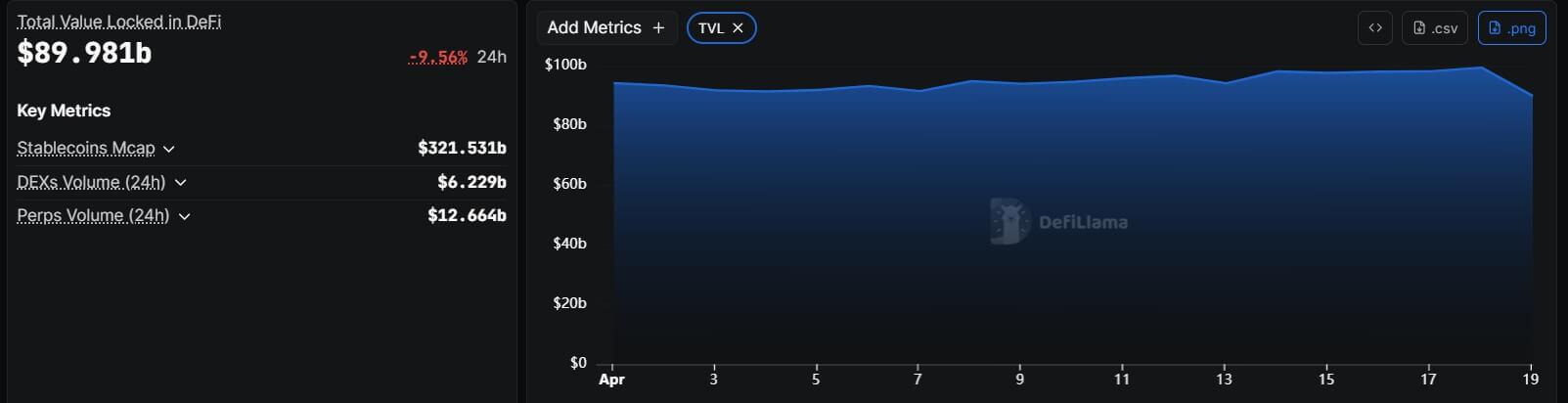
0xngmi, the pseudonymous founder of DeFiLlama, reported that the incident triggered a $10 billion drop across the DeFi sector. This includes the $6 billion exodus from Aave.

Notably, data from DeFiLlama show that TVL for DeFi protocols has dropped 10% from around $99 billion on April 18 to $89 billion as of press time.
CryptoSlate Daily Brief

Daily signals, zero noise.

Market-moving headlines and context delivered every morning in one tight read.

5-minute digest 100k+ readers

Free. No spam. Unsubscribe any time.

Whoops, looks like there was a problem. Please try again.

You’re subscribed. Welcome aboard.

DeFi Protocols TVL Decline
DeFi Protocols TVL Decline $10 Billion in 24 Hours(Source: DeFiLlama)

Meanwhile, the incident has also led several DeFi platforms to move quickly to reduce their exposure to the embattled rsETH token.

DeFi analyst Ignas flagged eight additional DeFi protocols, including Lido, SparkLend, Fluid, Compound, and Euler, which froze their rsETH lending markets.

He added:

“I suppose LayerZero is probably affected too, as rsETH were bridged from L2s, so I wonder if those rsETH on L2s aren’t worthless right now.”

Meanwhile, Ethena, the developer of the synthetic USDe dollar, temporarily suspended its LayerZero bridges as a precaution, while stating that it had no exposure to rsETH.

Those moves reflected how widely rsETH had been embedded across DeFi as it was deeply used in lending markets, vault products, and collateral strategies that depended on smooth cross-chain transfers and confidence in reserve backing.

As that confidence weakened, protocols moved to ring-fence risk before further withdrawals or price dislocations could deepen the damage.

The strain also exposed the speed at which capital can move once collateral quality comes into question. A bridge exploit at one venue was enough to send shockwaves through multiple markets within hours, pushing platforms to suspend activity even when their own contracts had not been directly breached.

Crypto community calls for solution to DeFi bridge hacks

Jonathan Man, the Head of Multi-Strategy Solutions & DeFi Strategies at Bitwise, said:

“This is another setback but we can bounce back stronger. We as an industry need to collectively up our game to make sure we are building the future of finance on solid foundations.”

Meanwhile, the KelpDAO exploit also prompted broader discussion about how lending protocols and token issuers can limit the damage from hacks targeting bridged or thinly traded assets.

See also  Kaspa Price Surges 20% as Hard Fork Hype Fuels Breakout Attempt

Keone Hon, co-founder of Monad, said pooled lending protocols should consider imposing rate limits on how quickly an asset can be deposited and used as collateral.

Under that model, an asset with a current circulating supply of $100 million and a formal cap of $300 million would not be allowed to jump straight to the full cap in a single burst. Instead, the supply allowed into the system would rise gradually over a set period, such as 10 minutes or a few hours.

Hon said that approach would narrow the available exit paths when an exotic asset is exploited, especially in cases involving infinite-mint bugs.

He argued that the size of the loss is often determined less by the mint itself than by how much of the compromised asset can be offloaded into lending venues or other liquid exits before markets react.

In that framework, large lending protocols become the main release valves because decentralized exchange liquidity is often too limited to absorb a major exploit.

He added that asset issuers should also have an interest in tighter caps, particularly when they issue receipt tokens with delayed redemption. In those cases, the issuer is not necessarily exposed to immediate redemption pressure from an attacker, but still benefits when downstream exit routes remain constrained.

Hon pointed to the Hyperbridge DOT exploit and the Resolv incident as examples where losses stayed below more catastrophic levels because the available paths for exiting the hacked asset were limited.

Guy Young, founder of Ethena, endorsed that view and said issuers should consider adding rate limits at the mint and redemption layer, as well as custom throttles on top of LayerZero’s OFT standard.

10B 292M Bank DeFi Hack KelpDAOs Run sparks
Share. Facebook Twitter Pinterest LinkedIn Tumblr Email

Related Posts

Ethereum Price Faces $2,800 Wall Again — Are Whales Selling or Accumulating ETH?

October 3, 2026

Bitcoin Is Up, DeFi Is Recovering, So Why Doesn’t This Look Like a Bull Market Yet?

October 3, 2026

Bank group sues U.S. regulator over granting crypto trust charters

October 3, 2026

Bull Market Targets for BTC, ETH, SOL, and XRP

October 3, 2026
Add A Comment
Leave A Reply Cancel Reply

Top Posts

UK moves to confiscate Craig Costello’s cash and cryptocurrency holdings

January 6, 2026

Banking giant Barclays explores blockchain platform for payments and tokenized deposits

March 1, 2026

Stay ahead with the latest crypto news, market updates, blockchain insights, and trends. Your trusted source for everything happening in the digital asset world.


We're social. Connect with us:

Facebook X (Twitter) Instagram Pinterest YouTube
Top Insights

583 Companies Go Public in 18 Months, Says SEC Chairman

October 3, 2026

Ethereum Price Faces $2,800 Wall Again — Are Whales Selling or Accumulating ETH?

October 3, 2026

New SIMD-0675 Proposal Aims to Streamline Block Production

October 3, 2026
Get Informed

Subscribe to Updates

Get the latest creative news From Free.cc directly in your Inbox!

  • Contact
  • Privacy Policy
  • Terms & Conditions
  • Disclosure
© 2026 free.cc - All rights reserved.

Type above and press Enter to search. Press Esc to cancel.