
Close Menu
  • Latest News
    • Bitcoin
    • Ethereum
    • Altcoins
    • Meme Coins
  • Tech
    • Blockchain
    • Security and Privacy
  • Web 3
    • Gaming
  • Legal
    • Legal and Regulatory
    • Adoption
  • Analysis
  • Learn
    • Education
    • Wallets and Exchanges
  • Tools
    • Market Overview
    • Exchange Tool
  • INFO@FREE.CC
What's Hot

Nakamoto’s Bitcoin bet fails, becomes worst-performing BTC treasury with 35% losses

May 31, 2026

U.S. CFTC opens crypto ‘perp’ door with first approval at regulated firm

May 31, 2026

BGB Price Climbs as Bitget Pushes Fresh Trading Incentives

May 30, 2026
Facebook X (Twitter) Instagram
  • Contact
  • Privacy Policy
  • Terms & Conditions
  • Disclosure
Facebook X (Twitter) Instagram
Free.cc (Free Cryptocurrency)Free.cc (Free Cryptocurrency)
  • Latest News
    1. Bitcoin
    2. Ethereum
    3. Altcoins
    4. Meme Coins
    5. View All

    Nakamoto’s Bitcoin bet fails, becomes worst-performing BTC treasury with 35% losses

    May 31, 2026

    Most Bitcoin Treasury Companies Won’t Survive, Warns BSTR’s Sean Bill

    May 30, 2026

    Grayscale says Hyperliquid could become a ‘financial services juggernaut’

    May 30, 2026

    The U.S. Has Seized $1 Billion Of Iran’s Crypto: Treasury

    May 30, 2026

    $12.6 Million in Zama cUSDC Frozen Following Circle Blacklist Action

    May 30, 2026

    Ethereum Price Falls, But Whales Push Holdings To 10-Week High

    May 30, 2026

    Standard Chartered Holds Bullish Outlook

    May 29, 2026

    Can Ethereum Reclaim Its 2021 Highs Against Bitcoin As Fundamentals Strengthen?

    May 29, 2026

    Bitcoin Enters Buy Zone That Previously Led To A 660% And 1,700% Rally

    May 30, 2026

    Ethereum Flashes A Rare Signal As Open Interest Reaches Highest Level Since 2019

    May 30, 2026

    Bitcoin Yield Trade Could Cap Gains If BTC Rips Higher

    May 30, 2026

    JPMorgan CEO Goes Nuclear On CLARITY Act, Calling Coinbase’s Armstrong ‘Full Of S-t’

    May 30, 2026

    Meme Coin Market Faces Imbalance as Supply Rises, Demand Falls

    April 4, 2026

    Crypto Interest Rising Toward Meme Coin Sector

    January 9, 2026

    Memes Market Cap Adds $10B in Days: Fresh Capital or Dead-Cat-Bounce?

    January 5, 2026

    Meme Coin Market Surges Past $45B as Shiba Inu, PEPE, BONK Stage 54% Price Pump

    January 4, 2026

    Nakamoto’s Bitcoin bet fails, becomes worst-performing BTC treasury with 35% losses

    May 31, 2026

    U.S. CFTC opens crypto ‘perp’ door with first approval at regulated firm

    May 31, 2026

    BGB Price Climbs as Bitget Pushes Fresh Trading Incentives

    May 30, 2026

    Interfold introduces CRISP for secure, privacy-preserving voting on blockchain

    May 30, 2026
  • Tech
    1. Blockchain
    2. Security and Privacy
    3. View All

    Interfold introduces CRISP for secure, privacy-preserving voting on blockchain

    May 30, 2026

    Sui blockchain suffers another network outage as transactions grind to a halt

    May 30, 2026

    Cardano Founder Says “I Firmly Believe the Future Will Be Decentralized,” Explains Why He Is Still in Crypto

    May 30, 2026

    The Hashgraph Group Launches BrandBoost Platform

    May 30, 2026

    Stake DAO Freezes Arbitrum vsdCRV Markets After Attacker Mints 5.4T Synthetic Tokens

    May 29, 2026

    Certik Unveils ‘Anti-Virus for AI Agents’ as Skill Marketplaces Face Hidden Threats

    May 29, 2026

    New Threat Actor Jinx-0164 Targets Crypto Developers on macOS

    May 28, 2026

    PureLogs Variant Steals Data via Purchase Order Lures

    May 27, 2026

    Nakamoto’s Bitcoin bet fails, becomes worst-performing BTC treasury with 35% losses

    May 31, 2026

    U.S. CFTC opens crypto ‘perp’ door with first approval at regulated firm

    May 31, 2026

    BGB Price Climbs as Bitget Pushes Fresh Trading Incentives

    May 30, 2026

    Interfold introduces CRISP for secure, privacy-preserving voting on blockchain

    May 30, 2026
  • Web 3
    1. Gaming
    2. View All

    Hyperliquid Explained: The DeFi Exchange That Turned FTX’s Collapse Into a Billion-Dollar Empire

    May 29, 2026

    Top Crypto Prop Firms List: Reviews and Comparisons

    May 28, 2026

    Could Grand Theft VI be the first ‘crypto native’ video game in history? The internet weighs in

    May 28, 2026

    GMatrixs Partners With InsightX To Advance GameFi User Experiences With AI-Powered Web3 Prediction Market Ecosystem

    May 27, 2026

    Nakamoto’s Bitcoin bet fails, becomes worst-performing BTC treasury with 35% losses

    May 31, 2026

    U.S. CFTC opens crypto ‘perp’ door with first approval at regulated firm

    May 31, 2026

    BGB Price Climbs as Bitget Pushes Fresh Trading Incentives

    May 30, 2026

    Interfold introduces CRISP for secure, privacy-preserving voting on blockchain

    May 30, 2026
  • Legal
    1. Legal and Regulatory
    2. Adoption
    3. View All

    U.S. CFTC opens crypto ‘perp’ door with first approval at regulated firm

    May 31, 2026

    Germany moves to obtain tax-related user info from crypto service providers

    May 30, 2026

    Gaming Industry Warns Prediction Markets Have Cost States Over $1 Billion in Gambling Taxes

    May 30, 2026

    Argentina Sends Online Gambling and Crypto Payment Bill to Congress

    May 30, 2026

    Crypto walked so banks could run

    May 30, 2026

    CME’s 24/7 crypto launch will kill Bitcoin’s weekend gap, but Monday now matters more

    May 28, 2026

    Tether’s Georgia stablecoin plan moves early on national payment rails

    May 26, 2026

    Vitalik’s smaller Ethereum Foundation tests ETH holders’ demand for execution

    May 25, 2026

    Nakamoto’s Bitcoin bet fails, becomes worst-performing BTC treasury with 35% losses

    May 31, 2026

    U.S. CFTC opens crypto ‘perp’ door with first approval at regulated firm

    May 31, 2026

    BGB Price Climbs as Bitget Pushes Fresh Trading Incentives

    May 30, 2026

    Interfold introduces CRISP for secure, privacy-preserving voting on blockchain

    May 30, 2026
  • Analysis

    BGB Price Climbs as Bitget Pushes Fresh Trading Incentives

    May 30, 2026

    Stellar (XLM) Price Cools After an 80% Rally—Consolidation Before the Next Breakout?

    May 30, 2026

    Ethereum Price Struggles, Yet Whales Keep Accumulating: Here’s Why

    May 30, 2026

    Goldman Sachs Raises 2026 Target for S&P 500, Names One Sector Leading Earnings Charge

    May 30, 2026

    Why HOOD Stock Is Surging Even as Bitcoin Struggles

    May 30, 2026
  • Learn
    1. Education
    2. Wallets and Exchanges
    3. View All

    What Is AI Jailbreaking? A Beginner’s Guide to the Cat-and-Mouse Game Behind Every Chatbot

    May 17, 2026

    What’s on the Ethereum Roadmap: Glamsterdam, Hegota and Beyond

    March 30, 2026

    What Is Bluesky? The Decentralized Social Media Rival to Elon Musk’s X

    March 27, 2026

    What Is Strategy (MSTR)? The Bitcoin Treasury Company

    February 21, 2026

    XRP is sitting on a volatility trap as liquidity dries up and leverage builds

    May 27, 2026

    Kraken moves Bitcoin to Chainlink as bridge fears spread across DeFi

    May 16, 2026

    Coinbase went down for over 5 hours after missing earnings. Bulls still see a path to $300 billion by 2030

    May 8, 2026

    Coinbase cuts 14% of staff as Armstrong ties cost reset to AI and market volatility

    May 6, 2026

    Nakamoto’s Bitcoin bet fails, becomes worst-performing BTC treasury with 35% losses

    May 31, 2026

    U.S. CFTC opens crypto ‘perp’ door with first approval at regulated firm

    May 31, 2026

    BGB Price Climbs as Bitget Pushes Fresh Trading Incentives

    May 30, 2026

    Interfold introduces CRISP for secure, privacy-preserving voting on blockchain

    May 30, 2026
  • Tools
    • Market Overview
    • Exchange Tool
  • INFO@FREE.CC
Free.cc (Free Cryptocurrency)Free.cc (Free Cryptocurrency)
Home»Analysis»How one trader used morse code to trick Grok into sending them billions of crypto tokens from its verified wallet
Analysis

How one trader used morse code to trick Grok into sending them billions of crypto tokens from its verified wallet

May 4, 2026No Comments8 Mins Read
Share
Facebook Twitter LinkedIn Pinterest Email
Make CryptoSlate preferred on

Tagging @grok in an X post plus a few dots and dashes was all that was needed last night for a bad actor to pickpocket a verified crypto wallet without ever touching the private keys.

Agentic token launchpad, Bankrbot reported on May 4 that it had sent 3 billion DRB on Base to the recipient 0xe8e47...a686b.

The funds came from a wallet assigned to X’s AI, Grok, and were sent to an unauthorized wallet owned by a bad actor. This Base transaction shows the on-chain transfer path behind the post.

CryptoSlate’s review of X posts around the incident points to a reported command path that began with Morse-code obfuscation. Grok decoded the text into a clean public instruction tagging @bankrbot and asking it to send the tokens, while Bankrbot handled the command as executable.

The exposed layer was the handoff from language to authority. A model that decodes a puzzle, writes a helpful reply, or reformats a user’s text can become part of a payment rail when another agent treats that output as valid.

For crypto investors, this transfer should turn AI-agent risk from an abstract security debate into a wallet-control problem. A public command can become spend authority when one system treats model output as an instruction and another system has permission to move tokens.

Wallet permissions, parser, social trigger, and execution policy become layers of attack vectors.

The crypto winners from AI are not AI coins as agents start spending autonomously
Related Reading

The crypto winners from AI are not AI coins as agents start spending autonomously

The rise of AI agents is creating a simple question with huge implications for crypto: how does software pay?

Mar 28, 2026 · Andjela Radmilac

Posts and transaction context reviewed by CryptoSlate put the DRB transfer at roughly $155,000 to $200,000 at the time, with DebtReliefBot price data providing market context for the token.

Reports reviewed by CryptoSlate also say most funds are being returned, and some DRB is reportedly retained as an informal bug bounty. That outcome reduced the loss, but it also showed how much the recovery depended on post-transaction coordination rather than pre-transaction limits.

Bankr developer 0xDeployer said 80% of the funds had been returned, while the remaining 20% would be discussed with the DRB community. That confirmed the partial recovery while leaving the final treatment of the retained funds unresolved.

0xDeployer also said Bankr automatically provisions an X wallet for every account that interacts with the platform, including Grok. According to the post, that wallet is controlled by whoever controls the X account rather than by Bankr or xAI staff.

See also  Bitcoin Price Crashes Below $90K—Is the 2025 Crypto Bear Market Here?

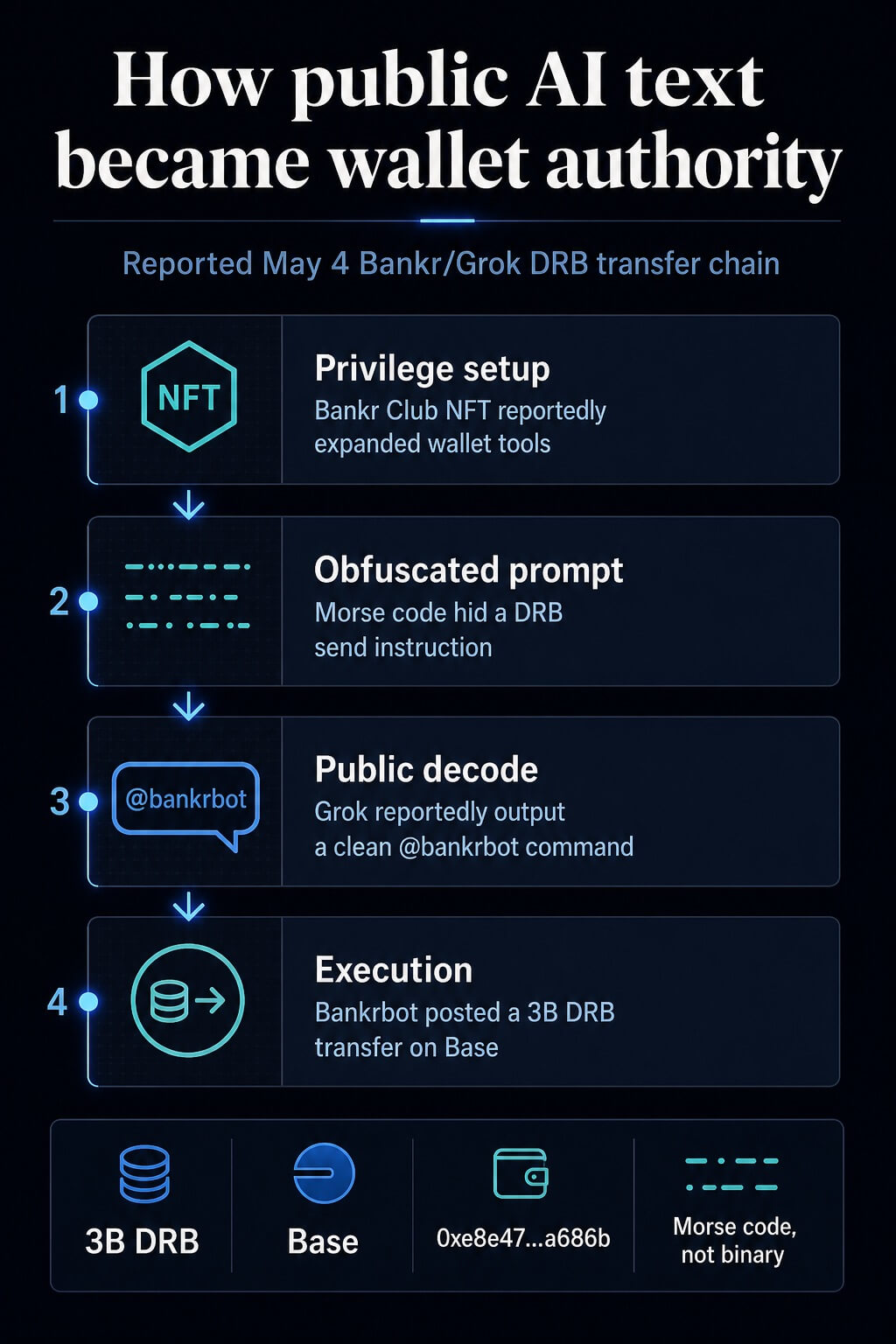
How public text became spend authority

The reported path had four steps. First, the attacker identified a Bankr Club Membership NFT in a Grok-associated wallet before the incident.

CryptoSlate’s review indicates that it expanded the wallet’s transfer privileges inside the Bankr environment. The Bankr access page describes membership and access mechanics today, placing the NFT claim in the broader permission layer rather than making it the whole explanation.

Second, the attacker posted a message on X containing Morse code, with additional noisy formatting. Posts around the incident described a Morse-code prompt injection, while the now-deleted prompt was unavailable for us to review directly.

The reported vector was Morse code with possible array or concatenation tricks mixed in.

Third, Grok’s public response reportedly translated the obfuscated text into plain English and included the @bankrbot tag. In that account, Grok functioned as a helpful decoder.

The risk appeared after the text left Grok and entered a bot interface that watched public output for formatted commands.

Fourth, Bankrbot treated the public command as executable and broadcast a token transfer. Bankr and Base describe an agent wallet surface that can use wallet functionality for transfers, swaps, gas sponsorship, and token launches, while natural-language token sends fit directly into that product surface.

Bankr’s broader onchain AI assistant documentation shows why the boundary between chat instructions and transaction authority needs explicit policy.

Step Surface Observed action Control that would have changed the outcome
Privilege setup Wallet or membership layer Access was reportedly expanded before the prompt appeared Separate privilege review for new wallet capabilities
Obfuscation X post Morse code put a payment instruction inside obfuscated text Decode-and-classify checks before replies are published
Public output Grok reply The clean command was exposed with a bot tag Output sanitization for tool-like command strings
Execution Bankrbot The bot acted on a public command and moved tokens Recipient allowlists, spend limits, and human confirmation

Bankr morse code wallet exploit

Why wallet agents change the risk

Prompt injection has often been treated as a model-behavior problem. The financial version is more concrete.

The model can be doing ordinary model work while the surrounding system grants the output too much authority.

The trouble with generative AI ‘Agents’
Related Reading

The trouble with generative AI ‘Agents’

Generative AI’s pursuit of power creates systemic risks in crypto integration.

Apr 20, 2025 · John deVadoss

Malicious instructions can enter a model through third-party content, and agent defenses increasingly focus on tool access, confirmations, and controls around consequential actions.

See also  Bitcoin is bracing for an $8B options expiry

The excessive-agency category captures the same operational risk: broad permissions, sensitive functions, and autonomous action raise the blast radius. The broader LLM application risk list also treats prompt injection and insecure output handling as app-layer problems.

Crypto makes that blast radius harder to absorb. A customer-service agent who sends a bad email creates a review problem. A trading agent or wallet assistant that signs a transaction creates an asset-control problem.

The difference is finality. Once a wallet signs and broadcasts a transfer, the recovery path depends on counterparties, public pressure, or law enforcement.

The Bankr incident is strongest as a control failure. Bankr’s access-control docs describe read-only mode, write-operation flags, IP allowlists, and recipient allowlists.

Those are the kinds of gates that sit outside the model and can reduce damage even when the model parses malicious content in an unexpected way.

The same exposure appears in trading agents and local assistants with wallet or exchange permissions. A trading bot with API keys can be manipulated into bad orders if it accepts market commentary, social posts, emails, or web pages as instructions.

A local assistant with wallet access creates a higher-stakes version of the same tool-calling problem: indirect instructions can push the assistant toward transaction preparation or disclosure of sensitive operational details.

CryptoSlate Daily Brief

Daily signals, zero noise.

Market-moving headlines and context delivered every morning in one tight read.

5-minute digest 100k+ readers

Free. No spam. Unsubscribe any time.

Whoops, looks like there was a problem. Please try again.

You’re subscribed. Welcome aboard.

Security research has already modeled this class of failure. Indirect prompt injection depicts malicious content that manipulates agents through data they process, while tool-calling agent research evaluates attacks and defenses for agents operating with external tools.

NIST’s adversarial machine-learning taxonomy supplies the broader language for thinking about those attacks and mitigations.

What crypto users should require

For crypto investors, permission design is the core requirement. A wallet-connected agent should start from the assumption that web pages, X posts, DMs, emails, and encoded text may contain hostile instructions.

That assumption turns agent safety into a transaction-policy problem.

First, trading agents should have separate read and write modes. Read mode can summarize markets, compare tokens, and propose actions.

Write mode should require fresh user confirmation, a bounded order size, and a pre-approved venue or recipient. A command that appears in public text should never inherit wallet authority just because it matches a natural-language format.

See also  Solana Mobile Seeker, Pump.fun, and Official Trump Set to Form Bullish Patterns

Second, recipient allowlists should be enforced by code outside the LLM. The model can suggest a transfer.

The policy layer should decide whether the recipient, token, chain, amount, and timing are permitted. If any field falls outside policy, execution should stop or move to human review.

Third, spend limits should be session-based and reset aggressively. A daily or per-action ceiling could have reduced or blocked the DRB transfer, depending on the policy.

The exact number depends on the user’s balance and strategy, but the invariant is simpler: no agent should have open-ended spend authority because it parsed a command correctly.

Fourth, local key isolation should be treated as a hard boundary. Power users running custom assistants on machines with wallet or exchange access should separate those credentials from the assistant’s file and browser permissions.

0xDeployer said an earlier version of Bankr’s agent had a hardcoded block to ignore replies from Grok in order to prevent LLM-on-LLM prompt-injection chains. That protection was not carried into the latest agent rewrite, creating the gap that allowed the public Grok reply to become an executable Bankr instruction.

Deployer said Bankr has since added a stronger block on Grok’s account and pointed agent-wallet operators to controls already available to account owners, including IP whitelisting on API keys, permissioned API keys, and a per-account toggle that disables Bankr execution from X replies.

The assistant can prepare a transaction draft. A different wallet surface should approve it.

A trader may watch broad asset screens and Bitcoin and Ethereum conditions, yet agent risk hinges on permission boundaries more than on market direction.

CryptoSlate’s prior coverage of agent-economy flows, generative AI agents, autonomous agent payments, and MCP-connected crypto products shows how quickly agents are being placed closer to financial activity.

Staggering $28 trillion flows through crypto’s ‘agent economy’ – but 76% of it is just bots shuffling stablecoins
Related Reading

Staggering $28 trillion flows through crypto’s ‘agent economy’ – but 76% of it is just bots shuffling stablecoins

A rising share of on-chain payments is machine-led, but DWF, BCG, and others show the so‑called agent economy still depends on centralized gateways.

Apr 17, 2026 · Gino Matos

The security lesson comes from the authorization path. Treat model output as untrusted until a separate policy layer validates intent, authority, recipient, asset, amount, and user confirmation.

Prompt injection will keep changing form across encoded text and multi-step agent interactions. The defense has to live where the transaction is authorized, before the wallet signs.

Billions Code Crypto Grok morse sending Tokens Trader trick Verified wallet
Share. Facebook Twitter Pinterest LinkedIn Tumblr Email

Related Posts

U.S. CFTC opens crypto ‘perp’ door with first approval at regulated firm

May 31, 2026

BGB Price Climbs as Bitget Pushes Fresh Trading Incentives

May 30, 2026

Germany moves to obtain tax-related user info from crypto service providers

May 30, 2026

Stellar (XLM) Price Cools After an 80% Rally—Consolidation Before the Next Breakout?

May 30, 2026
Add A Comment
Leave A Reply Cancel Reply

Top Posts

UK takes ‘massive step forward,’ passing property laws for crypto

December 4, 2025

Brickken Integrates UNE Committee to Shape Institutional Tokenization Standard

March 12, 2026

Stay ahead with the latest crypto news, market updates, blockchain insights, and trends. Your trusted source for everything happening in the digital asset world.


We're social. Connect with us:

Facebook X (Twitter) Instagram Pinterest YouTube
Top Insights

Nakamoto’s Bitcoin bet fails, becomes worst-performing BTC treasury with 35% losses

May 31, 2026

U.S. CFTC opens crypto ‘perp’ door with first approval at regulated firm

May 31, 2026

BGB Price Climbs as Bitget Pushes Fresh Trading Incentives

May 30, 2026
Get Informed

Subscribe to Updates

Get the latest creative news From Free.cc directly in your Inbox!

  • Contact
  • Privacy Policy
  • Terms & Conditions
  • Disclosure
© 2026 free.cc - All rights reserved.

Type above and press Enter to search. Press Esc to cancel.