

The Ethereum Foundation has cut roughly 20% of its workforce and slashed its budget by roughly 40% as part of a broad reorganization, even as the blockchain it helps steward has seen its highest-ever levels of user activity and is attracting deeper participation from major financial institutions.
On June 23, the nonprofit revealed that it dismissed 54 employees following a months-long review of its structure, spending, and long-term responsibilities.
Speaking on this move, Vitalik Buterin, Ethereum co-founder, said:
I respect my EF colleagues far too much to pretend that there was not much that is lost. They are brilliant people. They are dedicated engineers, some of whom have worked on the Ethereum protocol for nearly a decade. They have brought a bright light to the Ethereum ecosystem with their code, their words, their warmth as human beings, and their actions.
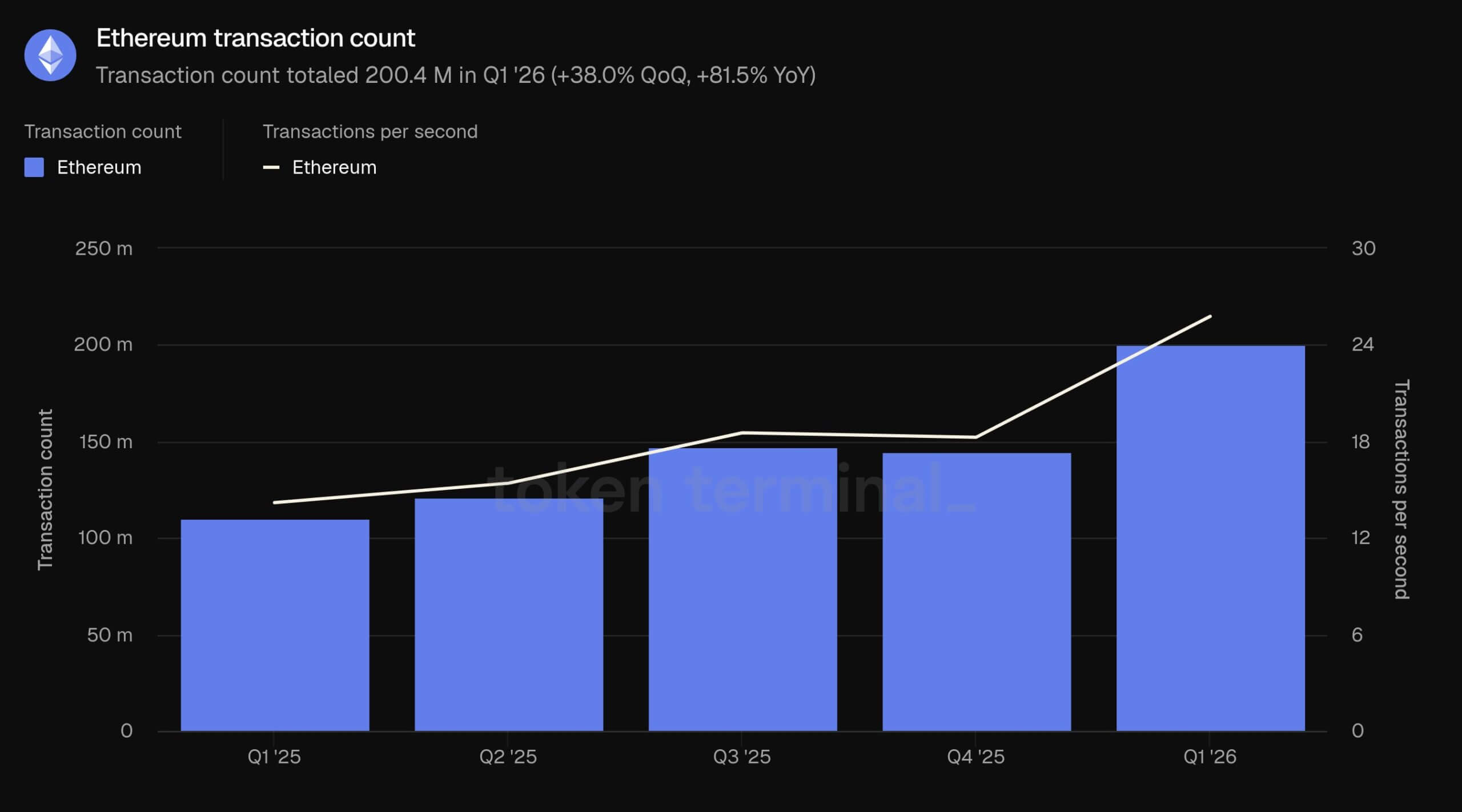
The downsizing reflects a widening divide across the Ethereum ecosystem. Data from Token Terminal showed that the network’s traffic and throughput reached records during the first quarter of 2026, while tokenized assets continued to expand across the blockchain.
Yet, the blockchain’s fee revenue, total value locked, and trading activity weakened, and ETH has fallen more than 44% this year to trade near $1,670.
While the Foundation did not blame the layoffs on ETH’s decline, it said the changes were intended to create an organization capable of executing its mandate without being repeatedly disrupted by short-term market movements.
Ethereum’s growth has yet to lift ETH
Ethereum entered 2026 with more users, transactions, and institutional activity, but those gains have yet to translate into stronger financial results for the network or sustained demand for its native token.
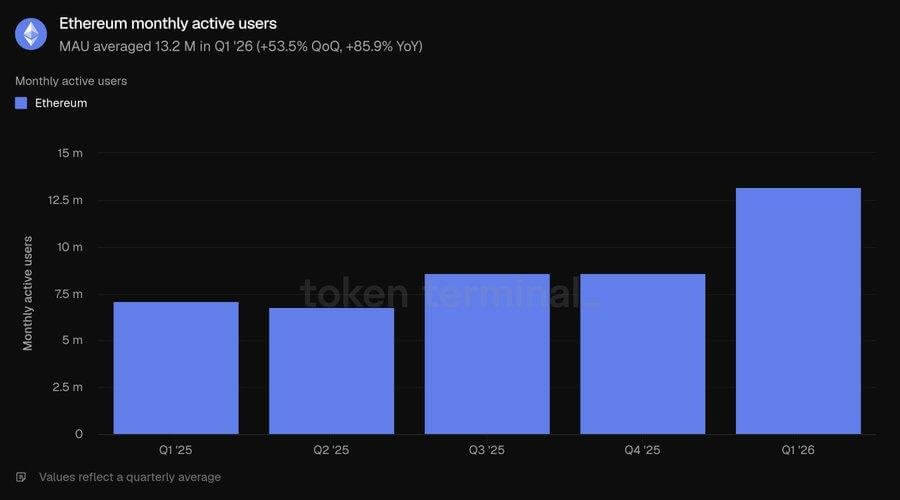
Data from blockchain analytics firm Token Terminal showed that monthly active users reached 13.2 million in the first quarter, up 53.5% from the previous three months and 85.9% from a year earlier. Transaction count rose 38% quarter over quarter to 200.4 million, while throughput increased to a record 25.78 transactions per second.
However, this surge in activity produced less revenue for Ethereum’s base layer.
Layer-1 transaction fees fell nearly 48% from the previous quarter to $39.9 million, an 81.9% decline from a year earlier. Total value locked across the ecosystem dropped 11% to $316.2 billion, while Ethereum’s fully diluted market value contracted 30.3% to $290 billion at quarter-end.
Meanwhile, the same disconnect is visible in Ethereum’s growing role within traditional finance.
The total value of tokenized assets on the network stood at $203.4 billion in the first quarter, including $178.9 billion in stablecoins, Token Terminal said. Tokenized funds increased 4.9% from the previous quarter and 73.1% from a year earlier to $19.4 billion.
Tokenized commodities rose 60% quarter over quarter to $4.7 billion, while tokenized stocks increased 16.5% to $365.1 million.
The expansion has been supported by financial institutions, including BlackRock, JPMorgan, Franklin Templeton, and Fidelity, which have developed tokenized funds or expanded other blockchain-based offerings using Ethereum.
Joseph Chalom, chief executive of Ethereum treasury company SharpLink, said the network’s position rests on a decade of accumulated developers, infrastructure, standards, liquidity, and applications.
He noted:
“Ethereum has become the default operating system for programmable finance and internet-native capital formation.”
Yet Wall Street’s willingness to build on Ethereum has not produced an equivalent appetite for ETH.
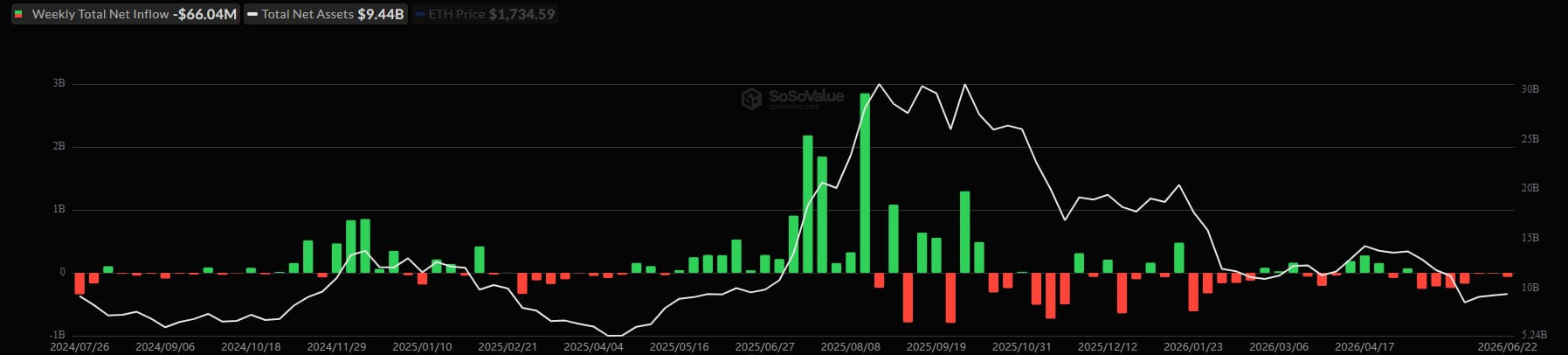
US-listed spot Ether ETFs have recorded seven consecutive weeks of outflows totaling nearly $1 billion, suggesting weak investor demand for direct exposure to the asset.
Financial companies can issue tokenized funds, move stablecoins, and use Ethereum as a settlement network without accumulating ETH in proportion to that activity. However, they may need only enough of the token to pay transaction costs, which are declining as the network becomes more efficient.
That leaves Ethereum’s institutional adoption and ETH’s market performance moving on separate tracks.
Asset managers are expanding their use of the network’s infrastructure, but the corresponding buying pressure has not been sufficient to lift the token, leaving it exposed to broader market weakness and competition from other digital assets.
Ethereum Foundation reorganizes around core defenses
To navigate this landscape, the Ethereum Foundation has completed an internal reorganization, shifting its structural framework away from general ecosystem promotion toward a highly specialized cluster model.
The organization’s remaining personnel have been partitioned into five functional divisions spanning the protocol, access, user, community, and institutional layers.
The restructured Protocol cluster will double down on core engineering priorities, specifically scaling, user-experience enhancements, and hardening layer-1 cryptographic guarantees.
Additionally, the policy shifts indicate that the foundation plans to move its internal compensation and financial agreements directly into ETH and native stablecoins.
Bastian Aue, Ethereum Foundation’s interim Co-Executive Director, said this decision would force its staff to operate entirely within the practical parameters and technical limitations of the ecosystem. He added:
“If the EF’s work is to make Ethereum usable as infrastructure for self-sovereignty, everyone at the EF will increasingly live inside the constraints of the system the EF exists to improve: wallet UX, volatility, accounting, privacy gaps, payment friction, stablecoin trust assumptions, recovery, dependency risk, etc. If we can’t use these tools ourselves, it is unrealistic to expect others to.”
This institutional realignment also signals an ideological hardening.
Aue stated that the Foundation will reject requests to adjust protocol parameters to satisfy short-term speculative interests or corporate appeal. Instead, developmental priorities will lean toward defensive software engineering designed to shield the ledger from institutional capture or centralization.
He stated:
“We are here to defensively strengthen places where Ethereum is, or can still become, extractive, totalizing, or vulnerable to cartel or state capture, or authoritarian tools of surveillance or coercion.”
MEV and Privacy move up the Foundation’s agenda
One of the Foundation’s main technical priorities will be reducing the risks created by maximal extractable value, or MEV.
MEV refers to profits that validators, block builders, and other market participants can extract by controlling how transactions are ordered, included, or excluded. Some forms arise naturally from arbitrage, but opaque routing and concentrated transaction flow can give a small number of operators disproportionate influence over the network.
Aue argues that Ethereum could remain permissionless in theory while becoming heavily intermediated at the point where users move value.
Its proposed responses include stronger transaction-inclusion guarantees, lower barriers to block building and validation, and greater transparency around the assumptions users make when routing transactions.
Forward Inclusion Lists, known as FOCIL, are intended to make it harder for builders to censor transactions by allowing validators to require the inclusion of selected transactions in future blocks.
Enshrining proposer-builder separation, or ePBS, would embed the relationship between validators and specialist block builders in the protocol, reducing reliance on external relays. The design would not eliminate concentration risks, but it could remove some trusted components from the current supply chain.
Researchers are also studying encrypted mempools, which could hide pending transaction details before execution, making front-running more difficult.
Such systems may introduce new technical and competitive risks, including advantages for specialized operators, leaving the Foundation to weigh privacy and fairness against additional complexity.
Privacy will become a parallel priority. The Foundation wants users to have access to strong privacy protections before information is selectively disclosed for identity, auditing, or compliance purposes.
That approach could conflict with the preferences of institutions and regulators seeking greater visibility into blockchain transactions. The Foundation’s position is that Ethereum should support programmable disclosure without making constant surveillance the network’s default.
Layoffs begin a period of tighter spending
The staff reduction also begins a stricter approach to the Foundation’s finances and external funding.
Ethereum co-founder Vitalik Buterin said the Foundation is reducing its budget by roughly 40% this year as it begins a multiyear shift toward a smaller, endowment-style organization.
The reduction follows the treasury policy adopted last year, which seeks to move the Foundation away from spending about 15% of its remaining assets annually, its average before 2026, toward a rate of roughly 5% a year after 2030.
The goal is to preserve sufficient capital to support Ethereum development over the long term and reduce the organization’s exposure to crypto market cycles.
According to Buterin, the Foundation is making those reductions while pursuing the third major iteration of Ethereum. That program, known as the Ethereum Strawmap, is intended to reshape major parts of the blockchain, including consensus, transaction proofs, privacy, user accounts, and the way network state is managed.
To execute this third iteration of Ethereum on a constrained budget, the foundation is scaling back several legacy initiatives.
The network’s longstanding multi-client model, which historically relied on redundant software clients to ensure chain stability during bugs, will see some development work become more specialized, with developers also looking to AI-assisted formal verification. Developers are increasingly looking to artificial intelligence to secure protocol upgrades, which could significantly reduce the engineering resources required to ship new software proposals.
Simultaneously, the foundation is winding down its Privacy and Scaling Explorations unit as an independent research arm, shifting its cryptography experts toward direct implementation within the protocol.
The organization’s flagship developer conference, Devcon, will be scaled down to a more spartan format, and institutional outreach will narrow its focus to highly specific, replicable deployment test cases.
Buterin also noted he would personally fund certain broader megaprojects that fall outside the foundation’s newly constrained scope.
Over the longer term, Buterin said he favors what he called a “soft lean-and-done” model for Ethereum. Once the Strawmap is completed, protocol development would focus primarily on security repairs and a limited number of high-value improvements, with a much higher threshold for adding new features.
Such an approach could reduce the permanent cost of maintaining Ethereum and limit the number of openings through which companies, governments, or concentrated interest groups might influence its development.
Ultimately, Buterin said Ethereum should learn less from sprawling software projects and more from Bitcoin’s narrower approach to protocol changes.