Close Menu
  • Latest News
    • Bitcoin
    • Ethereum
    • Altcoins
    • Meme Coins
  • Tech
    • Blockchain
    • Security and Privacy
  • Web 3
    • Gaming
  • Legal
    • Legal and Regulatory
    • Adoption
  • Analysis
  • Learn
    • Education
    • Wallets and Exchanges
  • Tools
    • Market Overview
    • Exchange Tool
What's Hot

Polymarket US Sues Ohio to Block Sports-Contract Crackdown

October 23, 2026

Ethereum Delays Glamsterdam Test On Hoodi Over Smart Contract Compatibility Questions

October 23, 2026

Pyth Pro Powers New Loan Pools with WIF, PUMP, and SOL

October 23, 2026
Facebook X (Twitter) Instagram
  • Contact
  • Privacy Policy
  • Terms & Conditions
  • Disclosure
Facebook X (Twitter) Instagram
Free.cc (Free Cryptocurrency)Free.cc (Free Cryptocurrency)
  • Latest News
    1. Bitcoin
    2. Ethereum
    3. Altcoins
    4. Meme Coins
    5. View All

    AI Risk Could Force Bitcoin Drawdown To $10,000

    October 23, 2026

    Bitcoin Open Interest jumps 8% – Why BTC price faces liquidation risks

    October 23, 2026

    Bitcoin, Hyperliquid (HYPE) and Zcash (ZEC) Price Ready to Bounce Back

    October 23, 2026

    Bitcoin, gold trim early losses as yen gives up gains. Oil stays near $100

    October 23, 2026

    ETH Slips Below $2,400 as ETF Outflows and Market Sell-Off Pressure Bulls

    October 22, 2026

    Ethereum: Can $61M in whale withdrawals help ETH bulls regain control?

    October 22, 2026

    Ethereum staking hits record highs – So why are yields falling?

    October 22, 2026

    Top Analysts Say A Rebound Could Be Close

    October 21, 2026

    Ethereum Delays Glamsterdam Test On Hoodi Over Smart Contract Compatibility Questions

    October 23, 2026

    Cosmos crypto defies market weakness – Can ATOM rally toward $2?

    October 23, 2026

    Chainlink’s $1.02M whale buy: An early Q4 signal or an isolated bet?

    October 23, 2026

    Zcash Foundation Details Zebra Sync Fixes Ahead Of NU7 Release

    October 23, 2026

    Top 5 Memecoins to Watch in 2026: Hype, Utility, or Growth?

    October 14, 2026

    Did Jean Phil Go Viral First — or Was the Viral Persona Built to Launch a Memecoin?

    October 5, 2026

    Thinking Cat Gains Momentum After CASHCAT’s Breakout

    August 12, 2026

    What Tokens Could He Target?

    July 30, 2026

    Polymarket US Sues Ohio to Block Sports-Contract Crackdown

    October 23, 2026

    Ethereum Delays Glamsterdam Test On Hoodi Over Smart Contract Compatibility Questions

    October 23, 2026

    Pyth Pro Powers New Loan Pools with WIF, PUMP, and SOL

    October 23, 2026

    AI Risk Could Force Bitcoin Drawdown To $10,000

    October 23, 2026
  • Tech
    1. Blockchain
    2. Security and Privacy
    3. View All

    Pyth Pro Powers New Loan Pools with WIF, PUMP, and SOL

    October 23, 2026

    neox-rs v2.7.0 merges 185 Reth upstream commits, closes nine vulnerabilities

    October 23, 2026

    NeoRedPill launches Telegram wallet bot with Neo N3 wallets, cross-chain bridging

    October 23, 2026

    Quantum-Safe Blockchain Design Could Cut Fees and Network Bloat

    October 23, 2026

    Coinbase, Bitgo Say Unaffected by PHP Flaw; Binance’s CZ Urges Caution

    October 22, 2026

    Crypto Thieves Hijack Ngrave Alerts and Walk Away With $2.56M

    October 21, 2026

    Zcash Proposes New Privacy Layer to Guard Swaps From Quantum Risks

    October 20, 2026

    Qubic Loses $1.3 Million in Wallet Raid Before Network Halts

    October 18, 2026

    Polymarket US Sues Ohio to Block Sports-Contract Crackdown

    October 23, 2026

    Ethereum Delays Glamsterdam Test On Hoodi Over Smart Contract Compatibility Questions

    October 23, 2026

    Pyth Pro Powers New Loan Pools with WIF, PUMP, and SOL

    October 23, 2026

    AI Risk Could Force Bitcoin Drawdown To $10,000

    October 23, 2026
  • Web 3
    1. Gaming
    2. View All

    Top 12 NFT games every player should know about in August 2026

    September 22, 2026

    GameShame Studios founder details Raijin Protocol’s roadmap in NeoPod’s sixth AMA

    September 22, 2026

    Proof of Play to shut down after blockchain gaming thesis falls short

    September 22, 2026

    How BC.GAME is turning players into stakeholders

    September 22, 2026

    Polymarket US Sues Ohio to Block Sports-Contract Crackdown

    October 23, 2026

    Ethereum Delays Glamsterdam Test On Hoodi Over Smart Contract Compatibility Questions

    October 23, 2026

    Pyth Pro Powers New Loan Pools with WIF, PUMP, and SOL

    October 23, 2026

    AI Risk Could Force Bitcoin Drawdown To $10,000

    October 23, 2026
  • Legal
    1. Legal and Regulatory
    2. Adoption
    3. View All

    Polymarket US Sues Ohio to Block Sports-Contract Crackdown

    October 23, 2026

    Crypto PACs spend big on Ohio Senate race

    October 23, 2026

    Stand With Crypto Advances GENIUS Act Implementation

    October 23, 2026

    Digital Chamber Celebrates GENIUS Act Finalization, A Win

    October 23, 2026

    Germany’s main savings bank network launches Bitcoin trading

    October 21, 2026

    Two firms control corporate Bitcoin buys, even as business adoption broadens

    October 16, 2026

    AI agents keep coming back for crypto as x402 wallet refill rate surges to 89%

    October 15, 2026

    Interactive Brokers moves into Ethereum’s $110 billion staking market as institutional demand accelerates

    October 14, 2026

    Polymarket US Sues Ohio to Block Sports-Contract Crackdown

    October 23, 2026

    Ethereum Delays Glamsterdam Test On Hoodi Over Smart Contract Compatibility Questions

    October 23, 2026

    Pyth Pro Powers New Loan Pools with WIF, PUMP, and SOL

    October 23, 2026

    AI Risk Could Force Bitcoin Drawdown To $10,000

    October 23, 2026
  • Analysis

    Can Rising Social Dominance Push PEPE Coin Higher?

    October 23, 2026

    Fake election polls expose a Kalshi loophole that could leave traders paying for fraud

    October 23, 2026

    Evernorth XRP Holdings to Target Higher XRP Per Share, CEO Says

    October 23, 2026

    The Crucial $245 Level That Decides Bittensor’s Next Move

    October 23, 2026

    Can Fibre Push TIA Toward $9?

    October 22, 2026
  • Learn
    1. Education
    2. Wallets and Exchanges
    3. View All

    What Is Robinhood Chain? The Ethereum Layer-2 Network for Tokenized Stocks

    July 12, 2026

    What Is BChat? The Decentralized Messaging App Built for Privacy

    June 2, 2026

    What Is an AI Prompt Injection Attack? The Hidden Threat Hijacking Your Chatbots

    May 31, 2026

    What Is AI Jailbreaking? A Beginner’s Guide to the Cat-and-Mouse Game Behind Every Chatbot

    May 17, 2026

    Coinbase Ireland’s cash safeguards fell €5 million short before 2024 fix

    October 23, 2026

    SideSwap reopens Bitcoin swaps while Liquid reserves stay locked

    October 22, 2026

    Binance bStocks collateral pricing moves to 24/7

    October 21, 2026

    Binance Pool shuts on November 10, with record access ending two weeks later

    October 18, 2026

    Polymarket US Sues Ohio to Block Sports-Contract Crackdown

    October 23, 2026

    Ethereum Delays Glamsterdam Test On Hoodi Over Smart Contract Compatibility Questions

    October 23, 2026

    Pyth Pro Powers New Loan Pools with WIF, PUMP, and SOL

    October 23, 2026

    AI Risk Could Force Bitcoin Drawdown To $10,000

    October 23, 2026
  • Tools
    • Market Overview
    • Exchange Tool
Free.cc (Free Cryptocurrency)Free.cc (Free Cryptocurrency)
Home»Analysis»Crypto exchanges are losing retail traders but are filling the gap with Wall Street-style bets
Analysis

Crypto exchanges are losing retail traders but are filling the gap with Wall Street-style bets

June 6, 2026No Comments8 Mins Read
Share
Facebook Twitter LinkedIn Pinterest Email

Crypto exchanges are seeing the weakest retail-driven activity in years, but some of the biggest platforms are finding a lucrative new source of volume in Wall Street-style bets on gold, silver, oil, stocks, and indexes.

According to a CryptoQuant report shared with CryptoSlate, the shift is emerging during one of the weakest trading periods for centralized crypto platforms in more than two years.

Spot trading volume fell to $679 billion in April, the lowest monthly level since October 2023, as lower prices and fading retail participation reduced market activity.
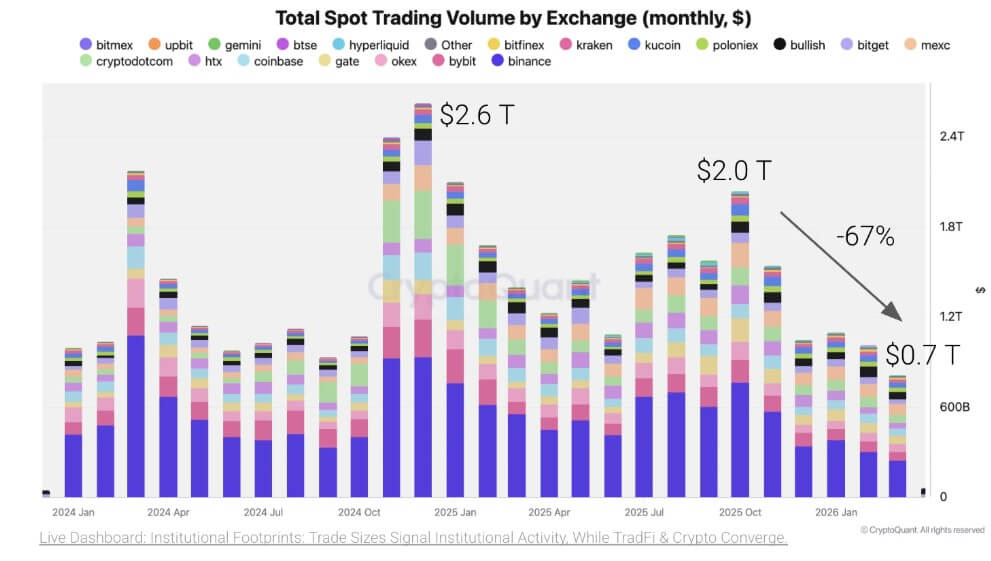
Crypto Exchanges Spot Volume
Crypto Exchanges Spot Volume (Source: CryptoQuant)

At the same time, some exchanges are seeing growth in products that look less like crypto speculation and more like traditional macro trading.

As a result, perpetual futures tied to metals, energy, and equities have become one of the fastest-growing segments on several major crypto venues. This shows how platforms built for Bitcoin and Ethereum are expanding into Wall Street-style markets that trade around the clock.

Retail volume falls to multi-year lows

The collapse in spot market turnover illustrates the sheer magnitude of the post-2025 market contraction.

According to the CryptoQuant report, centralized exchange spot volume in April plummeted 46% year-over-year, and sits a staggering 67% below the market top recorded in October 2025.

That contraction has hit the industry’s core business model, which depends on frequent trading, market volatility, and steady participation from retail users.

Still, Binance remained the largest spot venue by cumulative trading volume in 2026, with $1.3 trillion. Bybit followed with $285 billion, while Gate recorded $253 billion and Crypto.com processed $247 billion.

While these top-tier platforms still capture the lion’s share of available trading flow, the underlying data indicate a far less casual ecosystem of participants.

Historically, retail traders are the first demographic to retreat during protracted crypto downturns. Casual investors often exit the market entirely after incurring losses or drastically reduce their positions when prevailing momentum stalls.

Conversely, professional trading desks, automated market makers, and institutional arbitrageurs maintain their presence, as their strategies rely on hedging, executing relative-value trades, and providing market liquidity rather than chasing directional price movements.

This demographic transition has squarely placed the weakness in the derivatives sector, a domain previously dominated by aggressive retail speculation.

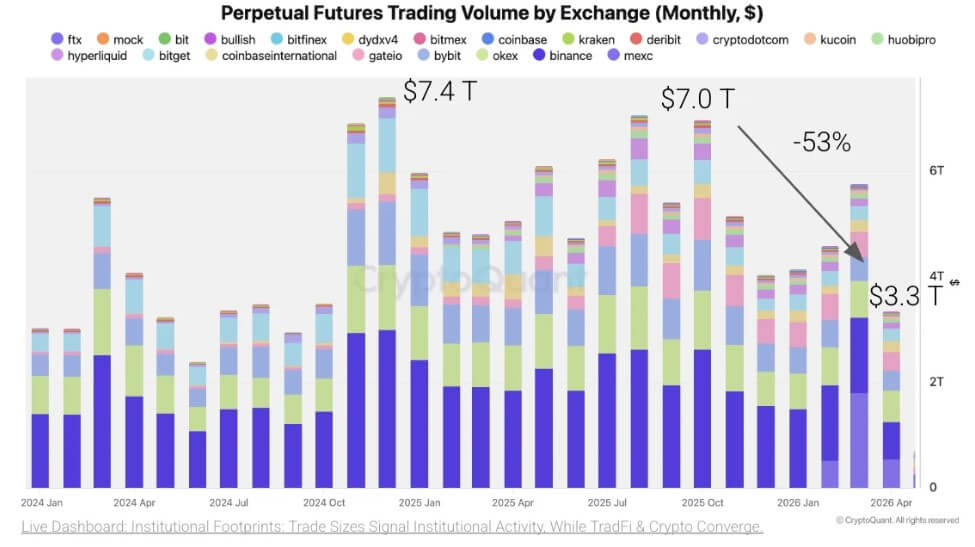
Perpetual futures volume has cascaded 53% from its October 2025 highs, closely mirroring the spot market contraction. Binance retains its dominant market share in the perpetual futures space, followed by MEXC, OKX, Bybit, and Gate.
See also  Crypto firms face July 1 EU cutoff as MiCA grace period ends
Crypto Exchanges Perpetual Trading Volume
Crypto Exchanges Perpetual Trading Volume (Source: CryptoQuant)

The parallel decline in both spot and leveraged trading indicates that users are not merely rotating among product types; overall demand for digital asset exposure has fundamentally weakened.

Larger trades point to a different customer base

Despite the pronounced drop in absolute trading volume, a granular look at average transaction sizes reveals a market that is steadily institutionalizing.

Average trade size is an imperfect signal, as large transactions can come from institutions, market makers, high-net-worth traders, or professional accounts. Smaller retail orders tend to pull the average down. Still, the metric helps show where bigger participants are most active.

In 2026, Gate logged the highest average Bitcoin spot trade size among major centralized venues, registering approximately $4,000 per transaction. This figure remains elevated even after cooling from a peak of $6,200 during a wave of institutional onboarding in 2025.
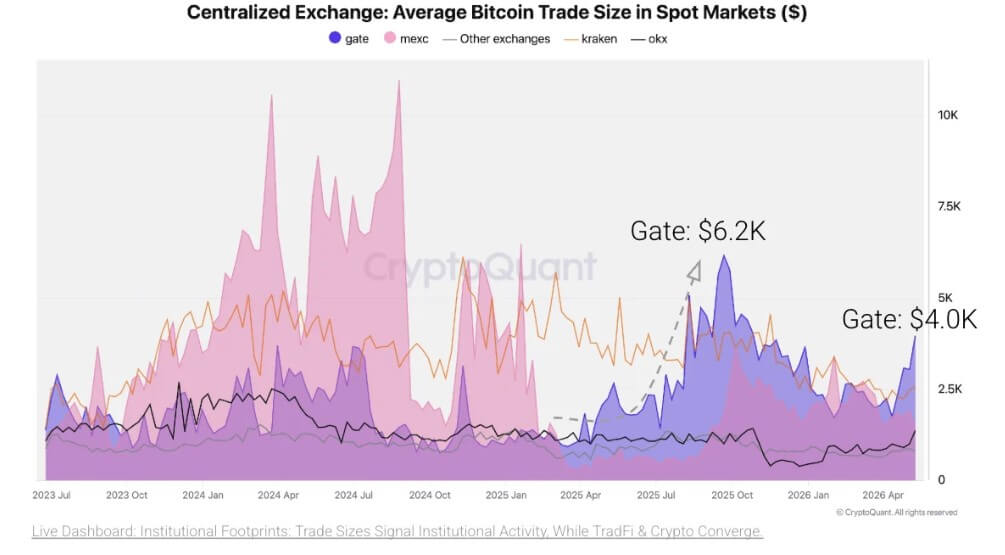
Average Bitcoin Trade Size on Centralized Exchanges
Average Bitcoin Trade Size on Centralized Exchanges (Source: CryptoQuant)

CryptoQuant pointed out that several crypto trading platforms, including Kraken, MEXC, and OKX, similarly ranked at the top of the industry for average Bitcoin spot trade sizes.

Kraken’s presence aligns with its long-standing reputation as a compliance-focused hub for professional entities, while OKX and MEXC have cultivated substantial global bases capable of executing bulk orders.

Meanwhile, this institutional footprint is even more pronounced in derivatives trading.

According to CryptoQuant, Gate led the market in average Bitcoin perpetual futures trade size in 2026 at roughly $8,900.

At the height of the 2025 market cycle, this metric briefly reached an astonishing $24,700 in August before normalizing. Kraken and OKX also maintain leading positions in derivatives trade sizes.

This trend suggests Gate has become a more important execution venue for larger Bitcoin trades in both spot and derivatives markets.

Kraken and OKX also remained among the leading venues by average Bitcoin futures trade size, reinforcing the divide between platforms that attract larger execution and those that rely more heavily on broad retail flow.

Notably, this consistency extends to Ethereum markets where Kraken, Gate, MEXC, and OKX continue to dominate average Ethereum spot trade sizes. Gate has also firmly established its presence in this top tier following sustained growth that began in early 2024.

See also  AI agents keep coming back for crypto as x402 wallet refill rate surges to 89%

This uniform pattern across multiple assets and product lines indicates that the shift toward wholesale, large-scale execution is a structural market evolution rather than an isolated anomaly.

Liquidity concentrates around fewer venues

This professional consolidation is heavily dependent on the underlying market structure, specifically order-book depth. Institutional participants require deep liquidity to enter and exit substantial positions without triggering severe price slippage or widening bid-ask spreads.

In Bitcoin spot markets, Gate and Binance have maintained among the deepest 1% order books among major exchanges, averaging roughly 200,000 to 250,000 BTC in depth over the period tracked.
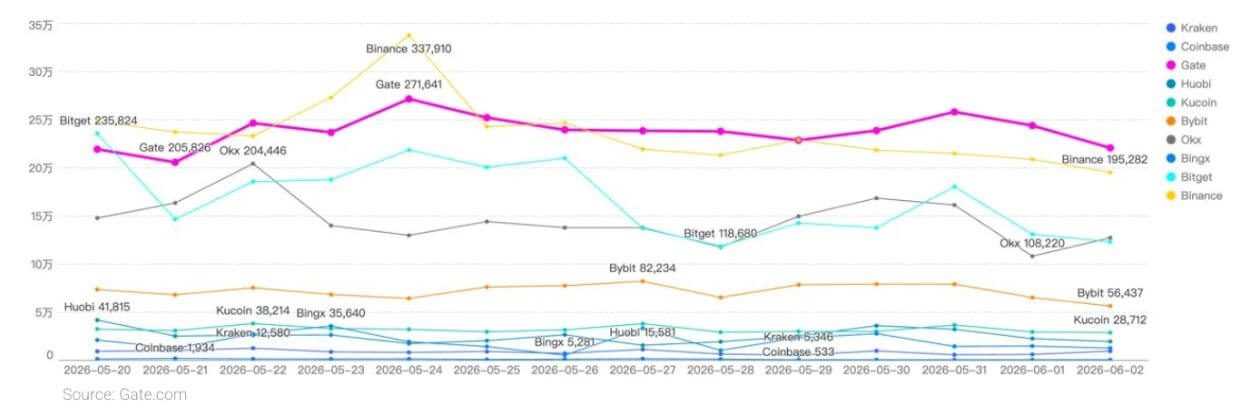
Crypto Exchanges Order Book Size
Crypto Exchanges Order Book Size (Source: CryptoQuant)

The perpetual futures market, while inherently more competitive, displays a similar concentration of liquidity. Gate regularly leads the pack, offering Bitcoin perpetual depth ranging from 750,000 to 1.3 million BTC daily.

Hyperliquid, the leading DEX platform, has surprisingly emerged as a formidable decentralized competitor, maintaining depth above 600,000 BTC.

CryptoSlate Daily Brief

Daily signals, zero noise.

Market-moving headlines and context delivered every morning in one tight read.

5-minute digest 100k+ readers

Free. No spam. Unsubscribe any time.

Whoops, looks like there was a problem. Please try again.

You’re subscribed. Welcome aboard.

Meanwhile, traditional heavyweights like Binance and OKX remain robust, generally fluctuating between 500,000 and 850,000 BTC in depth.

These figures show why liquidity has become a central battleground where exchanges with deep books can attract larger traders. In turn, these larger traders can bring greater liquidity, reinforcing the venue’s position as a preferred execution hub.

In a market where retail volume is falling, that feedback loop becomes more important. Platforms with thinner books may struggle to compete for professional activity, while larger venues can use liquidity to expand into new products beyond crypto.

Cartoon of retail traders leaving a crypto exchange while gold, silver, oil, and stocks traders take their place.

Crypto exchanges push into macro trading

Having secured deep liquidity and professional clientele, the most dominant crypto platforms are now leveraging their infrastructure to encroach on traditional finance.

CryptoQuant noted that trading volume for traditional-finance perpetual futures on crypto exchanges surged in 2026, reaching about $450 billion per month in March. Metals-linked contracts drove most of the activity, with gold and silver accounting for more than 90% of volume during the peak month.

The timing tracks a broader macro backdrop, with gold and silver rallying as investors reacted to inflation concerns.

See also  $LIQUID is the Choice for Traders

At the same time, equities reached new highs amid optimism about artificial intelligence, while oil markets became more volatile amid geopolitical tensions involving the United States and Iran.

Crypto exchanges capitalized on this macro turbulence to offer traders a familiar structure in a different venue: perpetual futures that trade 24 hours a day, seven days a week.

Perpetual futures are common in crypto because they allow traders to take leveraged long or short positions without an expiration date.

Extending that structure to gold, silver, oil, and stock-linked products gives crypto-native platforms a way to compete for macro trading activity that has traditionally been concentrated within brokerages, futures exchanges, and contracts-for-difference platforms.

CryptoQuant stated that the early demand has been strongest in metals. Gold and silver became the primary gateway for traders on crypto exchanges to express views on traditional markets.

More recently, oil-linked products have grown as energy volatility increased. Meanwhile, equity-linked contracts remain smaller, but they indicate that exchanges are testing a wider range of traditional assets.

Gate and Binance dominate the new segment

Still, CryptoQuant noted that the booming market for traditional-finance futures is largely dominated by a few exchanges.

For context, Gate handled nearly $290 billion in TradFi futures volume in March, far ahead of other platforms. This jump was mostly driven by gold and silver trading.
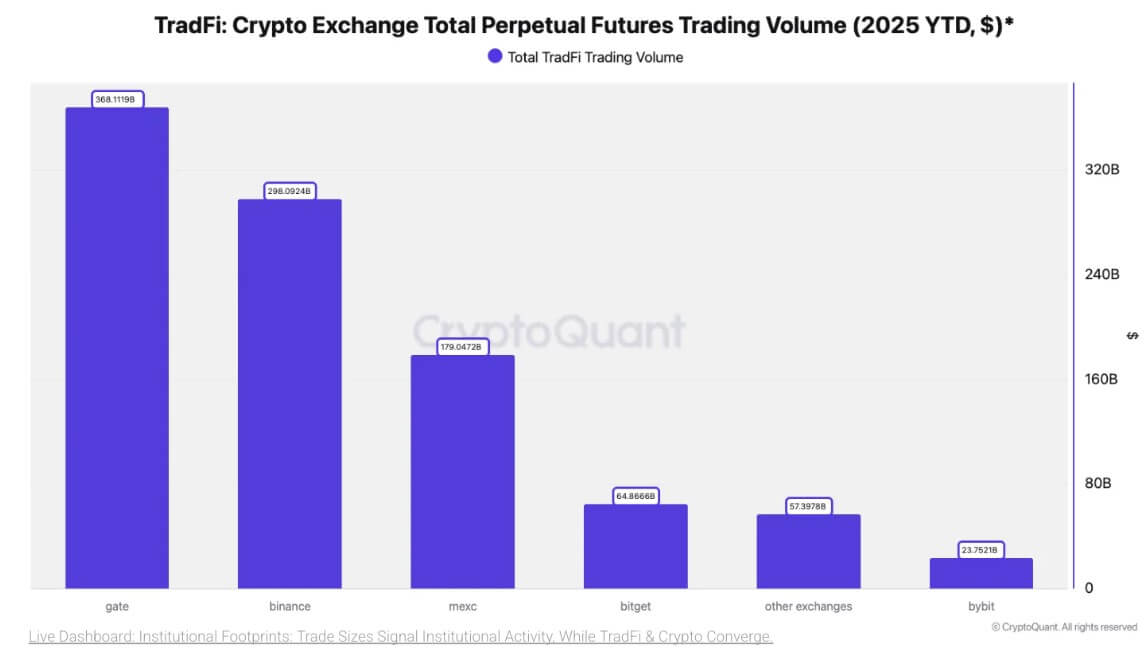
Crypto Exchanges TradFi Perpetual Trading Volume
Crypto Exchanges TradFi Perpetual Trading Volume (Source: CryptoQuant)

Binance ranked second, hitting $109 billion in March and maintaining high activity through May at $64 billion. MEXC, Bitget, and Bybit also saw increases as traders looked beyond metals into other asset classes.

Looking at the year as a whole, the market is highly concentrated. So far in 2026, Gate leads with about $368 billion in TradFi futures volume. Binance follows with $298 billion. Together, these two exchanges account for about two-thirds of the entire market.

MEXC is next with $179 billion, followed by Bitget with $65 billion. Bybit, despite being a major player in crypto derivatives, has handled a smaller $24 billion in traditional futures.

These numbers show how crypto exchanges are trying to adapt to the current market situation. Their original business relied on volatile digital tokens and everyday people making speculative bets.

Now, the focus is shifting to professional traders, deep market liquidity, and giving users access to traditional assets around the clock.

Bets Crypto exchanges filling Gap Losing retail Streetstyle traders Wall
Share. Facebook Twitter Pinterest LinkedIn Tumblr Email

Related Posts

Can Rising Social Dominance Push PEPE Coin Higher?

October 23, 2026

Crypto PACs spend big on Ohio Senate race

October 23, 2026

Fake election polls expose a Kalshi loophole that could leave traders paying for fraud

October 23, 2026

Stand With Crypto Advances GENIUS Act Implementation

October 23, 2026
Add A Comment
Leave A Reply Cancel Reply

Top Posts

Is SOL Setting Up for a Bullish Correction or Another Leg Lower?

December 26, 2025

Cyber-thieves Hit DeFi Platform Again

October 27, 2025

Stay ahead with the latest crypto news, market updates, blockchain insights, and trends. Your trusted source for everything happening in the digital asset world.


We're social. Connect with us:

Facebook X (Twitter) Instagram Pinterest YouTube
Top Insights

Polymarket US Sues Ohio to Block Sports-Contract Crackdown

October 23, 2026

Ethereum Delays Glamsterdam Test On Hoodi Over Smart Contract Compatibility Questions

October 23, 2026

Pyth Pro Powers New Loan Pools with WIF, PUMP, and SOL

October 23, 2026
Get Informed

Subscribe to Updates

Get the latest creative news From Free.cc directly in your Inbox!

  • Contact
  • Privacy Policy
  • Terms & Conditions
  • Disclosure
© 2026 free.cc - All rights reserved.

Type above and press Enter to search. Press Esc to cancel.