Close Menu
  • Latest News
    • Bitcoin
    • Ethereum
    • Altcoins
    • Meme Coins
  • Tech
    • Blockchain
    • Security and Privacy
  • Web 3
    • Gaming
  • Legal
    • Legal and Regulatory
    • Adoption
  • Analysis
  • Learn
    • Education
    • Wallets and Exchanges
  • Tools
    • Market Overview
    • Exchange Tool
  • INFO@FREE.CC
What's Hot

Consensys Urges SEC to Exempt Self-Custody Wallets, Citing Regulatory Gap for 99% of Tokens

May 14, 2026

UBOX Taps ClawWorks to Accelerate Independent AI Agent Economics

May 14, 2026

Analyst Says No Reason for Bitcoin Reversal, Sees BTC Approaching Next Resistance Levels – Here Are His Targets

May 14, 2026
Facebook X (Twitter) Instagram
  • Contact
  • Privacy Policy
  • Terms & Conditions
  • Disclosure
Facebook X (Twitter) Instagram
Free.cc (Free Cryptocurrency)Free.cc (Free Cryptocurrency)
  • Latest News
    1. Bitcoin
    2. Ethereum
    3. Altcoins
    4. Meme Coins
    5. View All

    Analyst Says No Reason for Bitcoin Reversal, Sees BTC Approaching Next Resistance Levels – Here Are His Targets

    May 14, 2026

    70% of long-term holders are in profit as the bitcoin floor hardens

    May 13, 2026

    What’s Really At Stake In The Market Structure Debate: The BRCA

    May 13, 2026

    Strategy adds 535 BTC – Still ‘buying the dip’ or something else entirely?

    May 13, 2026

    Bitcoin, Ethereum and XRP Price Analysis: What’s Coming Next?

    May 13, 2026

    Wells Fargo Boosts Ethereum ETF Holdings in Q1

    May 13, 2026

    Why Market Experts Are Still Predicting A Rise Above $10,000

    May 13, 2026

    Bitmine ETH Holdings Cross 5.2 Million—CEO Announces New Phase For Crypto Markets

    May 12, 2026

    Bitcoin Just Entered A Deceptive Territory, Here’s What You Should Know

    May 14, 2026

    XRP Ledger Hits Record High In 10K+ Wallets: Santiment

    May 13, 2026

    Mysterious Bitcoin Whale Transfers $40B After Years Of Silence

    May 13, 2026

    First Hyperliquid ETF Launch: Day One Volume Hits $1.8M–Key Details

    May 13, 2026

    Meme Coin Market Faces Imbalance as Supply Rises, Demand Falls

    April 4, 2026

    Crypto Interest Rising Toward Meme Coin Sector

    January 9, 2026

    Memes Market Cap Adds $10B in Days: Fresh Capital or Dead-Cat-Bounce?

    January 5, 2026

    Meme Coin Market Surges Past $45B as Shiba Inu, PEPE, BONK Stage 54% Price Pump

    January 4, 2026

    Consensys Urges SEC to Exempt Self-Custody Wallets, Citing Regulatory Gap for 99% of Tokens

    May 14, 2026

    UBOX Taps ClawWorks to Accelerate Independent AI Agent Economics

    May 14, 2026

    Analyst Says No Reason for Bitcoin Reversal, Sees BTC Approaching Next Resistance Levels – Here Are His Targets

    May 14, 2026

    Bitcoin Just Entered A Deceptive Territory, Here’s What You Should Know

    May 14, 2026
  • Tech
    1. Blockchain
    2. Security and Privacy
    3. View All

    UBOX Taps ClawWorks to Accelerate Independent AI Agent Economics

    May 14, 2026

    UXLINK And Origins Network Partner To Power Scalable AI-Driven Web3 Applications Using Decentralized Computing

    May 13, 2026

    WheelX.fi Expands Cross-Chain Liquidity Access Through KiteAI Integration

    May 13, 2026

    TopNod Integrates Hyperliquid – The Future of Seamless On-Chain Perpetual Trading

    May 13, 2026

    Ripple Shares DPRK Threat Data on Fraud Domains, Wallets, Campaigns

    May 5, 2026

    Digital Asset Security Moves Beyond Keys as Bitgo Adds 5-Layer Checks

    May 1, 2026

    Defillama Confirms April 2026 as Crypto’s Most-Hacked Month With 30 Incidents

    May 1, 2026

    Malicious npm Dependency Linked to AI Assisted Commit Targets Crypto W

    April 29, 2026

    Consensys Urges SEC to Exempt Self-Custody Wallets, Citing Regulatory Gap for 99% of Tokens

    May 14, 2026

    UBOX Taps ClawWorks to Accelerate Independent AI Agent Economics

    May 14, 2026

    Analyst Says No Reason for Bitcoin Reversal, Sees BTC Approaching Next Resistance Levels – Here Are His Targets

    May 14, 2026

    Bitcoin Just Entered A Deceptive Territory, Here’s What You Should Know

    May 14, 2026
  • Web 3
    1. Gaming
    2. View All

    NUMINE Joins Outer Ring MMO for the Expansion of Web3 Gaming Experiences

    May 13, 2026

    GMatrixs And MiniverseCore Join Forces To Unlock Web3 Gaming Experience With Cross-Chain DApp, DeFi Applications

    May 11, 2026

    The Identity Crisis of 2026: NFTs, AI Agents and Trust on the Agentic Web

    May 11, 2026

    DTCC’s May 2026 Tokenization Announcement Explained: What It Means for U.S. Securities and Real-World Assets

    May 11, 2026

    Consensys Urges SEC to Exempt Self-Custody Wallets, Citing Regulatory Gap for 99% of Tokens

    May 14, 2026

    UBOX Taps ClawWorks to Accelerate Independent AI Agent Economics

    May 14, 2026

    Analyst Says No Reason for Bitcoin Reversal, Sees BTC Approaching Next Resistance Levels – Here Are His Targets

    May 14, 2026

    Bitcoin Just Entered A Deceptive Territory, Here’s What You Should Know

    May 14, 2026
  • Legal
    1. Legal and Regulatory
    2. Adoption
    3. View All

    Consensys Urges SEC to Exempt Self-Custody Wallets, Citing Regulatory Gap for 99% of Tokens

    May 14, 2026

    Three men charged in US over crypto wrench attack spree

    May 13, 2026

    CLARITY Act faces 100+ amendments as bankers send 8,000 demand letters against stablecoin rewards

    May 13, 2026

    Bhutan’s GMC offers quick licenses, bank accounts to lure crypto firms

    May 13, 2026

    Tether launches decentralized local AI using Isaac Asimov’s Psychohistory straight out of Foundation

    May 11, 2026

    Has Donald Trump been a net positive for Bitcoin or created an unbreakable partisan divide?

    May 10, 2026

    BlackRock looks to sidestep Clarity yield issues, filing for two new tokenized money market funds

    May 10, 2026

    Cardano’s Charles Hoskinson says the future of crypto wallets will be inside iPhones and Androids

    May 8, 2026

    Consensys Urges SEC to Exempt Self-Custody Wallets, Citing Regulatory Gap for 99% of Tokens

    May 14, 2026

    UBOX Taps ClawWorks to Accelerate Independent AI Agent Economics

    May 14, 2026

    Analyst Says No Reason for Bitcoin Reversal, Sees BTC Approaching Next Resistance Levels – Here Are His Targets

    May 14, 2026

    Bitcoin Just Entered A Deceptive Territory, Here’s What You Should Know

    May 14, 2026
  • Analysis

    Wall Street is buying XRP while Binance traders keep betting against it

    May 13, 2026

    Is a Drop Below $1 Coming Next?

    May 13, 2026

    UB Price Breakout Enters Discovery Phase

    May 13, 2026

    Injective (INJ) Price Explodes 13% After Bullish Breakout—Is a Rally to $6 Next?

    May 13, 2026

    Bitcoin (BTC) Price Holds Strong Above $80K Despite Hot CPI Data—Is Retail Accumulation Returning?

    May 13, 2026
  • Learn
    1. Education
    2. Wallets and Exchanges
    3. View All

    What’s on the Ethereum Roadmap: Glamsterdam, Hegota and Beyond

    March 30, 2026

    What Is Bluesky? The Decentralized Social Media Rival to Elon Musk’s X

    March 27, 2026

    What Is Strategy (MSTR)? The Bitcoin Treasury Company

    February 21, 2026

    What Are Prediction Markets? How Polymarket, Kalshi and Myriad Work

    February 13, 2026

    Coinbase went down for over 5 hours after missing earnings. Bulls still see a path to $300 billion by 2030

    May 8, 2026

    Coinbase cuts 14% of staff as Armstrong ties cost reset to AI and market volatility

    May 6, 2026

    Bitcoin is still in charge

    May 3, 2026

    CLARITY Act stablecoin fight shifts from yield to who captures digital-dollar economics

    April 29, 2026

    Consensys Urges SEC to Exempt Self-Custody Wallets, Citing Regulatory Gap for 99% of Tokens

    May 14, 2026

    UBOX Taps ClawWorks to Accelerate Independent AI Agent Economics

    May 14, 2026

    Analyst Says No Reason for Bitcoin Reversal, Sees BTC Approaching Next Resistance Levels – Here Are His Targets

    May 14, 2026

    Bitcoin Just Entered A Deceptive Territory, Here’s What You Should Know

    May 14, 2026
  • Tools
    • Market Overview
    • Exchange Tool
  • INFO@FREE.CC
Free.cc (Free Cryptocurrency)Free.cc (Free Cryptocurrency)
Home»Legal and Regulatory»Congress on verge of making regulated dollar stablecoins act almost like digital cash
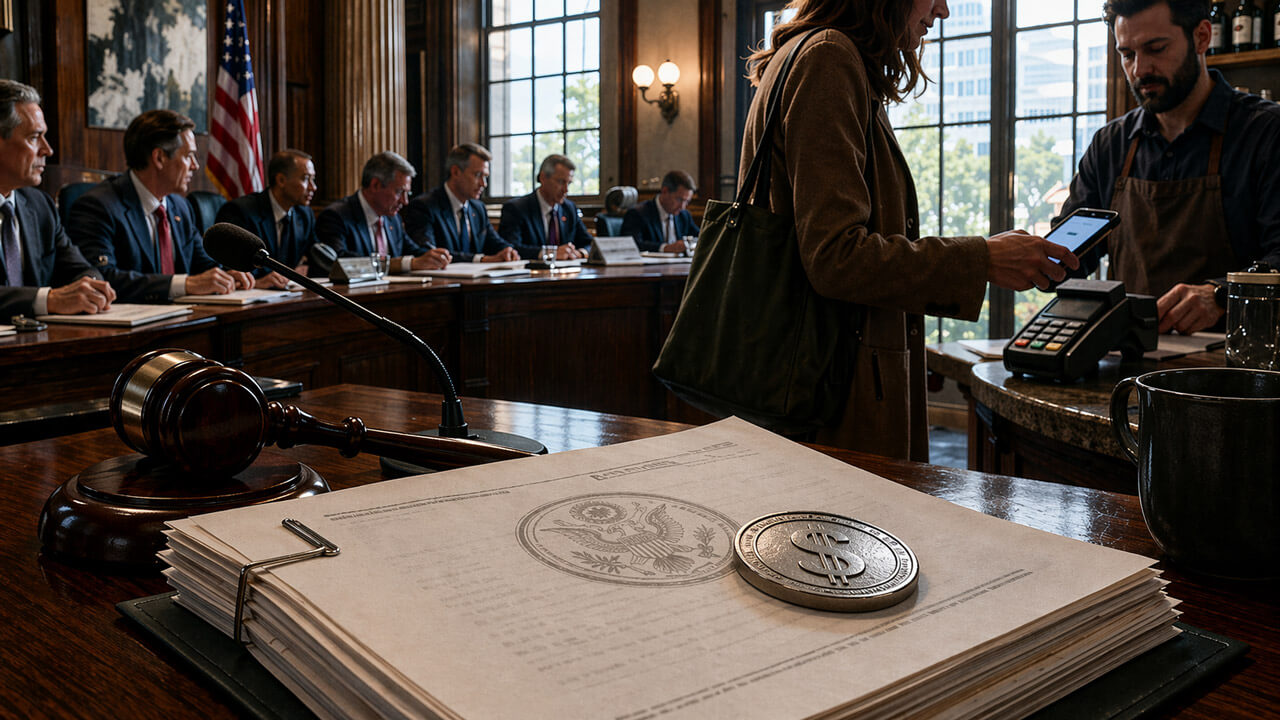
Congressional hearing room with U.S. documents and a dollar coin in the foreground as a woman pays by phone, symbolizing stablecoins becoming easier to use while Bitcoin still awaits regulatory clarity
Legal and Regulatory

Congress on verge of making regulated dollar stablecoins act almost like digital cash

April 19, 2026No Comments8 Mins Read
Share
Facebook Twitter LinkedIn Pinterest Email

Washington isn’t trying to solve every crypto policy fight at once, but it appears to be carving out a workable path for one specific category of digital asset: the regulated, dollar-pegged stablecoin.

The GENIUS Act established the first federal regulatory framework for payment stablecoins, and a bipartisan House tax discussion draft now proposes friendlier tax treatment for those same tokens when people actually use them.

Together, the two efforts point toward a deliberate, stablecoins-first lane in American crypto policy that could reshape how users, merchants, and issuers interact with digital dollars in the years ahead.

What the stablecoin tax draft actually proposes

The draft legislation is the Digital Asset PARITY Act, a bipartisan discussion draft first released in December 2025 by Representatives Max Miller (R-Ohio) and Steven Horsford (D-Nevada), both members of the House Ways and Means Committee. An updated version was re-released on March 26, 2026, with significant revisions to its core stablecoin provision.

In the revised March draft, gains from selling a “regulated payment stablecoin” generally wouldn’t be included in gross income, and losses wouldn’t be recognized, unless the taxpayer’s basis in the token falls below 99% of its redemption value.

For exchanges, the recipient would take a deemed basis of $1. To qualify, the stablecoin must be issued by a permitted payment stablecoin issuer under the GENIUS Act, pegged only to the US dollar, and have demonstrated tight price stability over the prior 12 months. Brokers and dealers are excluded.

For ordinary people, this means spending a qualifying dollar stablecoin could stop triggering a small, irritating tax event every time the token’s value drifts a fraction of a cent.

The draft is trying to give stable, regulated dollar tokens the kind of practical flexibility that cash already enjoys, rather than subjecting every micro-fluctuation to the capital gains framework applied to volatile crypto assets.

This is a narrow carve-out for tokens that behave, by design and by regulation, as digital representations of the dollar.

Why the GENIUS Act is the foundation

The tax draft can’t be understood in isolation because its scope is explicitly tied to the regulated stablecoin category that the GENIUS Act already created.

That law, which passed the Senate 68-30 and the House 308-122 with substantial bipartisan support, established who can issue payment stablecoins in the United States, what reserves they must hold, and what compliance obligations they must meet. It requires 100% reserve backing with liquid assets, subjects issuers to Bank Secrecy Act obligations, and mandates all kinds of anti-money-laundering and sanctions compliance programs.

See also  Coinbase to List First AUD and SGD Denominated Stablecoins on Sep 29

The regulatory machinery behind this new draft is already moving.

The OCC proposed its implementing rules in early March 2026, covering standards for reserves, capital, liquidity, and risk management. Treasury and FinCEN/OFAC followed in April with a joint proposed rule establishing anti-money-laundering and sanctions compliance requirements for permitted payment stablecoin issuers. The FDIC has also begun laying out application procedures for FDIC-supervised institutions seeking to issue payment stablecoins through subsidiaries.

The tax draft’s own explanatory notes acknowledge that its narrow focus on regulated payment stablecoins follows existing statute, specifically citing the GENIUS Act.

Congress appears to be building in sequence: first define the legal stablecoin, then make it practical to use.

No stablecoin issuer has received formal “permitted payment stablecoin issuer” status yet, because the regulatory machinery is still being assembled, and final implementing rules aren’t required until July 2026.

But the leading candidates are already visible.

Circle’s USDC is the clearest frontrunner: the company already publishes monthly reserve attestations verified by a Big Four accounting firm, holds reserves in US Treasuries and cash at regulated banks, and operates under existing state money transmitter licenses. USDC is widely expected to meet GENIUS Act compliance requirements without any major structural changes.

Rather than restructuring USDT for US compliance, Tether took a different route by launching USA₮ in January 2026 through Anchorage Digital Bank, creating a separate US-compliant token rather than restructuring its offshore flagship.

The GENIUS Act also opened a door that didn’t previously exist for traditional banks.

Any FDIC-insured institution can now apply to issue payment stablecoins through a subsidiary, and some major players are already exploring that path. JPMorgan’s blockchain arm Kinexys has been developing a deposit token aimed at institutional on-chain settlements, and Bank of America has publicly described stablecoin regulation as the beginning of a multi-year shift toward on-chain banking.

If those efforts produce tokens that qualify under the GENIUS Act’s framework, they would also be eligible for the PARITY Act’s proposed tax treatment. While it’s unlikely that these bank-issued stablecoins would see the kind of volumes USDC and USDT have, it’s still a significant change for the stablecoin market that has been dominated by crypto-native issuers since its inception.

See also  Will the CLARITY Act trigger a crypto market rally?

What this means for users, merchants, and issuers

The benefit this will have for users is straightforward friction reduction.

Under the current framework, every sale or exchange of a digital asset can generate a reportable gain or loss, no matter how trivial.

The PARITY Act draft is aimed at eliminating that burden for qualifying regulated dollar stablecoins, because tiny value fluctuations around $1 would generally stop being a tax problem.

If the token stays close enough to its peg and the user acquired it near $1, the special rule would apply. If the token breaks away from the peg and the transaction occurs outside that narrow band, it wouldn’t.

The benefit for merchants is simpler acceptance. A payment method works better when customers don’t feel that every transaction creates an accounting problem, and stablecoins have struggled with that perception in the US for years.

If the tax treatment becomes simpler for customers, merchants have one less obstacle when considering stablecoin adoption.

But issuers would be the ones who would most likely benefit the most, as this combination of acceptance and regulation could be quite transformative.

The GENIUS Act provides the rulebook: permitted issuers know what reserves they need, what compliance programs they must run, and what regulators expect.

But a stablecoin issuer’s business model only works if people actually hold and spend the token. If the tax draft passes, compliant issuers would have a considerably stronger case that their tokens are practical to use in everyday American commerce, and that distinction between regulatory permission and real-world usability is exactly where the commercial value sits.

However, it’s important to note that a discussion draft isn’t law. It’s much closer to a public working version of a bill, released by lawmakers to signal policy direction, invite feedback, and test political support before formal legislative movement.

The PARITY Act still contains explanatory notes and unfinished technical provisions, showing that the policy ideas behind it are real, but the legislative language is still being refined. Representatives Miller and Horsford said they intend to introduce the draft as a formal bill, and there’s been discussion about crypto tax provisions potentially fitting into a broader reconciliation package, but passage isn’t guaranteed.

See also  Crypto Lobbyists Pitching Trump on Getting Things Done During Congress' Uncertainty

The draft shows where influential lawmakers want policy to go, and discussion drafts can carry political weight without becoming law quickly, or at all.

What happens to stablecoins either way

If the PARITY Act’s stablecoin provision becomes law, certain regulated dollar stablecoins would become genuinely easier to use in routine transactions across the US economy. The bill text indicates the provision would apply to taxable years beginning after Dec. 31, 2025.

If it fails, it most likely won’t cause any negative effects for stablecoins.

The GENIUS Act is already law, and implementation is moving through Treasury, the OCC, the FDIC, and FinCEN. Issuers would still have a federal regulatory framework to operate under, and the infrastructure buildout would continue.

What would be missing is the tax simplification layer for users and businesses. The US could still become a regulated stablecoin market without becoming an easy-to-use stablecoin payment market.

The system would have legal rails for issuers, but retail users and merchants would continue facing the kind of tax ambiguity that discourages routine adoption.

Without the tax piece, the country may regulate stablecoins faster than it normalizes using them.

That tension captures the central question in American stablecoin policy right now. The country has already defined what a legal stablecoin is and who can issue one. What remains undecided is whether those regulated dollar stablecoins will sit as licensed financial products on a regulatory shelf or function as everyday digital dollars that people and businesses can use without hesitation.

The GENIUS Act built the framework. The tax draft, if it ever becomes law, would bridge the gap between regulation and routine use, and that gap is exactly where the future of American stablecoin payments will be decided.

The post Congress on verge of making regulated dollar stablecoins act almost like digital cash appeared first on CryptoSlate.

Act Cash Congress digital dollar Making regulated Stablecoins Verge
Share. Facebook Twitter Pinterest LinkedIn Tumblr Email

Related Posts

Consensys Urges SEC to Exempt Self-Custody Wallets, Citing Regulatory Gap for 99% of Tokens

May 14, 2026

Three men charged in US over crypto wrench attack spree

May 13, 2026

CLARITY Act faces 100+ amendments as bankers send 8,000 demand letters against stablecoin rewards

May 13, 2026

Bhutan’s GMC offers quick licenses, bank accounts to lure crypto firms

May 13, 2026
Add A Comment
Leave A Reply Cancel Reply

Top Posts

GaFin Joins Cyber Crash to Advance Web3 Gaming

September 7, 2025

Chainlink Co-Founder Explains How Chainlink Standards Cut Transaction Complexity by 90%

September 24, 2025

Stay ahead with the latest crypto news, market updates, blockchain insights, and trends. Your trusted source for everything happening in the digital asset world.


We're social. Connect with us:

Facebook X (Twitter) Instagram Pinterest YouTube
Top Insights

Consensys Urges SEC to Exempt Self-Custody Wallets, Citing Regulatory Gap for 99% of Tokens

May 14, 2026

UBOX Taps ClawWorks to Accelerate Independent AI Agent Economics

May 14, 2026

Analyst Says No Reason for Bitcoin Reversal, Sees BTC Approaching Next Resistance Levels – Here Are His Targets

May 14, 2026
Get Informed

Subscribe to Updates

Get the latest creative news From Free.cc directly in your Inbox!

  • Contact
  • Privacy Policy
  • Terms & Conditions
  • Disclosure
© 2026 free.cc - All rights reserved.

Type above and press Enter to search. Press Esc to cancel.