Close Menu
  • Latest News
    • Bitcoin
    • Ethereum
    • Altcoins
    • Meme Coins
  • Tech
    • Blockchain
    • Security and Privacy
  • Web 3
    • Gaming
  • Legal
    • Legal and Regulatory
    • Adoption
  • Analysis
  • Learn
    • Education
    • Wallets and Exchanges
  • Tools
    • Market Overview
    • Exchange Tool
  • INFO@FREE.CC
What's Hot

Western Union teams up with Crossmint to expand USDPT stablecoin access on Solana

March 6, 2026

Bitcoin Rally May Be Setting Up A Macro Lower High, Analyst Says

March 6, 2026

Bitcoin volatility could explode in April as SEC reviews the market behind ETF leverage

March 6, 2026
Facebook X (Twitter) Instagram
  • Contact
  • Privacy Policy
  • Terms & Conditions
  • Disclosure
Facebook X (Twitter) Instagram
Free.cc (Free Cryptocurrency)Free.cc (Free Cryptocurrency)
  • Latest News
    1. Bitcoin
    2. Ethereum
    3. Altcoins
    4. Meme Coins
    5. View All

    Solo Satoshi Launches Bitaxe Turbo Touch, An Open-Source Touchscreen Bitcoin Miner

    March 6, 2026

    Bitcoin holds $70K, but BTC bull market isn’t back: Here’s why

    March 6, 2026

    Bitcoin Miners Sell 15K BTC After $126K High, Is This the Reason Why Bitcoin is Dropping

    March 6, 2026

    OKX is building a social network directly into its trading app after a massive $25 billion valuation

    March 6, 2026

    Top Analyst Reveals What’s Next For Bitcoin, Ethereum and XRP

    March 5, 2026

    Ethereum Price Analysis: Institutional Buying Returns as Whales Accumulate

    March 5, 2026

    Ethereum Hovers at $2,150 — Can ETH Price Rally to $2,400 or Stall Below $2,200?

    March 5, 2026

    Vitalik Buterin Admits Ethereum Hasn’t Meaningfully Improved People’s Lives

    March 5, 2026

    Bitcoin Rally May Be Setting Up A Macro Lower High, Analyst Says

    March 6, 2026

    Bank Resistance Puts 2026 Passage Of Crypto Market Structure Bill In Doubt, Reuters

    March 6, 2026

    How Extreme Negative Funding Is Priming XRP For A High-Velocity Trend Reversal

    March 6, 2026

    Bitcoin Liquidity Set To Expand With Morgan Stanley BTC ETF Option

    March 6, 2026

    Crypto Interest Rising Toward Meme Coin Sector

    January 9, 2026

    Memes Market Cap Adds $10B in Days: Fresh Capital or Dead-Cat-Bounce?

    January 5, 2026

    Meme Coin Market Surges Past $45B as Shiba Inu, PEPE, BONK Stage 54% Price Pump

    January 4, 2026

    US Ranks #1 in CoinGecko Global Meme Coin Interest Report

    December 18, 2025

    Western Union teams up with Crossmint to expand USDPT stablecoin access on Solana

    March 6, 2026

    Bitcoin Rally May Be Setting Up A Macro Lower High, Analyst Says

    March 6, 2026

    Bitcoin volatility could explode in April as SEC reviews the market behind ETF leverage

    March 6, 2026

    Solo Satoshi Launches Bitaxe Turbo Touch, An Open-Source Touchscreen Bitcoin Miner

    March 6, 2026
  • Tech
    1. Blockchain
    2. Security and Privacy
    3. View All

    Western Union teams up with Crossmint to expand USDPT stablecoin access on Solana

    March 6, 2026

    The Protocol: New Ethereum scaling plans

    March 6, 2026

    EtherMail adds email identity for AI agents

    March 6, 2026

    Pi Network Co-Founder Unveils Crucial KYC Updates Every Pioneer Needs to Know

    March 6, 2026

    Leaked Database Sheds Light on Iranian Crypto Sanctions Evasion

    March 4, 2026

    DOJ seizures of $580M expose how crypto investment scams scaled into shift work with quotas and scripts

    March 3, 2026

    Aeternum Botnet Shifts Command Control to Polygon Blockchain

    February 27, 2026

    Former Defense Contractor Boss Gets 7+ Years for Selling Zero Days

    February 26, 2026

    Western Union teams up with Crossmint to expand USDPT stablecoin access on Solana

    March 6, 2026

    Bitcoin Rally May Be Setting Up A Macro Lower High, Analyst Says

    March 6, 2026

    Bitcoin volatility could explode in April as SEC reviews the market behind ETF leverage

    March 6, 2026

    Solo Satoshi Launches Bitaxe Turbo Touch, An Open-Source Touchscreen Bitcoin Miner

    March 6, 2026
  • Web 3
    1. Gaming
    2. View All

    Crypto Payroll in 2026: Stablecoins Are Rewiring Global Paychecks

    March 6, 2026

    SuperRare Liquid Editions: The Next Evolution of NFTs

    March 6, 2026

    METYA Partners With Kult Games to Expand Web3 Gaming Ecosystem

    March 6, 2026

    AurumX Collaborates with FishWar to Redefine Web3-Based Gaming Economies

    March 5, 2026

    Western Union teams up with Crossmint to expand USDPT stablecoin access on Solana

    March 6, 2026

    Bitcoin Rally May Be Setting Up A Macro Lower High, Analyst Says

    March 6, 2026

    Bitcoin volatility could explode in April as SEC reviews the market behind ETF leverage

    March 6, 2026

    Solo Satoshi Launches Bitaxe Turbo Touch, An Open-Source Touchscreen Bitcoin Miner

    March 6, 2026
  • Legal
    1. Legal and Regulatory
    2. Adoption
    3. View All

    Bitcoin volatility could explode in April as SEC reviews the market behind ETF leverage

    March 6, 2026

    Russian Central Bank Proposes Allowing Banks and Brokers to Obtain Crypto Licenses

    March 6, 2026

    Strategic Move Brings Former FINRA Examiner Justin Vose to Lead RWA Regulation

    March 6, 2026

    Coinbase Board and CEO Brian Armstrong Face Shareholder Lawsuit

    March 6, 2026

    XRP and XRPL get a credibility lift from Ripple’s expanding footprint

    March 5, 2026

    XRP rewrites the playbook for altcoin ETF approvals to surge in late 2026 after a wave of futures listings

    March 4, 2026

    Bitcoin ETF custody concentrates power in one place, and now a single operational failure causes dangerous ripples

    March 3, 2026

    Revolut’s stablecoin test targets its 12M UK users

    March 3, 2026

    Western Union teams up with Crossmint to expand USDPT stablecoin access on Solana

    March 6, 2026

    Bitcoin Rally May Be Setting Up A Macro Lower High, Analyst Says

    March 6, 2026

    Bitcoin volatility could explode in April as SEC reviews the market behind ETF leverage

    March 6, 2026

    Solo Satoshi Launches Bitaxe Turbo Touch, An Open-Source Touchscreen Bitcoin Miner

    March 6, 2026
  • Analysis

    Bitcoin miners’ AI pivot draws billion-dollar Wall Street bets

    March 6, 2026

    JPMorgan Chase Says One Asset Could ‘Quickly’ Surge Amid Middle East Conflict – And It’s Not Oil or Gold

    March 6, 2026

    XRP Price Consolidates Under $1.5 — What Could Drive the Next Move to $2?

    March 5, 2026

    Israel’s weekly $3B Iran war cost equals over 41,000 Bitcoin

    March 5, 2026

    Chainlink Price Gains Attention After Visa e-HKD Pilot and LINK Chart Signals Possible Breakout

    March 5, 2026
  • Learn
    1. Education
    2. Wallets and Exchanges
    3. View All

    What Is Strategy (MSTR)? The Bitcoin Treasury Company

    February 21, 2026

    What Are Prediction Markets? How Polymarket, Kalshi and Myriad Work

    February 13, 2026

    What Is Farcaster? The Decentralized Social Media Protocol

    February 10, 2026

    What Is Venice AI? The Privacy-Focused Chatbot

    January 13, 2026

    Crypto platform aims to let retail investors buy IPO shares at the same price as Wall Street insiders

    March 6, 2026

    The company holding all Bitcoin ETF coins is losing money, resurfacing questions about centralization

    February 21, 2026

    The Bitcoin CME gap will now close forever in May leaving a return to $84k hanging

    February 21, 2026

    Robinhood’s $221 million crypto revenue drop shows crypto winter isn’t on chain and retail already moved

    February 16, 2026

    Western Union teams up with Crossmint to expand USDPT stablecoin access on Solana

    March 6, 2026

    Bitcoin Rally May Be Setting Up A Macro Lower High, Analyst Says

    March 6, 2026

    Bitcoin volatility could explode in April as SEC reviews the market behind ETF leverage

    March 6, 2026

    Solo Satoshi Launches Bitaxe Turbo Touch, An Open-Source Touchscreen Bitcoin Miner

    March 6, 2026
  • Tools
    • Market Overview
    • Exchange Tool
  • INFO@FREE.CC
Free.cc (Free Cryptocurrency)Free.cc (Free Cryptocurrency)
Home»Bitcoin»Cluster Mempool, Problems Are Easier In Chunks
Bitcoin

Cluster Mempool, Problems Are Easier In Chunks

February 21, 2026No Comments8 Mins Read
Share
Facebook Twitter LinkedIn Pinterest Email

Cluster Mempool1 is a complete reworking of how the mempool handles organizing and sorting transactions, conceptualized and implemented by Suhas Daftuar and Pieter Wuille. The design aims to simplify the overall architecture, better align transaction sorting logic with miner incentives, and improve security for second layer protocols. It was merged into Bitcoin Core in PR #336292 on November 25, 2025. 

The mempool is a giant set of pending transactions that your node has to keep track of for a number of reasons: fee estimation, transaction replacement validation, and block construction if you’re a miner. 

This is a lot of different goals for a single function of your node to service. Bitcoin Core up to version 30.0 organizes the mempool in two different ways to help aid in these functions, both from the relative point of view of any given transaction: combined feerate looking forward of the transaction and its children (descendant feerate), and combined feerate looking backwards of the transaction and its parents (ancestor feerate). 

These are used to decide which transactions to evict from your mempool when it’s full, and which to include first when constructing a new block template. 

How Is My Mempool Managed?

When a miner is deciding whether to include a transaction in their block, their node looks at that transaction, and any ancestors that must be confirmed first for it to be valid in a block, and look at the average feerate per byte across all of them together considering the individual fees they paid as a whole. If that group of transactions fits within the blocksize limit while outcompeting others in fees, it is included in the next block. This is done for every transaction.

When your node is deciding which transactions to evict from its mempool when it is full, it looks at each transaction and any children it has, evicting the transaction and all its children if the mempool is already full with transactions (and their descendants) paying a higher feerate. 
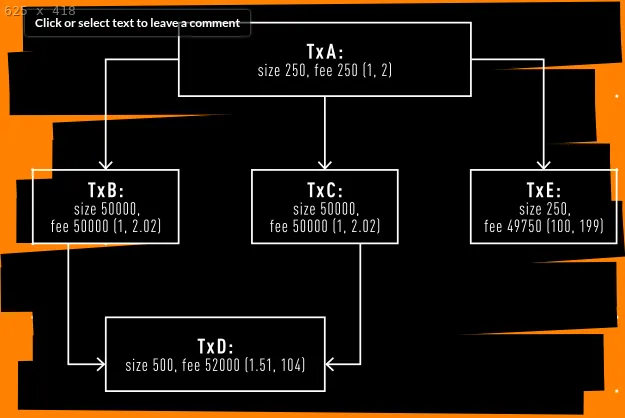
Look at the above example graph of transactions, the feerates are shown as such in parentheses (ancestor feerate, descendant feerate). A miner looking at transaction E would likely include it in the next block, a small transaction paying a very high fee with a single small ancestor. However, if a node’s mempool was filling up, it would look at transaction A with two massive children paying a low relative fee, and likely evict it or not accept and keep it if it was just received. 

See also  Trump-linked Truth Social seeks SEC approval for two crypto ETFs

These two rankings, or orderings, are completely at odds with each other. The mempool should reliably propagate what miners will mine, and users should be confident that their local mempool accurately predicts what miners will mine. 

The mempool functioning in this way is important for:

  • Mining decentralization: getting all miners the most profitable set of transactions
  • User reliability: accurate and reliable fee estimation and transaction confirmation times
  • Second layer security: reliable and accurate execution of second layer protocols’ on-chain enforcement transactions

The current behavior of the mempool does not fully align with the reality of mining incentives, which creates blind spots that can be problematic for second layer security by creating uncertainty as to whether a transaction will make it to a miner, as well as pressure for non-public broadcasting channels to miners, potentially worsening the first problem. 

This is especially problematic when it comes to replacing unconfirmed transactions, either simply to incentivize miners to include a replacement sooner, or as part of a second layer protocol being enforced on-chain. 

Replacement per the existing behavior becomes unpredictable depending on the shape and size of the web of transactions yours is caught in. In a simple fee-bumping situation this can fail to propagate and replace a transaction, even when mining the replacement would be better for a miner. 

In the context of second layer protocols, the current logic allows participants to potentially get necessary ancestor transactions evicted from the mempool, or make it not possible for another participant to submit a necessary child transaction to the mempool under the current rules because of child transactions the malicious participant created, or the eviction of necessary ancestor transactions. 

All of these problems are the result of these inconsistent inclusion and eviction rankings and the incentive misalignments they create. Having a single global ranking would fix these issues, but globally reordering the entire mempool for every new transaction is impractical. 

It’s All Just A Graph
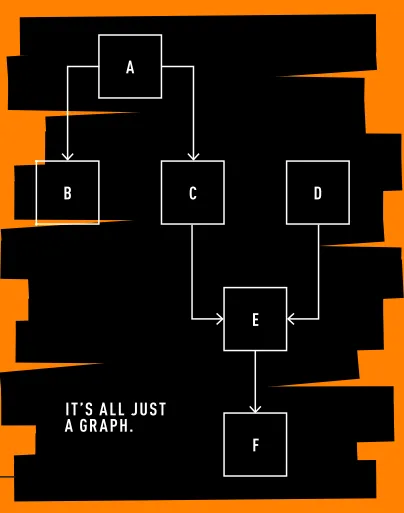
Transactions that depend on each other are a graph, or a directed series of “paths.” When a transaction spends outputs created by another in the past, it is linked with that past transaction. When it additionally spends outputs created by a second past transaction, it links both of the historical transactions together. 

See also  Singularity Compute Reveals Pioneering NVIDIA GPU Cluster for Enterprise Workloads

When unconfirmed, chains of transactions like this must have the earlier transactions confirmed first for the later ones to be valid. After all, you can’t spend outputs that haven’t been created yet. 

This is an important concept for understanding the mempool, it is explicitly ordered directionally. 

It’s all just a graph. 

Chunks Make Clusters Make Mempools
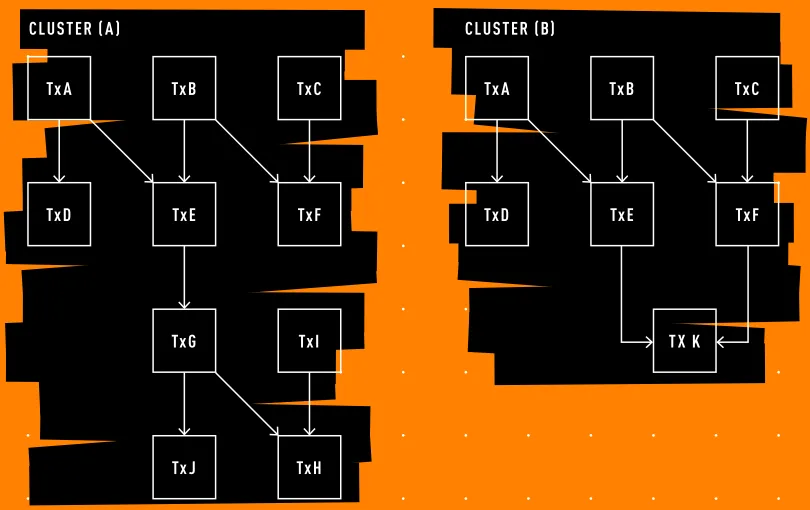
In cluster mempool, the concept of a cluster is a group of unconfirmed transactions that are directly related to each other, i.e. spending outputs created by others in the cluster or vice versa. This becomes a fundamental unit of the new mempool architecture. Analyzing and ordering the entire mempool is an impractical task, but analyzing and ordering clusters is a much more manageable one. 

Each cluster is broken down into chunks, small sets of transactions from the cluster, which are then sorted in order of highest feerate per byte to lowest, respecting the directional dependencies. So for instance, let’s say from highest to lowest feerate the chunks in cluster (A) are: [A,D], [B,E], [C,F], [G, J], and last [I, H]. 

This allows pre-sorting all of these chunks and clusters, and more efficient sorting of the whole mempool in the process. 

Miners can now simply grab the highest feerate chunks from every cluster and put them into their template, if there is still room they can go down to the next highest feerate chunks, continuing until the block is roughly full and just needs to figure out the last few transactions it can fit. This is roughly the optimal block template construction method assuming access to all available transactions. 

When nodes’ mempools get full, they can simply grab the lowest feerate chunks from every cluster, and start evicting those from their mempool until it is not over the configured limit. If that was not enough, it moves on to the next lowest feerate chunks, and so on, until it is within its mempool limits. Done this way it removes strange edge cases out of alignment with mining incentives. 

Replacement logic is also drastically simplified. Compare cluster (A) to cluster (B) where transaction K has replaced G, I, J, and H. The only criteria that needs to be met is the new chunk [K] must have a higher chunk feerate than [G, J] and [I, H], [K] must pay more in total fees than [G, J, I, H], and K cannot go over an upper limit of how many transactions it is replacing. 

See also  $40B erased in 4 months: Is Strategy’s Bitcoin bet backfiring?

In a cluster paradigm all of these different uses are in alignment with each other. 

The New Mempool

This new architecture allows us to simplify transaction group limits, removing previous limitations on how many unconfirmed ancestors a transaction in the mempool can have and replacing them with a global cluster limit of 64 transactions and 101 kvB per cluster. 

This limit is necessary in order to keep the computational cost of pre-sorting the clusters and their chunks low enough to be practical for nodes to perform on a constant basis. 

This is the real key insight of cluster mempool. By keeping the chunks and clusters relatively small, you simultaneously make the construction of an optimal block template cheap, simplify transaction replacement logic (fee-bumping) and therefore improve second layer security, and fix eviction logic, all at once. 

No more expensive and slow on the fly computation for template building, or unpredictable behavior in fee-bumping. By fixing the misalignment of incentives in how the mempool was managing transaction organization in different situations, the mempool functions better for everyone. 

Cluster mempool is a project that has been years-long in the making, and will make a material impact on ensuring profitable block templates are open to all miners, that second layer protocols have sound and predictable mempool behaviors to build on, and that Bitcoin can continue functioning as a decentralized monetary system. 

For those interesting in diving deeper into the nitty gritty of how cluster mempool is implemented and works under the hood, here are two Delving Bitcoin threads you can read:

High Level Implementation Overview (With Design Rationale): https://delvingbitcoin.org/t/an-overview-of-the-cluster-mempool-proposal/393 

How Cluster Mempool Feerate Diagrams Work: https://delvingbitcoin.org/t/mempool-incentive-compatibility/553 

Get your copy of The Core Issue today!

Don’t miss your chance to own The Core Issue — featuring articles written by many Core Developers explaining the projects they work on themselves!

This piece is the Letter from the Editor featured in the latest Print edition of Bitcoin Magazine, The Core Issue. We’re sharing it here as an early look at the ideas explored throughout the full issue.

[1] https://github.com/bitcoin/bitcoin/issues/27677 

[2] https://github.com/bitcoin/bitcoin/pull/33629 

Chunks Cluster Easier Mempool Problems
Share. Facebook Twitter Pinterest LinkedIn Tumblr Email

Related Posts

Solo Satoshi Launches Bitaxe Turbo Touch, An Open-Source Touchscreen Bitcoin Miner

March 6, 2026

Bitcoin holds $70K, but BTC bull market isn’t back: Here’s why

March 6, 2026

Bitcoin Miners Sell 15K BTC After $126K High, Is This the Reason Why Bitcoin is Dropping

March 6, 2026

OKX is building a social network directly into its trading app after a massive $25 billion valuation

March 6, 2026
Add A Comment
Leave A Reply Cancel Reply

Top Posts

XRP Price Action Hints at 50% Upside Despite Open Interest at 6-Month Low

January 2, 2026

Sam Bankman-Fried voices support for Republicans from prison

February 1, 2026

Stay ahead with the latest crypto news, market updates, blockchain insights, and trends. Your trusted source for everything happening in the digital asset world.


We're social. Connect with us:

Facebook X (Twitter) Instagram Pinterest YouTube
Top Insights

Western Union teams up with Crossmint to expand USDPT stablecoin access on Solana

March 6, 2026

Bitcoin Rally May Be Setting Up A Macro Lower High, Analyst Says

March 6, 2026

Bitcoin volatility could explode in April as SEC reviews the market behind ETF leverage

March 6, 2026
Get Informed

Subscribe to Updates

Get the latest creative news From Free.cc directly in your Inbox!

  • Contact
  • Privacy Policy
  • Terms & Conditions
  • Disclosure
© 2026 free.cc - All rights reserved.

Type above and press Enter to search. Press Esc to cancel.