
Close Menu
  • Latest News
    • Bitcoin
    • Ethereum
    • Altcoins
    • Meme Coins
  • Tech
    • Blockchain
    • Security and Privacy
  • Web 3
    • Gaming
  • Legal
    • Legal and Regulatory
    • Adoption
  • Analysis
  • Learn
    • Education
    • Wallets and Exchanges
  • Tools
    • Market Overview
    • Exchange Tool
  • INFO@FREE.CC
What's Hot

BTC ETFs lose $635 million in a single day. What next?

May 14, 2026

Ethereum Holders Take Profits as ETH Price Drops 5%—Is Selling Pressure Starting to Rise?

May 14, 2026

Bitcoin Risk Appetite Has Crashed Since October 2025

May 14, 2026
Facebook X (Twitter) Instagram
  • Contact
  • Privacy Policy
  • Terms & Conditions
  • Disclosure
Facebook X (Twitter) Instagram
Free.cc (Free Cryptocurrency)Free.cc (Free Cryptocurrency)
  • Latest News
    1. Bitcoin
    2. Ethereum
    3. Altcoins
    4. Meme Coins
    5. View All

    BTC ETFs lose $635 million in a single day. What next?

    May 14, 2026

    Senate Confirms Bitcoin Friendly Kevin Warsh As Fed Chair Ahead Of Clarity Act Vote

    May 14, 2026

    Exodus slashes Bitcoin holdings by 50% in Q1 2026 – Is BTC’s volatility why?

    May 14, 2026

    ZachXBT Names Teen Behind $19 Million Crypto Theft Who Flaunted It On Instagram

    May 14, 2026

    Ethereum Holders Take Profits as ETH Price Drops 5%—Is Selling Pressure Starting to Rise?

    May 14, 2026

    Bitcoin, Ethereum and XRP Price Analysis: What’s Coming Next?

    May 13, 2026

    Wells Fargo Boosts Ethereum ETF Holdings in Q1

    May 13, 2026

    Why Market Experts Are Still Predicting A Rise Above $10,000

    May 13, 2026

    Bitcoin Risk Appetite Has Crashed Since October 2025

    May 14, 2026

    XRP Holds Key Level, But Binance Flow Data Signals Weakening Demand

    May 14, 2026

    Bitcoin Just Entered A Deceptive Territory, Here’s What You Should Know

    May 14, 2026

    XRP Ledger Hits Record High In 10K+ Wallets: Santiment

    May 13, 2026

    Meme Coin Market Faces Imbalance as Supply Rises, Demand Falls

    April 4, 2026

    Crypto Interest Rising Toward Meme Coin Sector

    January 9, 2026

    Memes Market Cap Adds $10B in Days: Fresh Capital or Dead-Cat-Bounce?

    January 5, 2026

    Meme Coin Market Surges Past $45B as Shiba Inu, PEPE, BONK Stage 54% Price Pump

    January 4, 2026

    BTC ETFs lose $635 million in a single day. What next?

    May 14, 2026

    Ethereum Holders Take Profits as ETH Price Drops 5%—Is Selling Pressure Starting to Rise?

    May 14, 2026

    Bitcoin Risk Appetite Has Crashed Since October 2025

    May 14, 2026

    U.S. CFTC in talks with every major pro sports league on policing prediction markets

    May 14, 2026
  • Tech
    1. Blockchain
    2. Security and Privacy
    3. View All

    Monad Backs Stablecoin Startup Rain for Global Visa Payments

    May 14, 2026

    Stables Taps T-0 Network as Asia’s 60% Stablecoin Payment Share Tests USDT Rails

    May 14, 2026

    UBOX Taps ClawWorks to Accelerate Independent AI Agent Economics

    May 14, 2026

    UXLINK And Origins Network Partner To Power Scalable AI-Driven Web3 Applications Using Decentralized Computing

    May 13, 2026

    Ripple Shares DPRK Threat Data on Fraud Domains, Wallets, Campaigns

    May 5, 2026

    Digital Asset Security Moves Beyond Keys as Bitgo Adds 5-Layer Checks

    May 1, 2026

    Defillama Confirms April 2026 as Crypto’s Most-Hacked Month With 30 Incidents

    May 1, 2026

    Malicious npm Dependency Linked to AI Assisted Commit Targets Crypto W

    April 29, 2026

    BTC ETFs lose $635 million in a single day. What next?

    May 14, 2026

    Ethereum Holders Take Profits as ETH Price Drops 5%—Is Selling Pressure Starting to Rise?

    May 14, 2026

    Bitcoin Risk Appetite Has Crashed Since October 2025

    May 14, 2026

    U.S. CFTC in talks with every major pro sports league on policing prediction markets

    May 14, 2026
  • Web 3
    1. Gaming
    2. View All

    NUMINE Joins Outer Ring MMO for the Expansion of Web3 Gaming Experiences

    May 13, 2026

    GMatrixs And MiniverseCore Join Forces To Unlock Web3 Gaming Experience With Cross-Chain DApp, DeFi Applications

    May 11, 2026

    The Identity Crisis of 2026: NFTs, AI Agents and Trust on the Agentic Web

    May 11, 2026

    DTCC’s May 2026 Tokenization Announcement Explained: What It Means for U.S. Securities and Real-World Assets

    May 11, 2026

    BTC ETFs lose $635 million in a single day. What next?

    May 14, 2026

    Ethereum Holders Take Profits as ETH Price Drops 5%—Is Selling Pressure Starting to Rise?

    May 14, 2026

    Bitcoin Risk Appetite Has Crashed Since October 2025

    May 14, 2026

    U.S. CFTC in talks with every major pro sports league on policing prediction markets

    May 14, 2026
  • Legal
    1. Legal and Regulatory
    2. Adoption
    3. View All

    U.S. CFTC in talks with every major pro sports league on policing prediction markets

    May 14, 2026

    What Is the CLARITY Act? The US Crypto Bill That Could Reshape Digital Asset Regulation This Week

    May 14, 2026

    Michael Saylor Says the Transparency Act in the US Congress Will Positively Impact Bitcoin! Here Are the Details

    May 14, 2026

    Consensys Urges SEC to Exempt Self-Custody Wallets, Citing Regulatory Gap for 99% of Tokens

    May 14, 2026

    Tether launches decentralized local AI using Isaac Asimov’s Psychohistory straight out of Foundation

    May 11, 2026

    Has Donald Trump been a net positive for Bitcoin or created an unbreakable partisan divide?

    May 10, 2026

    BlackRock looks to sidestep Clarity yield issues, filing for two new tokenized money market funds

    May 10, 2026

    Cardano’s Charles Hoskinson says the future of crypto wallets will be inside iPhones and Androids

    May 8, 2026

    BTC ETFs lose $635 million in a single day. What next?

    May 14, 2026

    Ethereum Holders Take Profits as ETH Price Drops 5%—Is Selling Pressure Starting to Rise?

    May 14, 2026

    Bitcoin Risk Appetite Has Crashed Since October 2025

    May 14, 2026

    U.S. CFTC in talks with every major pro sports league on policing prediction markets

    May 14, 2026
  • Analysis

    Bitcoin (BTC) Price Loses Critical $80K Level as Crypto Markets Turn Bearish—What’s Next?

    May 14, 2026

    Trump’s CEO-filled China visit can decide whether Bitcoin’s $80,000 risk rally survives this week

    May 14, 2026

    Wall Street is buying XRP while Binance traders keep betting against it

    May 13, 2026

    Is a Drop Below $1 Coming Next?

    May 13, 2026

    UB Price Breakout Enters Discovery Phase

    May 13, 2026
  • Learn
    1. Education
    2. Wallets and Exchanges
    3. View All

    What’s on the Ethereum Roadmap: Glamsterdam, Hegota and Beyond

    March 30, 2026

    What Is Bluesky? The Decentralized Social Media Rival to Elon Musk’s X

    March 27, 2026

    What Is Strategy (MSTR)? The Bitcoin Treasury Company

    February 21, 2026

    What Are Prediction Markets? How Polymarket, Kalshi and Myriad Work

    February 13, 2026

    Coinbase went down for over 5 hours after missing earnings. Bulls still see a path to $300 billion by 2030

    May 8, 2026

    Coinbase cuts 14% of staff as Armstrong ties cost reset to AI and market volatility

    May 6, 2026

    Bitcoin is still in charge

    May 3, 2026

    CLARITY Act stablecoin fight shifts from yield to who captures digital-dollar economics

    April 29, 2026

    BTC ETFs lose $635 million in a single day. What next?

    May 14, 2026

    Ethereum Holders Take Profits as ETH Price Drops 5%—Is Selling Pressure Starting to Rise?

    May 14, 2026

    Bitcoin Risk Appetite Has Crashed Since October 2025

    May 14, 2026

    U.S. CFTC in talks with every major pro sports league on policing prediction markets

    May 14, 2026
  • Tools
    • Market Overview
    • Exchange Tool
  • INFO@FREE.CC
Free.cc (Free Cryptocurrency)Free.cc (Free Cryptocurrency)
Home»Legal and Regulatory»Central Bank of Brazil to Regulate Institutional Crypto Firms by 2027
Legal and Regulatory

Central Bank of Brazil to Regulate Institutional Crypto Firms by 2027

March 5, 2026No Comments7 Mins Read
Share
Facebook Twitter LinkedIn Pinterest Email

  • Brazil’s Central Bank to regulate institutional crypto firms by 2027, focusing on licensing and compliance.
  • Gradual implementation starting in February 2026 with resolutions for crypto company authorization.
  • Brazil’s strategy contrasts with fragmented regulatory approaches in North America.

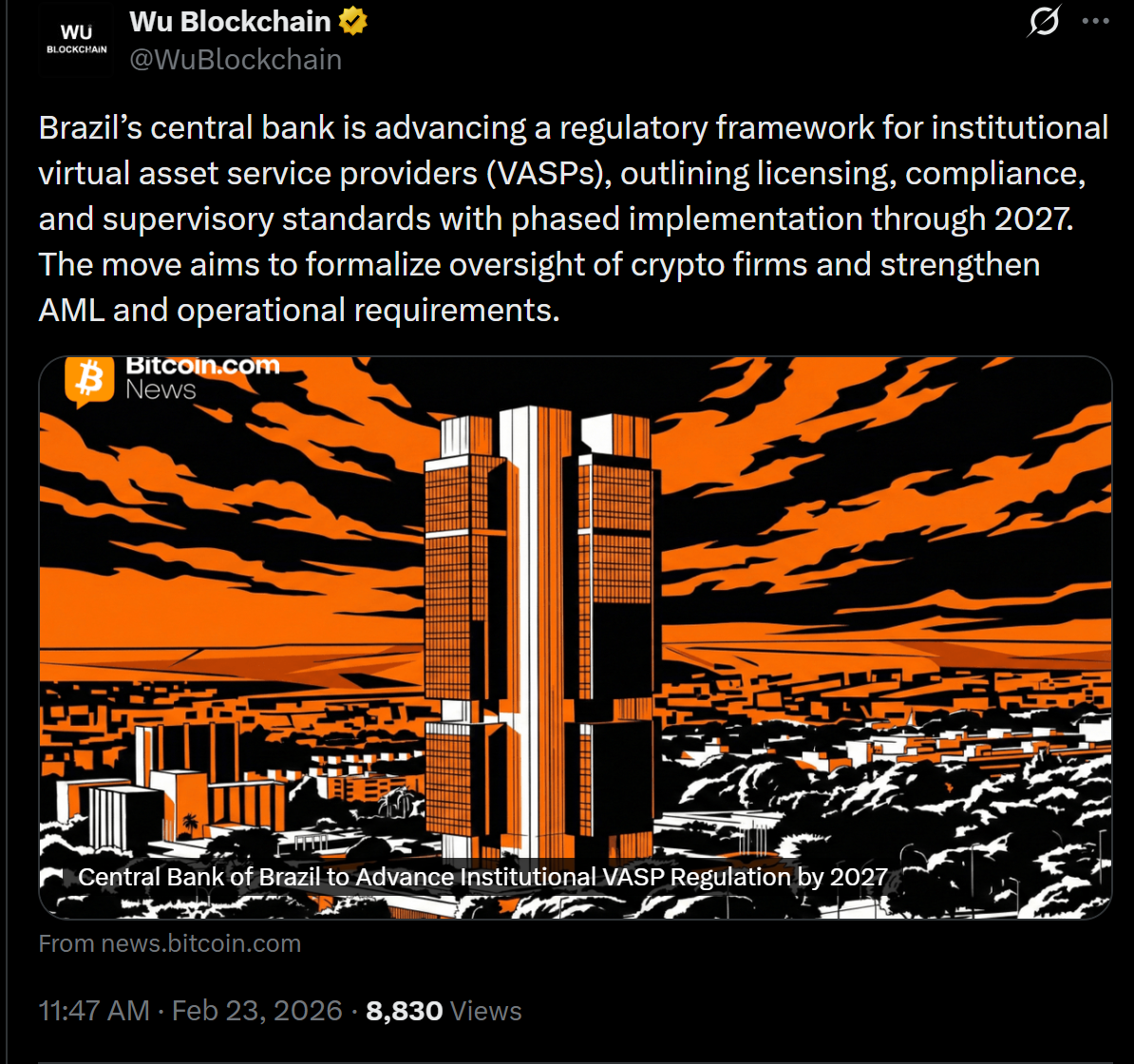
The Central Bank of Brazil has declared that it will have a formal regulatory framework of institutional crypto firms by 2027, which would go a long way in regulating the markets of digital assets in the largest economy of South America. The program, which is based on a set of consultations with the population and new resolutions by the central bank, is aimed at establishing clear licensing, compliance, and supervision criteria of virtual assets service providers (VASPs) that serve institutional clients instead of retail traders through infrastructural and service provision.

The central bank of Brazil has established the legal basis of the new regime under a set of measures that became effective at the beginning of February 2026, called Resolutions 519521. These resolutions establish an authorization procedure of crypto companies and establish gradual implementation course requirements, which will proceed till 2027. Some of the main compliance requirements are segregates of customer assets, a regular external audit requirement, and application of firms to be licensed by the end of 2026.
Source: X

This action puts Brazil on a list of increasing countries that are looking to strike a balance between innovation, consumer protection and financial stability in the fast-paced digital assets world. Although the current regulation of cryptocurrency in Brazil accepted virtual assets as valid tools of electronic operations in 2022, the institutional orientation of the new paradigm is also a significant move toward regulation ambition.

The plan of Brazil is to explain the way the institutional players such as custody firms, settlement providers, and the companies of infrastructure working in the back end of the financial system, are functioning in the domestic financial system. It deals with previously opaque areas, including the management of client assets by institutional VASPs as well as their adherence to the anti-money-laundering (AML) and counter-terrorism financing (CTF) rules.

See also  CLARITY Act Survives Bank Pushback as Trump Personally Warns Bankers to Back Off

Authorities have emphasized that despite the use of decentralized technologies by many crypto services, there is a need to have formal structures and accountability to establish trust and integrate with conventional finance. The framework of the central bank aims at encouraging investment and making Brazil a regional center of institutional crypto activity, which amounts to being regulated, and protecting the rest of the financial system against systemic risk by unregulated digital asset organizations.

Why Regulation Matters: Institutional Crypto and Market Integrity

The institutional virtual asset service providers are dissimilar to retail exchanges. They are the foundations of digital asset operations at large financial institutions, payment networks, custodians and infrastructure providers like Ripple, Fireblock and BitGo which could be affected by the new Brazilian regime. Stricter institutional regulation is not merely to regulate, but to offer some assurance to those businesses who wish to grow in the crypto space in a legitimate manner.

Clarity has been enthusiastically embraced by market participants who have pointed to that clear regulation has lowered regulatory arbitrage and regulatory uncertainty that institutional investors were afraid of previous. The step-by-step strategy used by the regulators in Brazil can be seen as part of the global trends in the context of money laundering and fraud, as well as market manipulation regulation.

As Brazil is on its way to institutionalizing crypto regulation, the situation in North America, especially the United States and Canada, is significantly different, characterized by both a healthy consumer base of the market and a regulatory maze that is difficult to resolve.

In the U.S, cryptocurrencies are regulated in a diffuse manner by various agencies such as the Securities and Exchange Commission (SEC), the Commodity Futures Trading Commission (CFTC), and the Financial Crimes Enforcement Network (FinCEN). Existing securities, commodities and anti-money-laundering statutes govern crypto activities by these agencies, and typically do not have a single federal law governing digital assets.

See also  5 Key Reasons Why the Crypto Market Is Up Today?

As a case in point, FinCEN registers as money transmitters, and is subject to AML and reporting requirements of the Bank Secrecy Act, a series of crypto exchanges. Nonetheless, SEC has argued that a large number of crypto tokens are securities and they evoke additional disclosure and registration obligations. The result of these overlapping jurisdictions has been regulatory confusion to firms who want a clear way to comply with the regulations, particularly institutional organizations who want a single regulatory point of contact.

The opposite of this was the case with the centralized plan of Brazil: Brazilian authorities are implementing a particular institutional-VASP framework during a certain period, in contrast to the U.S. regulators who have historically employed enforcement measures and agency direction to influence the crypto market. This has contributed to inconsistency in the clarity on the supervision of institutional custodians, trading platforms, and blockchain service providers.

Canada, however, has been a more centralized jurisdiction in comparison to the other North American jurisdictions. Canadian Securities Administrators have presented regulations that are centered on disclosure, custody, and protection of investors. The cryptocurrency trading platforms must comply with tough custody requirements and separation of customer funds, which offers certain homogeneity between provinces. Nevertheless, the wider regulatory framework is strongly connected with the securities law.

The regulatory trend in Mexico is also diverse as far as the region is concerned. It has put in place an inclusive Fintech Law which gives legal certainty to the digital-asset activities making the country one of the leading countries in Latin American regulative efforts in fintech. Even though its institutional cryptocurrency framework is not as detailed as the future rules in Brazil, the Fintech Law of Mexico provides a framework of legal operations and consumer protection.

North American Innovation and Institutional Momentum

Nevertheless, North America specifically the U.S. leads the world in regards to cryptocurrency adoption and institutional participation due to the regulatory issues. Based on adoption indices, the U.S. is one of the high-performing countries in terms of cryptocurrency adoption with a large portion of the transaction volume and interest in its institutional sector contributing to the development of products like exchange-traded funds (ETFs), tokenized treasuries, and digital financial instruments.

See also  Scaramucci says stablecoin yield prohibition undermines US dollar

Institutional investment has been on the boom, and large financial institutions and asset managers have begun to incorporate digital asset strategies into their service. This has generated interest that has spawned debate among policy-makers on how to change existing structures to suit the risk profile of crypto and encourage innovation. Recent regulatory actions in the U.S. have seen the introduction of conditional trust bank charters of crypto companies like Crypto.Com which represent a shift in acceptance of the digital asset companies in the regulated banking framework.

This tendency to more explicit institutional regulation, such as that of Brazil, represents a global realization that crypto is no longer a marginal financial innovation, but a more and more central feature of the contemporary financial systems. The global central banks and management are evaluating how they can include digital assets into regulated markets without suffocating innovations and putting consumers and investors at unnecessary risk.

The staged adoption of Brazil by 2027 is an indication of a calculated and slow strategy unlike regulatory environments which are based on haphazard or enforcement-based strategies. With a formal licensing pathway and institutional compliance requirement to institutional VASPs, Brazil can assist in the establishment of increased institutional investment, enhanced market integrity and diminished systemic risk within its native crypto-ecosystem.

In comparison, the diversity of regulatory bodies and strategies in North America points to the difficulty of governing crypto currencies within jurisdictions with decentralized legal frameworks and having multiple regulators. As innovation remains alive and well, there remains no unified U.S. federal structure as compared to Brazil’s emerging strategy – highlighting how various regions are approaching one of the most complicated regulatory dilemmas of the digital age.

Bank Brazil Central Crypto Firms Institutional Regulate
Share. Facebook Twitter Pinterest LinkedIn Tumblr Email

Related Posts

U.S. CFTC in talks with every major pro sports league on policing prediction markets

May 14, 2026

Bitcoin (BTC) Price Loses Critical $80K Level as Crypto Markets Turn Bearish—What’s Next?

May 14, 2026

What Is the CLARITY Act? The US Crypto Bill That Could Reshape Digital Asset Regulation This Week

May 14, 2026

Michael Saylor Says the Transparency Act in the US Congress Will Positively Impact Bitcoin! Here Are the Details

May 14, 2026
Add A Comment
Leave A Reply Cancel Reply

Top Posts

Solana Key Indicator Flashes First Bullish Signal Since January – Market Rebound Incoming?

March 15, 2026

RIVER, MYX, and CC Hit Key Breakout Levels

January 21, 2026

Stay ahead with the latest crypto news, market updates, blockchain insights, and trends. Your trusted source for everything happening in the digital asset world.


We're social. Connect with us:

Facebook X (Twitter) Instagram Pinterest YouTube
Top Insights

BTC ETFs lose $635 million in a single day. What next?

May 14, 2026

Ethereum Holders Take Profits as ETH Price Drops 5%—Is Selling Pressure Starting to Rise?

May 14, 2026

Bitcoin Risk Appetite Has Crashed Since October 2025

May 14, 2026
Get Informed

Subscribe to Updates

Get the latest creative news From Free.cc directly in your Inbox!

  • Contact
  • Privacy Policy
  • Terms & Conditions
  • Disclosure
© 2026 free.cc - All rights reserved.

Type above and press Enter to search. Press Esc to cancel.