
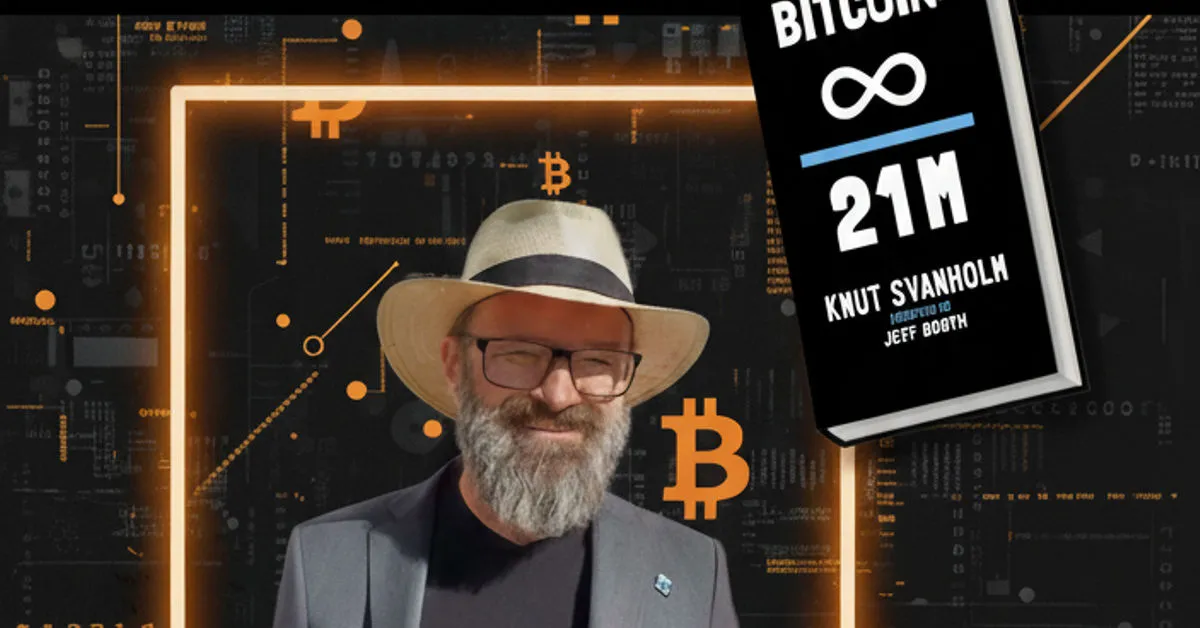
Knut Svanholm, the Swedish author, Bitcoiner, podcaster and educator, is a prolific writer and eccentric, charismatic persona in Bitcoinland. We don’t have royals in Bitcoin and we routinely slay our heroes, which means that anybody who sticks around for a long time has Lindy-proven integrity. Svanholm is one such character: If you’ve attended the conference circuit in recent years, you’re likely to have encountered Svanholm’s enchanting voice and scruffy beard — cowboy hat included for fashion and good measure.
I’ve always had a weak spot for this fellow Scandinavian, whether it be his uncompromising words or impressive output, his funky demeanor or funny personality. In a recent interview with Bitcoin Magazine, we chatted about publishing books in the modern age, writing, praxeology — the arcane science underpinning Austrian economics — spirituality, nation-states, the cooperative nature of Bitcoin, how Bitcoin wins and why leaning into “the fun” makes for a better path to the brilliant, bright, orange future we both see.
Together with his sidekick and co-author Luke de Wolf, Svanholm has incorporated the publishing house Lemiscate Media in Estonia, which allowed them to accept sats and keep bitcoin on the balance sheet — a bitcoin treasury company, the old-fashioned way. It also offered a convenient way around Amazon’s book publishing gatekeeping and meant that all books became print-on-demand. (All of Knut Svanholm’s previous book — including “Everything Divided by 21 Million” and “The Inverse of Clown World” — are available via Lemiscate.)
JB: Knut, tell me about your publishing company. Are you trying to copy Saifedean Ammous and make Lemiscate Media be like his The Saif House?
Knut: Yeah, I’ve always been a little bit Saifedean-like, or rather: Saif with a pirate hat. But it’s not because I’m copying Saif on purpose, but rather that things have just played out this way… There’s a reason why that happens. The same thing happened with my book “Praxeology: The Invisible Hand That Feeds You” — I re-wrote it this year and turned it into a full course for Plan ₿ that’ll be released this winter. It was all a very Saifedean-like approach, echoing what he did with his “Principles of Economics” textbook. Mine is much less dense: The chapters are shorter and a bit more accessible than in Saif’s book.
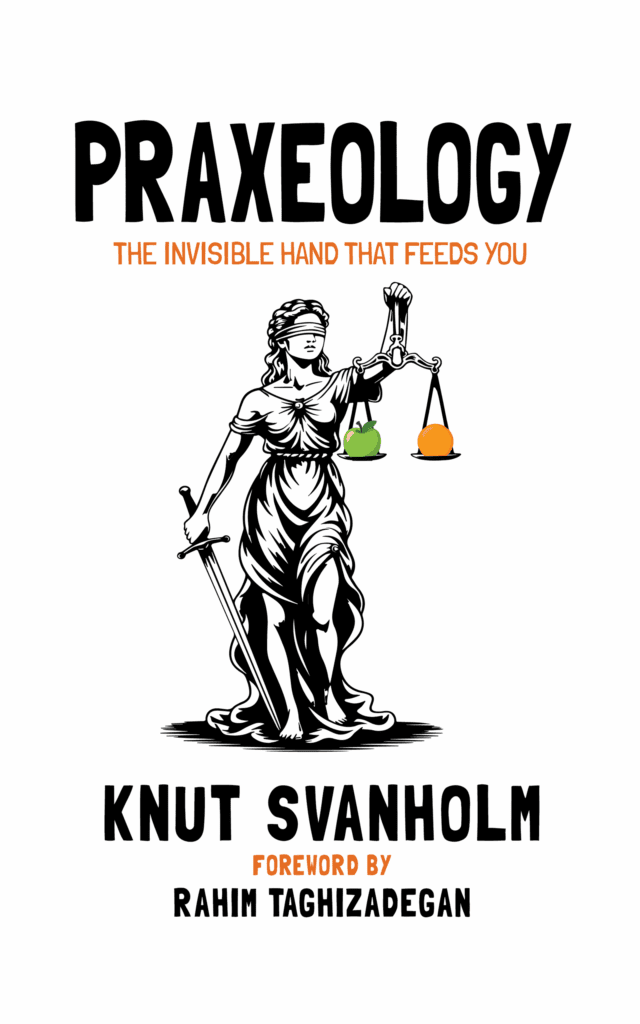
JB: One question I had for us sitting down was about your book “Praxeology,” your attempt to connect Bitcoiners with Austrian economists. When it came out, I saw almost nobody writing about it (I did!) — what happened? “Everything Divided by 21 Million,” massive success; “Praxeology,” almost nothing. What gives?
Knut: Generally speaking, I think people read less and it’s hard to follow up on a hit. Plus, there are a little too many Bitcoin books right now as well; people don’t know what to choose. The more long-term goal here is to assemble all of the books into one, a “collected volumes” type of thing, leatherbound etc. The podcast I run with Luke de Wolf, Bitcoin Infinity Show, is more for hardened Bitcoiners — conviction-deepening rather than orange-pilling…
JB: …then why are you clowning about so much on the show?
Knut: Haha… it doesn’t matter what you do, the absolute most important thing is that what you deliver is entertaining in some way. That can be because it’s interesting or because it’s passionate — or because it’s fun! And fun can be a shortcut to entertaining: If it’s fun, people stick around. If you keep your humor about, that becomes a tool for making people listen. We think about this when it comes to Satoshi Rockamoto [the pop-up concert events that Svanholm runs together with Mike Jarmuz, Samson Mow, Martti Malmi etc., eds. remark]. It started way back, at an event in Mexico and we all just borrowed some instruments and were all surprised at how good it sounded… Wouldn’t it be a good idea to do this at different conferences?!
JB: Yeah, those shows are amazing, and you can really tell that you guys are having fun. Is it all planned and rehearsed, or do you guys just wing it?
Knut: No, it’s completely improvised. This time in Helsinki at BTCHel was the first time we rehearsed together — once. I often gotta pinch myself… Am I really in a band with Martii Malmi and Samson Mow?! What everyone who is anyone in Bitcoin have in common is that they’re just themselves, and that just works.
Knut: I’m trying to live by my words, practice what I preach… and I’ve long had this idea that we are our satoshis.
JB: I remember the first time I heard you say that, on stage in Prague 2023 — and you just looked completely out of your mind!
Knut: The entire distinction between satoshis and personhood is pretty blurry: All there is to Bitcoin is keeping a secret from someone else… All nodes, all miners, etc., have a person behind them. They’re not “backed by energy,” but by human action (…which, technically, is also backed by energy). At the end of the day, I always say that Bitcoin is an agreement on a fixed set of rules, and the reason we agree on this specific set of rules is that they are costlier to try to break than to just follow. And that’s what allows for resistance, irreplicability and finiteness.
JB: There’s a quote in economics and game theory to the effect of “trading is cheaper than raiding,” but still world history is littered with wars. What do you make of that?
Knut: Yes, but if the aggressor thinks that he has enough to profit from violence, there’s a risk he will. Where Bitcoin is different is that I can threaten you with a gun — Joakim, give me all of your sats! — but there is no way for me to know how many sats you have. So game-theoretically, it’s better for me to offer you something of value and trade with you… Bitcoin has moved the point at which aggression pays further out, and this aspect of Bitcoin is so underappreciated.
But let’s return to this idea that we are all our satoshis. Everybody wants to pump their bags, and we all benefit from number-go-up, which means all companies and everybody in Bitcoin have an incentive to help each other.
With Lemiscate and Bitcoin Infinity Show we’re really trying to put that in practice right now, by giving as much as we can because, in the end, it all comes back to us! Why not cooperate? Take Vexl, the peer-to-peer trading platform out of Prague; they’re not paying us a dime to say this, but I still want everyone to be on Vexl — it’s an excellent service.
Bitcoin jobs in general is so completely different than fiat jobs; you don’t even need to, or can expect, to be paid anything to begin with. Rather, you must provide value first and then reap rewards later. That’s so powerful, and most people don’t get that: All I want is for you to flourish.
JB: The connection to Praxeology is so obvious: We’ve sort of fiat-ized what “work” is. A job is: you’re employed by someone, you do something and you’re paid by the hour… And there are laws around this, it’s your right as a laborer to receive this money. And nobody thinks about how working is about creating value for someone else.
Knut: And that doesn’t stop being true just because someone — the state, labor unions — is trying hard to make that not true. Still, an employer won’t hire anybody if it’s too costly. Say you want to hire somebody in Sweden. Then you have to consider that you can’t fire them very easily, you gotta pay payroll taxes, and income taxes etc., if they’re ill, you have to pay for their recovery, and blah-blah-blah.
It leads to this entitlement idea, a culture or I deserve all this. Most people don’t understand how Bitcoin is different here: What happens when there is a way to signal value that’s deflationary, absolutely finite, such that all prices — including salaries — fall over time, while purchasing power rises.
If you hire someone, and that someone gets the same amount of satoshis every month, their real salary is effectively increasing… You never need to readjust salaries. Micropayments is such a fiat idea… The entire model of velocity of money is a Keynesian idea.. I think subscription models will increase in popularity. On a deflationary standard, a company has every incentive to receive one larger payment early over many smaller payments later, because it will receive fewer and fewer satoshis every time.
JB: Uh, ok…
Knut: I think people just underestimate what deflation is. That’s the main thesis in “The Inverse of Clown World”: Everything that’s true in fiat, the inverse of that is true in Bitcoin.
On a bitcoin standard, we’ll have fewer transactions — not more. It’s a pet theory I have, and it was in a Bitcoin Magazine article (“The Real Scaling Solution for Bitcoin”) a few years ago: With a richer society, you’ll have fewer transactions. Say ten rich people and ten poor people are having dinner. Among the rich people, at the end of the night, someone picks up the tab, so over time there’ll be ten transactions — one per dinner. But for the poor people, who don’t have enough wealth, everyone has to pay for their own meal on every occasion, meaning a hundred transactions.
If we focus on quality instead of quantity, which is what happens in a deflationary economy, what happens is fewer transactions but more significant, valuable transactions.
“Will give everyone a reason to save rather than overconsume, giving more people access to whatever they want over time because of the falling prices. If you postpone your spending, your bitcoin will buy you more in the future. In other words, fewer transactions. Quality before quantity. The necessity for transactions per second will diminish.”
This article really didn’t pull any punches. In a hundred years, you won’t pay for coffee anymore; the barista will give it to you for free, since he has built up this entire chain of trust over generations, which will ensure that you want to give him something of value.
JB: Like that quote you referred to on stage here at BTCHel, know-your-customer laws are economically illiterate; trust is the opposite of money. Trading partners only need to use money when they don’t trust someone. The difference is, you use credit money with those you trust, and commodity money with strangers.
Knut: Precisely! You only need money in trade when you don’t trust the people you’re trading with. That’s the problem with credit money altogether: It isn’t money. Even if you have debt notes or credit money, it has to be denominated in something — and that something is what constitutes money.
I learned this in Murray Rothbard’s excellent book “What Has Government Done to Our Money?” There’s no doubt about it: Credit money is not money. Money represents something valuable; even if that’s a debt, it has to be denominated in something — and it’s that thing that is money. When you accept a receipt for something and you don’t receive the thing back, that’s theft.
And that’s what banknotes are.
JB: You write something to that effect in the beginning of your 2020 book “Independence Reimagined”, about how collective imagination is one of our greatest strengths as humans — but also our worst weakness. Natural law, property rights, money etc, aren’t out there, in nature, right; we don’t discover them, but invent them, no…?
Knut: No, all the way down to molecular biology or complex societies like ant hills, I think, where we find examples of what looks like cooperation and herd behavior, but in reality, you’re backstabbing them — the black sheep of the herd, etc. What’s evolutionarily good for the herd isn’t always the same as what’s good for the herd.
JB: This is something monetary scholars often talk about, what is it that money does in a society? Large-scale cooperation, overcoming Dunbar’s number etc. It’s these collective delusions that let a billion Catholics cooperate, or 330 million Americans to all believe in their shared stories — not that America is doing extraordinarily well, but that’s beside the point — the belief that we are one unit is what lets us cooperate so we’ll create bigger things.
Knut: Organized religion and, after that, nation-states, might be good for your tribe, for convincing people that they go to heaven if you murder members of this other tribe. And to do that, we have to cooperate, so we need to tax citizens this or that much and then demand that you give your life for the herd. That’s rarely good for the individual soldier. And some of these units have created pretty destructive things, too.
For some of these topics — like the question of God — I’m perfectly comfortable not knowing certain things, if I know these are questions we can’t answer. If you were to order the great Austrians in order of religiosity, I think we’d get Mises -> Rothbard -> Hoppe.
What I’ve changed my mind about is that I nowadays believe democracy to be the most dangerous religion. It’s better that people believe in a fake friend in the sky than an earthly friend who swindles them. Religion is a tool for managed control, the best way to fool 18-year-olds into war — and psychopaths will use it!
JB: What’s the connection to economics or praxeology?
Knut: Well, economic thought was actually better before the Enlightenment than after. At that time, all economists were also theologians grappling with the basic question, What does God want? Many of them are opposed to the phenomenon of interest, unethical practices and turning people into debt slaves
JB: … like Jeff Booth said in his lecture at BTCHel “No They. Only We”…
Knut: Precisely, and it’s not until we get Austrian economics that we actually can explain how interest is ethical — That it’s just the price of tomorrow, to quote Booth.
And prices and interest rates fall in a free market.
JB: Everything we talk about here is so in the weeds, so deep, so spiritual. Praxeology itself is a bit like that, making us wonder what in the world is this thing we call consciousness, choice, economics?
Knut: The basic tenet is that science cannot derive an ought from an is — but with praxeology, we can get pretty darn close! Hans-Hermann Hoppe explains it best, but if I were to try, I’d say, “All communications and interaction between humans are the result of some sort of conflict.” We perceive value in communicating rather than attacking, which means all language is for resolving conflict; we have human language so that we can comprehend one another.
From there, you’re very close to absolute property rights. And here’s argumentation ethics:
If I say every human owns their own bodies, you cannot rebuke that without proving my point.
And from there, we can derive so much knowledge from that, if you only accept those axioms. But they are still pretty darn sound axioms.
JB: So why isn’t this sexy? Why doesn’t it sell? I think this is, big-brain gigachad boom stuff… but nobody cares.
Knut: …and it’s so goddamn simple that it’s better to cooperate than to use violence. People don’t understand how much they’re being robbed today; everybody underestimates their own value. It’s tragic, but not that hard to explain: You have an institution — public school — entirely funded by theft. You learn math and English and whatever, but you also learn social science, which is nothing but opinions and bullshit. We’re taught obedience rather than providing value.
Everything that at some level is supported by government money is corrupt and unethical. These ideas have existed for centuries, but it’s so hard for normies to get past this:
If there’s one thing public education shoves down our throats more than anything else, it’s that democracy is the most important and most beautiful thing we have. It’s not. It’s a system that says, because of a popularity contest, you have the right to take others’ stuff; it’s completely wrong, beginning to end.
JB: How do you see this fixed? How do we win?
Knut: The more we use bitcoin, KYC-free, between each other without paying taxes, and without inflation, the more we disarm the psychopaths.
JB: Very, very slowly, one person at a time?
Knut: Yes: Sooner or later, everyone wakes up to this. Anyone who attends these Bitcoin conferences can see for themselves how freakin’ superior bitcoin is to fiat money.
JB: We went on a Bitcoin Walk in Helsinki yesterday. We stopped at a café — cute, small, two people working there, and 50 Bitcoiners show up. Obviously, everyone was gonna try to orange-pill this poor barista: wallets, zapping, the whole ordeal. Just think about it for a minute, 50 people, 5,000-10,000 sats zapped each, that’s a good couple of hundred bucks. Easy money, right? No, the dude had zero interest; he just wanted to serve coffee and get on with his day.
Knut: Well, at dinner last night, we met a server who was exactly the other way around. She was super interested, “Oh yes, I’ve heard about bitcoin but I’ve never tried it, don’t know how it works.” From just a handful of us, she got some $50 — super happy about it!
JB: So the guy we met yesterday just didn’t have curiosity awakened yet, whereas your server from last night did…? You think that’s the difference?
Knut: Yes! The biggest reason for this is that to even grasp what Bitcoin is or what it does, you need to spend 100 hours on self-education… and most people aren’t willing to do that! The biggest hurdle to adoption is that people don’t have time; they don’t have 10,000 hours or whatever to invest into Bitcoin in order to fully understand it.
JB: But we do have that time — certainly in a country like Finland. At least in the West, we work fewer hours, we have higher real wages, more leisure time. You can devote your time to whatever.
Knut: Sure, but most people want to go to work, then go home and feel like they made a living for themselves when actually they worked three out of five days for the government, and another for the banks.
That we still have money and time left is a testament to how strong the free market is: Everything good in the world comes from the free market. It’s a more powerful force than any totalitarian, self-pompos leader ever could be.
Despite democracy, taxes and inflation, things move forward. We have progress.
JB: Alright, wrapping up. What gives you hope? Where do you see the light? I don’t think the future is dark — it’s bright af — but the more you look out into fiatland, the worse things look.
Knut: That’s because the future isn’t in fiat — it’s in Bitcoin. The future is bitcoin. It’s definitely this “Which Way, Western Man” meme. Either we’re in a world where everyone cooperates — like Booth says, eight billion people in service of eight billion people — or we’re going further down totalitarian oppression, darker and darker.
If we didn’t have Bitcoin, I’d be much less hopeful for the future.
Bitcoin exists, it’s easy to learn, and when a system is better, people make the change — put like that, why wouldn’t Bitcoin win?
The world with Bitcoin is beautiful.