
Close Menu
  • Latest News
    • Bitcoin
    • Ethereum
    • Altcoins
    • Meme Coins
  • Tech
    • Blockchain
    • Security and Privacy
  • Web 3
    • Gaming
  • Legal
    • Legal and Regulatory
    • Adoption
  • Analysis
  • Learn
    • Education
    • Wallets and Exchanges
  • Tools
    • Market Overview
    • Exchange Tool
What's Hot

GMX Sponsors Arbitrum’s Open House Singapore as Buildathon

October 3, 2026

IMF Praises El Salvador But Tries To Scale Back Bitcoin Use

October 3, 2026

CFTC wins $31M Fundsz fraud order as crypto scam losses mount worldwide

October 3, 2026
Facebook X (Twitter) Instagram
  • Contact
  • Privacy Policy
  • Terms & Conditions
  • Disclosure
Facebook X (Twitter) Instagram
Free.cc (Free Cryptocurrency)Free.cc (Free Cryptocurrency)
  • Latest News
    1. Bitcoin
    2. Ethereum
    3. Altcoins
    4. Meme Coins
    5. View All

    IMF Praises El Salvador But Tries To Scale Back Bitcoin Use

    October 3, 2026

    Bitcoin ETFs record $102M inflows – Why $85K matters for BTC now

    October 3, 2026

    Bitcoin Is Up, DeFi Is Recovering, So Why Doesn’t This Look Like a Bull Market Yet?

    October 3, 2026

    Bank group sues U.S. regulator over granting crypto trust charters

    October 3, 2026

    SEC Approves 3x Leveraged Bitcoin Ether & Other ETPs for Listing

    October 3, 2026

    Ethereum: Why ETH faces October reversal risk after 70% Q3 rally

    October 3, 2026

    Why Did Blast Decide to Wind Down Its L2?

    October 2, 2026

    Bitcoin Q3 Strength Faces a Tougher Q4 Test

    October 1, 2026

    Fidelity exec’s new 60/20/20 portfolio makes room for crypto – Here’s why

    October 3, 2026

    Can NEAR crypto rebound? THESE metrics could decide what’s next

    October 3, 2026

    Polymath And CineCity Explore Regulated Tokenized Film Investment Platform

    October 3, 2026

    XLM price prediction – Why Stellar’s $0.21 rebound could trigger a 9% rally

    October 2, 2026

    Thinking Cat Gains Momentum After CASHCAT’s Breakout

    August 12, 2026

    What Tokens Could He Target?

    July 30, 2026

    The Next Meme Coin Winner Could Be Determined by Incentives, Not Memes

    July 30, 2026

    Why Is BOME’s Price Up Today? Finally, Capital Rotating to the Meme Coins?

    July 28, 2026

    GMX Sponsors Arbitrum’s Open House Singapore as Buildathon

    October 3, 2026

    IMF Praises El Salvador But Tries To Scale Back Bitcoin Use

    October 3, 2026

    CFTC wins $31M Fundsz fraud order as crypto scam losses mount worldwide

    October 3, 2026

    Plunging GPU prices threaten AI hosts, and new hedges step in

    October 3, 2026
  • Tech
    1. Blockchain
    2. Security and Privacy
    3. View All

    GMX Sponsors Arbitrum’s Open House Singapore as Buildathon

    October 3, 2026

    Ceteris Introduces Tokenized Stocks via Crypto Neobanks

    October 3, 2026

    New SIMD-0675 Proposal Aims to Streamline Block Production

    October 3, 2026

    State Street Fund Goes Live on Stellar

    October 3, 2026

    Masked Robbers Threaten Pregnant Wife in UK Crypto Home Attack

    October 3, 2026

    Bitcoin Lightning Nodes Targeted as Core Lightning Sounds Alarm

    October 2, 2026

    The $459,000 Bot Hacker Was a Customer First, Researchers Say

    October 2, 2026

    Metamask Pulls Validators as Meager ETH Theft Sounds Big Alarm

    October 2, 2026

    GMX Sponsors Arbitrum’s Open House Singapore as Buildathon

    October 3, 2026

    IMF Praises El Salvador But Tries To Scale Back Bitcoin Use

    October 3, 2026

    CFTC wins $31M Fundsz fraud order as crypto scam losses mount worldwide

    October 3, 2026

    Plunging GPU prices threaten AI hosts, and new hedges step in

    October 3, 2026
  • Web 3
    1. Gaming
    2. View All

    Top 12 NFT games every player should know about in August 2026

    September 22, 2026

    GameShame Studios founder details Raijin Protocol’s roadmap in NeoPod’s sixth AMA

    September 22, 2026

    Proof of Play to shut down after blockchain gaming thesis falls short

    September 22, 2026

    How BC.GAME is turning players into stakeholders

    September 22, 2026

    GMX Sponsors Arbitrum’s Open House Singapore as Buildathon

    October 3, 2026

    IMF Praises El Salvador But Tries To Scale Back Bitcoin Use

    October 3, 2026

    CFTC wins $31M Fundsz fraud order as crypto scam losses mount worldwide

    October 3, 2026

    Plunging GPU prices threaten AI hosts, and new hedges step in

    October 3, 2026
  • Legal
    1. Legal and Regulatory
    2. Adoption
    3. View All

    CFTC wins $31M Fundsz fraud order as crypto scam losses mount worldwide

    October 3, 2026

    583 Companies Go Public in 18 Months, Says SEC Chairman

    October 3, 2026

    New SEC crypto rules threaten small advisers, but big firms win

    October 3, 2026

    Daines Unveils Crypto Tax Bill Pairing Payment Relief With Wash-Sale Rules

    October 3, 2026

    Stablecoin issuers have replaced 40% of China’s lost US Treasury demand

    October 3, 2026

    Bitcoin’s $113,000 case strengthens as US regulators push 9 crypto actions

    October 2, 2026

    Bitget restores $300M fund after absorbing $388M security breach

    October 2, 2026

    Ripple’s biggest institutional bet may now be Brazil

    October 1, 2026

    GMX Sponsors Arbitrum’s Open House Singapore as Buildathon

    October 3, 2026

    IMF Praises El Salvador But Tries To Scale Back Bitcoin Use

    October 3, 2026

    CFTC wins $31M Fundsz fraud order as crypto scam losses mount worldwide

    October 3, 2026

    Plunging GPU prices threaten AI hosts, and new hedges step in

    October 3, 2026
  • Analysis

    Plunging GPU prices threaten AI hosts, and new hedges step in

    October 3, 2026

    Ethereum Price Faces $2,800 Wall Again — Are Whales Selling or Accumulating ETH?

    October 3, 2026

    Bull Market Targets for BTC, ETH, SOL, and XRP

    October 3, 2026

    Ethereum Price Faces A Critical $0.040 ETH/BTC Test

    October 2, 2026

    AAVE Price Surges 8% as Whale Activity Spikes — Can AAVE Break $200?

    October 2, 2026
  • Learn
    1. Education
    2. Wallets and Exchanges
    3. View All

    What Is Robinhood Chain? The Ethereum Layer-2 Network for Tokenized Stocks

    July 12, 2026

    What Is BChat? The Decentralized Messaging App Built for Privacy

    June 2, 2026

    What Is an AI Prompt Injection Attack? The Hidden Threat Hijacking Your Chatbots

    May 31, 2026

    What Is AI Jailbreaking? A Beginner’s Guide to the Cat-and-Mouse Game Behind Every Chatbot

    May 17, 2026

    Coinbase completes Deribit migration, ends INTX trading

    October 2, 2026

    Binance Funding Account ends direct crypto deposits

    October 1, 2026

    Coinbase just completed its US derivatives stack but its biggest bet still sits outside it

    September 30, 2026

    Bitget had 30 minutes to contain its hack before $290 million started moving

    September 30, 2026

    GMX Sponsors Arbitrum’s Open House Singapore as Buildathon

    October 3, 2026

    IMF Praises El Salvador But Tries To Scale Back Bitcoin Use

    October 3, 2026

    CFTC wins $31M Fundsz fraud order as crypto scam losses mount worldwide

    October 3, 2026

    Plunging GPU prices threaten AI hosts, and new hedges step in

    October 3, 2026
  • Tools
    • Market Overview
    • Exchange Tool
Free.cc (Free Cryptocurrency)Free.cc (Free Cryptocurrency)
Home»Analysis»Plunging GPU prices threaten AI hosts, and new hedges step in
Analysis

Plunging GPU prices threaten AI hosts, and new hedges step in

October 3, 2026No Comments8 Mins Read
Share
Facebook Twitter LinkedIn Pinterest Email

Companies building AI applications can rent powerful computers instead of buying the equipment themselves, paying for access to the graphics processing units, or GPUs, that run their software.

Lower rental prices make those applications cheaper to operate, but they can also make life harder for the company that bought the machines and needs the rent to pay its debts.

If you’ve financed a room full of GPUs assuming customers will pay a certain hourly rate, a cheaper competitor can upset the calculation long before you’ve paid off the equipment. Your machines might still work perfectly, and demand for AI might still be strong, but the amount you earn from each hour could start falling below what the business needs.

Financial contracts could let you protect part of that income by arranging a payment when rental prices fall, in exchange for taking on your own obligations. That’s the basic idea behind AI compute derivatives, which let businesses trade their exposure to computing prices separately from renting the computers themselves.

Luxor, a company that provides services and financial products to Bitcoin miners, included these contracts in its latest expansion into AI. It sees an opportunity to bring its experience hedging mining revenue to another business that spends heavily on machines before knowing what it’ll earn.

The company told CryptoSlate that it’s already brokering agreements between owners of computing capacity and customers who want to use it.

However, its cash-settled derivatives business is still early, and the company said it couldn’t provide a customer hedge example or current derivatives trading volumes because a liquid market hadn’t formed yet.

That gives this promising idea the difficult commercial task of persuading someone to accept losses another business wants to avoid.

Getting that arrangement to work could help operators plan around more predictable income, but the protection is only as dependable as the price used to calculate it and the party responsible for paying.

Locking in the rent without locking in a customer

The tried-and-true way to make rental income more predictable is to sign a customer for a longer period at an agreed price. The customer gets access to the machines, while the operator gets a commitment it can use to plan its business.

That works well when both sides want the same arrangement, but customers don’t always know how much computing they’ll need that far into the future. Operators may also prefer to keep selling capacity to different users.

See also  U.S. Treasury Takes Next Step in Turning GENIUS Act Into Stablecoin Regulations

Cash-settled derivatives offer another approach because the contract pays money according to a price formula, without requiring the parties to exchange computing capacity. The operator can keep renting its GPUs to customers while using a separate financial agreement to offset movements in the rental rate.

Imagine an operator expecting to sell 1 million GPU-hours in a month, where one GPU-hour means access to one processor for an hour. At $2 per hour, that would produce $2 million in rental income, and the operator enters a hypothetical contract designed to protect that rate.

If the agreed market benchmark falls to $1.50, the contract pays the operator the 50-cent difference across the million hours, or $500,000. Assuming its actual rental income also falls to $1.5 million, that payment brings the combined amount back to $2 million before fees and other costs.

The obligation runs both ways, so if the benchmark increases to $2.50, the operator owes $500,000 while earning more from its customers. It gives up the benefit of a higher rate in exchange for protection against a lower one, making revenue easier to plan around.

This is just back-of-the-napkin math to explain the arrangement, as the result depends on the operator actually selling the expected hours at a rate that tracks the benchmark. Empty machines still produce no rental income, so fixing the hourly price doesn’t guarantee someone will buy it.

Someone on the other side needs a reason to accept the opposite payments, and an AI business worried about more expensive computing could have one. Its financial contract would pay when the benchmark increased, helping cover a larger rental bill, while a fall would create a payment obligation alongside cheaper computing.

Dealers could help connect those interests or take some of the exposure themselves, charging for the risk they carry. But customers need a price for the amount of protection they want, covering the period when their business needs it.

CME Group is pursuing an exchange-traded version of this idea through its announced H100 and B200 rental-index futures. Its Aug. 11 announcement targeted Oct. 5, subject to regulatory review, for contracts tied to Silicon Data’s GPU rental benchmarks, although listing a contract alone can’t guarantee enough participation to make it easy to trade.

Related Reading

Bitcoin miners are getting a new AI hedge, but it may protect them from the wrong risk

See also  Altcoins See Broad Relief Rally as Gaming, AI, and Memecoins Lead Sector Gains

Your GPU hour might be different from mine

But even with willing counterparties, the payment formula needs a price both sides accept as relevant to their business.

The Catalyst

What’s moving crypto. Why it matters.

Get CryptoSlate’s essential stories and what to watch next.

Published on Substack

Seven days a week. Unsubscribe anytime.

Whoops, looks like there was a problem. Please try again.

Check your inbox.

Your signup request was sent. If confirmation is required, follow the email from Substack.

Look in spam or promotions if you don’t see it.

In the example above, the hedge works perfectly because the operator’s rental income moved exactly with the benchmark. However, you can’t replicate perfect conditions once actual customers enter the picture.

Suppose its customers negotiate rates down to $1.25 while the benchmark only falls to $1.50, perhaps because the index covers a different service or type of equipment. The same $500,000 hedge payment would then bring its $1.25 million in rental income to $1.75 million, leaving a gap even though the contract works as written.

That mismatch is called basis risk, which simply means the price you’ve protected against doesn’t move exactly like the price you actually receive. Compute hedges can leave Bitcoin miners exposed, and this is one reason a hedge needs to be judged against the particular business using it.

Luxor compared its AI ambitions with its path in Bitcoin mining, where publishing a reference price helped create a foundation for financial contracts. Its hashprice measure estimates what a unit of computing power can earn from mining Bitcoin, giving operators a shared revenue reference even when their own operating costs differ.

Bitcoin miners perform the same network task, whereas AI customers can attach different values to access that looks similar on a specification sheet. Someone buying uninterrupted access for months is purchasing a different service from someone willing to have a short job stopped whenever the provider needs the machines back.

Price providers already account for differences like these, with CCIR’s rental-data methodology treating interruptibility and commitment length as separate characteristics. It uses publicly advertised rates, which also means the figures don’t necessarily capture privately negotiated discounts.

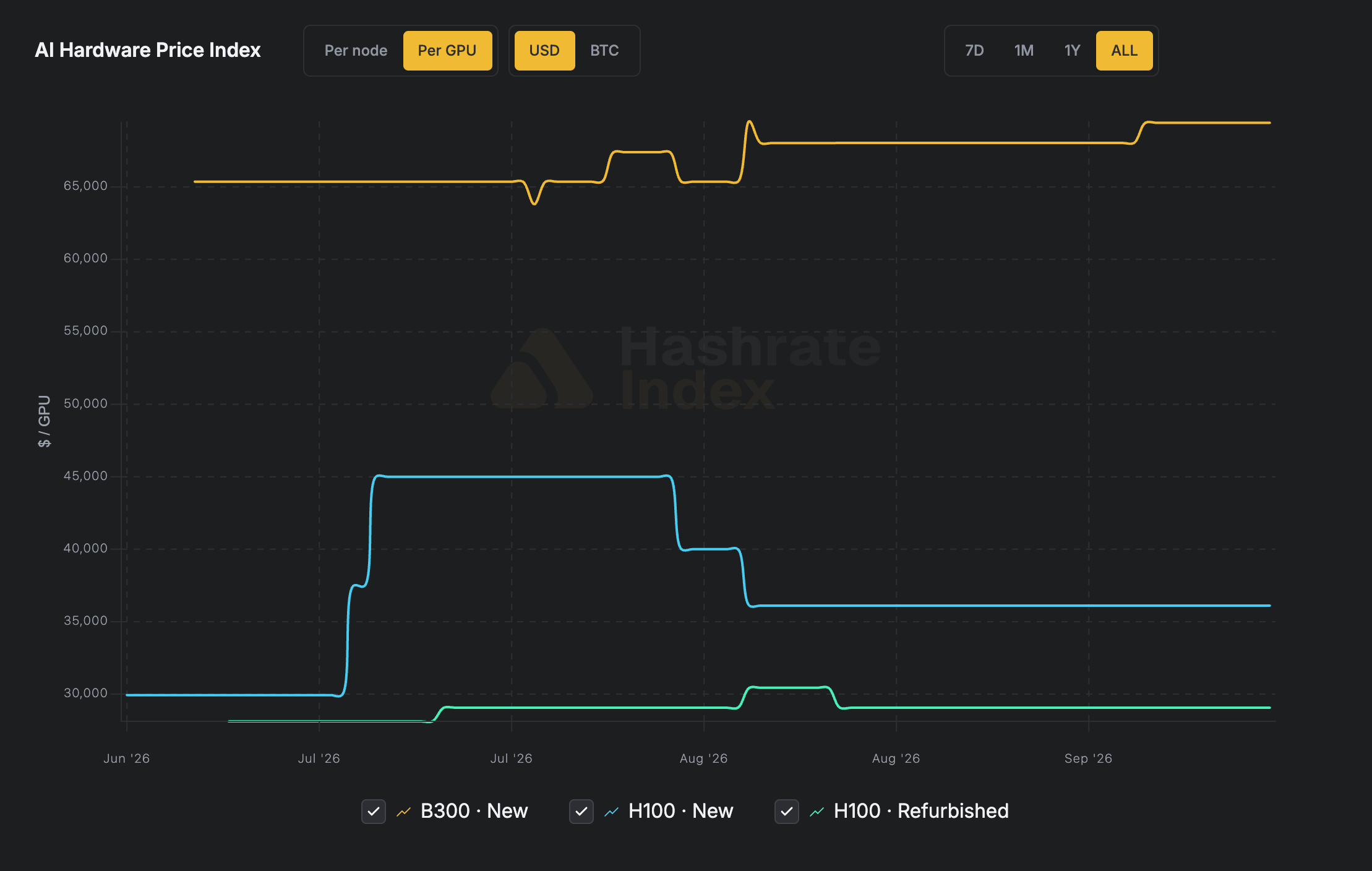
The index Luxor supplied in its reply was its AI Hardware Price Index, which measures advertised prices for selected GPU systems. That can help someone assess an equipment purchase, but buying a machine and earning rent from it involve different prices, so the link doesn’t establish how an AI rental hedge would settle.
See also  How High Can Bitcoin, Ethereum and XRP Prices Go Next?
Graph showing Luxor's AI hardware price index from June 23 to Oct. 2, 2026 (Source: Hashrate Index)Graph showing Luxor's AI hardware price index from June 23 to Oct. 2, 2026 (Source: Hashrate Index)
B300 prices climbed toward $69,000 as new and refurbished H100s settled near $36,000 and $29,000.

Luxor’s August data announcement described expanded compute spot pricing as forthcoming. Operators trying to protect income would still need contracts that name a rental benchmark and show it tracks what customers pay.

Narrower benchmarks might fit better, but each additional contract splits potential trading among smaller groups. Building this market requires a compromise between matching each customer’s business closely and bringing enough people together under the same contract to make trading affordable.

The protection has to survive the bad month

Even a closely matched contract leaves the operator relying on someone else’s ability to pay when rental income falls.

If that counterparty also earns much of its money from AI infrastructure, cheaper computing could damage both businesses at the same moment, just when one expects support from the other.

Collateral can reduce that dependence by requiring money or eligible assets to be posted against obligations, giving the recipient something to draw on if the other party fails. It also creates a financing requirement, because money committed to the hedge can’t simultaneously pay the operator’s other bills.

In the example where rental prices increase, the operator might have to pay its hedge obligation before customers settle their higher invoices.

The overall economics could still work even if the bank account runs short, making the timing of cash flows a huge part of that protection’s affordability.

Luxor didn’t provide the requested AI collateral terms or explain the procedures for a counterparty failing to pay. Its reply also left unanswered how it separates its own trading from the business it arranges for customers, a relevant point because the launch announcement disclosed an internal compute trading fund.

More predictable rental income could give an operator greater confidence about meeting its debt payments, even when customers become less willing to pay yesterday’s rates.

Getting that benefit requires a contract that follows the income closely enough, with payment obligations the operator can afford throughout the period it’s trying to protect.

Cheaper computing could let more people build and use AI while leaving some owners of the machines with disappointing returns.

Financial contracts won’t make that loss disappear, but they could move part of it to someone prepared to bear it, giving the operator more room to keep serving customers when the rent falls.

GPU hedges Hosts Plunging Prices Step threaten
Share. Facebook Twitter Pinterest LinkedIn Tumblr Email

Related Posts

Ethereum Price Faces $2,800 Wall Again — Are Whales Selling or Accumulating ETH?

October 3, 2026

New SEC crypto rules threaten small advisers, but big firms win

October 3, 2026

Masked Robbers Threaten Pregnant Wife in UK Crypto Home Attack

October 3, 2026

Bull Market Targets for BTC, ETH, SOL, and XRP

October 3, 2026
Add A Comment
Leave A Reply Cancel Reply

Top Posts

Citadel pushes SEC to classify open-source developers as unregistered stockbrokers – Uniswap fires back

December 7, 2025

Best Crypto Payment Gateways to Accept Crypto Payments in 2025

September 5, 2025

Stay ahead with the latest crypto news, market updates, blockchain insights, and trends. Your trusted source for everything happening in the digital asset world.


We're social. Connect with us:

Facebook X (Twitter) Instagram Pinterest YouTube
Top Insights

GMX Sponsors Arbitrum’s Open House Singapore as Buildathon

October 3, 2026

IMF Praises El Salvador But Tries To Scale Back Bitcoin Use

October 3, 2026

CFTC wins $31M Fundsz fraud order as crypto scam losses mount worldwide

October 3, 2026
Get Informed

Subscribe to Updates

Get the latest creative news From Free.cc directly in your Inbox!

  • Contact
  • Privacy Policy
  • Terms & Conditions
  • Disclosure
© 2026 free.cc - All rights reserved.

Type above and press Enter to search. Press Esc to cancel.