

The US Securities and Exchange Commission’s proposed crypto custody fallback could broaden investment choices while making them easier for larger advisers to offer.
The agency’s economic analysis says the expense of safeguarding assets and arranging independent oversight may lead smaller firms to decline to offer the service.
Approved on Oct. 1, the proposal would let advisers hold covered client crypto assets when an eligible custodian is unavailable, subject to safeguards. Table 8 models certain annual costs of $433,833 per adviser using that option.
That estimate includes an independent control report but leaves out some potentially significant technology costs.
For clients, the consequence could be that an asset might become available through an adviser with sufficient custody resources while remaining outside another adviser’s offering.
SEC Commissioner Hester Peirce distinguished adviser “self-custody” from investors holding their own assets. Here, an intermediary would hold clients’ key materials, potentially including a non-controlling portion. Clients would still depend on that intermediary’s safeguards.
For ordinary advisory clients, the adviser amendments concern crypto assets that are funds or securities, while the relevant scope for regulated-fund accounts is securities or similar investments.
What the annual estimate includes
The largest modeled annual component is the independent internal control report. The SEC puts its average cost at $376,000, alongside $57,833 in recurring internal compliance work.
Table 8 combines those amounts and separately lists an initial internal compliance cost of $173,499, all in 2026 dollars.
| Modeled adviser cost | Amount | Timing |
|---|---|---|
| Internal compliance work | $173,499 | Initial |
| Internal compliance work | $57,833 | Recurring annually |
| Independent internal control report | $376,000 | Annual estimate |
| Table 8 adviser annual subtotal | $433,833 | Internal work plus control report |
The internal estimate assumes 300 initial hours and 100 recurring annual hours at $578.33 an hour. It covers information, communications, and an agreement between adviser and client to treat the asset as a financial asset under applicable state law.
The subtotal leaves out some technology, software, hardware, and associated systems and processes. The SEC expects those costs to be economically high. Recordkeeping and disclosure burdens also appear separately in other tables, so the subtotal cannot serve as a complete operating budget.
The accountant figure comes from an inflation-adjusted prior estimate in the Paperwork Reduction Act analysis, rounded to the nearest $1,000, reflecting the agency’s historical cost model. Report costs could vary with the assets, safeguarding systems, and expertise needed to check different networks.
The agency assumes approximately 823 advisers, or 5% of 16,442 registered advisers, would use self-custody for that burden calculation. It cautions that actual uptake may be lower.
Scale changes the cost of access
The economic analysis explicitly anticipates that smaller advisers may elect against self-custody, while larger advisers could have sufficient resources to meet the safeguards. It also identifies ways to share some costs across a larger client base, multiple assets, or affiliated businesses.
That creates a plausible advantage without establishing a universal minimum firm size. An adviser with substantial overall assets may have only a small pool of covered crypto assets needing this fallback.
Conversely, an adviser with a focused crypto business may already have the expertise and infrastructure another firm would have to acquire.
A shared cost weighs more heavily on a small pool of assets than a large one, if the burden stays constant. Firms could allocate costs across their wider businesses rather than charge only clients using the fallback.
The SEC expects many direct costs could be passed on to clients through fees or expenses. More assets and more networks can require more complex controls and more specialized accountant work, increasing absolute costs. The potential benefit comes from spreading or reusing parts of the infrastructure.
Accountant pricing could work either way: the SEC warns that demand for people who can assess crypto controls could make services harder to obtain, particularly for smaller advisers with less bargaining power.
An option that can expire for each asset
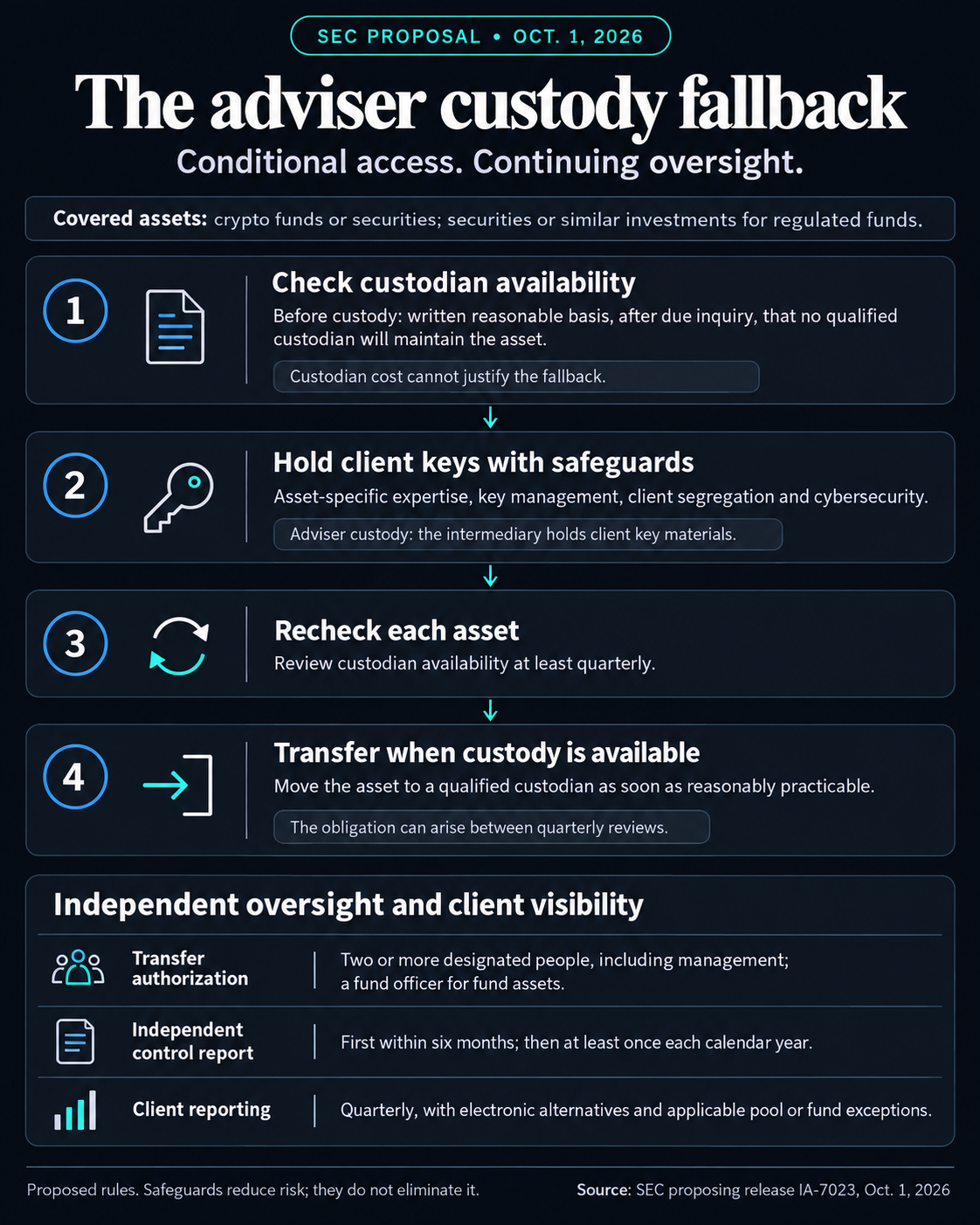
The proposed fallback would depend on the adviser having a written reasonable basis, after due inquiry, that no qualified custodian would maintain each asset.
The adviser would need to make this determination before taking custody and at least quarterly afterward. Custodian costs could not form the basis of that determination.
An adviser could not choose the fallback simply because its custody arrangement looked cheaper. The relevant barrier is the availability of an eligible custodian for the asset, assessed under the proposed conditions.
Once an adviser learned that a qualified custodian had become available, it would have to place the asset with that custodian as soon as reasonably practicable. That obligation could arise between quarterly reviews. The proposal does not specify a single transfer deadline for every situation.
A firm might incur costs to support an asset and later have to move it out of adviser custody. Eligibility could also leave the firm with only a narrow set of unsupported assets to spread the remaining expense across.
If no client crypto assets remained in self-custody by the report’s due date, the report would not be required. That could reduce costs for a short-lived arrangement, although advisers retaining other covered client crypto assets in self-custody would still face the applicable obligation.
The safeguards buy independent scrutiny
The expense accompanies a change in who holds the assets. An adviser offering investment advice would also hold client key materials, creating risks of misuse, misappropriation and operational error. A lower-cost arrangement would have to be assessed alongside those risks.
As SEC Commissioner Mark Uyeda’s statement explains, the proposed conditions include safeguarding expertise, cybersecurity protections, annual reviews, reporting and client disclosures.
The adviser would need asset-specific expertise and systems for key management, authorization by two or more designated people, and segregation of each client’s assets.
The first independent control report would be due within six months of taking self-custody and at least once each calendar year thereafter. It would assess the design, implementation and effectiveness of controls and include verification of reconciliation to the crypto network.
That supplies scrutiny beyond an adviser’s assessment of its capability.
Quarterly client reporting would also apply, with electronic alternatives and exceptions for qualifying audited pools and regulated funds. Clients’ visibility into balances and transactions can complement safeguards, while the accountant’s work addresses questions that a balance alone cannot settle.
These protections would not eliminate custodial risk, and the SEC cautions that spending itself does not establish safeguarding competence. A firm’s ability to absorb compliance costs is a separate question from whether its systems effectively protect clients.
Alternatives could soften the scale advantage
SEC Commissioner Hester Peirce’s Sept. 30, 2025 statement described conditional staff no-action relief for certain state trust companies and identified national and state banks as other permissible custodians.
The October proposal would also permit eligible state trust companies to custody crypto assets, subject to initial and annual due inquiry into authorization and safeguards. Where an eligible institution supports an asset, clients may gain access without their adviser building the proposed fallback arrangement.
Its cost advantage would depend on the particular asset and custody arrangement, since a firm authorized to provide crypto custody does not necessarily maintain every asset a client wants to hold.
The question for investors is whether the proposal would produce usable access at an acceptable cost and level of protection. The SEC’s analysis supports a possible advantage for advisers with sufficient resources and reusable infrastructure.
How widely clients benefit would depend on firms’ actual implementation costs, independent-accountant pricing, and the assets that eligible custodians begin to support.