

Prediction markets have entered a period of accelerated growth, transitioning from niche event-based trading platforms into an increasingly recognized financial market. Between July 2025 and mid-2026, virtually every major industry metric expanded at an unprecedented pace. Monthly trading volumes increased several-fold, cumulative trading activity crossed hundreds of billions of dollars, open interest reached record highs, venture capital investment remained elevated, and market participation increasingly shifted toward sports-related contracts.
The industry is currently dominated by Kalshi and Polymarket, although their operating models differ substantially. Kalshi operates as a regulated exchange under the oversight of the U.S. Commodity Futures Trading Commission (CFTC), whereas Loading profile preview International primarily operates outside U.S. regulatory jurisdiction through blockchain infrastructure. A newly launched Polymarket US, regulated under the CFTC framework, has begun serving American users but remains significantly smaller than its international counterpart.
The scale of market expansion has prompted several financial institutions to reassess the industry’s long-term potential. Bernstein projects annual prediction market volumes could reach $1 trillion by 2030, implying an approximate 80% compound annual growth rate (CAGR) from 2025. Bank of America similarly describes Kalshi as one of the fastest-growing non-AI companies in the United States, highlighting growth rates that rival those observed within artificial intelligence.
However, rapid expansion has also intensified regulatory scrutiny. Federal regulators, state governments, lawmakers, casino operators, and prediction market platforms remain engaged in an evolving debate over market classification, jurisdiction, insider trading, sports contracts, and consumer protection. As adoption accelerates, the industry’s long-term trajectory will increasingly depend on how regulatory frameworks evolve alongside technological innovation.

1. Market Expansion
The prediction market industry experienced one of the fastest growth periods observed across digital financial markets between mid-2025 and mid-2026.
Monthly trading volumes illustrate the scale of expansion. In July 2025, Kalshi generated approximately $740 million in monthly trading volume, while Polymarket recorded around $1.28 billion. Less than one year later, market activity expanded dramatically.
By June 2026:
| Platform | Monthly Volume |
| Kalshi | $33 billion |
| Polymarket International | $10.7 billion |
| Polymarket US | $3.25 billion |
Although Polymarket initially dominated the sector, Kalshi experienced substantially faster expansion during 2026, becoming the industry’s largest platform by trading activity.
This growth reflects more than increasing user numbers. Higher trading volumes indicate greater market participation, improved liquidity, broader contract availability, and stronger engagement across multiple event categories.
The cumulative trading figures reinforce this structural trend.
By July 2025:
| Platform | Cumulative Volume |
| Polymarket | $24.5 billion |
| Kalshi | $5.38 billion |
By 2026, cumulative trading volumes had increased substantially:
| Platform | Cumulative Volume |
| Kalshi | $155.37 billion |
| Polymarket | $101.23 billion |
| Polymarket US | $11.72 billion |
These figures indicate that Kalshi not only closed the historical gap with Polymarket but surpassed it by total cumulative trading activity.
Another notable trend is the emergence of Polymarket US. Although significantly smaller than the international platform, its launch demonstrates how regulatory approval can expand access to U.S. users while creating a separate liquidity pool operating under federal oversight.
2. Market Leadership Has Shifted
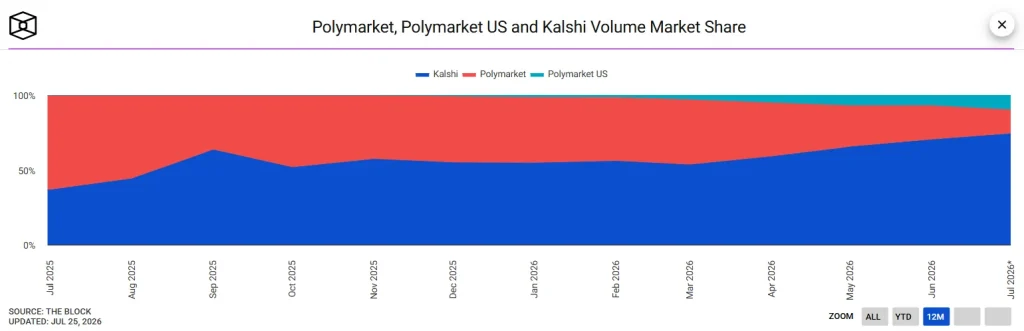
Trading volumes alone do not fully illustrate competitive positioning. Market share data demonstrates how rapidly leadership has shifted during the past year.
During July 2025, Kalshi accounted for approximately 36.73% of prediction market trading activity, while the remainder belonged almost entirely to Polymarket.
By 2026, the competitive landscape share among these top two had changed considerably.
| Platform | Market Share |
| Kalshi | 74.30% |
| Polymarket | 16.03% |
| Polymarket US | 9.67% |
Kalshi’s market share more than doubled within a year, reflecting significantly faster growth than competing platforms.
Several structural differences distinguish the two ecosystems.
Kalshi operates entirely within the United States under CFTC oversight. Account registration requires identity verification, and trading occurs through a regulated centralized infrastructure similar to traditional financial exchanges.
However, Polymarket follows a different model. Its international platform operates through crypto wallets, primarily on Polygon, allowing users worldwide to participate without conventional brokerage accounts. While Americans can technically access the international platform using VPN services, the company formally restricts U.S. participation.
The introduction of Polymarket US reflects a strategic move toward regulatory compliance while maintaining the international platform separately. These different operating structures continue shaping user adoption, liquidity distribution, and regulatory exposure.
3. Liquidity Continues Strengthening
Open interest provides another important measure of market maturity. Unlike trading volume, which measures executed transactions, open interest reflects capital that remains committed to unresolved contracts.
Higher open interest generally indicates stronger market confidence, deeper liquidity, and greater participant engagement.
During July 2025:
| Platform | Daily Open Interest |
| Polymarket | $121 million |
| Kalshi | $71 million |
By 2026, open interest expanded significantly.
Peak levels reached:
| Platform | Peak Open Interest |
| Kalshi | $1.41 billion |
| Polymarket | Around $600 million |
| Polymarket US | Around $150 million |
Kalshi’s open interest increased nearly twenty-fold compared with mid-2025, substantially outpacing growth across competing platforms.
This suggests that market expansion has not been driven solely by short-term speculative trading. Instead, larger amounts of capital are remaining active within unresolved prediction contracts, reflecting broader participation and improving market depth.
4. Sports Now Dominate Activity
One of the most significant behavioral changes across prediction markets has been the concentration of trading around sports contracts. Kalshi’s category distribution illustrates this trend clearly.
In July 2025, sports-related contracts represented approximately 63% of daily trading volume. By 2026, sports accounted for roughly 84%, while crypto remained the second-largest category.
Looking at Polymarket, it also followed a similar trajectory but numbers are just different.
During July 2025:
- Sports represented 22% of trading activity.
- Crypto accounted for approximately 20%.
By 2026:
- Sports expanded to 81% of daily trading volume.
- Crypto declined to approximately 9%, remaining the second-largest category.
The data suggests that prediction markets are becoming increasingly diversified beyond cryptocurrency-focused speculation.
Sports contracts now serve as the primary driver of trading activity across both leading platforms, broadening user participation beyond traditional crypto-native audiences.
5. Capital Is Scaling
The rapid expansion in trading activity has been accompanied by significant increases in capital committed to the prediction market ecosystem. Weekly notional trading volume and venture funding demonstrate that market growth extends beyond user participation and reflects broader investor confidence in the sector’s long-term potential.
Weekly prediction market notional volume has increased sharply within a year.
| Period | Weekly Notional Volume |
| July 2025 | $531 million |
| 2026 | $15.89 billion |
The increase represents one of the strongest year-over-year expansions across digital financial platforms. Rising notional volume indicates larger transaction sizes, improved market liquidity, and higher levels of capital flowing through prediction markets.
The growth is also reflected in venture capital investment.
| Year | Venture Funding |
| 2024 | $146.75 million |
| 2025 | $3.70 billion |
| July 2026 | $1.97 billion |
Funding activity accelerated dramatically between 2024 and 2025 as institutional investors increased exposure to prediction market infrastructure. Although funding through July 2026 remains below the full-year 2025 figure, investment levels remain substantially above historical norms, suggesting continued confidence in the industry’s long-term expansion.
The combination of record trading volumes, growing open interest, and sustained venture investment indicates that growth is occurring simultaneously across both market participation and infrastructure development.
6. Why Analysts See a $1 Trillion Market
The industry’s rapid expansion has led several research firms to reassess the long-term size of prediction markets.
Bernstein projects that annual prediction market trading volume could reach $240 billion during 2026, representing approximately 370% growth compared with the previous year.
Looking further ahead, Bernstein analyst Gautam Chhugani estimates that maintaining an approximate 80% compound annual growth rate (CAGR) between 2025 and 2030 could increase annual prediction market trading volume to nearly $1 trillion by the beginning of the next decade.
Bernstein attributes this outlook to several structural drivers rather than a single catalyst.
Key factors include:
- Greater regulatory clarity at the federal level.
- Increasing blockchain tokenization.
- Deeper cryptocurrency integration.
- Expanding market liquidity.
- Diversification of event contracts beyond politics and crypto.
Bank of America also highlights the industry’s pace of expansion. Analyst Julie Hoover described Kalshi as one of the fastest-growing non-AI companies in the United States, noting that its growth rates rival those seen within the artificial intelligence sector.
The competitive landscape is also expected to broaden. While Kalshi and Polymarket currently dominate market activity, additional participants are entering the sector.
According to Bernstein and Bank of America, companies have either launched or are developing dedicated prediction market offerings.
This suggests the industry is entering a new phase where growth is no longer limited to two primary operators but is attracting established financial and gaming platforms.
7. Retail Users Are Driving Adoption
A notable characteristic of current prediction market growth is that it is primarily being driven by retail participants rather than institutional traders.
According to WalletConnect, approximately 82% of Polymarket users traded less than $10,000 during the first quarter of 2026. Where, average transaction sizes were approximately $35 per trade.
These figures suggest that market expansion is being supported by a broad base of individual participants rather than a relatively small number of high-value institutional accounts.
Users are increasingly participating across several categories, including:
- Sports.
- Politics.
- Crypto prices.
- Macroeconomic events.
However, the trading experience extends beyond placing a prediction.
WalletConnect identifies four operational stages that directly affect user retention and platform efficiency:
- Wallet connection.
- Account funding.
- Settlement and payouts.
- Compliance and identity verification.
Failure at any stage introduces friction that may discourage continued participation.
As transaction volumes continue expanding, infrastructure quality increasingly becomes a competitive differentiator alongside contract availability.
8. Blockchain Infrastructure Matters
The rapid growth of on-chain prediction markets has fundamentally changed how contracts are created, traded, settled, and verified.
Unlike traditional betting systems that rely on centralized operators, blockchain-based prediction markets automate much of the contract lifecycle through smart contracts.
According to Arkham Intelligence, several core technologies underpin modern prediction market infrastructure.
Peer-to-peer settlement
Funds transfer directly between market participants without requiring a central custodian to hold customer balances throughout the contract lifecycle.
Smart contracts
Contract creation, execution, settlement, and payouts are governed automatically through blockchain code rather than manual intervention.
This reduces operational discretion while improving settlement transparency.
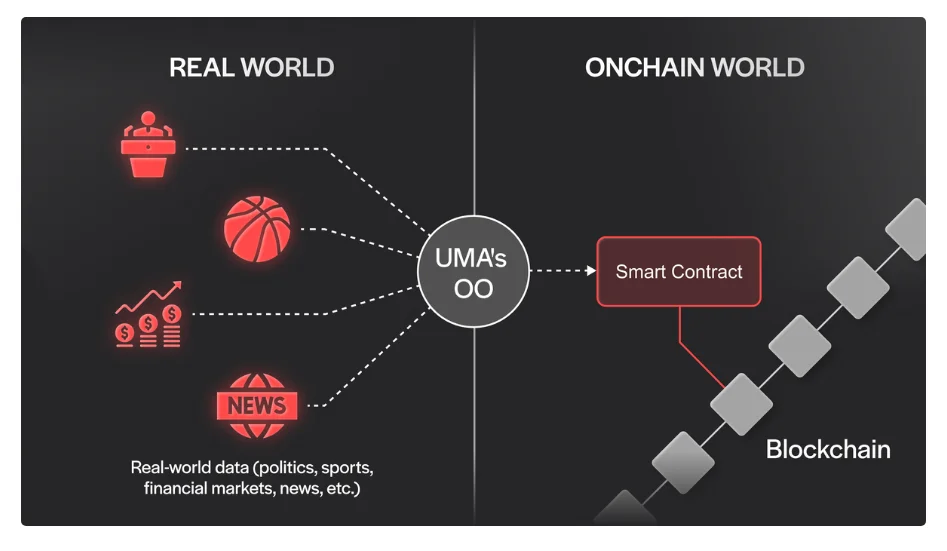
Oracles
Prediction markets must connect blockchain contracts with real-world outcomes.
Polymarket relies on UMA’s Optimistic Oracle.
Market outcomes can be challenged before final settlement, with UMA token holders ultimately determining disputed resolutions.
Although decentralized, this mechanism introduces governance risk because large token holders may influence disputed outcomes.
Central Limit Order Books (CLOBs)
Rather than maintaining a fully on-chain order book, Polymarket uses an off-chain matching engine with on-chain settlement.
This hybrid structure lowers transaction costs while maintaining blockchain settlement.
Kalshi follows a similar order-matching model using conventional centralized financial infrastructure.
Fully Collateralized Contracts
Polymarket requires contracts to be fully collateralized using USDC.
Every YES and NO position is backed by deposited collateral, eliminating counterparty credit risk and avoiding leverage-based liquidation scenarios.
Kalshi achieves similar economic protection through CFTC-regulated margin and clearing requirements.
Arkham also highlights that prediction markets generate transparent on-chain data, enabling advanced trader analytics including:
- Profit and Loss (PnL).
- Return on Investment (ROI).
- Win rates.
- Trading volume.
- Largest profitable trades.
- Active positions.
- Trader Elo ratings based on prediction accuracy.
Because blockchain transactions remain publicly verifiable, market participants can evaluate trading behavior in considerably greater detail than traditional betting platforms.
9. Regulation Becomes the Defining Variable
While prediction markets have experienced exceptional growth throughout 2026, regulation has emerged as the industry’s most significant variable. The debate is no longer centered on whether prediction markets can attract users or liquidity, but on how they should be classified, who should regulate them, and which contracts should remain permissible.
A key distinction exists between the industry’s two largest platforms.
- Kalshi operates as a federally regulated Designated Contract Market (DCM) under the supervision of the Commodity Futures Trading Commission (CFTC).
- Polymarket International primarily operates through blockchain infrastructure outside CFTC jurisdiction and formally restricts U.S. participation.
- Polymarket US, launched under a regulated framework, serves American users but remains substantially smaller than the international platform.
This regulatory divide has become one of the primary competitive differences between the two ecosystems.
Federal regulators maintain that prediction market contracts are financial derivatives regulated under the CFTC rather than conventional gambling products. Several state governments, however, argue that contracts involving elections and sports function similarly to betting markets and therefore fall within state gambling laws.
This disagreement has resulted in an ongoing legal dispute between federal regulators and individual states over regulatory authority.
10. States Push Back
The rapid expansion of prediction markets has prompted legislative and regulatory responses across the United States.
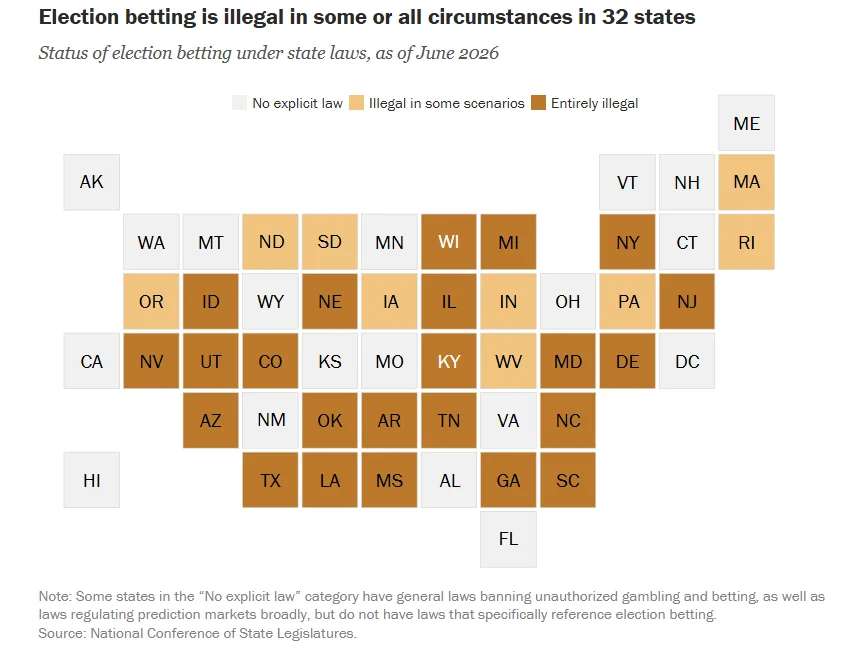
According to Pew Research Center’s analysis of National Conference of State Legislatures (NCSL) data:
- 23 states prohibit election betting entirely.
- 9 additional states impose partial restrictions depending on circumstances.
- Only 18 states and the District of Columbia have no laws specifically addressing election betting.
Several states have also initiated direct legal action or introduced legislation specifically targeting prediction markets.
Notable developments include:
- Minnesota became the first state to prohibit Kalshi, Polymarket, and similar platforms statewide, while allowing limited exemptions for weather-related and insurance-style contracts.
- Kentucky enacted legislation banning election betting while also imposing taxes on prediction market operators.
- Tennessee introduced legislation making it a felony to influence an event after placing a related prediction market trade.
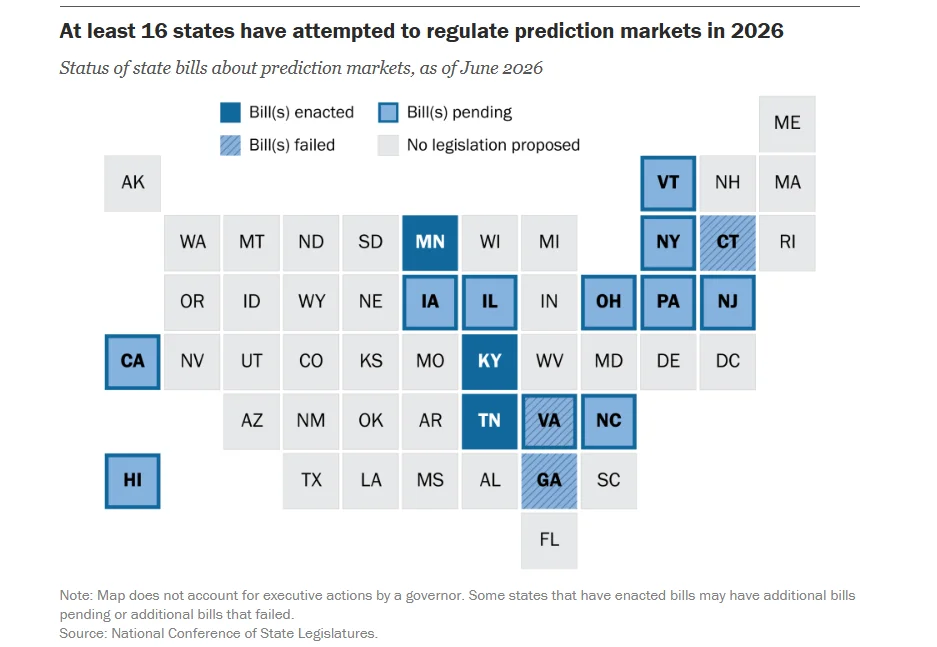
At least:
- 16 states introduced prediction market legislation during 2026.
- 12 states still have bills pending.
- 4 states have seen proposed legislation fail.
Meanwhile, the CFTC has challenged several state actions in court, arguing that prediction markets fall under exclusive federal jurisdiction.
The result is an increasingly fragmented regulatory environment where market expansion continues alongside ongoing legal uncertainty.
11. Insider Trading Remains a Major Concern
As trading volumes have expanded into hundreds of billions of dollars, concerns surrounding insider trading have received increasing attention from lawmakers and regulators. Several high-profile incidents during 2026 intensified scrutiny.
According to Loading profile preview , investigations were launched following trades reportedly placed before U.S. military actions involving Venezuela and Iran.
Additional scrutiny followed:
- Trading reportedly linked to inside political information.
- Investigation involving a former presidential teleprompter operator accused of using material non-public information while trading on Kalshi.
- House Oversight Committee inquiries into prediction market compliance procedures.
Both Kalshi and Polymarket state that they have implemented measures designed to detect and prevent insider trading.
However, lawmakers continue evaluating whether existing safeguards remain adequate as user participation expands. These concerns extend beyond financial integrity.
That said, Prediction markets increasingly cover elections, geopolitical developments, sporting events, and government decisions turning these areas where privileged information can materially influence contract outcomes before becoming publicly available.
As market participation grows, surveillance and compliance are likely to become increasingly important alongside trading infrastructure.
12. Lobbying Intensifies
Regulatory uncertainty has triggered an equally significant lobbying effort.
Prediction market operators and the traditional casino industry are both increasing political engagement in an effort to influence future regulation.
According to CNBC post:
Kalshi
- $990,000 in direct lobbying during the first half of 2026.
- Nearly $1.8 million including external lobbying firms.
- Already exceeds its total lobbying expenditure for all of 2025.
American Gaming Association
- $1.39 million in direct lobbying during the first half of 2026.
- Nearly $1.8 million including outside firms.
Polymarket
- Approximately $180,000 spent through its lobbying firm during the first half of 2026.
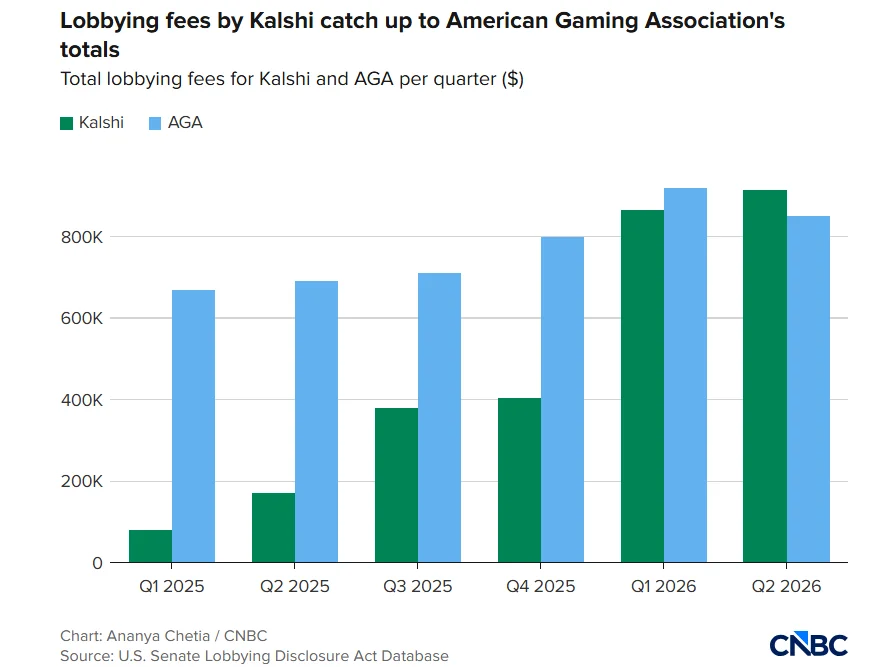
The debate extends beyond market competition. As Casino operators argue that sports-related event contracts closely resemble traditional sports betting and should therefore remain regulated by individual states.
Prediction market platforms counter that event contracts are financial derivatives comparable to commodity swaps and should remain under CFTC supervision.
This distinction is likely to shape future market expansion more than any technological development.
13. Policy Challenges
Policy researchers argue that the industry’s growth has outpaced existing regulatory frameworks.
According to the American Institute for Boys and Men (AIBM), lawmakers must address several structural issues as prediction markets continue expanding.
These include:
- Clarifying CFTC authority.
- Defining which contracts are susceptible to manipulation.
- Improving responses to suspicious market activity.
- Regulating marketing practices.
- Developing responsible trading tools.
- Determining how prediction markets coexist alongside traditional gambling industries.
The report argues that future regulation should move beyond restricting individual contracts and instead establish broader market protections capable of adapting as crypto infrastructure becomes increasingly integrated with prediction markets.
The data presented across market activity, liquidity, funding, user adoption, infrastructure, and industry forecasts indicates that prediction markets have entered a period of structural expansion rather than temporary speculative growth.
Between July 2025 and mid-2026:
- Monthly trading volumes expanded from billions to tens of billions of dollars.
- Weekly notional volume increased from $531 million to $15.89 billion.
- Cumulative platform volume surpassed $268 billion across Kalshi and both Polymarket platforms.
- Peak open interest exceeded $1.4 billion.
- Venture investment remained elevated after a record-setting 2025.
- Retail participation became the primary growth engine, with most users trading relatively small amounts while collectively driving substantial market activity.
- Sports emerged as the dominant contract category across both leading platforms.
The industry’s technological foundation has also matured. Blockchain settlement, smart contracts, oracle-based resolution, fully collateralized trading, and transparent on-chain analytics have created infrastructure capable of supporting significantly larger trading volumes than earlier prediction market models.
At the same time, regulation remains the principal uncertainty.
Federal regulators continue asserting authority over prediction markets, while numerous states seek greater oversight of election and sports-related contracts. Investigations into insider trading, proposed legislation, and expanding lobbying efforts demonstrate that policy development is progressing alongside market growth.
Despite these uncertainties, the available evidence explains why Bernstein projects annual prediction market volume could approach $1 trillion by 2030. The forecast is not based on a single catalyst but on the convergence of sustained trading growth, increasing liquidity, expanding retail participation, continued venture investment, improving blockchain infrastructure, broader product offerings, and expectations of greater regulatory clarity.
Whether that projection is ultimately achieved will depend less on demand (which current data shows is already expanding rapidly) and more on the industry’s ability to navigate the evolving legal and regulatory landscape while maintaining market integrity, operational transparency, and investor confidence.