Close Menu
  • Latest News
    • Bitcoin
    • Ethereum
    • Altcoins
    • Meme Coins
  • Tech
    • Blockchain
    • Security and Privacy
  • Web 3
    • Gaming
  • Legal
    • Legal and Regulatory
    • Adoption
  • Analysis
  • Learn
    • Education
    • Wallets and Exchanges
  • Tools
    • Market Overview
    • Exchange Tool
What's Hot

Bitcoin ETF Outflows Hit $1.44B as BlackRock’s IBIT Faces Heavy Selling

November 12, 2026

SEC enforcement actions fall 24%, crypto cases in spotlight

November 12, 2026

XRP sharks add 16.8K wallets as price nears critical $1 support: Can buyers defend it?

November 12, 2026
Facebook X (Twitter) Instagram
  • Contact
  • Privacy Policy
  • Terms & Conditions
  • Disclosure
Facebook X (Twitter) Instagram
Free.cc (Free Cryptocurrency)Free.cc (Free Cryptocurrency)
  • Latest News
    1. Bitcoin
    2. Ethereum
    3. Altcoins
    4. Meme Coins
    5. View All

    Bitcoin ETF Outflows Hit $1.44B as BlackRock’s IBIT Faces Heavy Selling

    November 12, 2026

    How Sam Altman-Backed Meanwhile Is Disrupting The $20T Life Insurance Industry

    November 12, 2026

    $1.04B out of Bitcoin ETFs – Short term holders plunge into net unrealized losses

    November 12, 2026

    Israel Discount Bank to Launch Bitcoin, Ethereum Trading in Its Ap

    November 12, 2026

    Ethereum – What BitMine’s $6.3B loss reveals about building treasury around ETH

    November 12, 2026

    BlackRock’s crypto portfolio falls by nearly $5 billion so far in November 2026

    November 11, 2026

    Ether ETFs Shed $184.6M in a Day as BlackRock Leads Redemptions

    November 11, 2026

    Is Ethereum’s slide below $2250 sign of ‘impatience of markets’?

    November 10, 2026

    XRP sharks add 16.8K wallets as price nears critical $1 support: Can buyers defend it?

    November 12, 2026

    ARK Invest Trims Block and Bullish Positions as Bitcoin ETF Outflows Continue

    November 12, 2026

    Binance gives HYPE and TRX the same 75x cap – Which faces more risk?

    November 12, 2026

    Quant won The Clearing House deal – Will QNT slip below THIS?

    November 11, 2026

    Top 5 Memecoins to Watch in 2026: Hype, Utility, or Growth?

    October 14, 2026

    Did Jean Phil Go Viral First — or Was the Viral Persona Built to Launch a Memecoin?

    October 5, 2026

    Thinking Cat Gains Momentum After CASHCAT’s Breakout

    August 12, 2026

    What Tokens Could He Target?

    July 30, 2026

    Bitcoin ETF Outflows Hit $1.44B as BlackRock’s IBIT Faces Heavy Selling

    November 12, 2026

    SEC enforcement actions fall 24%, crypto cases in spotlight

    November 12, 2026

    XRP sharks add 16.8K wallets as price nears critical $1 support: Can buyers defend it?

    November 12, 2026

    Whitechain Moves to Ethereum Layer 2 on Optimism’s OP Stack, Keeping WBT as Gas Token

    November 12, 2026
  • Tech
    1. Blockchain
    2. Security and Privacy
    3. View All

    Whitechain Moves to Ethereum Layer 2 on Optimism’s OP Stack, Keeping WBT as Gas Token

    November 12, 2026

    Ondo Claims the Tokenisation Leadership on the Back of Securitize’s Shrinking Assets

    November 12, 2026

    Talos’ NEAR Intents integration brings cross-chain liquidity to institutions

    November 12, 2026

    Bhutan’s Ethereum digital identity verifies credentials without putting data on-chain

    November 12, 2026

    Bitcoin Core Discloses High-Severity Security Bug That Could Halt Mining Nodes

    November 12, 2026

    Near AI Confirms Security Breach Affecting 100 Users and 18 Agents

    November 11, 2026

    Apple iOS Vulnerability Puts Crypto Wallets at Risk as Binance Issues Warning

    November 11, 2026

    Pompliano Says a Bitcoin ETF Beats Hardware Wallets on Security

    November 10, 2026

    Bitcoin ETF Outflows Hit $1.44B as BlackRock’s IBIT Faces Heavy Selling

    November 12, 2026

    SEC enforcement actions fall 24%, crypto cases in spotlight

    November 12, 2026

    XRP sharks add 16.8K wallets as price nears critical $1 support: Can buyers defend it?

    November 12, 2026

    Whitechain Moves to Ethereum Layer 2 on Optimism’s OP Stack, Keeping WBT as Gas Token

    November 12, 2026
  • Web 3
    1. Gaming
    2. View All

    FLOKI Ships Valhalla 1.13.2 ‘Special Delivery’ to Players on Mainnet

    October 27, 2026

    Top 12 NFT games every player should know about in August 2026

    September 22, 2026

    GameShame Studios founder details Raijin Protocol’s roadmap in NeoPod’s sixth AMA

    September 22, 2026

    Proof of Play to shut down after blockchain gaming thesis falls short

    September 22, 2026

    Bitcoin ETF Outflows Hit $1.44B as BlackRock’s IBIT Faces Heavy Selling

    November 12, 2026

    SEC enforcement actions fall 24%, crypto cases in spotlight

    November 12, 2026

    XRP sharks add 16.8K wallets as price nears critical $1 support: Can buyers defend it?

    November 12, 2026

    Whitechain Moves to Ethereum Layer 2 on Optimism’s OP Stack, Keeping WBT as Gas Token

    November 12, 2026
  • Legal
    1. Legal and Regulatory
    2. Adoption
    3. View All

    SEC enforcement actions fall 24%, crypto cases in spotlight

    November 12, 2026

    Kalshi Faces Possible CFTC Charges Over Contract Filings

    November 12, 2026

    FSB pressures Turkey regulators to lock down foreign stablecoins

    November 12, 2026

    Giancarlo says US crypto can thrive without the Clarity Act

    November 12, 2026

    Millions watched Kalshi’s election odds without betting a dollar

    November 7, 2026

    Why Ripple’s $16 trillion payment volume isn’t boosting XRP

    October 31, 2026

    Ripple is heading for its best year ever while XRP faces its worst since 2022

    October 29, 2026

    BNY offers XRP custody, but only 1 rollout type exists

    October 28, 2026

    Bitcoin ETF Outflows Hit $1.44B as BlackRock’s IBIT Faces Heavy Selling

    November 12, 2026

    SEC enforcement actions fall 24%, crypto cases in spotlight

    November 12, 2026

    XRP sharks add 16.8K wallets as price nears critical $1 support: Can buyers defend it?

    November 12, 2026

    Whitechain Moves to Ethereum Layer 2 on Optimism’s OP Stack, Keeping WBT as Gas Token

    November 12, 2026
  • Analysis

    XRP Price Reversal Ahead? Whale Buying Accelerates Near $1 Support

    November 12, 2026

    Why Is Crypto Crashing? Kevin O’Leary and Raoul Pal Reveal Major Reasons

    November 12, 2026

    Bitcoin’s recovery faces a $75,600 trap

    November 12, 2026

    Binance hacker’s XRP stockpile rapidly crashes driven by Bitcoin swaps

    November 12, 2026

    Expert Lists Key Conditions for Bitcoin to Rally to $100,000

    November 12, 2026
  • Learn
    1. Education
    2. Wallets and Exchanges
    3. View All

    What Is Robinhood Chain? The Ethereum Layer-2 Network for Tokenized Stocks

    July 12, 2026

    What Is BChat? The Decentralized Messaging App Built for Privacy

    June 2, 2026

    What Is an AI Prompt Injection Attack? The Hidden Threat Hijacking Your Chatbots

    May 31, 2026

    What Is AI Jailbreaking? A Beginner’s Guide to the Cat-and-Mouse Game Behind Every Chatbot

    May 17, 2026

    Binance CFO leaves the company to tokenize real assets

    November 11, 2026

    NYSE brings stocks to Avalanche, but bans direct wallets

    November 11, 2026

    Any Bitcoin recovery faces a cash problem as Binance’s stablecoins fall to $32 billion

    November 10, 2026

    Mercado Bitcoin plans viewing, not withdrawals

    November 10, 2026

    Bitcoin ETF Outflows Hit $1.44B as BlackRock’s IBIT Faces Heavy Selling

    November 12, 2026

    SEC enforcement actions fall 24%, crypto cases in spotlight

    November 12, 2026

    XRP sharks add 16.8K wallets as price nears critical $1 support: Can buyers defend it?

    November 12, 2026

    Whitechain Moves to Ethereum Layer 2 on Optimism’s OP Stack, Keeping WBT as Gas Token

    November 12, 2026
  • Tools
    • Market Overview
    • Exchange Tool
Free.cc (Free Cryptocurrency)Free.cc (Free Cryptocurrency)
Home»Adoption»XRPL’s May 27 upgrade shows how validators and markets decide a blockchain split
Adoption

XRPL’s May 27 upgrade shows how validators and markets decide a blockchain split

May 22, 2026No Comments6 Mins Read
Share
Facebook Twitter LinkedIn Pinterest Email
Make CryptoSlate logo CryptoSlate preferred on Google logo

XRPL’s known amendments page lists fixCleanup3_1__3 for activation on May 27, and by design the event is a maintenance upgrade.

Version 3.1.3 of rippled bundles fixes for NFTs, Permissioned Domains, Vaults, and the Lending Protocol, and the XRPL blog set the default vote to Yes because of the importance of those fixes.

The amendment process requires more than 80% support from trusted validators sustained for two weeks before the new rules become permanent.

What makes the episode worth examining beyond the deadline is what XRPL co-creator David Schwartz said about what a real fork would actually require, because his answer reveals how protocol legitimacy works on any blockchain.

Schwartz’s central point is that raw node count is a poor proxy for consensus power. A system where nodes vote in proportion to their number creates an attack surface where anyone can spin up thousands of machines at low cost.

In the XRPL model, each server operator maintains a curated set of validators the server trusts not to collude, the Unique Node List, and the UNL determines which validation votes the server counts during consensus.
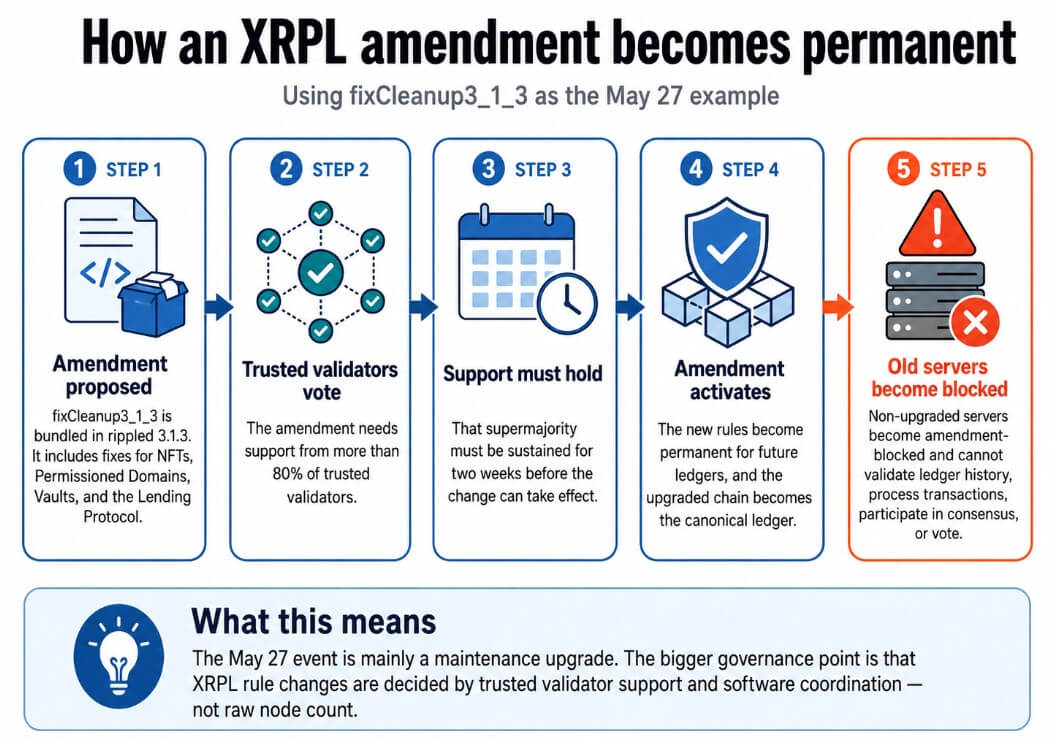
XRPL amendment becoming permanent
The XRPL amendment process requires support from more than 80% of trusted validators sustained for two weeks before new rules become permanent, blocking non-upgraded servers.

A server receives validation messages from many nodes across the network, and the validators on its UNL determine which of those messages shape the server’s view of the ledger.

Schwartz explained that consensus legitimacy on XRPL flows through trust lists and validator coordination, producing a system in which UNL alignment and economic adoption determine which ledger survives a split.

Why a real fork requires a full coordination campaign

For the XRPL vote on May 27, servers that become amendment-blocked lose the ability to determine ledger validity, submit or process transactions, participate in consensus, or vote on future amendments.

See also  KRW1 to be integrated into Circle’s Arc blockchain

That makes the deadline operationally important for any exchange, wallet, explorer, or infrastructure operator still running pre-3.1.3 software, as those servers become non-participants in the canonical ledger until the operator updates.

Amendment-blocked infrastructure loses access to the upgraded chain and lacks the coordination infrastructure to anchor a functional rival.

To produce a credible fork, a dissenting group would need validators willing to keep producing ledgers under the old rules, and without validators, there is no ledger stream to follow.

They would then need a competing Unique Node List that servers can configure or software can default to, because without a trusted validator list, nodes have no mechanism for coordinating around the old rules.

On top of that, they would need a code distribution that preserves the old rules and ships with defaults pointing to the rival UNL, and they would need infrastructure support from wallets, exchanges, explorers, and apps sufficient to make the old-rule ledger accessible and tradable.
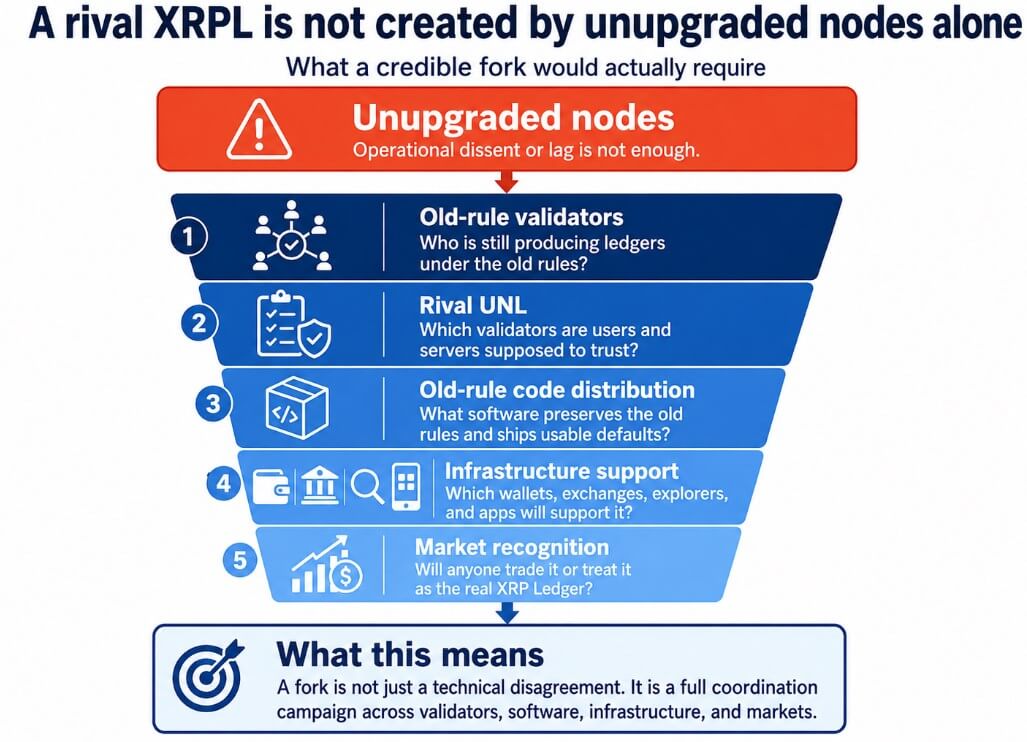
XRPL and the relation with nodes
A credible XRPL fork requires five layers beyond unupgraded nodes: old-rule validators, a rival UNL, old-rule code, infrastructure support, and market recognition.

XRPL documentation cites research showing that competing UNLs may need 90% overlap in the worst case to prevent a fork, meaning any rival UNL would need to share nearly the entire trusted validator set with the canonical one to maintain internal coherence.

A fork forming around a radically different validator set risks producing a ledger that cannot sustain its own consensus, let alone attract market adoption.

What the amendment process actually tracks is validator support, and the 80%-for-two-weeks threshold ensures that the entities the network trusts have reached a durable agreement before new rules become permanent.

A large share of unupgraded non-validator nodes can reflect infrastructure lag without implying anything about the canonical ledger’s trajectory.

See also  Keone Hon: On-chain finance democratizes global access to financial tools, Monad’s billion transactions per day revolutionizes blockchain, and the risks of centralized exchanges exposed

The distance between infrastructure lag and a rival chain

In the bear case, exchanges, wallets, or infrastructure operators that lag behind the May 27 activation become amendment-blocked and stop functioning as ledger participants.

Users routing through those providers encounter service disruptions, such as transactions that cannot be submitted, explorers that cannot confirm ledger validity, and apps that cannot process payments.

CryptoSlate Daily Brief

Daily signals, zero noise.

Market-moving headlines and context delivered every morning in one tight read.

5-minute digest 100k+ readers

Free. No spam. Unsubscribe any time.

Whoops, looks like there was a problem. Please try again.

You’re subscribed. Welcome aboard.

That operational cost falls on operators who deprioritized the upgrade, and it is worth tracking, particularly for any major exchange or custodian still running pre-3.1.3 nodes at activation.

Sustained infrastructure lag across enough providers would create real user-facing friction even as the canonical ledger continues under the new rules.

In the bull case, fixCleanup3_1_3 activates on schedule with the validator supermajority intact, infrastructure operators update without major incident, and the episode becomes a routine amendment activation.

The fixes to NFTs, Permissioned Domains, Vaults, and the Lending Protocol take effect, and the network moves on. The governance debate the upgrade surfaces survives either outcome, because Schwartz’s explanation of what a real split would require applies to any future amendment.

Sustaining old rules requires a dissenting group running old software, recruiting validators around a competing UNL, and convincing wallets, exchanges, and market makers to recognize their ledger as the canonical XRP Ledger, against a default configuration pointing everyone else to the upgraded chain.

See also  Shiba Inu Price Holds Ground, Yet Data Shows the Market Isn’t Ready To Chase

Every blockchain has a governance layer

Schwartz drew a comparison to Stellar, whose Protocol 24 upgrade is itself a stability fix for a state-archival bug in Stellar Core, which was a maintenance event requiring the same kind of coordinated validator adoption.

Bitcoin’s equivalent legitimacy layer runs through miners, economic nodes, client implementations, and exchange listings. Ethereum’s runs through validators, staking infrastructure, client diversity, core developers, and app-layer adoption.

What XRPL makes explicit through UNLs, other networks embed in mining power distribution, staking economics, or the social consensus around which client software developers trust.

The mechanisms differ across Bitcoin, Ethereum, and XRPL, while the dependence on coordinated human decisions to make rule changes permanent runs through all three.
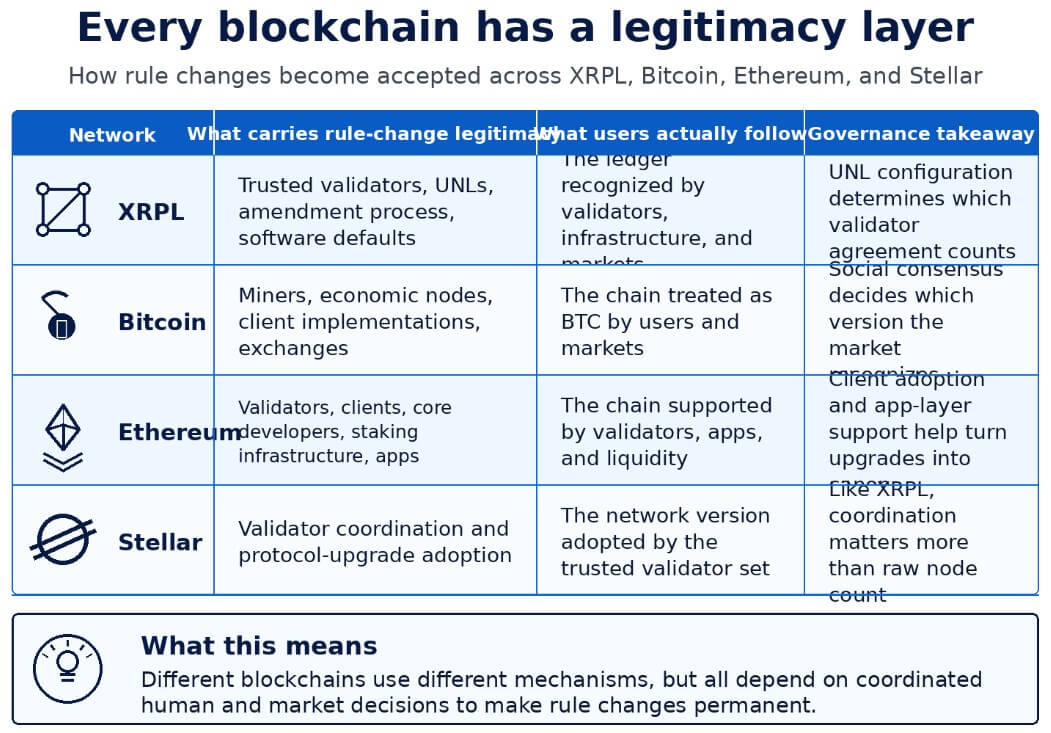
Every blockchain has a legitimacy layer
Across XRPL, Bitcoin, Ethereum, and Stellar, rule changes become permanent through coordinated validator, miner, developer, and market decisions rather than raw node count.

The May 27 activation illustrates how XRPL’s governance layer converts validator agreement into ledger permanence, with UNL configuration determining which agreements count.

An operator who disagrees with fixCleanup3_1_3 has the technical freedom to run old software and configure a rival UNL.

Whether any exchange lists the resulting token, any wallet supports it, or any market maker provides liquidity is a question the protocol cannot answer for them.

That coordination disconnect is why protocol upgrades on well-adopted networks rarely produce durable forks: the economics of following the canonical chain almost always outweigh the economics of building a parallel chain from scratch, and the canonical chain is whichever the market decides is real.

Blockchain Decide markets Shows split Upgrade validators XRPLs
Share. Facebook Twitter Pinterest LinkedIn Tumblr Email

Related Posts

China Blockchain Firms Now File Next to AI and Deepfakes

November 12, 2026

Coinbase’s blockchain got faster. Some apps can still connect but get no data

November 11, 2026

China’s internet regulator launches unified filing system for AI and blockchain

November 11, 2026

NYSE picks Avalanche to settle tokenized stocks amid Wall Street’s blockchain race

November 11, 2026
Add A Comment
Leave A Reply Cancel Reply

Top Posts

Crypto Funds Attract Over $2 Billion This Week

January 20, 2026

This Is The Key Level That Stands Between The Ethereum Price And A Surge To $5,000

September 16, 2025

Stay ahead with the latest crypto news, market updates, blockchain insights, and trends. Your trusted source for everything happening in the digital asset world.


We're social. Connect with us:

Facebook X (Twitter) Instagram Pinterest YouTube
Top Insights

Bitcoin ETF Outflows Hit $1.44B as BlackRock’s IBIT Faces Heavy Selling

November 12, 2026

SEC enforcement actions fall 24%, crypto cases in spotlight

November 12, 2026

XRP sharks add 16.8K wallets as price nears critical $1 support: Can buyers defend it?

November 12, 2026
Get Informed

Subscribe to Updates

Get the latest creative news From Free.cc directly in your Inbox!

  • Contact
  • Privacy Policy
  • Terms & Conditions
  • Disclosure
© 2026 free.cc - All rights reserved.

Type above and press Enter to search. Press Esc to cancel.