Close Menu
  • Latest News
    • Bitcoin
    • Ethereum
    • Altcoins
    • Meme Coins
  • Tech
    • Blockchain
    • Security and Privacy
  • Web 3
    • Gaming
  • Legal
    • Legal and Regulatory
    • Adoption
  • Analysis
  • Learn
    • Education
    • Wallets and Exchanges
  • Tools
    • Market Overview
    • Exchange Tool
What's Hot

SEC flags tokenization as high-risk area in 2027 market examinations

October 25, 2026

Analyzing why Uniswap’s network growth hit a 4-year high despite UNI’s 5.4% drop

October 25, 2026

Israel Eyes Blockchain as Netanyahu Warns of US Military Aid Cuts

October 25, 2026
Facebook X (Twitter) Instagram
  • Contact
  • Privacy Policy
  • Terms & Conditions
  • Disclosure
Facebook X (Twitter) Instagram
Free.cc (Free Cryptocurrency)Free.cc (Free Cryptocurrency)
  • Latest News
    1. Bitcoin
    2. Ethereum
    3. Altcoins
    4. Meme Coins
    5. View All

    China to Seize 61,896 Bitcoin in $5.6 Billion Fraud Case

    October 25, 2026

    New York AG Pursues $1,300,000,0000 From Crypto Pyramid Scheme Targeting Prayer Groups

    October 25, 2026

    Strategy (MSTR), Strive (ASST) must balance bitcoin (BTC) purchases, preferred stock dividends

    October 25, 2026

    Blockstream Launches Institutional Consulting Services, Opens Lugano Office

    October 24, 2026

    Ethereum outflows hit 4-month high – Why ETH price still risks $2,300

    October 24, 2026

    Initia halts L1 and rollups after $2.7 million exploit — What happened?

    October 24, 2026

    Ethereum’s deflationary edge fades – Is an ETH/BTC breakout still possible?

    October 24, 2026

    Ethereum’s Glamsterdam testnet hits setback – Why Solana remains ahead

    October 23, 2026

    Analyzing why Uniswap’s network growth hit a 4-year high despite UNI’s 5.4% drop

    October 25, 2026

    Lighter crypto dips 11% – Will $2.2M buybacks spark LIT’s rebound?

    October 25, 2026

    How Quack AI’s 22% price crash puts Q’s $0.06 support in focus

    October 24, 2026

    Bitdeer Reports 1,355 Bitcoin Mined In September While Building AI Capacity

    October 24, 2026

    Top 5 Memecoins to Watch in 2026: Hype, Utility, or Growth?

    October 14, 2026

    Did Jean Phil Go Viral First — or Was the Viral Persona Built to Launch a Memecoin?

    October 5, 2026

    Thinking Cat Gains Momentum After CASHCAT’s Breakout

    August 12, 2026

    What Tokens Could He Target?

    July 30, 2026

    SEC flags tokenization as high-risk area in 2027 market examinations

    October 25, 2026

    Analyzing why Uniswap’s network growth hit a 4-year high despite UNI’s 5.4% drop

    October 25, 2026

    Israel Eyes Blockchain as Netanyahu Warns of US Military Aid Cuts

    October 25, 2026

    China to Seize 61,896 Bitcoin in $5.6 Billion Fraud Case

    October 25, 2026
  • Tech
    1. Blockchain
    2. Security and Privacy
    3. View All

    Israel Eyes Blockchain as Netanyahu Warns of US Military Aid Cuts

    October 25, 2026

    Aero Launches on OP Mainnet, Boosting Liquidity for OP

    October 25, 2026

    China targets national blockchain network completion by 2030

    October 25, 2026

    BlockRunAI Implements Zero Data Retention on Solana

    October 24, 2026

    Keystone Wallet Data Breach Exposes Buyers’ Addresses to Scammers

    October 25, 2026

    X 100 Global Loses Millions as Three-Seat Senate Is Hijacked

    October 25, 2026

    New York demands $1.3B from NovaTech and 11,000 victims face delay

    October 24, 2026

    Hacker Prints $2.7M in Crypto as Initia Blockchain Grinds to a Halt

    October 24, 2026

    SEC flags tokenization as high-risk area in 2027 market examinations

    October 25, 2026

    Analyzing why Uniswap’s network growth hit a 4-year high despite UNI’s 5.4% drop

    October 25, 2026

    Israel Eyes Blockchain as Netanyahu Warns of US Military Aid Cuts

    October 25, 2026

    China to Seize 61,896 Bitcoin in $5.6 Billion Fraud Case

    October 25, 2026
  • Web 3
    1. Gaming
    2. View All

    Top 12 NFT games every player should know about in August 2026

    September 22, 2026

    GameShame Studios founder details Raijin Protocol’s roadmap in NeoPod’s sixth AMA

    September 22, 2026

    Proof of Play to shut down after blockchain gaming thesis falls short

    September 22, 2026

    How BC.GAME is turning players into stakeholders

    September 22, 2026

    SEC flags tokenization as high-risk area in 2027 market examinations

    October 25, 2026

    Analyzing why Uniswap’s network growth hit a 4-year high despite UNI’s 5.4% drop

    October 25, 2026

    Israel Eyes Blockchain as Netanyahu Warns of US Military Aid Cuts

    October 25, 2026

    China to Seize 61,896 Bitcoin in $5.6 Billion Fraud Case

    October 25, 2026
  • Legal
    1. Legal and Regulatory
    2. Adoption
    3. View All

    SEC flags tokenization as high-risk area in 2027 market examinations

    October 25, 2026

    Pentagon bans personnel from using insider information to trade on prediction markets

    October 25, 2026

    South Korea’s FSC Says Digital Asset Basic Act Nears Completion Ahead of 2027 Crypto Tax

    October 25, 2026

    Senator probes Tether payments to former White House crypto adviser

    October 25, 2026

    3.3M users gain HSBC RedCoin, yet 1 strict rule blocks them

    October 24, 2026

    Germany’s main savings bank network launches Bitcoin trading

    October 21, 2026

    Two firms control corporate Bitcoin buys, even as business adoption broadens

    October 16, 2026

    AI agents keep coming back for crypto as x402 wallet refill rate surges to 89%

    October 15, 2026

    SEC flags tokenization as high-risk area in 2027 market examinations

    October 25, 2026

    Analyzing why Uniswap’s network growth hit a 4-year high despite UNI’s 5.4% drop

    October 25, 2026

    Israel Eyes Blockchain as Netanyahu Warns of US Military Aid Cuts

    October 25, 2026

    China to Seize 61,896 Bitcoin in $5.6 Billion Fraud Case

    October 25, 2026
  • Analysis

    Arthur Hayes exits Maelstrom’s crypto trading positions

    October 25, 2026

    Can ENA Reach $0.55 After Ethena’s OKX Launch?

    October 24, 2026

    NYSE’s owner is backing 24/7 stock tokens without Wall Street’s usual price rules

    October 24, 2026

    Can INJ Reach $70 After Injective’s Washington Meetings?

    October 24, 2026

    3 Stocks to Watch Before Next Week’s Earnings

    October 24, 2026
  • Learn
    1. Education
    2. Wallets and Exchanges
    3. View All

    What Is Robinhood Chain? The Ethereum Layer-2 Network for Tokenized Stocks

    July 12, 2026

    What Is BChat? The Decentralized Messaging App Built for Privacy

    June 2, 2026

    What Is an AI Prompt Injection Attack? The Hidden Threat Hijacking Your Chatbots

    May 31, 2026

    What Is AI Jailbreaking? A Beginner’s Guide to the Cat-and-Mouse Game Behind Every Chatbot

    May 17, 2026

    Kraken drops Monero spending questions; XMR cap stays

    October 25, 2026

    Bitcoin’s $80,000 recovery faces liquidity questions as Binance’s Tether flows swing $14 billion

    October 24, 2026

    Coinbase to drop this Japanese yen stablecoin years after its price crash sparked investor lawsuits

    October 24, 2026

    Coinbase Ireland’s cash safeguards fell €5 million short before 2024 fix

    October 23, 2026

    SEC flags tokenization as high-risk area in 2027 market examinations

    October 25, 2026

    Analyzing why Uniswap’s network growth hit a 4-year high despite UNI’s 5.4% drop

    October 25, 2026

    Israel Eyes Blockchain as Netanyahu Warns of US Military Aid Cuts

    October 25, 2026

    China to Seize 61,896 Bitcoin in $5.6 Billion Fraud Case

    October 25, 2026
  • Tools
    • Market Overview
    • Exchange Tool
Free.cc (Free Cryptocurrency)Free.cc (Free Cryptocurrency)
Home»Analysis»Ethereum’s biggest staker has just become a public company with over $10 billion locked up
Analysis

Ethereum’s biggest staker has just become a public company with over $10 billion locked up

May 5, 2026No Comments7 Mins Read
Share
Facebook Twitter LinkedIn Pinterest Email
Make CryptoSlate preferred on

Bitmine has staked more than $10 billion in ETH, making it the largest corporate Ethereum treasury company and a yield-generating bet on the network’s proof-of-stake economy.

On May 4, the Las Vegas-based company said its staked ETH position stood at 4.36 million tokens, valued at $10.2 billion at ETH’s average price of $2,336.

The position represents more than 84% of BitMine’s total ETH holdings and gives the company one of the largest visible corporate exposures to Ethereum’s validator system.

BitMine said it held 5.18 million ETH as of May 3, equal to about 4.29% of Ethereum’s total supply. The company also reported 200 Bitcoin, $700 million in cash, an investment in Beast Industries, and a stake in Eightco Holdings, bringing total crypto, cash, and “moonshot” holdings to $13.1 billion.
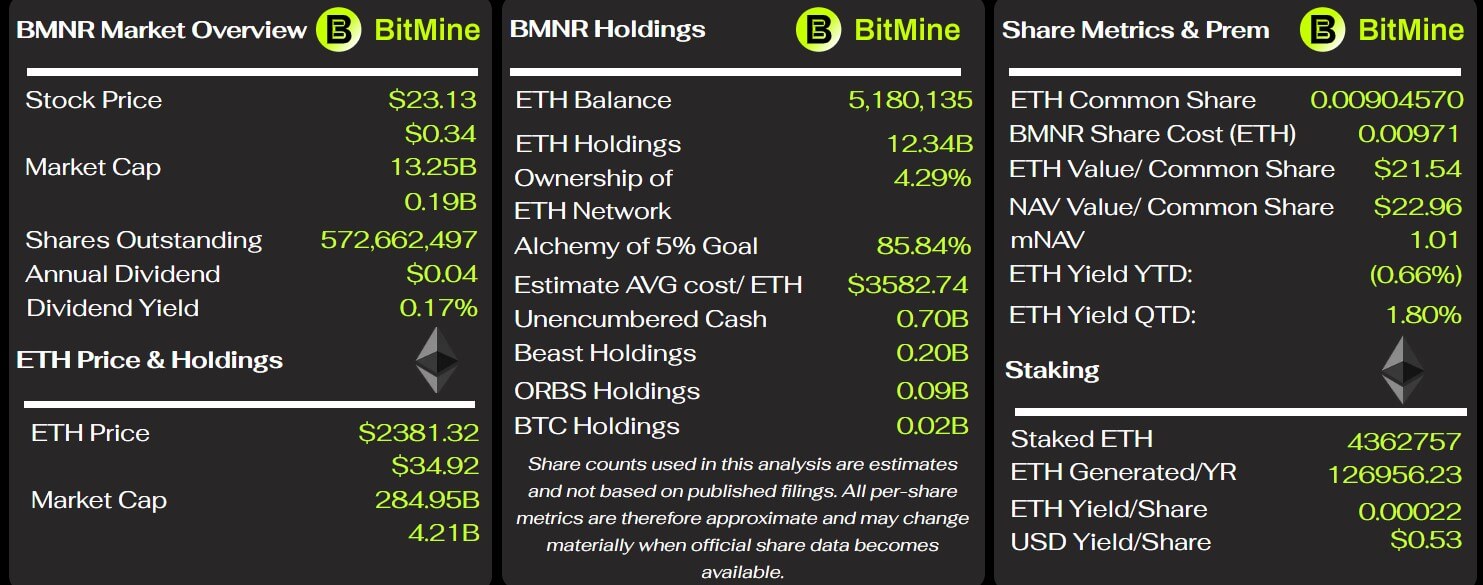
BitMine's Ethereum Key Metrics
BitMine’s Key Metrics (Source: BitMine)

Ethereum’s treasury bet becomes a staking business

BitMine said its staking operations are generating annualized revenue of about $297 million, based on a seven-day annualized yield of 2.91%.

Chairman Thomas “Tom” Lee said projected annual staking rewards could reach $352 million once the company’s ETH holdings are fully staked through MAVAN, its Made in America Validator Network, and other staking partners.

The disclosure shifts BitMine’s Ethereum strategy from a balance-sheet-accumulation move to a recurring-revenue test.

Public companies have used Bitcoin primarily as a treasury reserve asset, with Michael Saylor’s Strategy setting the template for corporate accumulation. Ethereum gives BitMine a different structure because the asset can be staked directly into the network to earn protocol rewards.

BitMine’s scale makes it a public-market proxy for Ethereum’s staking economy. Investors in its BMNR stock are no longer only exposed to changes in ETH’s market price. They are also exposed to the company’s ability to manage validator infrastructure, earn network rewards, and compound its Ethereum position over time.

Notably, BMNR traded an average daily dollar volume of $625 million over five days as of May 1, ranking 173rd among US-listed stocks.

See also  SEC Looking To Greenlight Trading of Tokenized Stocks on Decentralized Crypto Platforms: Report

That liquidity gives the company a public equity channel through which investors can express a view on Ethereum accumulation and staking without directly holding the token.

Ethereum’s validator queue shows wider demand

BitMine’s staking push comes as Ethereum’s validator entry queue has grown sharply, signaling renewed demand for ETH as a yield-bearing asset even as the token’s price narrative remains contested.

ValidatorQueue data showed about 3.72 million ETH waiting to enter the validator set, with an estimated activation delay of more than 64 days. About 346,000 Ethereum were waiting to exit, with an estimated wait of about six days.
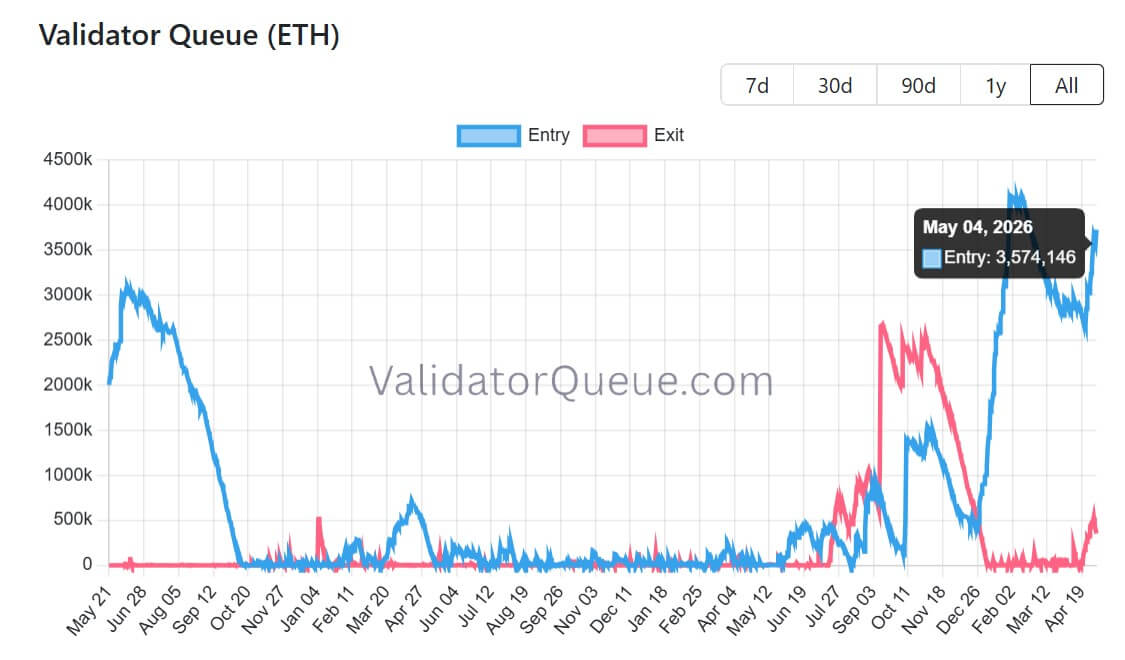
Ethereum Validator Queue
Ethereum Validator Queue (Source: ValidatorQueue)

The network had about 898,000 active validators, 38.6 million ETH staked, and a staking rate of roughly 31.7% of supply.

Ethereum limits how much ETH can enter or leave validation at a time through a churn mechanism designed to protect consensus stability. That throttle can create a long waiting line when new deposits exceed the rate at which validators can be activated.

Meanwhile, the queue does not mean all of that ETH is already earning rewards. Deposited Ethereum must wait for activation before it begins participating in validation.

Still, the imbalance between the entry and exit queues shows that more capital is trying to enter Ethereum staking than leave it.

That is a notable signal for the Ethereum markets. A larger staking base can immediately reduce the liquid supply, while validator rewards turn ETH into a productive asset for holders who are willing to accept lockup, technical, and operational risks.

Yield comes with operational risk

Ethereum staking differs from crypto lending because rewards come from the protocol rather than from a borrower.

Validators lock ETH as collateral, run software, attest to blocks and help secure the network. They earn rewards when they perform correctly and can lose rewards if they go offline. In more severe cases, validators can be penalized through slashing for harmful behavior.

See also  Ethereum’s Pullback Complete? ETH Set Eyes On 77% Breakout Run

While that structure has made staking attractive to institutions looking for native crypto yield, it also creates a new category of operational risk for public companies.

This is because a corporate ETH holder that stakes at scale must manage validator uptime, client selection, custody, key management, and exposure to staking partners.

For BitMine, the revenue opportunity is clear. A 2.91% annualized staking yield on billions of dollars of Ethereum creates a material income stream. However, the risk is that staking is not passive, unlike holding spot Ether in a corporate wallet.

The company’s MAVAN infrastructure is central to that strategy. If BitMine continues staking most of its Ethereum, its treasury model will depend not only on ETH’s price but also on validator performance and how reliably staking rewards can be generated across market cycles.

CryptoSlate Daily Brief

Daily signals, zero noise.

Market-moving headlines and context delivered every morning in one tight read.

5-minute digest 100k+ readers

Free. No spam. Unsubscribe any time.

Whoops, looks like there was a problem. Please try again.

You’re subscribed. Welcome aboard.

That makes BitMine’s model different from a conventional crypto treasury company. It is seeking to hold ETH, earn the digital asset, and potentially increase its share of the asset over time through protocol rewards.

Ownership is not the same as control

Moreover, BitMine’s staggering ETH holdings also raise a more precise question about decentralization for the blockchain network.

Under Ethereum’s proof-of-stake system, validators stake Ethereum into the network and participate in consensus.

Ethereum.org says that an attacker with more than 33% of staked Ether can interfere with finality, while higher thresholds pose greater risks. Finality depends on a two-thirds supermajority of staked Ether voting on checkpoints.

That means BitMine’s 4.29% share of the total ETH supply is economically significant but does not, by itself, grant control over Ethereum.

See also  $8.8 billion at risk! Can crypto avoid Monday shakeout if U.S. stocks crack?

Considering this, the more relevant question is how much of the actively staked ETH BitMine controls, whether the stake is spread across operators and clients, and how much of the network becomes dependent on a small group of institutional validators.

Ethereum’s decentralization debate has long focused on staking concentration, liquid staking protocols, centralized exchanges, and client diversity. Large pools and staking providers can influence the network because they operate validators, shape defaults, and coordinate around upgrades.

BitMine’s emergence adds a new corporate layer to that debate. A public company staking billions of dollars of Ethereum can strengthen ETH’s security by increasing the value locked into validation.

However, it can also intensify concerns if a growing share of validator power becomes concentrated through a limited set of operators, custodians, or software clients.

Public markets test Ethereum’s staking economy

The market question is whether BitMine’s strategy will be treated as a leveraged ETH trade, a staking-income vehicle, or a hybrid of both.

If Ethereum rises, the company’s treasury value increases. If staking yields remain stable, BitMine can generate recurring ETH-denominated rewards. If the validator queue remains elevated, the company’s early staking scale may become more valuable because new entrants must wait longer before earning rewards.

At the same time, the opposite risks are also clear. ETH price declines can quickly reduce the dollar value of the treasury.

Staking yields can fall as more Ethereum enters the validation process. Operational mistakes, partner concentration, or client failures can turn a yield strategy into a source of losses.

For Ethereum, BitMine’s move shows how proof-of-stake has changed the asset’s role in public markets. ETH is no longer being held only as a speculative token or a reserve asset.

At BitMine’s scale, it is also being used as productive capital that can generate revenue, secure the network, and reshape the debate over institutional participation.

Biggest Billion company Ethereums Locked Public staker
Share. Facebook Twitter Pinterest LinkedIn Tumblr Email

Related Posts

China to Seize 61,896 Bitcoin in $5.6 Billion Fraud Case

October 25, 2026

Arthur Hayes exits Maelstrom’s crypto trading positions

October 25, 2026

Can ENA Reach $0.55 After Ethena’s OKX Launch?

October 24, 2026

NYSE’s owner is backing 24/7 stock tokens without Wall Street’s usual price rules

October 24, 2026
Add A Comment
Leave A Reply Cancel Reply

Top Posts

Alfa-Bank Prepares to Enter Cryptocurrency Market

July 9, 2026

From panic to positioning: How Bitcoin whales are setting up for December

December 1, 2025

Stay ahead with the latest crypto news, market updates, blockchain insights, and trends. Your trusted source for everything happening in the digital asset world.


We're social. Connect with us:

Facebook X (Twitter) Instagram Pinterest YouTube
Top Insights

SEC flags tokenization as high-risk area in 2027 market examinations

October 25, 2026

Analyzing why Uniswap’s network growth hit a 4-year high despite UNI’s 5.4% drop

October 25, 2026

Israel Eyes Blockchain as Netanyahu Warns of US Military Aid Cuts

October 25, 2026
Get Informed

Subscribe to Updates

Get the latest creative news From Free.cc directly in your Inbox!

  • Contact
  • Privacy Policy
  • Terms & Conditions
  • Disclosure
© 2026 free.cc - All rights reserved.

Type above and press Enter to search. Press Esc to cancel.