
Crypto has an AI sector of its own, and from the outside it looks like one trade. Up close, the projects in it do very different jobs, and a comparison only makes sense once you know which job each one does.
Part of the sector already earns real revenue. Venice, a private AI app, became a unicorn in July 2026 with a $65 million Series A, and its CEO, Erik Voorhees, told TechCrunch that the company is profitable, with annualized run-rate revenues of over $70 million. People pay for private AI.
The map goes layer by layer, and each project is described from its own site.
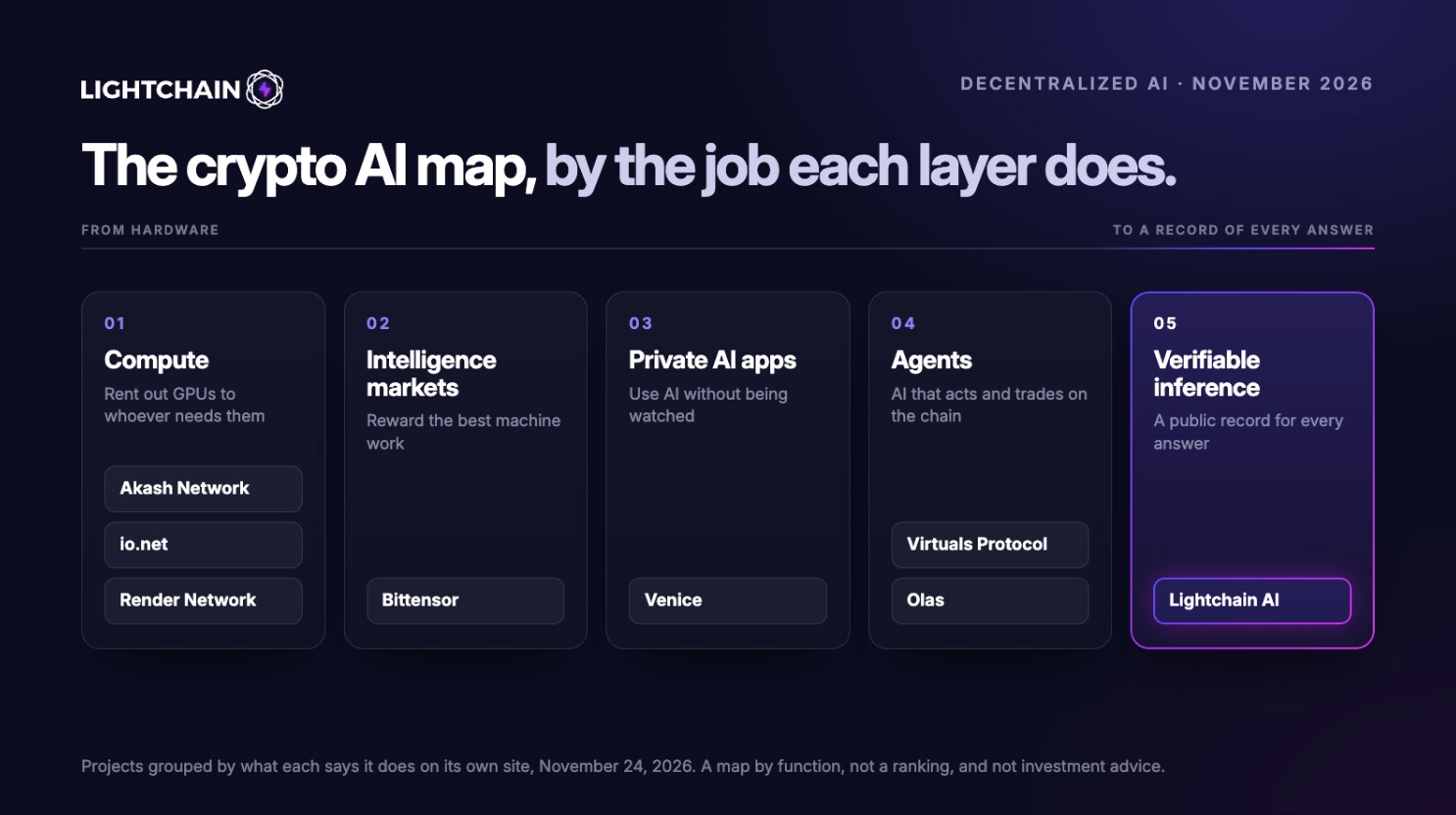
Compute: Renting out GPUs
The base layer connects idle graphics cards with the people who need them.
- Akash Network is “an open network that lets users buy and sell computing resources”.
- io.net offers AI teams access to “30,000+ GPUs and leading open source models”, at what it says is up to 70% lower cost than AWS.
- Render Network calls itself a “decentralized GPU rendering platform” and now combines 3D render engines with generative AI imaging tools.
Most of what this layer sells is time on hardware, though Akash and io.net now also sell access to open models through APIs. For teams weighing a rented GPU against their own hardware, Lightchain AI has published a comparison of self-hosting an LLM and a worker network.
Intelligence markets: rewarding the best work
- Bittensor is an open network where subnets produce digital commodities, such as compute, inference, storage and prediction, and contributors earn TAO. Each subnet sets its own task and its own way to score the work.
Here the network itself decides whose work is best, and pays for it.
Private AI apps: using AI without being watched
- Venice gives access to more than 200 AI models for text, images, video and code. Its site says that prompts sent to its private, self-hosted open-source models are never stored, and TechCrunch reports that user input is encrypted on the user’s device and passes through an outside proxy, with no data stored on Venice’s own systems. As of July, it served more than 3 million active users.
This layer competes with ChatGPT on the user’s side of the screen.
Agents: AI that acts and trades on the chain
- Virtuals Protocol describes “a society of productive AI agents” that sell services and trade on the chain with people or with other agents, each agent tokenized through its own Agent Token.
- Olas lets people own and monetize their AI agents.
Lightchain is building an agents layer of its own, Lightchain Agents, with a waitlist open now.
Verifiable inference: a public record for every answer
This is where Lightchain AI sits. It is a layer-1 blockchain built to run AI. Its blog keeps a plain list of what is live on the network today.
How it works, in short:
- Who serves the models. Independent operators, called workers, stake 50,000 LCAI and serve open models such as Llama, Qwen, GPT-OSS, and DeepSeek-R1 32B from their own GPUs.
- Who picks the worker. The chain does, by a weighted random draw for each new session. No company assigns the work.
- What an answer costs. Each model has one fixed fee per answer, from 0.02 to 0.20 LCAI on the network’s list of October 21, 2026.
- What can be checked. Every job leaves an onchain record of the worker that served it. A checking service re-runs a sample of jobs, and the user who paid for an answer can dispute it within 24 hours.
- What it does not prove. The record shows that a paid job was served by a named worker, not which model wrote the answer.
Lightchain also touches three of the other layers:
- Compute. Its workers bring their own GPUs, as on a compute market, but the network sells answers, each with an onchain record, not hardware time.
- Private AI apps. Lightchain Chat signs users in with a wallet and encrypts prompts before they reach the chain. The worker serving the session and the checking service can still read them.
- Agents. Lightchain Agents, AI agents with their own names, balances and a record of every job, are coming next. The public roadmap targets a mainnet launch in early 2027, after a go or no-go decision and its own approval.
One stack, not one trade
The sector will keep trading as one theme. It works more like a stack, where each layer needs the others: GPUs to run on, models worth running, apps people want, agents that act, and a record that shows what happened. Lightchain’s bet is on that last layer: the more AI runs on open networks, and the more agents pay one another, the more a public record of who served each answer matters.
About Lightchain AI
Lightchain AI is a layer-1 blockchain for AI. Independent operators stake LCAI and serve open models such as gpt-oss, Qwen3, and Llama from their own GPUs. The chain assigns each job, holds the fee in escrow, and keeps a record of every job that anyone can look up. Products live today include Lightchain Chat, Lightchain Desktop (beta), Lightchain Studio, the Lightchain Bridge, and the Lightscan explorer. The LCAI DUNA, a Wyoming association, is the project’s legal entity.
Website: lightchain.ai · X: @LightchainAI · Discord: discord.gg/lightchain
This article is for informational purposes only and is not financial or investment advice.
Disclaimer: This is a paid post and should not be treated as news/advice.