

The DRV price exploded as much as 70% to $0.1920 before cooling to around $0.1530, putting the spotlight back on Derive, the decentralized derivatives protocol formerly known as Lyra Finance. The sharp rally followed Upbit’s listing announcement, with the token slicing through previous resistance levels at $0.1250 and $0.1314 in a move that caught traders off guard.
Price spikes fueled purely by hype don’t usually last. This one, however, arrived alongside a noticeable jump in on-chain activity.
Derive Is Chasing Institutional DeFi Trading
Loading profile preview rebranded from Lyra Finance in 2024, migrating from the LYRA token to DRV while sharpening its focus on decentralized options and perpetual futures trading.
The protocol aims to deliver institutional-grade derivatives without requiring users to give up custody of their assets. It combines an off-chain central limit orderbook with on-chain settlement through its own OP Stack Layer-2 network, allowing traders to access CEX-like execution speeds while maintaining self-custody.

Its product suite includes portfolio margin across options, perpetuals, and spot markets, alongside yield-bearing collateral through its Ethena partnership.
Derive Transaction Activity Climbs With Price
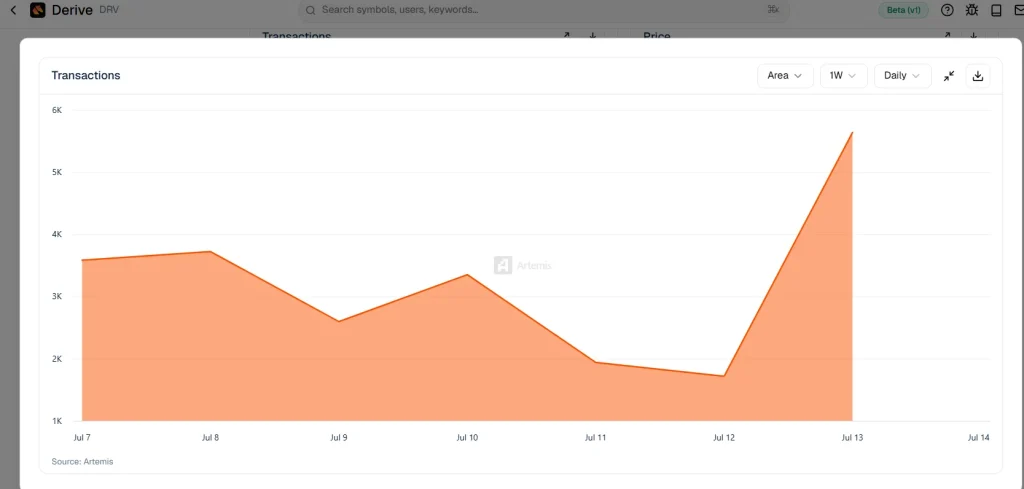
Interestingly, network activity appears to have moved alongside the rally. Earlier this week, transaction count had fallen to roughly 1.7K, reflecting relatively quiet network usage.
That changed quickly as the price accelerated. Transaction count climbed to approximately 5.6K, suggesting increased protocol activity during the rally rather than a price move occurring in isolation.
Key Levels Traders Are Watching
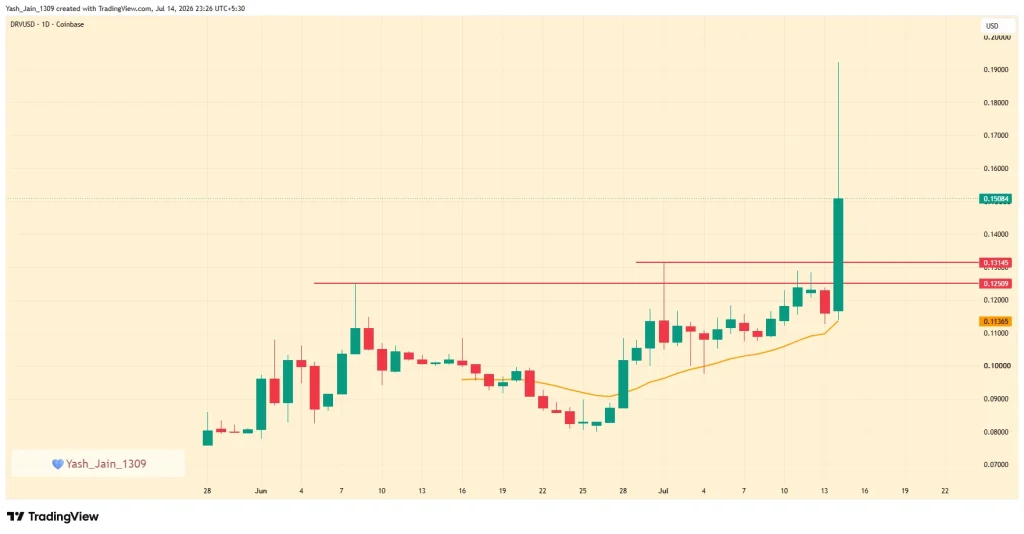
From a technical perspective, DRV price has already broken above the former resistance zones at $0.1250 and $0.1314.
Whether the rally extends now depends on demand. A sustained hold above $0.1314 would keep the breakout structure intact and could allow another attempt toward $0.1900 or beyond. On the other hand, losing that level would weaken the current breakout and raise the possibility that the latest surge was primarily a volatility-driven move.