

When market heavyweights speak, it’s usually worth paying attention.
From BitMine’s Tom Lee to Binance’s CZ, several industry leaders are pointing to the same trend. Crypto has entered a risk-off phase, but they argue the main reason isn’t weak crypto fundamentals. Instead, capital is rotating into AI and semiconductor stocks, where investors expect stronger long-term returns.
More importantly, this isn’t just a narrative. The data backs it up. As the chart below shows, investors have been moving money out of gold and Bitcoin and into semiconductor stocks. Since April, U.S. gold and Bitcoin ETFs have seen a combined $12 billion in net outflows, while U.S. semiconductor ETFs have attracted more than $20 billion in net inflows.
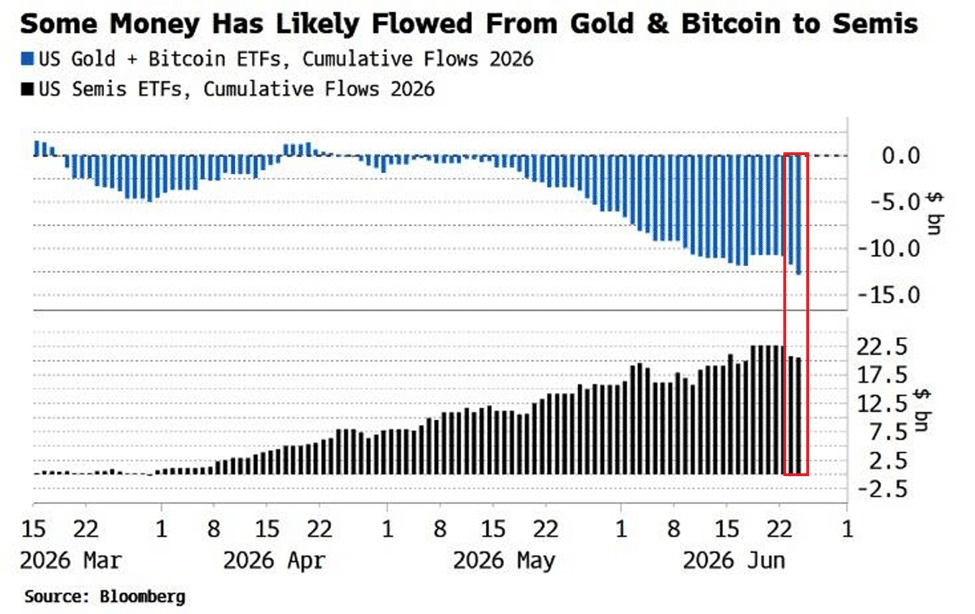
In short, capital isn’t leaving the market.
Instead, it’s simply moving to where investors see the biggest opportunity. From a technical standpoint, the impact is already showing. The total crypto market cap is down more than 5% on the weekly chart. More importantly, the sell-off came after two weeks of sideways price action, where bulls failed to reclaim control. That suggests buyers are stepping aside, with capital rotation into AI stocks adding to the selling pressure.
Against this backdrop, calling the end of crypto’s bear cycle may be too early. Instead, when combined with current Bitcoin [BTC] positioning, continued capital rotation into AI, weakening technicals, and the broader market narrative, the recent price action could be the start of a deeper bear phase, not the end of one.
Record ETF outflows add to crypto’s bearish outlook
The gap between on-chain signals and the broader market is starting to widen.
On-chain data shows that long-term holders (LTHs) are beginning to capitulate. The LTH SOPR has moved deeper into negative territory, meaning more long-term holders are selling at a loss. The monthly LTH SOPR has dropped from 1.03 to 0.87, showing that LTHs have realized an average 13% loss over the past thirty days. Most of that selling came during Bitcoin’s drops below $60,000.
Historically, LTH capitulation has often marked the late stage of bear markets. But the current setup looks different. Bitcoin ETFs just saw their largest weekly outflow on record, with $1.79 billion leaving spot ETFs. BlackRock’s IBIT alone accounted for about $1.3 billion of those outflows.
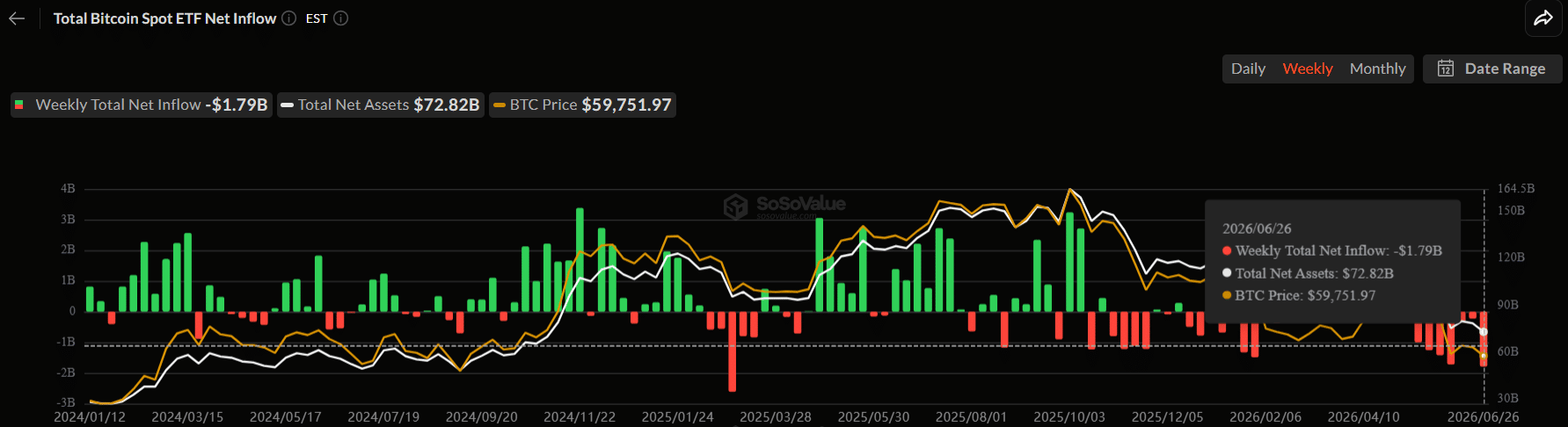
Put simply, instead of fresh demand stepping in, institutions appear to be pulling capital.
This is where the broader macro backdrop comes in. As investors rotate into AI-driven momentum, the ongoing outflows from Bitcoin ETFs don’t look like a short-term move. Instead, they suggest long-term positioning may be favoring AI over crypto, creating a clear divergence as markets head into Q3.
If this trend continues, the end of the bear cycle could still be far away, leaving crypto investors exposed to deeper downside risk.
Final Summary
- Money is rotating out of crypto into AI stocks, with ETFs showing heavy Bitcoin outflows and strong semiconductor inflows.
- Crypto weakness may not be over yet, as technicals, LTH selling, and ETF outflows still point to downside risk.