Close Menu
  • Latest News
    • Bitcoin
    • Ethereum
    • Altcoins
    • Meme Coins
  • Tech
    • Blockchain
    • Security and Privacy
  • Web 3
    • Gaming
  • Legal
    • Legal and Regulatory
    • Adoption
  • Analysis
  • Learn
    • Education
    • Wallets and Exchanges
  • Tools
    • Market Overview
    • Exchange Tool
What's Hot

GMX Sponsors Arbitrum’s Open House Singapore as Buildathon

October 3, 2026

IMF Praises El Salvador But Tries To Scale Back Bitcoin Use

October 3, 2026

CFTC wins $31M Fundsz fraud order as crypto scam losses mount worldwide

October 3, 2026
Facebook X (Twitter) Instagram
  • Contact
  • Privacy Policy
  • Terms & Conditions
  • Disclosure
Facebook X (Twitter) Instagram
Free.cc (Free Cryptocurrency)Free.cc (Free Cryptocurrency)
  • Latest News
    1. Bitcoin
    2. Ethereum
    3. Altcoins
    4. Meme Coins
    5. View All

    IMF Praises El Salvador But Tries To Scale Back Bitcoin Use

    October 3, 2026

    Bitcoin ETFs record $102M inflows – Why $85K matters for BTC now

    October 3, 2026

    Bitcoin Is Up, DeFi Is Recovering, So Why Doesn’t This Look Like a Bull Market Yet?

    October 3, 2026

    Bank group sues U.S. regulator over granting crypto trust charters

    October 3, 2026

    SEC Approves 3x Leveraged Bitcoin Ether & Other ETPs for Listing

    October 3, 2026

    Ethereum: Why ETH faces October reversal risk after 70% Q3 rally

    October 3, 2026

    Why Did Blast Decide to Wind Down Its L2?

    October 2, 2026

    Bitcoin Q3 Strength Faces a Tougher Q4 Test

    October 1, 2026

    Fidelity exec’s new 60/20/20 portfolio makes room for crypto – Here’s why

    October 3, 2026

    Can NEAR crypto rebound? THESE metrics could decide what’s next

    October 3, 2026

    Polymath And CineCity Explore Regulated Tokenized Film Investment Platform

    October 3, 2026

    XLM price prediction – Why Stellar’s $0.21 rebound could trigger a 9% rally

    October 2, 2026

    Thinking Cat Gains Momentum After CASHCAT’s Breakout

    August 12, 2026

    What Tokens Could He Target?

    July 30, 2026

    The Next Meme Coin Winner Could Be Determined by Incentives, Not Memes

    July 30, 2026

    Why Is BOME’s Price Up Today? Finally, Capital Rotating to the Meme Coins?

    July 28, 2026

    GMX Sponsors Arbitrum’s Open House Singapore as Buildathon

    October 3, 2026

    IMF Praises El Salvador But Tries To Scale Back Bitcoin Use

    October 3, 2026

    CFTC wins $31M Fundsz fraud order as crypto scam losses mount worldwide

    October 3, 2026

    Plunging GPU prices threaten AI hosts, and new hedges step in

    October 3, 2026
  • Tech
    1. Blockchain
    2. Security and Privacy
    3. View All

    GMX Sponsors Arbitrum’s Open House Singapore as Buildathon

    October 3, 2026

    Ceteris Introduces Tokenized Stocks via Crypto Neobanks

    October 3, 2026

    New SIMD-0675 Proposal Aims to Streamline Block Production

    October 3, 2026

    State Street Fund Goes Live on Stellar

    October 3, 2026

    Masked Robbers Threaten Pregnant Wife in UK Crypto Home Attack

    October 3, 2026

    Bitcoin Lightning Nodes Targeted as Core Lightning Sounds Alarm

    October 2, 2026

    The $459,000 Bot Hacker Was a Customer First, Researchers Say

    October 2, 2026

    Metamask Pulls Validators as Meager ETH Theft Sounds Big Alarm

    October 2, 2026

    GMX Sponsors Arbitrum’s Open House Singapore as Buildathon

    October 3, 2026

    IMF Praises El Salvador But Tries To Scale Back Bitcoin Use

    October 3, 2026

    CFTC wins $31M Fundsz fraud order as crypto scam losses mount worldwide

    October 3, 2026

    Plunging GPU prices threaten AI hosts, and new hedges step in

    October 3, 2026
  • Web 3
    1. Gaming
    2. View All

    Top 12 NFT games every player should know about in August 2026

    September 22, 2026

    GameShame Studios founder details Raijin Protocol’s roadmap in NeoPod’s sixth AMA

    September 22, 2026

    Proof of Play to shut down after blockchain gaming thesis falls short

    September 22, 2026

    How BC.GAME is turning players into stakeholders

    September 22, 2026

    GMX Sponsors Arbitrum’s Open House Singapore as Buildathon

    October 3, 2026

    IMF Praises El Salvador But Tries To Scale Back Bitcoin Use

    October 3, 2026

    CFTC wins $31M Fundsz fraud order as crypto scam losses mount worldwide

    October 3, 2026

    Plunging GPU prices threaten AI hosts, and new hedges step in

    October 3, 2026
  • Legal
    1. Legal and Regulatory
    2. Adoption
    3. View All

    CFTC wins $31M Fundsz fraud order as crypto scam losses mount worldwide

    October 3, 2026

    583 Companies Go Public in 18 Months, Says SEC Chairman

    October 3, 2026

    New SEC crypto rules threaten small advisers, but big firms win

    October 3, 2026

    Daines Unveils Crypto Tax Bill Pairing Payment Relief With Wash-Sale Rules

    October 3, 2026

    Stablecoin issuers have replaced 40% of China’s lost US Treasury demand

    October 3, 2026

    Bitcoin’s $113,000 case strengthens as US regulators push 9 crypto actions

    October 2, 2026

    Bitget restores $300M fund after absorbing $388M security breach

    October 2, 2026

    Ripple’s biggest institutional bet may now be Brazil

    October 1, 2026

    GMX Sponsors Arbitrum’s Open House Singapore as Buildathon

    October 3, 2026

    IMF Praises El Salvador But Tries To Scale Back Bitcoin Use

    October 3, 2026

    CFTC wins $31M Fundsz fraud order as crypto scam losses mount worldwide

    October 3, 2026

    Plunging GPU prices threaten AI hosts, and new hedges step in

    October 3, 2026
  • Analysis

    Plunging GPU prices threaten AI hosts, and new hedges step in

    October 3, 2026

    Ethereum Price Faces $2,800 Wall Again — Are Whales Selling or Accumulating ETH?

    October 3, 2026

    Bull Market Targets for BTC, ETH, SOL, and XRP

    October 3, 2026

    Ethereum Price Faces A Critical $0.040 ETH/BTC Test

    October 2, 2026

    AAVE Price Surges 8% as Whale Activity Spikes — Can AAVE Break $200?

    October 2, 2026
  • Learn
    1. Education
    2. Wallets and Exchanges
    3. View All

    What Is Robinhood Chain? The Ethereum Layer-2 Network for Tokenized Stocks

    July 12, 2026

    What Is BChat? The Decentralized Messaging App Built for Privacy

    June 2, 2026

    What Is an AI Prompt Injection Attack? The Hidden Threat Hijacking Your Chatbots

    May 31, 2026

    What Is AI Jailbreaking? A Beginner’s Guide to the Cat-and-Mouse Game Behind Every Chatbot

    May 17, 2026

    Coinbase completes Deribit migration, ends INTX trading

    October 2, 2026

    Binance Funding Account ends direct crypto deposits

    October 1, 2026

    Coinbase just completed its US derivatives stack but its biggest bet still sits outside it

    September 30, 2026

    Bitget had 30 minutes to contain its hack before $290 million started moving

    September 30, 2026

    GMX Sponsors Arbitrum’s Open House Singapore as Buildathon

    October 3, 2026

    IMF Praises El Salvador But Tries To Scale Back Bitcoin Use

    October 3, 2026

    CFTC wins $31M Fundsz fraud order as crypto scam losses mount worldwide

    October 3, 2026

    Plunging GPU prices threaten AI hosts, and new hedges step in

    October 3, 2026
  • Tools
    • Market Overview
    • Exchange Tool
Free.cc (Free Cryptocurrency)Free.cc (Free Cryptocurrency)
Home»Adoption»Standard Chartered’s $100 Uniswap call exposes the open DeFi problem Wall Street may need to solve
Adoption

Standard Chartered’s $100 Uniswap call exposes the open DeFi problem Wall Street may need to solve

June 16, 2026No Comments8 Mins Read
Share
Facebook Twitter LinkedIn Pinterest Email

Standard Chartered has set a $100 UNI target for the end of 2030, a forecast that would put one of DeFi’s largest governance tokens far above its current market range.

The bank’s thesis states that tokenized assets may eventually require DeFi venues to convert fragmented on-chain instruments into usable liquidity.

The Standard Chartered note said the bank assumes tokenized assets could reach $4 trillion by 2028. The same thesis puts the share active in DeFi rising from about 3.5% today to 30% by 2030.

On that math, DeFi could hold over $2 trillion by 2030.

Tokenization is being built by banks, asset managers, transfer agents, and regulated platforms, yet the liquidity layer could still reward open protocols if those assets require round-the-clock trading, collateral movement, and composability beyond a single issuer’s system.

CryptoSlate data on June 16 showed UNI trading near $3.02, with a market cap of roughly $1.88 billion and 24-hour trading volume of about $353.9 million. The broader CryptoSlate coin rankings snapshot showed a crypto market of about $2.27 trillion and a daily trading volume of about $89.8 billion.

Against that market backdrop, the practical question is whether tokenized Treasuries, funds, equities, stablecoins, and other on-chain assets become inventory for open liquidity, or stay in systems where access, settlement, and transfer remain tightly controlled.
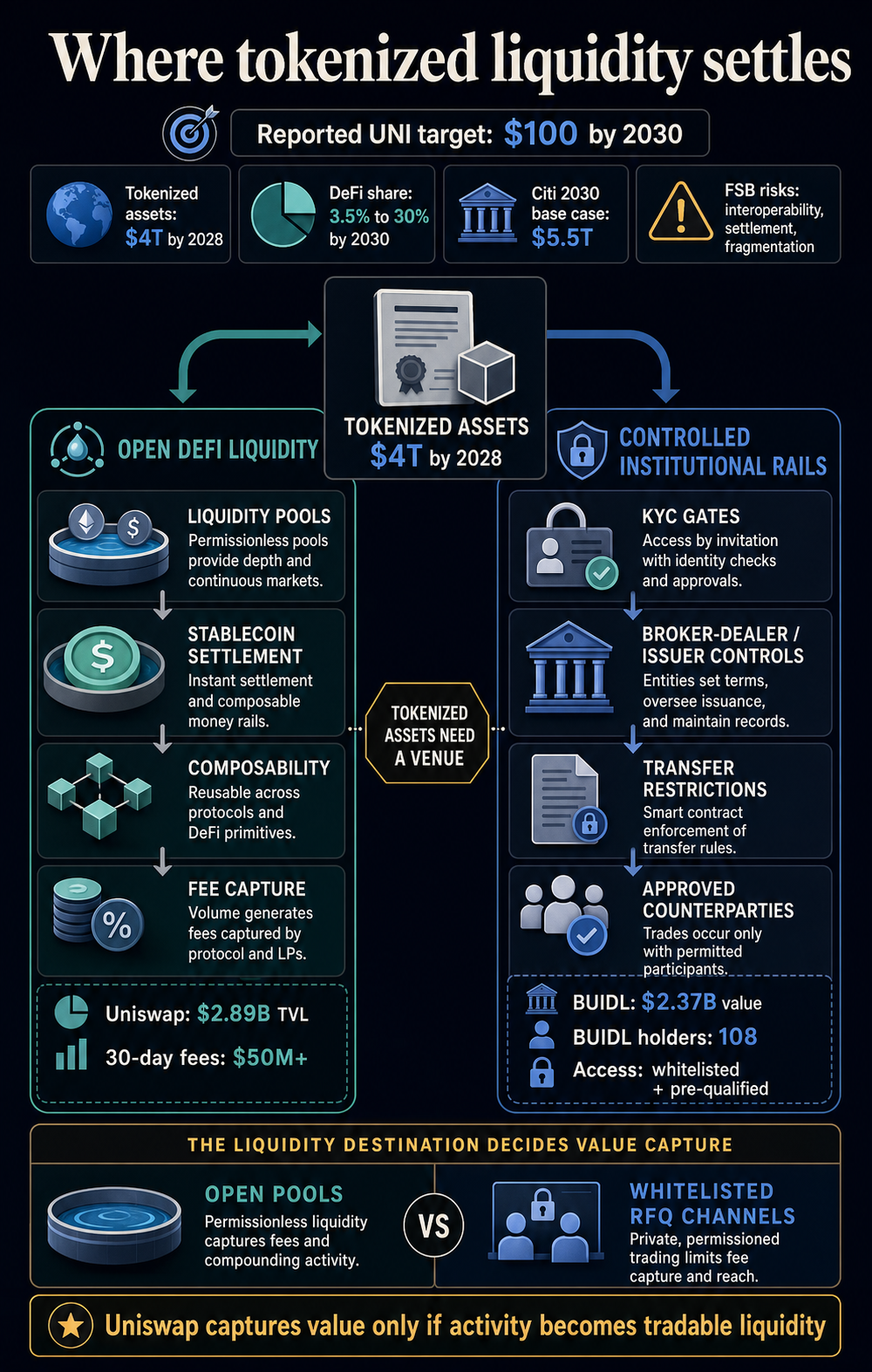

Infographic comparing open DeFi liquidity with controlled institutional rails for tokenized assets, including UNI, BUIDL, Citi, and FSB callouts.

Wall Street’s on-chain push leaves DeFi facing a $330 billion trust test
Related Reading

Wall Street’s on-chain push leaves DeFi facing a $330 billion trust test

Regulated players are taking blockchain finance on-chain, forcing DeFi to prove its risk is worth the upside.

Apr 5, 2026 · Gino Matos

The bank thesis depends on open liquidity

The Standard Chartered call rests on a chain of assumptions. Tokenized assets first need to grow into a large enough market. A meaningful share, then, needs to become active in DeFi, rather than simply sitting on-chain as a record of ownership within a regulated wrapper.

Finally, Uniswap has to capture enough of that activity for UNI economics to benefit. The claim shifts the focus from issuance to liquidity.

Standard Chartered’s public work already frames tokenization as a large long-term opportunity. In 2024, the bank said a paper with Synpulse projected tokenized real-world assets could reach $30.1 trillion by 2034, with trade finance among the major categories.

The same release said tokenization could create new applications in DeFi and new business models.

See also  XRPL’s May 27 upgrade shows how validators and markets decide a blockchain split

Citi’s June 2026 tokenization report points in the same direction on market size, while adding a counterweight. Citi projected a $5.5 trillion base-case tokenized asset market by 2030 and an $8.2 trillion bull case.

It also said hybrid models may dominate, with institutions controlling issuance, distribution, and settlement rails.

The divide defines Uniswap’s opportunity. If tokenization grows but the value remains within bank platforms, transfer-agent systems, broker-dealer networks, or approved marketplaces, open DeFi plays a limited role.

If assets need broader venues where different tokenized instruments, stablecoins, and collateral can trade against one another, protocols such as Uniswap become more central.

DefiLlama data supports the view that Uniswap is a plausible candidate for that thesis. As of press time, the protocol had about $2.89 billion in total value locked across multiple chains and more than $50 million in 30-day fees.

The present data only establishes an operating base, but it places Uniswap in the liquidity-infrastructure category rather than the pure governance-token category.

For institutions, the distinction is practical. Issuing a fund token is one process; creating a venue where it can trade against stablecoins, collateral, and other tokenized instruments is another.

That gap is where an open automated market maker could either become useful infrastructure or remain a marginal connection point.

The venue decision, therefore, becomes as important as issuance, because liquidity determines whether tokenized products become usable markets, collateral, and settlement assets, or remain static records within approved systems.

BUIDL shows the bridge and the gate

BlackRock’s BUIDL fund provides a live example of the thesis. In February, Uniswap Labs and Securitize announced that BlackRock’s USD Institutional Digital Liquidity Fund was available for trading on UniswapX.

The integration uses an RFQ framework, whitelisted subscribers, and pre-qualified participants.

CryptoSlate’s earlier BUIDL coverage captured the central tension: BUIDL holders can swap into USDC through UniswapX, but the access is gated.

The trade touches DeFi technology while keeping the asset limited to approved participants.

BlackRock’s original BUIDL launch terms show how controlled that model can be. The fund was offered to qualified investors through Securitize, had a $5 million initial investment minimum, could be transferred only to pre-approved investors, and was not listed on an exchange.

RWA.xyz showed BUIDL at about $2.37 billion in total asset value and 108 holders on June 16.

See also  New Hampshire rejects $100M Bitcoin-backed bond after public finance hearing

Read together with the access terms, that supports a cautious view of tokenization’s current state: large tokenized products can exist on-chain while participation remains concentrated and permissioned.

Standard Chartered’s own May 2026 investor presentation also cited BUIDL’s integration into Uniswap to enable distribution and trading.

CryptoSlate Daily Brief

Daily signals, zero noise.

Market-moving headlines and context delivered every morning in one tight read.

5-minute digest 100k+ readers

Free. No spam. Unsubscribe any time.

Whoops, looks like there was a problem. Please try again.

You’re subscribed. Welcome aboard.

The deck places Uniswap within the same institutional digital-asset infrastructure that the reported target depends on, even though the exact UNI initiation note has not been made public.

Routing model What it gives institutions What it gives Uniswap Main constraint
Open DeFi liquidity 24/7 markets, composability, stablecoin settlement, and broader collateral use More pools, more fees, deeper relevance for tokenized assets Compliance, identity, and transfer restrictions must be solved without killing open access
Controlled bank and broker-dealer rails Permissioned access, familiar compliance, curated counterparties, and easier risk controls Limited integration points such as RFQ access or whitelisted liquidity Liquidity may stay fragmented across private systems and approved venues

The BUIDL example currently sits between those two models. It uses Uniswap technology, yet preserves institutional controls around who can participate. That design creates a bridge into DeFi infrastructure without moving tokenized assets into fully open liquidity.

RWA tokenization nears $30 billion, but DeFi is capturing only a fraction
Related Reading

RWA tokenization nears $30 billion, but DeFi is capturing only a fraction

Only $2.47 billion of nearly $30 billion in tokenized RWAs is active in DeFi, showing how compliance rails still limit open-market use.

May 18, 2026 · Gino Matos

This is the version of open liquidity institutional assets may accept first: DeFi rails for execution and settlement, paired with restrictions around identity, transferability, and counterparties.

UNI still needs a capture mechanism

Greater RWA activity on Uniswap would not by itself guarantee value for UNI holders. The asset still needs a capture mechanism.

The executed UNIfication proposal on Tally describes the protocol-fee and UNI-burn mechanics and states that Uniswap aims to become the default exchange for tokenized value.

See also  Standard Chartered says Ethena's ENA can reach $2 by 2028

That gives the valuation argument a route, but it also makes the path conditional. Governance decisions, fee settings, commercial integrations, and actual volume all need to line up.

The reported Standard Chartered target is well above current market levels and UNI’s 2021 all-time high. A $100 target cannot rest only on asset issuance. It requires real trading flows, durable fee generation, and a clearer link between protocol growth and token economics.

The institutional tokenization debate becomes practical at that point. Banks and asset managers may want blockchain settlement, 24/7 transferability, programmable collateral, and stablecoin payment rails.

They may also want KYC, transfer restrictions, approved counterparties, and control over where secondary markets form.

SEC targets 20-year-old rule standing between Wall Street and blockchain trading
Related Reading

SEC targets 20-year-old rule standing between Wall Street and blockchain trading

The SEC’s plan to scrap the trade-through rule could remove a major obstacle for equities trading on blockchain networks.

Jun 12, 2026 · Oluwapelumi Adejumo

The Financial Stability Board’s tokenization work reinforces that caution. It describes tokenization as still small in scale and highlights issues such as limited-access structures, interoperability gaps, settlement-asset constraints, and platform fragmentation.

Those are the frictions that can keep tokenized assets from becoming liquid, composable DeFi inventory.

If those frictions dominate, Uniswap becomes an integration point at the edge of institutional tokenization. If they ease, the protocol could become one of the venues where tokenized funds, stablecoins, and crypto-native assets meet.
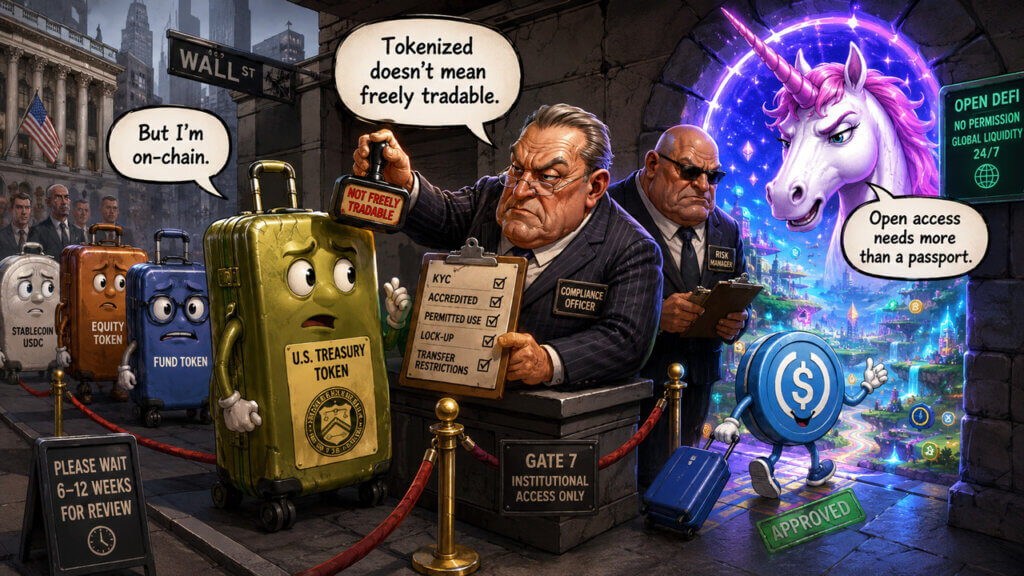
Cartoon depicting tokenized assets passing through a Wall Street checkpoint, with regulators scrutinizing a tokenized U.S. Treasury while a DeFi unicorn and stablecoin await approval, illustrating tensions between institutional tokenization and open blockchain access.

Standard Chartered’s reported call ultimately depends on where tokenized liquidity settles. The $100 target introduces market upside, while the stronger claim is that a Wall Street bank sees a path for DeFi protocols to capture part of the institutional tokenization wave.

BUIDL already shows that asset managers can use DeFi technology while preserving tight access controls. Citi’s tokenization outlook suggests Wall Street may build hybrid systems that keep issuance, distribution, and settlement close to institutions.

The FSB’s caveats show why interoperability and settlement remain central.

The next evidence will come from new tokenized asset integrations. If they remain isolated, whitelisted RFQ channels, open DeFi captures only a slice of the market.

If they create broader pools that allow tokenized assets to move across DeFi liquidity with fewer bespoke controls, Uniswap’s role in tokenization could expand beyond crypto-native swaps.

call Chartereds DeFi Exposes open problem Solve standard Street Uniswap Wall
Share. Facebook Twitter Pinterest LinkedIn Tumblr Email

Related Posts

GMX Sponsors Arbitrum’s Open House Singapore as Buildathon

October 3, 2026

Ethereum Price Faces $2,800 Wall Again — Are Whales Selling or Accumulating ETH?

October 3, 2026

Bitcoin Is Up, DeFi Is Recovering, So Why Doesn’t This Look Like a Bull Market Yet?

October 3, 2026

State Street Fund Goes Live on Stellar

October 3, 2026
Add A Comment
Leave A Reply Cancel Reply

Top Posts

Coinbase completes Deribit migration, ends INTX trading

October 2, 2026

Zcash whale expands $14.9M short bet – Will ZEC drop to $410?

July 7, 2026

Stay ahead with the latest crypto news, market updates, blockchain insights, and trends. Your trusted source for everything happening in the digital asset world.


We're social. Connect with us:

Facebook X (Twitter) Instagram Pinterest YouTube
Top Insights

GMX Sponsors Arbitrum’s Open House Singapore as Buildathon

October 3, 2026

IMF Praises El Salvador But Tries To Scale Back Bitcoin Use

October 3, 2026

CFTC wins $31M Fundsz fraud order as crypto scam losses mount worldwide

October 3, 2026
Get Informed

Subscribe to Updates

Get the latest creative news From Free.cc directly in your Inbox!

  • Contact
  • Privacy Policy
  • Terms & Conditions
  • Disclosure
© 2026 free.cc - All rights reserved.

Type above and press Enter to search. Press Esc to cancel.