
Close Menu
  • Latest News
    • Bitcoin
    • Ethereum
    • Altcoins
    • Meme Coins
  • Tech
    • Blockchain
    • Security and Privacy
  • Web 3
    • Gaming
  • Legal
    • Legal and Regulatory
    • Adoption
  • Analysis
  • Learn
    • Education
    • Wallets and Exchanges
  • Tools
    • Market Overview
    • Exchange Tool
  • INFO@FREE.CC
What's Hot

Miniverse Partners with UNIPLAY to Expand CoFi Across DeFi and GameFi

May 9, 2026

Fomoin Partners with Catto Verse to Advance AI-Powered Web3 Innovation

May 9, 2026

What Does Bitcoin “Power Projection” Mean To The U.S. Military?

May 9, 2026
Facebook X (Twitter) Instagram
  • Contact
  • Privacy Policy
  • Terms & Conditions
  • Disclosure
Facebook X (Twitter) Instagram
Free.cc (Free Cryptocurrency)Free.cc (Free Cryptocurrency)
  • Latest News
    1. Bitcoin
    2. Ethereum
    3. Altcoins
    4. Meme Coins
    5. View All

    What Does Bitcoin “Power Projection” Mean To The U.S. Military?

    May 9, 2026

    Are overvalued U.S. equities signaling the next crypto market risk? Assessing…

    May 9, 2026

    Swiss Bitcoin Reserve Campaign Fails to Reach Referendum Threshold

    May 9, 2026

    Kraken parent goes for the OCC charter in bid to become a federal crypto bank

    May 8, 2026

    Ethereum Sees Sharp Decline In High-Leverage Long Positions — See What Happens Next

    May 9, 2026

    Ethereum To $10k? Analyst Says ETH Must Clear This Level First

    May 8, 2026

    Ethereum Struggles as Traders Await CLARITY Act Catalyst

    May 8, 2026

    Tom Lee Says Ethereum Price Could Reach $22,000 Leading Next Crypto Rally

    May 8, 2026

    Adoption & Activity Plunge From 2024 Peak

    May 9, 2026

    Analyst Predicts Bitcoin Price Will Top $320,000 After ‘Cleanest Signal’ Emerged

    May 8, 2026

    100K BTC Vanish From Exchanges

    May 8, 2026

    Bitcoin Found Support Where Recent Buyers Can’t Afford to Lose: Discover the Mechanics

    May 8, 2026

    Meme Coin Market Faces Imbalance as Supply Rises, Demand Falls

    April 4, 2026

    Crypto Interest Rising Toward Meme Coin Sector

    January 9, 2026

    Memes Market Cap Adds $10B in Days: Fresh Capital or Dead-Cat-Bounce?

    January 5, 2026

    Meme Coin Market Surges Past $45B as Shiba Inu, PEPE, BONK Stage 54% Price Pump

    January 4, 2026

    Miniverse Partners with UNIPLAY to Expand CoFi Across DeFi and GameFi

    May 9, 2026

    Fomoin Partners with Catto Verse to Advance AI-Powered Web3 Innovation

    May 9, 2026

    What Does Bitcoin “Power Projection” Mean To The U.S. Military?

    May 9, 2026

    South Korea to Impose Crypto Tax, Starting January 2027

    May 9, 2026
  • Tech
    1. Blockchain
    2. Security and Privacy
    3. View All

    Fomoin Partners with Catto Verse to Advance AI-Powered Web3 Innovation

    May 9, 2026

    Xange.com, Aptos Labs, and Decibel Foundation Partner

    May 9, 2026

    Chainlink Completes Compliance Initiative With Bermuda Monetary Authority

    May 9, 2026

    AWS Launches AI Agent Payment Infrastructure with Coinbase and Stripe

    May 9, 2026

    Ripple Shares DPRK Threat Data on Fraud Domains, Wallets, Campaigns

    May 5, 2026

    Digital Asset Security Moves Beyond Keys as Bitgo Adds 5-Layer Checks

    May 1, 2026

    Defillama Confirms April 2026 as Crypto’s Most-Hacked Month With 30 Incidents

    May 1, 2026

    Malicious npm Dependency Linked to AI Assisted Commit Targets Crypto W

    April 29, 2026

    Miniverse Partners with UNIPLAY to Expand CoFi Across DeFi and GameFi

    May 9, 2026

    Fomoin Partners with Catto Verse to Advance AI-Powered Web3 Innovation

    May 9, 2026

    What Does Bitcoin “Power Projection” Mean To The U.S. Military?

    May 9, 2026

    South Korea to Impose Crypto Tax, Starting January 2027

    May 9, 2026
  • Web 3
    1. Gaming
    2. View All

    Miniverse Partners with UNIPLAY to Expand CoFi Across DeFi and GameFi

    May 9, 2026

    Top NFT games in 2026 shift from speculation to real ownership risks

    May 9, 2026

    What the CLARITY Act Means for NFT Projects: A 2026 Builder’s Guide

    May 8, 2026

    Top 8 play-to-earn NFT games to play in May 2026

    May 7, 2026

    Miniverse Partners with UNIPLAY to Expand CoFi Across DeFi and GameFi

    May 9, 2026

    Fomoin Partners with Catto Verse to Advance AI-Powered Web3 Innovation

    May 9, 2026

    What Does Bitcoin “Power Projection” Mean To The U.S. Military?

    May 9, 2026

    South Korea to Impose Crypto Tax, Starting January 2027

    May 9, 2026
  • Legal
    1. Legal and Regulatory
    2. Adoption
    3. View All

    South Korea to Impose Crypto Tax, Starting January 2027

    May 9, 2026

    30 Defendants Charged in Massive Insider Trading Ring Linked to Law Firms

    May 9, 2026

    South Korean Court Rules Orbit Bridge Operator Liable for $80.5 Million Hack

    May 9, 2026

    Monaco opens Zondacrypto probe as Poland alleges pyramid scheme

    May 8, 2026

    Cardano’s Charles Hoskinson says the future of crypto wallets will be inside iPhones and Androids

    May 8, 2026

    How to choose a safe DeFi platform before you deposit in 2026

    May 7, 2026

    If GameStop buys eBay, Bitcoin payments could suddenly have a 135M-buyer marketplace test case

    May 5, 2026

    Canada wants to ban crypto ATMs as fraud fears turn Bitcoin access into a political target

    May 3, 2026

    Miniverse Partners with UNIPLAY to Expand CoFi Across DeFi and GameFi

    May 9, 2026

    Fomoin Partners with Catto Verse to Advance AI-Powered Web3 Innovation

    May 9, 2026

    What Does Bitcoin “Power Projection” Mean To The U.S. Military?

    May 9, 2026

    South Korea to Impose Crypto Tax, Starting January 2027

    May 9, 2026
  • Analysis

    Can XTZ Price Escape Its Multi-Year Downtrend?

    May 8, 2026

    STRK Price Jumps 50% But Starknet Still Faces Brutal Reality

    May 8, 2026

    Global Gold Demand Soars to Record $193,000,000,000 As Trade Group Says Geopolitical Risk Premium To Continue Raising Demand

    May 8, 2026

    How XRP can break its all-time high this year

    May 8, 2026

    Will Insurance Adoption Push HBAR Price Higher?

    May 7, 2026
  • Learn
    1. Education
    2. Wallets and Exchanges
    3. View All

    What’s on the Ethereum Roadmap: Glamsterdam, Hegota and Beyond

    March 30, 2026

    What Is Bluesky? The Decentralized Social Media Rival to Elon Musk’s X

    March 27, 2026

    What Is Strategy (MSTR)? The Bitcoin Treasury Company

    February 21, 2026

    What Are Prediction Markets? How Polymarket, Kalshi and Myriad Work

    February 13, 2026

    Coinbase went down for over 5 hours after missing earnings. Bulls still see a path to $300 billion by 2030

    May 8, 2026

    Coinbase cuts 14% of staff as Armstrong ties cost reset to AI and market volatility

    May 6, 2026

    Bitcoin is still in charge

    May 3, 2026

    CLARITY Act stablecoin fight shifts from yield to who captures digital-dollar economics

    April 29, 2026

    Miniverse Partners with UNIPLAY to Expand CoFi Across DeFi and GameFi

    May 9, 2026

    Fomoin Partners with Catto Verse to Advance AI-Powered Web3 Innovation

    May 9, 2026

    What Does Bitcoin “Power Projection” Mean To The U.S. Military?

    May 9, 2026

    South Korea to Impose Crypto Tax, Starting January 2027

    May 9, 2026
  • Tools
    • Market Overview
    • Exchange Tool
  • INFO@FREE.CC
Free.cc (Free Cryptocurrency)Free.cc (Free Cryptocurrency)
Home»Adoption»Cardano’s Charles Hoskinson says the future of crypto wallets will be inside iPhones and Androids
Adoption

Cardano’s Charles Hoskinson says the future of crypto wallets will be inside iPhones and Androids

May 8, 2026No Comments7 Mins Read
Share
Facebook Twitter LinkedIn Pinterest Email
Make CryptoSlate preferred on

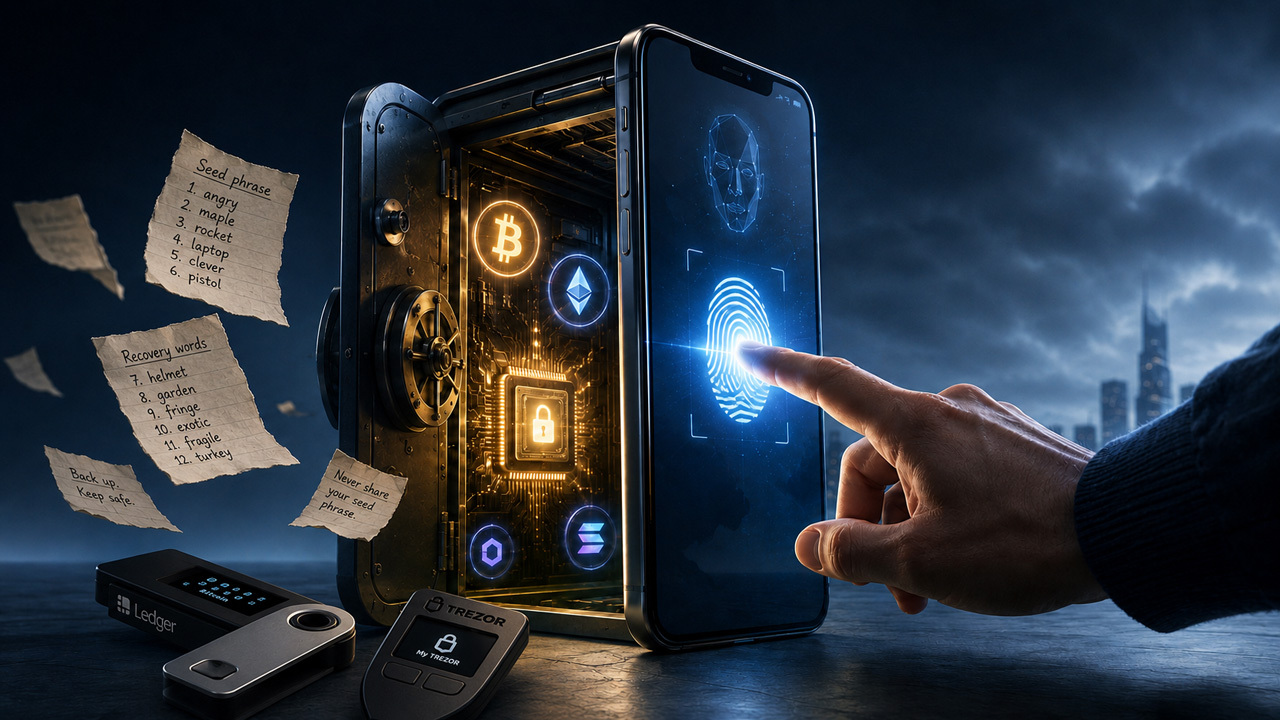
At Consensus 2026, Cardano’s Charles Hoskinson said that “users should probably never have their private keys,” adding that “something should have the private keys for the users.”

He argued that the secure chips already embedded in iPhones, Android phones, and Samsung devices outperform those in Ledger and Trezor devices, and that most crypto users already carry better signing hardware in their pockets without realizing it.

Private key management has been a bottleneck to retail adoption since Bitcoin’s earliest days. Users have trouble with their 12- or 24-word seed phrase, usually forgetting it, photographing it, storing it in cloud notes, or losing it entirely.

Hardware wallets solved the extraction problem, since a Ledger or Trezor generates and stores keys that never leave the device in plaintext, while introducing a friction that mainstream users have consistently rejected.

FIDO reported on May 7 that there are now 5 billion active passkeys globally, with 75% of consumers having enabled at least one. Users already accept device-bound, biometric-unlocked credentials as a normal part of authentication.

Coinbase’s smart wallet operationalizes this by letting users onboard without a recovery phrase, using Apple or Google passkeys, and by creating a non-exportable credential bound to secure hardware. Face ID or a PIN becomes the only interface the user needs.

Hoskinson is correct that mainstream phones contain serious security hardware. Apple’s Secure Enclave is a dedicated subsystem isolated from the main processor, and the firm says it protects sensitive data even if an attacker compromises the application-processor kernel.

Android’s Keystore system supports hardware-backed keys that can stay non-exportable and bind to a Trusted Execution Environment or secure element, with StrongBox implementations adding a dedicated CPU and further isolation requirements.

Samsung’s Knox system provides hardware-backed key protection through TrustZone, with DualDAR adding additional encryption layers for managed work profile data.

Hoskinson described the Knox work profile as “a separate operating system, separate circuits in the hardware.”

Model Where the key lives Can the key be extracted? Can malware still trick signing? How transaction details are verified Best use case
Seed phrase wallet Derived from a 12- or 24-word recovery phrase, often stored in software or written down by the user Yes, potentially — the secret can be exposed through bad storage, screenshots, cloud backups, phishing, or device compromise Yes — if the wallet app or device is compromised, the attacker may trick the user or steal the secret outright Usually through the wallet app interface on the same device Low-friction onboarding, small balances, users comfortable with manual backup
Phone-based hardware-backed wallet Inside a phone’s secure hardware, such as Apple Secure Enclave, Android Keystore/TEE/StrongBox, or Samsung Knox-backed protections Generally no — the key can remain non-exportable and bound to device hardware Yes — the key may stay protected, but a compromised app or OS could still try to get the device to sign something malicious Through the phone UI, biometrics, PIN, and wallet prompts; security depends heavily on approval UX and intent verification Everyday payments, routine self-custody, mainstream users, seedless/passkey-style onboarding
Dedicated hardware wallet Inside a separate signing device such as Ledger or Trezor Generally no — keys are designed to stay on the device and not leave in plaintext Much harder, but not impossible — the key is better isolated, though attackers may still try to deceive the user into approving a bad transaction On the wallet’s own trusted display / secure screen, physically separate from the phone or computer Larger balances, long-term storage, users who want stronger isolation and a cleaner threat model
See also  Is America About to Finally Solve Crypto Chaos? Lummis’ Bill Could Change Everything

Dedicated wallets hold an advantage

Phone-based secure hardware and dedicated signing devices operate on different threat models.
Ledger’s secure element drives a secure screen on the device itself, so users can verify transaction details even when the connected phone or laptop is under attack.

Trezor’s trusted display shows the transaction being signed, regardless of what the host machine displays. Trezor’s newer Safe 3, Safe 5, and Safe 7 models also include secure elements, so the critique that hardware wallets lack secure silicon is now outdated.

The shortcoming Hoskinson identified is accessibility, since Ledger and Trezor require a separate device, a companion app, and a signing flow that interrupts the transaction.

For everyday transaction volumes and routine self-custody, phones are plausible primary signers. For larger balances or users who want the strongest available threat model, dedicated devices with isolated displays keep the signing screen physically separate from the compromised machine, ensuring that the host’s malware cannot reach the display.

The integration of AI into payments adds a layer to the stack. AI agents need payment authority to be useful, but granting an agent access to a master private key is something most users would not knowingly accept.

The viable architecture is bounded delegation, consisting of an agent authorized to spend within preset limits, during a set period, without access to the credential that controls the broader wallet.

Base’s Spend Permissions documentation already frames AI-agent purchases as a core use case for recurring, limited-scope authorizations. Coinbase’s AgentCore Payments integration and AWS’s stablecoin agent payment tooling implement the same model of agents transacting under budget controls with full audit logs, without direct private-key access.

See also  Trump’s Crypto Czar David Sacks Calls Crypto the “Industry of the Future”

Ethereum’s EIP-4337 has enabled over 26 million smart wallets and 170 million UserOperations, and Pectra’s EIP-7702 extends programmable wallet behavior to externally owned accounts, enabling batching, gas sponsorship, recovery logic, and custom controls.

The infrastructure for permission-based, agent-compatible wallets already exists at a meaningful scale.
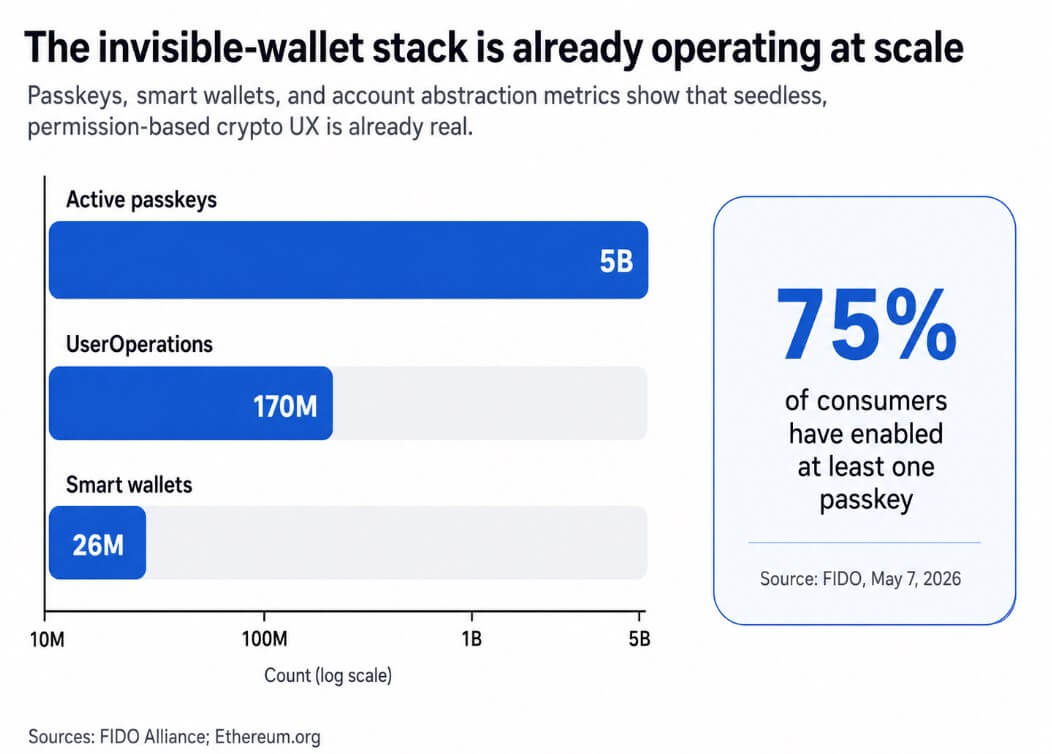
Numbers for Charles Hoskinson remarks
A bar chart shows 5 billion active passkeys, 170 million UserOperations, and 26 million smart wallets, with 75% of consumers enabling at least one passkey.

Your keys, but you never see them

“Not your keys, not your coins” was always as much a philosophical position as a technical one, and it assumes that users should handle cryptographic secrets directly.

Yet, this position may not survive contact with mass-market distribution. The more durable version of self-custody looks like biometric-based authentication and generating a non-exportable key in secure hardware, without seeing the raw key material.

What the user controls are spending caps, session keys, delegated allowances, recovery logic, and human-readable approval flows.

CryptoSlate Daily Brief

Daily signals, zero noise.

Market-moving headlines and context delivered every morning in one tight read.

5-minute digest 100k+ readers

Free. No spam. Unsubscribe any time.

Whoops, looks like there was a problem. Please try again.

You’re subscribed. Welcome aboard.

Apple’s secure intent mechanism lets hardware physically confirm user intent in a way even root or kernel software cannot spoof. Android Keystore supports per-operation authentication requirements.

Those capabilities relocate custody from “can you keep a secret” to “can you verify what you meant to authorize.”

The sharpest limitation in Hoskinson’s framing is that a compromised application or operating system may be unable to extract a hardware-backed key while still being able to use it on the device.

Key non-extractability and transaction security are separate guarantees, and recent history shows how catastrophically that difference can play out.

See also  WisdomTree launches blockchain-based CRDT private credit fund

CertiK’s analysis of the Bybit incident found that attackers deceived signers into authorizing a malicious transaction. The attack succeeded even as the private key never left the hardware.

Chainalysis reported that impersonation scams grew over 1,400% in 2025, and AI-enabled scams produced 4.5 times the returns of traditional ones.

A phone-native self-custody model would hide private keys from users and simultaneously make transaction intent, approval UX, and spending limits the primary security surface.

Two trajectories

If wallets solve intent UX well enough to earn consumer trust via standardized spend caps, revocable delegation, and clear approval prompts, phone-primary self-custody could account for 70% to 85% of new retail users by 2028.

Seedless onboarding becomes the default, account abstraction moves from advanced feature to baseline expectation, and the seed phrase becomes a configuration option for users who want it.

If mobile signing incidents, phishing, compromised approval flows, or confusing recovery mechanics continue to produce high-profile losses, phone-based self-custody stalls at 20% to 35% of the retail market.

Users who lose funds due to a phone wallet manipulation attack describe it as a hack and return to exchanges.
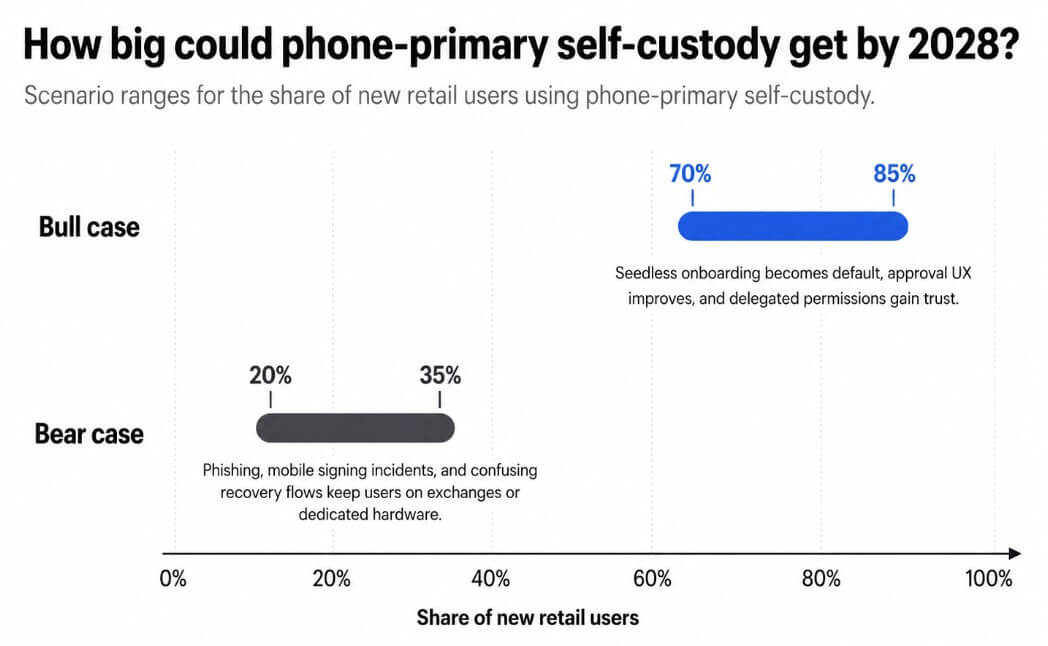
Potential outcomes for the scenario based on Charles Hoskinson remarks
A scenario chart projects phone-primary self-custody reaching 70% to 85% of new retail users by 2028 in the bull case, and 20% to 35% in the bear case.

The uncomfortable subtext in either trajectory is platform dependence. If self-custody moves into hardware embedded inside phones, then Apple, Google, Samsung, and major wallet SDK providers become quite powerful centers in crypto’s security architecture.

The model stays non-custodial in a technical sense, but wallet security depends more on OS APIs, enclave access policies, and app distribution rules.

Androids Cardanos Charles Crypto Future Hoskinson iPhones wallets
Share. Facebook Twitter Pinterest LinkedIn Tumblr Email

Related Posts

South Korea to Impose Crypto Tax, Starting January 2027

May 9, 2026

Are overvalued U.S. equities signaling the next crypto market risk? Assessing…

May 9, 2026

Kraken parent goes for the OCC charter in bid to become a federal crypto bank

May 8, 2026

Coinbase Says Crypto Bill ‘Clarity Act’ Will Pass by the End of Next Summer

May 8, 2026
Add A Comment
Leave A Reply Cancel Reply

Top Posts

Can Hyperliquid Absorb Its Largest Supply Shock?

November 28, 2025

Bitcoin layer-2s keep failing because they’re not real L2s

February 17, 2026

Stay ahead with the latest crypto news, market updates, blockchain insights, and trends. Your trusted source for everything happening in the digital asset world.


We're social. Connect with us:

Facebook X (Twitter) Instagram Pinterest YouTube
Top Insights

Miniverse Partners with UNIPLAY to Expand CoFi Across DeFi and GameFi

May 9, 2026

Fomoin Partners with Catto Verse to Advance AI-Powered Web3 Innovation

May 9, 2026

What Does Bitcoin “Power Projection” Mean To The U.S. Military?

May 9, 2026
Get Informed

Subscribe to Updates

Get the latest creative news From Free.cc directly in your Inbox!

  • Contact
  • Privacy Policy
  • Terms & Conditions
  • Disclosure
© 2026 free.cc - All rights reserved.

Type above and press Enter to search. Press Esc to cancel.